Indian Cricket Has 11 Players On The Field And Quite A Few Politicians Behind It. From Jay Shah To Arun Jaitley And The Gehlots, How Political Families Found A Place In Indian Cricket Administration
BCCI is too powerful and too financially significant to be viewed simply as a cricket administration body, and its repeated connections with politicians and politically influential families raise questions about how independent its administration really is.

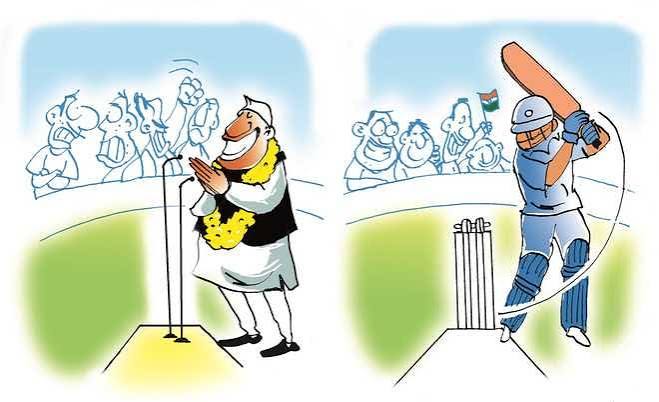
Indian cricket likes to present itself as a game played between two teams, 11 players on either side, with the occasional controversy over a dropped catch, a bad decision or someone arguing with an umpire.
But away from the boundary rope, Indian cricket has another game going on, one involving office bearers, political connections, influential families and some remarkably familiar surnames.
The Board of Control for Cricket in India may run the country’s cricket administration, but look at the people who have occupied positions around the BCCI and its state associations over the years and a different picture begins to emerge.
This is not a story about whether a politician, a politician’s son or someone from a politically prominent family is automatically incapable of running a cricket organisation. It is much simpler than that.
It is about looking at the names, the positions they have held and the connections between them, because once those names are put together, the list becomes difficult to ignore. From Gujarat to Delhi, Rajasthan and Himachal Pradesh, political families have repeatedly appeared in the administrative machinery surrounding Indian cricket.
And then there is the BCCI itself, which is not exactly an inconsequential sporting body. It controls Indian cricket, sits at the centre of the world’s most commercially powerful cricket ecosystem and exercises enormous influence over the sport internationally.
So when the same political families and politically connected individuals keep appearing in the administration of Indian cricket, it is worth looking at how they got there, where they went next and whether the reforms intended to keep politics away from cricket actually changed very much.
The easiest place to start is with a name that has become impossible to miss in global cricket: Jay Shah.
From Gujarat to the BCCI and then the ICC
Jay Shah’s cricket administration career did not begin at the BCCI. According to the ICC, his involvement in cricket administration began in 2009 at the district and state level, followed by positions within the Gujarat Cricket Association. In October 2019, he was elected BCCI Honorary Secretary, becoming the board’s youngest-ever secretary at the time. The BCCI’s own record of its 2019 office-bearers confirms the appointment.
That position would prove to be considerably more than a short stop in an administrative career. Shah remained BCCI secretary through the years in which the board was dealing with the enormous commercial expansion of the IPL, the launch of the Women’s Premier League and a succession of major decisions affecting Indian cricket. In October 2022, the BCCI again listed him as its Honorary Secretary, alongside Roger Binny as president and Rajeev Shukla as vice-president.
Then came the bigger move. In August 2024, Shah was elected unopposed as the next chair of the International Cricket Council after Greg Barclay decided not to seek a third term. He formally began his tenure on December 1, 2024. The ICC describes his path as one that took him from the Gujarat Cricket Association to the BCCI, the Asian Cricket Council and eventually the governing body of international cricket itself.
And this is where the name becomes politically interesting because Jay Shah is the son of Amit Shah, one of the most prominent political figures in contemporary India and a senior BJP leader. That family connection is not an allegation or an inference; it is simply part of the public record. What it does not establish, by itself, is why any particular cricketing appointment happened. But for a piece examining the overlap between Indian cricket administration and political families, it is obviously a connection that belongs in the story.
The interesting part, therefore, is not merely that a politician’s son eventually became ICC chair. It is the journey in between: Gujarat Cricket Association, BCCI secretary, Asian Cricket Council and finally the ICC.
One of the most powerful positions in world cricket was reached through a distinctly Indian cricket-administration ladder, and that makes the question of who occupies the rungs below it rather more interesting.
Because Jay Shah is hardly the only politically connected surname to have appeared in Indian cricket administration. The next one takes us from Gujarat to Himachal Pradesh and from one political family to another.
The Dhumals
If Jay Shah is the most obvious example of a political surname travelling from Gujarat’s cricket administration to the top of the international game, the Dhumal family offers a rather more elaborate version of the same story.
There is the father, Prem Kumar Dhumal, twice Chief Minister of Himachal Pradesh; the elder son, Anurag Thakur, who moved from the Himachal Pradesh Cricket Association into national politics and eventually became BCCI president; and the younger son, Arun Singh Dhumal, who moved through the same cricket administration system before eventually taking charge of the IPL Governing Council.
The Himachal Pradesh Cricket Association had been closely associated with Anurag Thakur for years. Thakur became its president in 2000 and remained at the helm until the Supreme Court’s implementation of the Lodha Committee recommendations forced changes in cricket administration. When he had to leave the HPCA presidency, his younger brother Arun Dhumal emerged as a central figure in the association.
In 2017, Arun was included in the ad hoc committee overseeing the HPCA’s cricket affairs, and by 2019 he was elected HPCA president. At the time, The Tribune described the development rather bluntly: control of the association remained with the family of former chief minister Prem Kumar Dhumal.
Arun Dhumal’s cricket administration career then moved upwards. In 2019, he was elected BCCI treasurer alongside Sourav Ganguly as president and Jay Shah as secretary. He held the treasurer’s position from 2019 to 2022 before being unanimously elected chairman of the IPL Governing Council. Today, the IPL’s own records continue to list Arun Singh Dhumal as chairman of its Governing Council.
There is, of course, another way of telling this story. Arun Dhumal has himself said that cricket was hardly an accidental part of the family’s life: he played cricket at school and university, while his brother Anurag also had a cricketing background. In other words, the Dhumals have their own explanation for the family’s presence in cricket – an interest in the sport that predates the administrative positions.
But that is precisely what makes the family worth examining in the first place. This is not simply a case of one politically connected individual appearing briefly in a cricket organisation. It is a family in which the father was a chief minister, one son became a politician and BCCI president, and the other moved through state cricket administration, the BCCI and eventually into the chairmanship of the IPL Governing Council. The cricketing credentials may be part of the story; so is the family tree.
And if the Dhumals demonstrate how political and cricketing worlds can overlap within one family, the next name on the list takes the overlap in an entirely different direction: Rajiv Shukla, a man who came into cricket administration after a long career in politics and public life.
Rajeev Shukla And The Political Route Into Cricket
If the Dhumals show how cricket administration can become a family affair, Rajeev Shukla offers another route into the BCCI – through politics itself. Shukla began his career as a journalist and entered politics in 2000, eventually joining the Congress and serving as a Rajya Sabha member. Somewhere along the way, however, cricket administration became an equally important part of his public career. He first became involved with the Uttar Pradesh Cricket Association before moving up through the BCCI’s administrative structure.
Shukla’s cricket résumé is substantial. He became chairman of the IPL in 2011, stepped down from the position in 2013 and returned to it in 2015. He was subsequently elected BCCI vice-president in December 2020, a position he continued to hold after the board’s 2025 annual general meeting. The BCCI’s current records list him as vice-president, while its historical records show that his involvement with the board and IPL goes back considerably further.
There is something almost amusingly circular about Shukla’s career. He entered politics and then became deeply involved in one of India’s most powerful sporting institutions, while the BCCI itself has always existed in that peculiar space between being a private cricket body and exercising enormous public influence.
Shukla did not arrive at the BCCI as somebody’s son or brother; he arrived as a politician with an established public career and then built a substantial career inside cricket administration.
And the overlap becomes even more interesting when you look at the people around him. When Shukla filed his nomination for the BCCI vice-president’s election in 2020, the official BCCI nomination document listed Rohan Jaitley – the son of former Union minister Arun Jaitley – as his proposer. It is a small detail, but this is precisely where the list of names starts becoming rather entertaining: one political figure enters cricket administration, another political family’s next generation is involved in the same institutional machinery, and the surnames begin to form a surprisingly familiar circle.
Shukla’s story also matters because it demonstrates that the political connection to Indian cricket is not confined to one party or one family. The examples stretch across different political backgrounds and different cricket associations. The common thread is the proximity between political influence and cricket administration – sometimes through family, sometimes through political office, and sometimes through a combination of both.
And then there is the politician who did not merely have a connection to cricket administration but actually ran a state cricket association while simultaneously running the state itself.
That takes us to Gujarat, and to Narendra Modi.
Narendra Modi and the Gujarat Cricket Association
Before Jay Shah became BCCI secretary and eventually moved to the ICC, there was another Shah – and before him, another political heavyweight – already sitting inside the Gujarat cricket establishment.
Narendra Modi served as president of the Gujarat Cricket Association while he was Chief Minister of Gujarat, making the GCA one of the clearest examples of a senior politician directly occupying the top position of a state cricket association. The GCA itself records that Modi was its president before he moved to Delhi as Prime Minister in 2014.
The succession is particularly interesting because it neatly connects several of the names already in this story.
When Modi left Gujarat for Delhi, Amit Shah took over as president of the GCA, having previously served as its vice-president while Modi was president. The GCA’s own account says that Shah and Modi worked together on the association’s administration and on the redevelopment of the Motera stadium. Later, Jay Shah served as GCA joint secretary, while Amit Shah was president.
And then came the stadium. What had been the Sardar Patel Stadium at Motera was rebuilt into the enormous stadium that now carries Narendra Modi’s name, with the project being pursued after Modi became Prime Minister and Amit Shah took over at the GCA. The President’s Secretariat, describing the stadium’s inauguration in 2021, specifically said the project had begun under Modi’s guidance as Gujarat Chief Minister and was subsequently followed up by Amit Shah as chairman of the GCA.
Put the names together and Gujarat produces an unusually neat sequence: Narendra Modi at the GCA, Amit Shah succeeding him, and Jay Shah operating within the same cricket administration before moving into the BCCI and then the ICC. None of that, by itself, proves that political connections determined any individual appointment. But as a chapter in the larger story of who has occupied influential positions in Indian cricket, it is difficult to miss.
And Gujarat is not the only state where a political surname continued to appear after the original political figure was gone. In Delhi, another familiar surname would make the transition from one generation to the next rather more literally.
Arun Jaitley and the Delhi cricket succession
Arun Jaitley was not a peripheral figure in Delhi cricket. The former Union minister and senior BJP leader served as president of the Delhi & District Cricket Association (DDCA) for more than a decade, until 2013. The stadium formerly known as Feroz Shah Kotla was subsequently renamed the Arun Jaitley Stadium.
Then, in 2020, his son Rohan Jaitley entered the picture. Rohan filed his nomination for the DDCA presidency following his father’s death, and the move was explicitly described at the time as following in his father’s footsteps. He subsequently became DDCA president. The association’s current office-bearers still list Rohan Jaitley as president.
There is something almost too tidy about the Delhi example. One Jaitley spends more than a decade at the head of the capital’s cricket administration; a few years later, another Jaitley takes over the same organisation. The DDCA is not a family-owned company, of course, and Rohan Jaitley’s appointment was the result of an election within the association. But for anyone trying to understand the recurring presence of political families in Indian cricket administration, the surname appearing twice at the top is certainly relevant.
It also brings us back to the broader pattern. In Gujarat, a Chief Minister moved through the state cricket association before becoming Prime Minister, followed by another senior political figure and then his son. In Delhi, a senior Union minister led the city’s cricket body before his son subsequently took the same office. In Himachal Pradesh, the Dhumal family produced two sons who became prominent figures in cricket administration and politics.
And then there is Rajasthan, where another political family entered the picture – this time through the son of a sitting Chief Minister.
The Gehlots and Rajasthan’s Cricket Chair
The pattern takes another turn in Rajasthan, where Vaibhav Gehlot, son of former Rajasthan Chief Minister Ashok Gehlot, entered the top tier of the state’s cricket administration. In October 2019, Vaibhav was elected president of the Rajasthan Cricket Association, with the backing of Congress leader C.P. Joshi, himself a former RCA president. He was subsequently re-elected unopposed in December 2022.
The interesting part is not simply that Vaibhav Gehlot was the son of a sitting political heavyweight. It is what the succession of names looks like when placed alongside the earlier examples. In Gujarat there was Narendra Modi, followed by Amit Shah and then Jay Shah. In Delhi there was Arun Jaitley followed by Rohan Jaitley. In Himachal Pradesh there were the Dhumals. In Rajasthan, there was now another chief minister’s son at the head of the state cricket association.
Vaibhav’s tenure eventually became embroiled in a dispute involving the Rajasthan State Sports Council, the Sawai Mansingh Stadium and the internal functioning of the RCA. In February 2024, he resigned as president after the dispute escalated and a no-confidence motion was brought against him. Gehlot said the Sports Council’s actions were hostile and that he was stepping down to prevent the continuing dispute from affecting Rajasthan cricket.
The episode is useful to the larger story because it shows that political connections do not automatically translate into permanent control. Cricket associations still have elections, rival factions, courts, government bodies and their own internal power struggles. In fact, Rajasthan’s subsequent troubles became complicated enough that the state’s cricket administration eventually ended up under prolonged ad-hoc arrangements and further judicial intervention.
But by this point, the list is getting long enough to ask a fairly obvious question: wasn’t Indian cricket supposed to have changed all this?
Because there was a point when the Supreme Court stepped into the BCCI’s affairs precisely because the old system had become too concentrated, too entrenched and too resistant to change.
Then came the Lodha Committee
The Lodha Committee reforms are where the story stops being merely a collection of interesting surnames and becomes a question about the rules governing Indian cricket administration. In July 2016, the Supreme Court accepted most of the committee’s recommendations, including a rule that ministers and civil servants could not become members of the BCCI, along with a 70-year age limit and other structural changes.
The committee’s larger objective was to prevent cricket administration from becoming the permanent preserve of the same people. Its recommendations included three-year terms for office-bearers, a maximum of three terms and mandatory cooling-off periods, specifically arguing that indefinite continuation could allow vested interests to develop and authority to become concentrated among a small group.
The reforms did have consequences. Anurag Thakur, then BCCI president, was removed by the Supreme Court in 2017 over non-compliance with the reforms, while several other long-serving administrators were forced out because they had crossed the prescribed limits. The new framework also contained restrictions on ministers, government servants and those who had completed nine years as office-bearers.
But there was an interesting loophole, or at least an interesting distinction, in the new system. The reforms did not prohibit the children of former BCCI officials from entering cricket administration. As The Indian Express noted in its explanation of the new rules, there was no bar on sons or daughters succeeding their parents so long as they were properly nominated through their respective state associations.
And that distinction matters.
The Lodha reforms could regulate who could hold office, how long they could hold it and whether a serving minister or government official could sit inside the BCCI. They could not, and apparently were never designed to, regulate something much less tangible: who knows whom, which families have built relationships inside state associations, and whether influence can survive even when an individual office-holder cannot.
Which brings us back to the surnames. Because once you put Shah, Dhumal, Jaitley and Gehlot next to the Lodha reforms, the question is no longer whether politicians were formally barred from the BCCI.
The more interesting question is what happens to political influence after the politician himself has left the chair.
So did the reforms actually change the game?
On paper, the answer is straightforward: yes, the rules changed substantially. The Supreme Court-backed Lodha framework introduced term limits, cooling-off periods, age restrictions, one-person-one-post principles and disqualifications intended to prevent administrators from turning cricket associations into permanent personal fiefdoms. The Supreme Court has subsequently described the cooling-off requirement as a safeguard against vested interests and the concentration of power in a small group.
But there is a rather obvious distinction between removing a politician from an office and removing political families from the cricket ecosystem. The first can be done with a rule.
The second is considerably harder. The Lodha framework regulates office-holding; it does not regulate surnames, family relationships, political networks or the ability of a new generation to enter administration through a state association. That distinction becomes particularly interesting when the examples in this story are placed alongside the reforms rather than viewed individually.
The Dhumal family, for instance, did not disappear from cricket administration when Anurag Thakur’s tenure came under the Lodha reforms. Arun Dhumal subsequently became HPCA president, then BCCI treasurer and eventually IPL Governing Council chairman.
The Jaitley name similarly remained prominent in Delhi cricket after Arun Jaitley’s tenure, with Rohan Jaitley taking over as DDCA president. In Rajasthan, Vaibhav Gehlot became RCA president after his father had spent years as one of the state’s most powerful political figures.
And in Gujarat, the succession from Narendra Modi to Amit Shah and then the emergence of Jay Shah within the same cricket administration provides perhaps the neatest example of how political and cricketing networks can overlap across generations.
None of this means that the Lodha reforms were meaningless. They changed the formal architecture of cricket administration and put real limits on how long individuals could remain in office. The BCCI’s present constitution continues to operate within that framework, with the Supreme Court having clarified that nine years in a state association or nine years in the BCCI carries disqualification consequences.
But the list raises a different question, one that rules about tenure cannot really answer: what happens when the person leaves but the network stays?
And that is where the BCCI becomes particularly interesting. Because the people running it may change, the posts may have term limits and the constitution may have been rewritten, but the institution itself has only become more powerful.
The BCCI Is No Longer Just About Cricket
There was a time when a cricket board could reasonably be thought of as an organisation concerned primarily with selecting teams, organising matches and dealing with the mundane business of running a sport. The BCCI has long since outgrown that description.
The board sits at the centre of the IPL, India’s biggest cricket property, and controls one of the most commercially valuable sporting ecosystems in the world. It negotiates broadcast and sponsorship rights, determines the domestic and international cricket calendar, controls major cricketing infrastructure and has enormous influence within the International Cricket Council.
Even the current BCCI structure illustrates how much institutional power sits within the organisation: its September 2026 AGM continued Arun Singh Dhumal as one of the two representatives elected to the IPL Governing Council.
That makes the question of who occupies cricket administration rather less trivial than it might initially sound. This is not simply about deciding who gets to sit in a boardroom and discuss Ranji Trophy fixtures. Control over Indian cricket means control over a huge commercial ecosystem, relationships with broadcasters and sponsors, international cricket negotiations and, increasingly, the business surrounding the IPL.
And perhaps that explains why the political connections around Indian cricket have always been worth watching. Politics brings power, cricket brings money, and the BCCI sits rather comfortably where the two can occasionally come close to each other.
The curious thing is that the relationship has survived repeated attempts to redraw the rules. The Supreme Court intervened. The Lodha Committee proposed structural changes. The BCCI constitution was rewritten. Office-bearers were forced out. Term limits arrived. Cooling-off periods arrived.
Yet, years later, the surnames remain remarkably familiar.
And that leaves us with the simplest question in the entire story: if the rules were changed to stop cricket administration from becoming concentrated in the hands of a few, how much did the power structure actually change?
The Last Bit, The BCCI’s Revolving Door Of Power
Perhaps the easiest way to understand the whole thing is to stop looking at these names as isolated cases. One politician here, one politician’s son there, one cricket administrator somewhere else – individually, each example can be explained away quite easily. Put them together, however, and a rather familiar pattern starts to emerge.
The point is simpler: the same kind of political and familial connections keep appearing in an institution that is extraordinarily powerful and commercially valuable.
And that makes the BCCI somewhat different from the average sporting association. The board has become a machine capable of generating enormous revenues, negotiating billion-dollar broadcast arrangements and determining the direction of Indian cricket while simultaneously carrying considerable weight in international cricket. The IPL has only amplified that power.
Which brings us back to the joke hidden in the headline. There are 11 players on the field. But behind them sits an administrative structure in which the family tree can sometimes be almost as interesting as the scorecard.
The question, then, is not whether every person with a political connection should be presumed to have reached a cricketing position because of that connection. That would be far too easy – and the evidence would not support such a blanket conclusion.
The more uncomfortable question is why political families appear so frequently around Indian cricket administration in the first place, and whether the reforms designed to dilute concentrated power were ever capable of addressing that phenomenon.