Adani’s $100 Billion AI Data Centre Bet Signals India’s AI Gold Rush – Who Wins, Who Funds, Who Risks?


Adani Group on Tuesday announced plans to invest $100 billion by 2035 to develop renewable energy-powered, AI-ready data centres across India. The conglomerate said the investment would aim to create what it described as the world’s largest integrated data centre platform.
The company estimates that the initiative could help catalyse a broader $250 billion AI infrastructure ecosystem in India over the next decade. It also expects an additional $150 billion in downstream investments across server manufacturing, sovereign cloud platforms, and related industries.
“This is an Intelligence Revolution more profound than any previous Industrial Revolution,” Gautam Adani, chairman of the group, said in a statement, adding that India “will not be a mere consumer in the AI age” but a builder and exporter of digital intelligence.
The announcement coincides with the AI Impact Summit being hosted in New Delhi, a five-day gathering of global policymakers and technology leaders. Executives including Sam Altman of OpenAI and Sundar Pichai of Alphabet Inc. are expected to participate.
Expanding AdaniConneX
Adani’s AI infrastructure push builds on AdaniConneX, its joint venture with US-based EdgeConnex. The platform currently operates around 2 gigawatts (GW) of national data centre capacity, with plans to expand toward 5 GW in the coming years.
The company said its strategy is supported by strategic partnerships, including with Google, and that discussions are underway with other global players to establish large-scale campuses across India.
In October, Alphabet had announced plans to invest $15 billion over five years to develop an AI data centre hub in southern India, underscoring growing hyperscaler interest in the country’s digital infrastructure.
Market Reaction and Recent Volatility
Shares of Adani Enterprises rose approximately 2.3% following the announcement, ranking among the top gainers on the benchmark Nifty 50. Adani Green Energy also traded higher.
The announcement comes amid recent volatility in Adani Group stocks.
Last month, court filings indicated that the US Securities and Exchange Commission was seeking to serve summons on Gautam Adani and his nephew Sagar Adani in connection with bribery and fraud charges. The group has previously denied wrongdoing.
Adani’s announcement is part of a much larger acceleration underway in India’s data centre and AI infrastructure ecosystem. Multiple corporate groups – domestic and global – are committing significant capital as demand for high-performance computing and cloud infrastructure surges.
Reliance’s Jamnagar Ambition
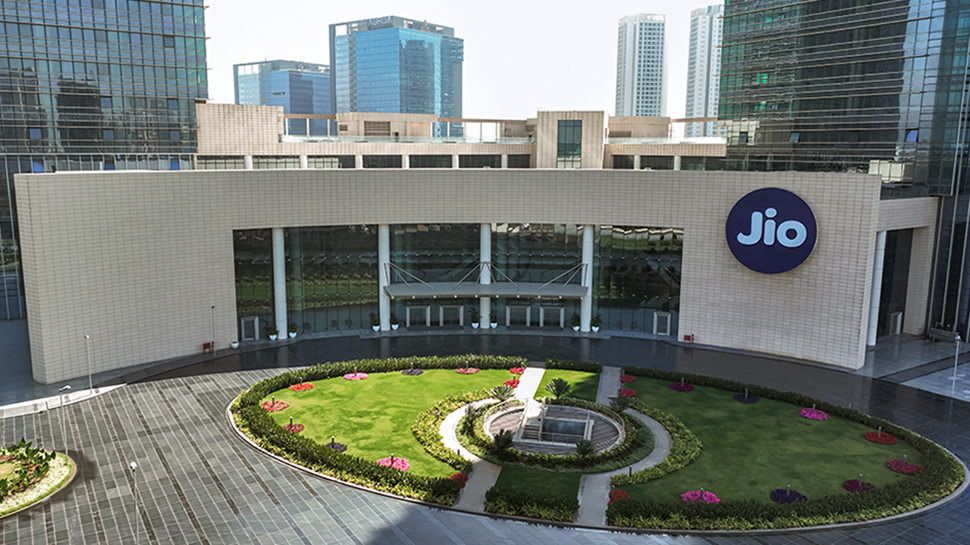
Reliance Industries is building a large AI-focused data centre in Jamnagar, Gujarat, with a reported capacity of 3 gigawatts (GW). While the exact investment has not been formally disclosed, industry estimates place the project size between $20 billion and $30 billion. If completed at scale, it would rank among the largest data centre facilities globally.
The Jamnagar project signals that AI infrastructure is becoming central to Reliance’s broader digital strategy, which already spans telecom, retail and digital services.
Global Hyperscalers Deepen India Exposure
Global technology firms are also expanding aggressively.
Alphabet Inc. has significantly scaled up its India investment plans, with commitments for AI-related data centre infrastructure rising to roughly $10–15 billion over multiple years. Its subsidiary Raiden Info Tech is leading key development initiatives in the country.
Microsoft has committed $17.5 billion toward expanding artificial intelligence infrastructure in India, describing it as its largest investment in Asia. CEO Satya Nadella has emphasised India’s importance as a long-term AI growth market.
These commitments reflect a strategic calculation: India’s scale, rising data consumption and regulatory push toward data localisation make it an increasingly critical geography for AI infrastructure deployment.
IT Services Firms Enter the Infrastructure Layer
India’s traditional IT services majors are also moving beyond software services into physical AI infrastructure.
Tata Consultancy Services has announced plans to build approximately 1 GW of AI-grade data centre capacity over the next five to seven years, requiring an estimated $6–7 billion in investment. The company plans to execute this through a dedicated subsidiary focused on AI and sovereign cloud infrastructure, positioning itself to serve hyperscalers and AI-driven enterprises.
Meanwhile, Bharti Airtel, through its data centre arm Nxtra, continues to expand capacity as enterprises demand lower latency and regulatory-compliant hosting solutions.
India’s Capacity Trajectory
India’s current operational data centre capacity stands at roughly 1.7 GW. According to a recent report by Jefferies, capacity could quintuple to nearly 8 GW by 2030, driven by:
- Surging data traffic
- AI workloads
- Data localisation requirements
- Demand for lower latency services
Achieving that expansion would require an estimated $30 billion in facility capital expenditure alone.
The brokerage estimates that India’s data centre leasing market – currently valued at roughly $1.7 billion – could grow to around $8 billion by 2030, assuming current leasing rates of approximately ₹7,400 per kW per month.
The Economics Behind the Build-Out
While the announcements are large, the economics of data centres are fundamentally different from software-led digital businesses. This is heavy infrastructure – capital intensive, energy intensive and long-gestation.
According to industry estimates, setting up 1 megawatt (MW) of data centre capacity in India costs approximately $4–5 million. On that basis, adding nearly 6–7 GW of incremental capacity by 2030 would require investments of around $30 billion in facility capex alone.
But the capital outlay does not stop at the server racks.
The Downstream Value Chain
A large-scale AI data centre ecosystem creates a broad investment pipeline across sectors:
- Real estate and land development
- Electrical and power systems
- Cooling infrastructure
- Racks and fit-outs
- Network connectivity
Jefferies estimates that of the $30 billion required:
- Around $6 billion could flow into real estate
- Roughly $10 billion into electrical and power systems
- Approximately $7 billion into racks and fit-outs
- Close to $4 billion into cooling systems
- About $1 billion into networking infrastructure
This makes the AI data centre boom not just a technology story, but a multi-sector industrial build-out.
Engineering, procurement and construction (EPC) companies, energy solution providers, cooling system manufacturers, and global infrastructure investors such as Brookfield and Blackstone are positioned to benefit alongside telecom and technology firms.
Capital Intensity and Funding Discipline
Unlike digital platforms that scale through software and network effects, data centres demand continuous capital deployment. Returns depend heavily on:
- Occupancy rates
- Long-term leasing contracts
- Power cost efficiency
- Regulatory stability
Access to low-cost capital will therefore become a competitive differentiator. Companies with stronger balance sheets or global funding access may be better positioned to sustain multi-year build-outs.
The model resembles utilities more than startups — stable, asset-heavy and dependent on long-term contracts rather than rapid margin expansion.
Energy and Water Considerations
AI workloads are significantly more power-intensive than traditional cloud services. Large-scale AI-ready facilities require high rack densities and advanced cooling systems, including liquid cooling.
Electricity demand is therefore central to the viability of these projects. Several state governments are aligning data centre expansion with renewable energy corridors, while Andhra Pradesh has secured in-principle approval for multiple nuclear power plants to support future capacity.
Water usage – particularly for cooling – has also become a consideration in coastal and high-density clusters. Policymakers argue that surplus monsoon water and seawater-based cooling can mitigate strain, though implementation will be closely watched.
Andhra Pradesh’s “Data City” Vision
As corporate India scales its AI infrastructure ambitions, state governments are positioning themselves as strategic enablers. Among the most ambitious proposals has emerged from Andhra Pradesh, which is seeking to transform Visakhapatnam into a large-scale AI and data centre hub.
Nara Lokesh, the state’s Information Technology Minister, has outlined plans for what he describes as an integrated “data city” ecosystem within a 100-kilometre radius of Visakhapatnam. The project aims to combine data centres, server manufacturing, cooling infrastructure, connectivity networks and energy supply into a single industrial cluster.
The state has announced investment agreements worth approximately $175 billion across 760 projects, including a reported $15 billion commitment by Google for AI infrastructure development in the region. A joint venture involving Reliance Industries, Canada-based Brookfield and US firm Digital Realty is also investing billions to develop AI-focused data centre capacity in the same city.
Capacity Targets and Infrastructure Backbone
Andhra Pradesh has set a target of building up to 6 gigawatts (GW) of data centre capacity, with roughly half already signed and the remainder in the pipeline, according to state officials.
To support this scale, the central government has granted in-principle approval for six 1.2 GW nuclear power plants at Kovvada in the state. The aim is to ensure reliable, high-capacity electricity supply — a prerequisite for AI-ready facilities.
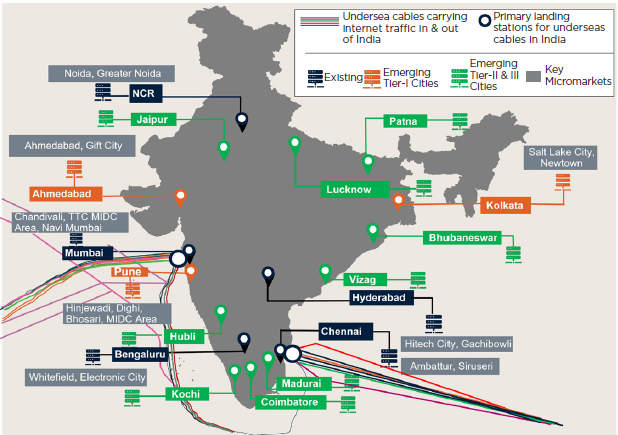
Visakhapatnam is also being positioned as a landing point for submarine internet cables connecting India to Southeast Asia, potentially strengthening its role as a digital gateway.
Industrial Clustering Strategy
The state government has adopted an industrial clustering approach, offering land at highly concessional rates and courting not just data centre operators but also manufacturers of servers, cooling systems and electrical equipment.
The strategy draws parallels to earlier technology clustering models seen in Hyderabad’s development as an IT hub and in industrial corridors elsewhere in Asia. The underlying economic logic is straightforward: scale, proximity and infrastructure density can reduce costs and accelerate deployment.
However, the approach also implies concentrated capital deployment and long-term infrastructure commitments. The viability of such clusters will ultimately depend on sustained demand growth, stable regulatory policy and consistent power availability.
The Structural Question – Can Infrastructure Translate into AI Leadership?
India’s rapid expansion of AI-ready data centre capacity signals strategic intent. The country currently ranks among the top global AI ecosystems across several indicators, including talent, startup activity and digital adoption. Yet a critical gap remains in high-end computing capacity and advanced semiconductor manufacturing.
Building large-scale data centre infrastructure addresses one part of that gap — access to compute. AI systems, particularly generative models, are fundamentally constrained by access to power, cooling and high-performance chips. In that sense, infrastructure is not peripheral to AI leadership; it is foundational.
However, infrastructure alone does not guarantee technological sovereignty.
Advanced AI development still depends on access to cutting-edge GPUs, semiconductor supply chains and foundational research ecosystems – areas where the United States and China maintain structural advantages. India’s build-out may strengthen its position as a major deployment and services hub, but translating that into original frontier model development will require parallel investments in research, chip design and talent retention.
The Employment Debate
Proponents argue that every industrial transformation creates more jobs than it displaces. Data centres generate employment during construction phases and support ancillary industries such as engineering services, energy, cooling systems and connectivity.
Yet operational data centres are highly automated environments. Once built, employment intensity is relatively modest compared to traditional manufacturing sectors. The broader economic multiplier will therefore depend on whether AI infrastructure catalyses downstream industries – cloud services, AI startups, manufacturing automation and enterprise digitisation – rather than remaining a standalone asset class.
Energy, Scale and Execution Risk
AI-ready facilities demand enormous and continuous electricity supply. India’s strategy of linking data centres to renewable corridors and, in some cases, nuclear generation indicates recognition of this constraint.
Execution risk remains significant. Projects of multi-gigawatt scale require land acquisition, transmission upgrades, regulatory clearances and stable long-term contracts. Delays in any one of these components can alter return assumptions.
Moreover, utilisation rates will ultimately determine financial viability. Overcapacity could compress leasing rates, while underinvestment could leave India dependent on overseas compute.
The Last Bit,
India’s AI infrastructure surge marks a decisive shift from policy ambition to asset creation. Corporate conglomerates, global hyperscalers and state governments are committing capital at a scale rarely seen in the country’s digital economy.
Data centres are emerging as the steel plants of the AI era – capital heavy, energy intensive and strategically significant. Whether this wave becomes the backbone of a self-sustaining AI ecosystem or remains primarily a hosting destination for global technology firms will depend on execution, demand growth and complementary innovation investment.
For now, the direction is: India is not waiting on the sidelines of the AI revolution. It is building the physical foundation – at scale.