Top 10 Best Diagnostic Equipment Companies in India in 2027
India’s diagnostic equipment industry is experiencing significant transformation due to increasing healthcare expenditure, expanding hospital infrastructure, technological advancements and growing awareness of preventive healthcare. Diagnostic equipment plays a fundamental role in identifying diseases, monitoring medical conditions, facilitating clinical decisions and improving patient outcomes.
From advanced magnetic resonance imaging systems, computed tomography scanners and digital X-ray machines to automated blood analysers, molecular diagnostic instruments and point-of-care testing devices, diagnostic equipment manufacturers support nearly every segment of modern healthcare.
The rising prevalence of cardiovascular diseases, diabetes, cancer, respiratory disorders and infectious diseases has increased demand for accurate and efficient diagnostic technologies. Hospitals, diagnostic laboratories, research institutions and specialised healthcare centres are increasingly adopting automated equipment capable of improving testing accuracy, reducing turnaround times and managing large patient volumes.
Government initiatives promoting domestic medical device manufacturing, including Make in India and production-linked incentive schemes, are encouraging companies to expand their manufacturing and research capabilities within the country. Artificial intelligence, digital imaging, laboratory automation, remote diagnostics and cloud-connected medical devices are also transforming the diagnostic equipment market.
India’s diagnostic equipment industry comprises multinational medical technology corporations and domestic manufacturers developing innovative and comparatively affordable healthcare technologies.
1. Wipro GE Healthcare
Wipro GE Healthcare is one of India’s leading medical technology companies, offering an extensive portfolio of diagnostic imaging systems, ultrasound equipment, molecular imaging technologies and healthcare information solutions. Established in 1990 as a joint venture between Wipro and GE, the company has developed substantial manufacturing, research and engineering capabilities in India.
The company’s diagnostic imaging portfolio includes magnetic resonance imaging systems, computed tomography scanners, digital radiography equipment, mammography systems and positron emission tomography systems. These technologies support disease detection across oncology, cardiology, neurology, orthopaedics and emergency medicine.
Wipro GE Healthcare is particularly prominent in ultrasound technology. Its ultrasound systems support obstetrics, gynaecology, cardiovascular imaging, abdominal examinations, musculoskeletal assessments and point-of-care diagnostics. Artificial intelligence-assisted imaging capabilities help healthcare professionals enhance workflow efficiency and maintain consistency during examinations.
The company has also contributed significantly to domestic medical equipment manufacturing. Its manufacturing operations in Bengaluru support the production of sophisticated diagnostic equipment, reducing dependence on imported medical technologies. Under the government’s production-linked incentive scheme, Wipro GE Healthcare received approval for manufacturing categories covering CT scanners, catheterisation laboratories and ultrasonography equipment.
Another important component of its portfolio is molecular imaging technology. PET-CT systems assist specialists in evaluating cancer progression, identifying metabolic abnormalities and planning appropriate therapeutic interventions.
Wipro GE Healthcare also provides healthcare institutions with equipment maintenance, technical training, digital imaging solutions and remote service capabilities. Its extensive service infrastructure is particularly valuable for hospitals operating expensive diagnostic equipment that requires regular calibration and preventive maintenance.
The company’s combination of advanced imaging technology, domestic manufacturing, research capabilities and nationwide healthcare relationships makes it a prominent diagnostic equipment manufacturer in India.
2. Siemens Healthineers India
Siemens Healthineers India is a major medical technology company specialising in diagnostic imaging, laboratory diagnostics, molecular medicine and advanced healthcare technologies. Its comprehensive diagnostic portfolio makes it particularly suitable for large hospitals, medical research institutions and specialised diagnostic centres.
The company’s medical imaging equipment includes MRI systems, CT scanners, digital X-ray equipment, mammography systems, ultrasound machines and molecular imaging technologies. These systems support detailed anatomical and functional examinations across numerous medical specialties.
Siemens Healthineers has substantial expertise in advanced CT imaging, including technologies designed to improve image reconstruction, optimise radiation exposure and support cardiovascular assessments. Its MRI systems provide sophisticated imaging capabilities for neurological, musculoskeletal, abdominal and cardiovascular examinations.
Laboratory diagnostics is another significant component of the company’s business. Its diagnostic analysers support clinical chemistry, immunoassay testing, haematology, coagulation testing and point-of-care diagnostics. Automated laboratory systems help healthcare institutions manage large sample volumes while reducing repetitive manual processes.
The company also provides integrated laboratory automation solutions that connect different stages of sample handling, analysis and result management. These systems are particularly valuable for high-volume diagnostic laboratories requiring efficient workflows and consistent testing procedures.
Siemens Healthineers has expanded its domestic manufacturing capabilities in Bengaluru. Government production-linked incentive support covers its manufacturing activities involving CT and MRI equipment.
Artificial intelligence and digital healthcare technologies are increasingly important components of its product development strategy. Automated image processing, clinical decision support and connected healthcare infrastructure can assist medical professionals in improving diagnostic workflows.
The company’s extensive capabilities across imaging and laboratory diagnostics distinguish it from manufacturers specialising exclusively in one diagnostic equipment category. Its advanced technologies and enterprise-level healthcare solutions make Siemens Healthineers a major participant in India’s diagnostic equipment industry.
3. Philips Healthcare India
Philips Healthcare India is an established medical technology company offering diagnostic imaging systems, ultrasound equipment, image-guided healthcare technologies and connected clinical solutions. The company possesses substantial research, engineering and manufacturing capabilities in India.
Its diagnostic imaging portfolio encompasses MRI systems, CT scanners, digital radiography equipment and advanced ultrasound technologies. These systems support diagnostic examinations across cardiology, oncology, neurology, emergency medicine and women’s healthcare.
Philips is particularly recognised for its cardiovascular ultrasound and echocardiography capabilities. Its equipment supports the assessment of cardiac structures, blood flow, heart valve functioning and other cardiovascular parameters. Advanced imaging features can assist specialists in evaluating complicated cardiac conditions.
The company’s ultrasound systems also support obstetric, abdominal, musculoskeletal and vascular examinations. Portable and compact ultrasound configurations are particularly relevant for hospitals, smaller diagnostic centres and healthcare institutions operating in geographically dispersed locations.
Philips also provides image-guided intervention systems used in catheterisation laboratories and specialised cardiovascular procedures. These technologies combine imaging capabilities with procedural guidance to support medical professionals during complex interventions.
Digital healthcare infrastructure represents another important area of expertise. Philips provides imaging informatics, clinical data management and enterprise healthcare solutions that facilitate the storage, retrieval and interpretation of diagnostic information.
Its domestic manufacturing activities include MRI coils at its manufacturing facility in Chakan, Pune, supported under the government’s production-linked incentive scheme.
The company also emphasises equipment usability, clinical workflow efficiency and patient comfort. These considerations are particularly relevant for hospitals conducting large numbers of diagnostic examinations daily.
Philips Healthcare India’s combination of imaging expertise, connected healthcare technologies, cardiovascular solutions and domestic engineering capabilities makes it a prominent diagnostic equipment company serving India’s evolving healthcare sector.
4. Roche Diagnostics India
Roche Diagnostics India is a leading provider of in-vitro diagnostic equipment, clinical laboratory analysers, molecular diagnostic systems and disease-specific testing technologies. Unlike companies primarily focused on medical imaging, Roche specialises in the analysis of biological samples to support disease detection, monitoring and treatment decisions.
Its diagnostic equipment portfolio encompasses clinical chemistry analysers, immunoassay systems, molecular diagnostic instruments and laboratory automation technologies. These systems are extensively relevant to diagnostic laboratories, hospitals, blood screening facilities and medical research institutions.
Clinical chemistry systems support the measurement of biochemical parameters associated with liver functioning, kidney functioning, cardiovascular health, metabolic disorders and diabetes. Immunoassay technologies help laboratories evaluate hormones, infectious disease markers, cardiac biomarkers and other clinically significant substances.
Roche’s molecular diagnostic technologies are particularly important for identifying infectious agents and genetic abnormalities. Molecular testing can support the diagnosis and monitoring of infectious diseases and provide information relevant to selected cancer treatments.
The company also offers automated laboratory systems capable of integrating different testing disciplines within centralised environments. These technologies help laboratories manage sample processing, testing workflows, reagent utilisation and result reporting.
Oncology diagnostics represents another significant component of Roche’s global healthcare strategy. Its tissue diagnostic technologies support pathology laboratories in evaluating cancer-related biomarkers and identifying characteristics that may influence treatment selection.
Roche also provides laboratory information solutions, technical assistance and quality management support. Such capabilities are particularly valuable for large diagnostic chains requiring consistent testing procedures across multiple locations.
Its combination of molecular diagnostics, clinical laboratory automation, immunochemistry and disease-specific testing technologies makes Roche Diagnostics India a significant company in India’s laboratory equipment market.
5. Transasia Bio-Medicals Limited
Transasia Bio-Medicals Limited is one of India’s prominent indigenous diagnostic equipment manufacturers, specialising in clinical laboratory instruments, diagnostic reagents and automated testing technologies. Established in 1979 and headquartered in Mumbai, the company has developed extensive expertise in in-vitro diagnostics.
Through its Erba Diagnostics business ecosystem, Transasia serves healthcare institutions across India and international markets. Its product portfolio includes clinical chemistry analysers, haematology instruments, immunoassay systems, coagulation analysers, electrolyte analysers and urinalysis equipment.
The company’s haematology analysers assist laboratories in conducting complete blood count examinations and evaluating blood cell characteristics. These instruments are essential for investigating anaemia, infections, inflammatory conditions and numerous other medical disorders.
Its clinical chemistry equipment supports routine biochemical testing, including blood glucose measurement, lipid profiles, kidney function assessments and liver function examinations. The company offers different analyser configurations suited to laboratories with varying sample volumes and operational requirements.
Transasia’s portfolio includes semi-automated and fully automated laboratory instruments. Smaller diagnostic centres can utilise comparatively compact systems, while hospitals and high-volume laboratories can adopt equipment offering greater automation and testing capacity.
A major advantage of Transasia’s business model is its ability to combine diagnostic instruments with reagents, consumables, technical assistance and equipment maintenance. Reliable reagent availability is particularly important for laboratories conducting routine investigations throughout the year.
The company has contributed to expanding access to diagnostic technologies beyond major metropolitan cities. Affordable diagnostic systems can help healthcare institutions in smaller towns establish local testing infrastructure and reduce dependence on distant centralised laboratories.
Transasia Bio-Medicals’ indigenous manufacturing capabilities, extensive diagnostic portfolio and established presence in India’s laboratory equipment sector make it a significant contributor to the country’s medical technology industry.
6. Abbott Diagnostics
Abbott Diagnostics, part of the global healthcare company Abbott, provides advanced diagnostic instruments, laboratory automation systems, molecular testing technologies and point-of-care diagnostic solutions in India.
Its core laboratory equipment portfolio supports clinical chemistry, immunoassay testing, haematology and other diagnostic investigations. These systems enable healthcare institutions to perform tests associated with infectious diseases, cardiovascular health, metabolic disorders, hormonal abnormalities and general disease monitoring.
Abbott’s automated laboratory technologies are particularly relevant for hospitals and diagnostic chains processing substantial numbers of patient samples. Integrated testing environments can improve workflow coordination, standardise analytical processes and reduce the need for repetitive manual intervention.
The company’s immunoassay technologies support the measurement of biomarkers associated with thyroid disorders, cardiac conditions, infectious diseases and reproductive health. Such testing capabilities are essential for routine healthcare investigations and specialised clinical assessments.
Abbott also offers molecular diagnostic equipment that enables laboratories to analyse genetic material associated with infectious agents and other clinically relevant targets. Molecular testing has become increasingly important in modern infectious disease management and public health surveillance.
Point-of-care diagnostics represents another important component of Abbott’s portfolio. Portable diagnostic instruments enable healthcare professionals to conduct selected investigations closer to patients, supporting faster clinical decisions in emergency departments, intensive care units and other healthcare environments.
Abbott’s broader healthcare business also includes diabetes monitoring technologies and rapid diagnostic testing solutions. These capabilities extend its presence beyond conventional centralised laboratory environments.
The company’s extensive research capabilities, laboratory automation technologies and diversified diagnostic portfolio make it particularly relevant for Indian hospitals seeking advanced and scalable testing infrastructure. Abbott remains a significant multinational participant in India’s diagnostic equipment industry.
7. Trivitron Healthcare
Trivitron Healthcare is an Indian medical technology company specialising in diagnostic imaging, in-vitro diagnostics, newborn screening, radiation protection and other medical equipment categories. Established in 1997 and headquartered in Chennai, the company has developed domestic and international manufacturing capabilities.
Its diagnostic imaging portfolio includes digital radiography systems, ultrasound equipment, mammography machines and surgical imaging technologies. These products support healthcare institutions requiring diagnostic and procedural imaging capabilities.
Trivitron’s laboratory diagnostics division provides instruments and reagents for clinical chemistry, haematology, immunodiagnostics and other laboratory investigations. Its diversified portfolio enables hospitals and diagnostic laboratories to access equipment suited to different operational requirements.
Newborn screening is a particularly significant area of its diagnostic expertise. Screening equipment helps healthcare professionals identify selected metabolic, hormonal and genetic disorders in newborn children. Early identification of such conditions can support timely medical intervention and improve long-term health outcomes.
The company also offers radiation protection products relevant to diagnostic imaging and interventional healthcare environments. Protective equipment helps healthcare workers and patients manage exposure to ionising radiation during medically necessary procedures.
Trivitron has expanded its domestic manufacturing activities through facilities in Maharashtra and Andhra Pradesh. Its government-supported manufacturing categories include X-ray equipment, C-arm systems, mammography and ultrasonography equipment.
Its broad medical technology portfolio allows the company to serve multispeciality hospitals, independent diagnostic centres, government healthcare institutions and medical research organisations.
Trivitron’s focus on expanding domestic medical device manufacturing is particularly relevant to India’s efforts to strengthen local healthcare technology supply chains.
The company’s combination of medical imaging, laboratory diagnostics, newborn screening technologies and indigenous manufacturing capabilities makes it one of India’s prominent integrated medical technology manufacturers.
8. Mindray Medical India
Mindray Medical India is part of the global medical technology company Mindray, established in 1991 in China. The company specialises in medical imaging, in-vitro diagnostics, patient monitoring and critical care equipment.
Mindray’s diagnostic imaging business is particularly prominent in ultrasound technology. Its ultrasound systems support general imaging, cardiovascular assessment, obstetrics, gynaecology, vascular examinations and point-of-care diagnostics.
The company offers different ultrasound configurations suited to large hospitals, specialist clinics, maternity centres and smaller healthcare institutions. Compact and portable systems enable clinicians to conduct examinations in environments where conventional imaging infrastructure may be limited.
Mindray’s laboratory diagnostic equipment includes haematology analysers, clinical chemistry systems, immunoassay instruments and integrated laboratory solutions. These technologies enable healthcare institutions to conduct routine and specialised diagnostic examinations.
Its haematology equipment supports automated blood cell analysis, while clinical chemistry systems facilitate investigations involving metabolic, renal, hepatic and cardiovascular health parameters.
Mindray also provides laboratory automation technologies that connect different analytical processes within coordinated laboratory environments. These systems can help high-volume laboratories improve sample handling, turnaround times and operational efficiency.
Another distinguishing feature of the company’s portfolio is its integration of diagnostic equipment with patient monitoring and critical care technologies. Hospitals can source equipment across diagnostic laboratories, imaging departments, emergency units and intensive care environments.
Mindray’s broad range of equipment configurations makes it particularly relevant for healthcare institutions seeking a balance between technical sophistication and capital expenditure.
Its combination of ultrasound expertise, laboratory diagnostics and integrated medical equipment capabilities makes Mindray a major competitor within India’s diagnostic technology market.
9. Allengers Medical Systems Limited
Allengers Medical Systems Limited is an established Indian medical equipment manufacturer specialising in diagnostic imaging, radiology equipment and associated healthcare technologies. Founded in 1987, the company has developed a substantial presence in India’s medical imaging industry.
Its diagnostic equipment portfolio encompasses conventional and digital X-ray machines, computed tomography equipment, mammography systems, C-arm machines and catheterisation laboratory systems.
Digital radiography is a particularly important component of its product portfolio. Digital X-ray technologies enable healthcare professionals to capture, process, store and retrieve radiographic images without relying exclusively on traditional film-based workflows.
The company’s equipment supports chest imaging, orthopaedic examinations, general radiography and other diagnostic applications. Its mobile imaging configurations are useful for hospitals requiring bedside radiography services in intensive care units and emergency departments.
Allengers also provides mammography equipment used in breast imaging. Mammography remains an important technology for breast cancer screening and the clinical assessment of suspicious breast abnormalities.
Its C-arm imaging systems support real-time X-ray visualisation during orthopaedic, surgical and interventional procedures. Catheterisation laboratory systems similarly provide imaging guidance for cardiovascular examinations and interventions.
The company’s manufacturing facility in Derabassi, Punjab, forms part of India’s expanding domestic medical imaging manufacturing infrastructure. Allengers has received government production-linked incentive support for eligible medical imaging equipment categories.
By developing domestic radiology manufacturing capabilities, Allengers contributes to expanding access to diagnostic imaging equipment across government hospitals, private healthcare institutions and independent imaging centres.
Its specialisation in radiography, fluoroscopy and interventional imaging makes Allengers Medical Systems a prominent Indian alternative within a market traditionally dominated by multinational medical technology companies.
10. Agappe Diagnostics Limited
Agappe Diagnostics Limited is an Indian in-vitro diagnostic equipment and reagent manufacturer headquartered in Kerala. Established in 1995, the company specialises in clinical laboratory technologies and diagnostic solutions designed for healthcare institutions with diverse operational requirements.
Its product portfolio includes clinical chemistry analysers, haematology equipment, immunodiagnostic systems, electrolyte analysers, laboratory reagents and other diagnostic consumables.
Clinical chemistry is one of the company’s core areas of expertise. Its analysers support investigations involving blood glucose, cholesterol, liver enzymes, kidney function markers, proteins and other biochemical parameters. These tests represent a substantial component of routine diagnostic laboratory activities.
Agappe offers semi-automated and fully automated diagnostic instruments, allowing healthcare institutions to select equipment according to testing requirements, available laboratory space and financial resources.
Its haematology diagnostic systems support blood cell analysis, enabling laboratories to investigate conditions involving red blood cells, white blood cells and platelets. Automated analytical processes can help improve laboratory efficiency and reduce repetitive manual counting procedures.
The company also manufactures diagnostic reagents used alongside laboratory instruments. Maintaining an integrated portfolio of equipment, reagents and consumables helps support laboratories requiring dependable supplies for continuous diagnostic operations.
Agappe’s emphasis on domestic manufacturing makes it particularly relevant to India’s expanding network of independent diagnostic laboratories, nursing homes, district hospitals and smaller healthcare institutions.
The company also provides technical assistance, laboratory equipment installation and product training, which are important considerations for healthcare institutions establishing new testing facilities.
Its combination of indigenous diagnostic technology, laboratory automation, reagent manufacturing and comparatively accessible equipment configurations makes Agappe Diagnostics a significant contributor to India’s in-vitro diagnostics industry.
Major Types of Diagnostic Equipment Available in India
Diagnostic Imaging Equipment
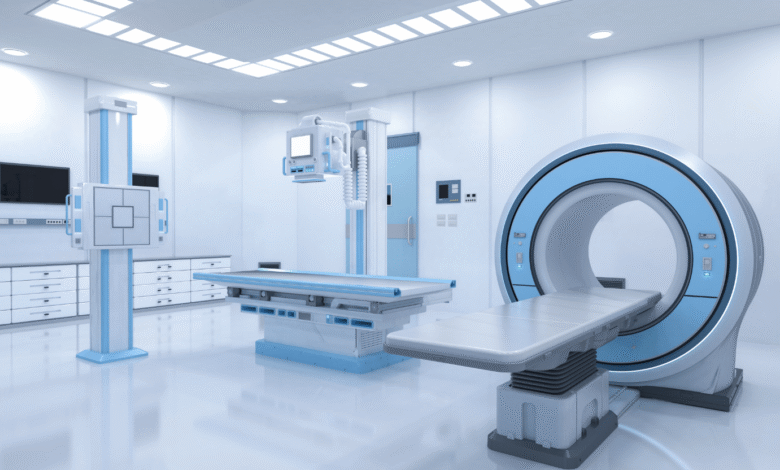
Diagnostic imaging equipment enables healthcare professionals to examine internal anatomical structures and identify abnormalities. Major categories include MRI machines, CT scanners, ultrasound systems, digital X-ray equipment, mammography machines and PET-CT systems.
These technologies support disease detection, treatment planning and clinical monitoring across oncology, cardiology, neurology, orthopaedics and other medical specialties. Advancements in artificial intelligence-assisted image reconstruction and digital imaging workflows are improving the capabilities of modern radiology departments.
Clinical Laboratory Diagnostic Equipment
Clinical laboratory equipment is used to analyse blood, urine and other biological samples. Major categories include clinical chemistry analysers, haematology instruments, coagulation systems, immunoassay analysers and electrolyte measurement equipment.
Automated laboratory systems help healthcare institutions process substantial sample volumes while maintaining standardised analytical procedures. Demand for these instruments is increasing alongside the expansion of diagnostic laboratory chains and preventive healthcare services.
Molecular Diagnostic Equipment
Molecular diagnostic instruments analyse genetic material to identify infectious agents, genetic abnormalities and disease-specific biomarkers. Technologies involving polymerase chain reaction and other nucleic acid amplification methods have become important components of modern healthcare diagnostics.
Molecular testing is particularly relevant for infectious disease surveillance, oncology, genetic testing and personalised medicine.
Point-of-Care Diagnostic Devices
Point-of-care diagnostic equipment enables healthcare professionals to conduct selected medical investigations near patients instead of relying exclusively on centralised laboratories.
Portable diagnostic systems are particularly useful in emergency departments, intensive care units, primary healthcare centres, ambulances and remote healthcare facilities. Faster availability of selected test results can facilitate timely clinical decisions.
How to Choose the Best Diagnostic Equipment Company in India
Healthcare institutions should evaluate diagnostic equipment manufacturers according to equipment accuracy, clinical performance, technological capabilities, regulatory compliance, maintenance support and operating expenditure. The selection process should consider the specific diagnostic requirements of the institution rather than focusing exclusively on equipment purchase prices.
Equipment reliability is particularly important for hospitals and diagnostic laboratories operating throughout the year. Frequent equipment breakdowns can disrupt healthcare services, delay patient investigations and increase operational expenditure. Access to trained service engineers, replacement components and preventive maintenance programmes should therefore form an important part of procurement decisions.
Diagnostic laboratories must also evaluate reagent availability, calibration requirements, quality control systems and the total cost per test. An instrument with a comparatively low acquisition price may generate substantial recurring expenditure through proprietary consumables and maintenance requirements.
Hospitals purchasing imaging equipment should evaluate image quality, radiation management, installation requirements, electricity consumption, software compatibility and integration with existing healthcare information systems.
Regulatory requirements are equally important. Healthcare institutions should ensure that equipment meets applicable Indian medical device regulations and obtain relevant licensing documentation wherever required.
Future of the Diagnostic Equipment Industry in India
India’s diagnostic equipment industry is expected to benefit from expanding hospital infrastructure, increased preventive healthcare awareness, domestic medical device manufacturing and technological innovation.
Artificial intelligence is transforming diagnostic imaging through automated image analysis, workflow optimisation and clinical decision-support capabilities. Laboratory automation is similarly improving sample processing, testing efficiency and diagnostic information management.
Domestic manufacturing is likely to remain an important growth driver. Production-linked incentive programmes, medical device parks and investments in research and development are encouraging manufacturers to establish sophisticated equipment production facilities within India.
Growing demand for healthcare services in Tier 2 and Tier 3 cities is also creating opportunities for affordable, compact and digitally connected diagnostic technologies. Portable ultrasound equipment, automated laboratory instruments and point-of-care devices can help improve diagnostic accessibility in underserved regions.
Conclusion
India’s diagnostic equipment industry is evolving into a technologically advanced ecosystem supported by multinational healthcare corporations and established domestic manufacturers. Wipro GE Healthcare, Siemens Healthineers and Philips Healthcare offer sophisticated diagnostic imaging technologies, while Roche Diagnostics and Abbott provide advanced laboratory and molecular diagnostic equipment.
Transasia Bio-Medicals, Trivitron Healthcare, Allengers Medical Systems and Agappe Diagnostics are contributing to domestic medical technology manufacturing and expanding diagnostic accessibility. Mindray complements the market through its diversified ultrasound, laboratory diagnostics and medical equipment portfolio.
The increasing integration of artificial intelligence, laboratory automation, digital healthcare infrastructure and indigenous manufacturing will continue shaping India’s diagnostic equipment industry in 2027.