Foreign Ministry makes Snapchat debut amid PM Modi’s Gen Z push. It Would Not Be Surprising If Tomorrow Modi Opens An OnlyFan Account

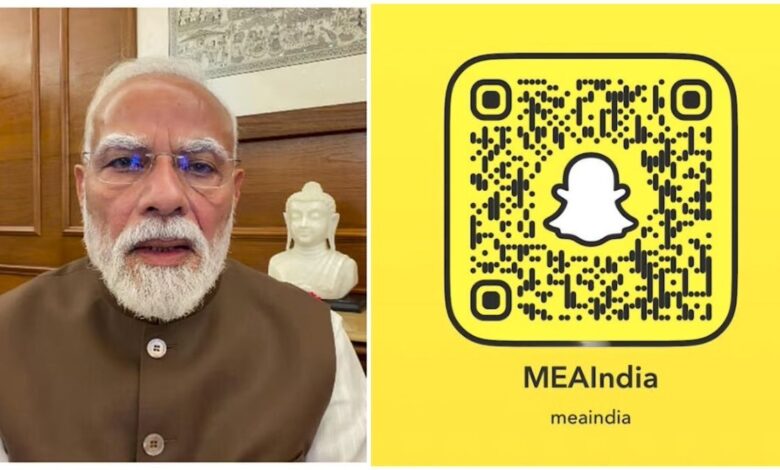
On 6–7 August 2026, the Ministry of External Affairs announced its official Snapchat channel. Spokesperson Randhir Jaiswal appeared in a short video inviting the young to “hear more about what the Ministry of External Affairs does… both in India and through our missions and posts abroad.” The caption was cheerful: “We’re now on Snapchat! … Let’s Snap!”
The move was presented as progressive, modern, and responsive. It arrived weeks after Prime Minister Narendra Modi’s reported instruction to ministers to prioritise Instagram, reels, and interactive formats because “Young audiences are on Instagram.” That instruction itself followed the prolonged Cockroach Janta Party protests over the NEET paper-leak crisis — protests that were youth-driven, meme-heavy, reel-saturated, and ended with the resignation of Union Education Minister Dharmendra Pradhan.
The sequence looks coherent: youth protest on digital platforms → government notices the platforms → government joins the platforms.
But this coherence is superficial. The deeper story is far more troubling.
What the Indian government has demonstrated, with increasing clarity, is a preference for managing the perception of connection with Gen Z rather than delivering the structural development and tangible benefits that generation actually requires. The Snapchat account is not an isolated experiment in digital diplomacy. It is a revealing symptom of a larger political choice: to treat attention as a substitute for outcomes.
The Communication Pivot Versus the Development Deficit
Gen Z in India is not an abstract demographic. It is the largest cohort of young people any democracy has ever had to absorb into education, employment, and citizenship simultaneously. Their core demands are not mysterious. They revolve around:
- Integrity and fairness in high-stakes examinations that determine life trajectories
- Quality of education that goes beyond rote and coaching factories
- Employment that matches the scale of the workforce entering the market every year
- Skills that survive technological disruption
- Mental health support in a high-pressure, high-uncertainty environment
- Affordable housing and urban opportunity
These are development problems. They require institutional redesign, long-term investment, political courage, and measurable delivery.
Instead, the dominant governmental response after the CJP protests has been communicative. Ministers are urged to post reels. The Foreign Ministry opens a Snapchat channel. The Prime Minister records informal vertical videos. The language of “outreach,” “engagement,” and “staying connected” multiplies.
This is not accidental. Communication is faster, cheaper, more controllable, and more photogenic than reform. A 20-second reel of a diplomat boarding a plane or an embassy helping stranded Indians can be produced, distributed, and measured in likes and views within hours. Redesigning the National Testing Agency, insulating examinations from leaks, creating millions of productive jobs, or reforming higher education takes years, faces bureaucratic resistance, creates political losers, and cannot be reduced to a vertical video.
The government has therefore chosen the path of least resistance: occupy the platforms where young people already live, speak in the formats they consume, and hope that the appearance of proximity will blunt the sharper edges of structural failure.
Why Connection Is Being Prioritised Over Benefits
There are several interlocking reasons.
First, electoral arithmetic. India’s youth bulge is also a voting bulge. Gen Z and younger millennials will form a decisive share of the electorate in coming cycles. Connecting with them on Instagram and Snapchat is a low-cost way of attempting to shape narrative and soft loyalty without having to deliver the harder goods of employment and institutional trust.
Second, the lessons of the CJP moment. The protests showed that young Indians can organise, meme, and pressure the system with remarkable speed when the issue is existential (a paper leak that can destroy years of preparation). The government’s response was not primarily a deep institutional overhaul of examination integrity. It was a combination of a high-profile resignation and a rapid acceleration of youth-facing digital communication. The signal was clear: manage the optics of responsiveness more aggressively than the substance of systemic repair.
Third, the nature of modern political power. In an attention economy, the ability to occupy mental space can feel more immediate than the slower work of building capability. A ministry that posts exclusive Snapchat stories about cultural diplomacy or evacuation operations can claim it is “reaching the youth.” A ministry that fails to prevent the next major examination scandal cannot make the same claim, no matter how many press releases it issues. The incentives therefore tilt toward platform presence.
Fourth, the absence of accountability mechanisms that force delivery. When the metric of success becomes “engagement” rather than “outcomes for 20-year-olds,” governments naturally optimise for the former. Snapchat stories, Instagram reels, and casual videos are measurable in real time. Job creation rates, exam integrity metrics, graduate employability, and youth mental-health indicators are slower, more contested, and politically riskier.
The Actual Ground Work Is Zero — Or Close Enough to It
This is the central charge, and it must be stated without softening.
Relative to the scale of the challenge, the government’s substantive groundwork for Gen Z’s developmental needs remains negligible.
Consider the examination system. The NEET paper-leak crisis was not an isolated technical failure. It was the latest and most visible expression of a deeper rot: high-stakes tests that function as life-or-death filters, a coaching industry that thrives on scarcity and anxiety, and institutions that have repeatedly failed to protect the integrity of the process. After the resignation and the protests, the structural redesign required — independent testing architecture, radical transparency, technological and procedural safeguards, reduction of the coaching-industrial complex’s power — has not been delivered at the depth required. Communication about concern is abundant. Institutional reconstruction is not.
Consider employment. India’s youth unemployment and underemployment numbers have remained structurally high even during periods of headline GDP growth. The gap between degrees produced and productive jobs available continues to widen. Skill missions and schemes exist on paper and in social-media graphics. On the ground, the absorption capacity of the formal economy for the millions entering the workforce each year remains inadequate. Posting reels about foreign policy does nothing to close that gap.
Consider education quality. Expanding access has been real. Expanding excellence and relevance has lagged. Large numbers of graduates emerge with credentials that the market does not value. The system still rewards rote performance over capability. Mental-health support for students under extreme pressure remains fragmented and under-resourced.
In each of these domains the pattern is similar: schemes are announced, targets are set, social-media content is produced, and the underlying machinery of delivery remains weak. The distance between the narrative of a youthful, aspirational India and the lived experience of competitive desperation, paper-leak anxiety, and job scarcity is vast.
The Snapchat channel does not narrow that distance. It papers over it with visual storytelling.
The Strategic Implication
When a government invests more visible energy in learning the grammar of Snapchat and Instagram Reels than in rebuilding the institutions that shape young lives, it reveals its actual priorities. Connection becomes a substitute for construction. Attention management becomes a substitute for capability building. The language of “reaching Gen Z” becomes a sophisticated way of avoiding the harder question: what has been delivered for Gen Z?
This is not an argument against digital presence. Governments should be on the platforms their citizens use. Diplomacy should be explained in accessible formats. Transparency and storytelling have value.
The problem arises when platform presence is allowed to stand in for developmental substance — when the energy that should go into fixing examination systems, expanding productive employment, and raising educational quality is instead redirected into mastering short-form video and disappearing stories.
Gen Z is not primarily asking to be followed on Snapchat. It is asking for a system that does not treat its future as a high-stakes lottery vulnerable to leaks, a labour market that can absorb its ambition, and institutions that treat its time and effort with respect.
Those demands cannot be met by exclusive stories from missions abroad or by reels of ministerial engagement. They require ground work — slow, unglamorous, measurable, and often politically costly ground work.
On the evidence of the post-CJP period, that ground work remains largely unbuilt. The Snapchat account is open. The deeper architecture of opportunity is not.
That is the real story behind the cheerful invitation to “Let’s Snap.”