Sentient, Superintelligence Or Singularity: Inventor Vatsal Soin’s 0→1 Doctrine Gates Runaway AI At The Decision Point

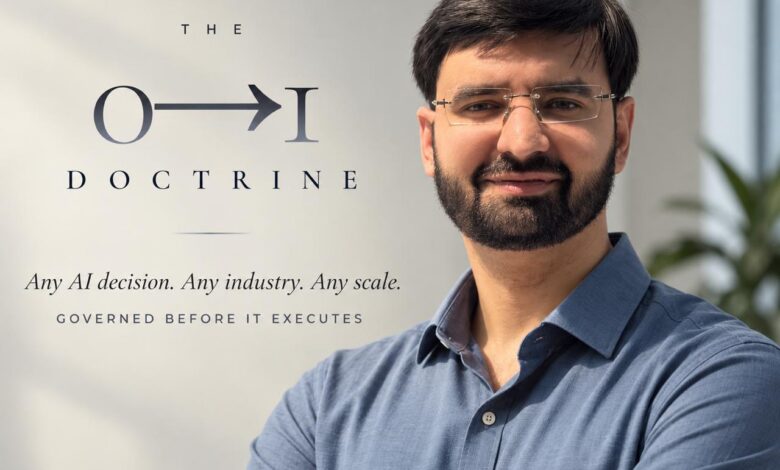
Whether a system is sentient, has reached AGI, or approaches the Singularity remains genuinely unsettled — but none of those debates need resolving before a proposed action executes. Vatsal Soin’s 0→1 Doctrine gates that action at the one moment that actually matters: the decision point, tested against an authorized boundary and sealed either way.
Live: www.0to1doctrine.com
A PRIMER FOR FIRST-TIME READERS
THE FOUNDATIONAL LOGIC OF 0→1
For readers new to the 0→1 Doctrine, the architecture maps operational needs into standardized value bands between zero and one. It proposes checking those bands against authorized conditions before a system crosses an execution boundary.
CAPABILITY AND EXECUTION PRIVILEGE
SEPARATING WHAT A MODEL CAN DO FROM WHAT IT MAY DO
A model’s ability to plan or generate instructions differs from its authority to execute them. An agent may calculate a logistics plan without permission to transfer assets. The 0→1 approach proposes separating capability from execution privilege, requiring defined checks before action.
AI PACING AND GOVERNANCE
SLOWING DEVELOPMENT VERSUS CONTROLLING ACTION
Debates about pausing or slowing advanced AI development address the pace of capability growth. A separate question is how deployed systems are authorized to act. The 0→1 proposal focuses on execution boundaries; it does not establish that pacing measures are unnecessary or that technical controls alone resolve broader AI risks.
SENTIENCE AND OPERATIONAL RISK
COGNITIVE-NEUTRAL CONTROLS
Whether an AI system is conscious remains contested. Immediate operational controls can instead examine observable requests, permissions, constraints and potential consequences. The doctrine’s proposed gate need not settle questions of sentience to check whether a particular action meets an authorized boundary.
A SHARED NUMERICAL LANGUAGE
NORMALIZING DIFFERENT DOMAINS
Different sectors measure different things: logistics may track weight, finance may track margins, and computing systems may track throughput. The doctrine proposes converting relevant inputs into normalized index arrays, so requirements can be compared without assuming raw units are interchangeable.
AN EXECUTIVE NUMERICAL EXAMPLE
HOW AUTHORIZED BANDS ARE USED
In the proposed process, a human defines requirements and authorized ranges. The system maps relevant inputs into bands and checks whether mandatory conditions are met before execution. The examples below are illustrative governance inputs, not measured performance results or universal safety thresholds.
MACRO LIQUIDITY EXAMPLE
CHECKING A HIGH-VALUE TRANSACTION
Consider a hypothetical sovereign investment transaction with a composite risk band of [0.68, 0.74] and a human-authorized range of [0.62, 0.80]. The ranges overlap, so this illustrative check passes. Settlement would still depend on other controls, legal authority, verification and operational safeguards.
MESO GRID EXAMPLE
CHECKING INDUSTRIAL RECONFIGURATION
A hypothetical power-distribution agent requests a reconfiguration with a capacity band of [0.86, 0.93], while the authorized cap is [0.50, 0.76]. Because the ranges do not overlap, the proposed gate blocks the request pending review. These figures illustrate the logic; they are not validated grid thresholds.
MICRO LABORATORY EXAMPLE
CONTAINING HIGH-IMPACT ACTIONS
A hypothetical laboratory automation request has a capability band of [0.69, 0.74], against an authorized envelope of [0.65, 0.72]. Partial overlap does not prove every condition is satisfied. The system would need to apply mandatory rules and route uncertain or high-impact actions for review.
MULTI-AGENT OVERLAP
VERIFYING COLLECTIVE ACTION
Multiple agents can divide tasks across services, making their combined effect harder to assess. The doctrine proposes grouping relevant parameters and checking the collective request against defined constraints. An overlap or combined signature is evidence to verify, not permission by itself.
MACRO FINANCIAL CONTROLS
MONITORING LIQUIDITY DRIFT
High-frequency capital-routing systems can create interacting exposures. A fit or risk engine could compare execution indicators with defined limits and flag drift. Whether this reduces systemic risk depends on the indicators, thresholds, integration and response arrangements; normalization alone cannot guarantee protection.
CLOUD INFRASTRUCTURE
CHECKING RESOURCE ALLOCATION
Large data centers manage many parallel workloads. When an optimization agent requests sweeping configuration changes, a pre-execution check could compare the request with capacity, tenancy and policy limits. A failed condition would hold the change for review before resources are reassigned.
BIO-DIGITAL CONTAINMENT
VALIDATING LABORATORY COMMANDS
Distributed laboratory systems require strict controls over what may change and who may authorize it. A gate could check a proposed formulation or equipment command against approved parameters and block requests lacking authorization. Such controls must accompany laboratory safety procedures and independent validation.
MODEL OPACITY
EXTERNAL CHECKS WITHOUT CLAIMING FULL EXPLANATION
Complex reasoning systems may be difficult to interpret fully. The doctrine proposes placing authorization checks outside the model, so permission does not depend solely on explaining every internal computation. External checks can constrain actions, but do not eliminate the need to evaluate model behavior and system risks.
TOKEN CHAIN AND RECEIPT
RECORDING THE GOVERNANCE OUTCOME
The described workflow uses USP, UCC, PDT, ACT, MAT and OCT stages, followed by an Actuation Compliance Receipt (ACR). The receipt is intended to record the governance outcome and link it to the workflow. Cryptography can support integrity, but cannot make an incorrect authorization decision correct.
PRAT AND EMERGE
ADVISORY CHANNELS FOR RISK REVIEW
The architecture describes PRAT as a predictive advisory channel and EMERGE as an envelope for reviewing privacy-preserved metadata. These components could flag anomalies and support a governed hold or review. Reliability would require defined signals, tested thresholds and clear responsibility for responding.
FAIR AND TRANSPARENT WASTE ESTIMATOR
MEASURING RESOURCE USE
The FTWE concept proposes measuring time, waste and carbon-related variables against a baseline. Such comparisons could help assess resource use around specific decisions. Claims of prevented waste require a defensible baseline, transparent assumptions and real measurement; a normalized estimate alone is not proof of savings.
PRIVACY AND DATA SOVEREIGNTY
LOCAL PROCESSING AND LIMITED SHARING
The HUPA concept proposes keeping raw data within a local privacy boundary, sharing only normalized outputs or proof-based digests. Sensitive information stays put; only a verifiable summary travels outward, though real privacy still depends on implementation and applicable law.
POST-QUANTUM CRYPTOGRAPHY
PLANNING FOR CRYPTO-AGILITY
The architecture discusses post-quantum cryptographic options for protecting signatures and lineage. Crypto-agility can make algorithm updates easier, supporting long-term security over time. Strong implementations rely on appropriate standards, sound key management, careful migration planning and independent review at each stage.
CLOSING NOTE
“Sentient or not, running or paused, the question capital actually asks is narrower: was this specific action authorized before it moved. That answer is now filed.”
Live: www.0to1doctrine.com
This can be tested, live, via API, governed against ungoverned, side by side.
THE INVENTOR
Vatsal Soin is a serial inventor and entrepreneur with patent filings across six continents and grants in the US, India, Japan and South Africa. He is a SIM–RMIT alumnus and an alumnus of Nanyang Technological University, Singapore. His latest grant, dated August 14, 2026, introduces an AI-powered footwear system and Global Sharable Size Card invention.
SELECTED REFERENCES
Granted: US Patent 12,446,652 B2 · Japan Patent 7560909 · India Patents 454081 and 599317 · Filed: PCT/IN2025/051943 · US 19/489,595 · India 202511115781 · Australia AU2022450649
DISCLAIMER
Informational only. Not certified. No endorsement implied. Not investment advice. Vatsal Soin · © 2026 All Rights Reserved.