From Anaesthesiologist To Accused: How Did Vatsala Aggarwal Rise To Control Delhi’s Entire Medical Procurement Chain?
Dr Vatsala Aggarwal rose from a 1993 entrant into Delhi's government medical service to Director General of Health Services in August 2025, and within nine months found herself arrested, chargesheeted across nearly 12,000 pages, and accused of presiding over an alleged ₹600–700 crore procurement racket spanning X-ray machines, bedsheets, ORS sachets and surgical consumables. No court has yet found her guilty, and her defence insists not a single traced rupee links her to the money. This is an interrogation of what has actually been established, what remains only alleged, and what the case exposes about institutional oversight.


Nearly 12,000 Pages, Zero Convictions: What Does Delhi’s ₹700 Crore Medical Scam Actually Prove, and What Does It Still Not?
How Did a Vigilance Visit Become a ₹700 Crore Criminal Case?
Every major corruption scandal has an origin point where the façade first cracks, and in this case it was 18 May 2026, the day Delhi’s Directorate of Vigilance walked into the Central Procurement Agency (CPA) seeking records on portable X-ray machines, bedsheets, C-Arms, ORS, surgical consumables and anaesthesia equipment. What should have been a routine records check instead met resistance: investigators reportedly struggled to obtain files, encountered the CPA’s Head of Office Dr Vinod Kumar Ranga, who was said to have contacted Dr Vatsala Aggarwal during the episode, and the matter escalated to the Anti-Corruption Branch (ACB). By 2 June 2026, FIR No. 7 had been registered.
Ask the obvious question: why would a routine Vigilance records request trigger resistance serious enough to collapse an entire health administration’s leadership within weeks? If the procurement process had been clean, wouldn’t producing the paperwork have been the fastest way to close the matter, rather than the beginning of a chain that would end in a nearly 12,000-page chargesheet, three arrested public servants, and a fourth accused who fled the country before surrendering months later?
The Money Trail: How Far Does It Actually Go?
The headline figure, ₹600 crore, later recast as ₹700 crore as investigators expanded the inquiry’s scope, demands scrutiny before it is repeated as settled fact. These are not four different proven losses; they represent the case’s evolving characterization as the ACB’s net widened. What can be said with more confidence is the structure investigators allege: government money moved from the CPA to the bank accounts of five identified supplier firms, and from there, according to prosecution submissions in Dr Ranga’s court proceedings, into hundreds of further accounts — some belonging to people the prosecution says had no discernible connection to medical supplies. Money allegedly moved again from there, through further transfers and cash withdrawals.
Here is the uncomfortable admission buried inside the prosecution’s own account: the complete trail to the ultimate beneficiaries was, as of the latest reporting, still being established. That is a genuinely significant gap. A case built on the premise that ₹600–700 crore was siphoned from a public health budget should, in a rigorous investigation, eventually be able to show precisely where that money landed — not merely that it passed through a maze of accounts before vanishing from view. Is the maze itself the scheme’s design, deliberately constructed to make recovery and attribution all but impossible? Or is it evidence that investigators have, so far, chased the money only partway to its destination?
Who Are the People Allegedly Running This Chain?
At the apex of the alleged private-sector network sits Rajiv Rangila, also referred to in some reports as Rajiv Kumar or Rajeev Arora, described by investigators as a pharmaceutical trader and liaison between manufacturers and government procurement officials. The ACB alleges he controlled multiple firms, F-Med Devices, Technocrats, Raj Shree, Ashi Surgical and Pharmaceuticals, M Sahib and Sons, while nominal ownership was held by others, including, strikingly, people the ACB describes as of very limited economic means.
If true, what does it mean that a multi-hundred-crore procurement operation allegedly rested, on paper, in the names of people least capable of operating it? Doesn’t that structure itself amount to a confession of intent — a deliberate architecture of deniability built from the identities of people with the least power to resist being used?
Below Rangila, the alleged chain runs through Dr Vinod Kumar Ranga, the CPA’s Head of Office, accused of preparing or receiving restrictive technical specifications and pushing them through tender committees; Neeraj Chopra, the CPA’s Deputy Controller of Accounts, allegedly responsible for the financial-processing side — clearing bills and, in some instances, personally carrying them to the Pay & Accounts Office; and finally, at the top of the administrative pyramid, Dr Vatsala Aggarwal herself, who as DGHS allegedly gave final approval to tender conditions already tilted toward predetermined suppliers.
The ACB has also alleged that tender committee members, the formal, supposedly independent safeguard against exactly this kind of manipulation, were pressured into endorsing specifications prepared in advance, with technical evaluations sometimes completed and approved within hours. If an institutional safeguard can be bypassed that routinely, was it ever functioning as a safeguard at all, or merely as a rubber stamp waiting to be told what to approve?
The Receipts: What Do the Individual Allegations Actually Show?
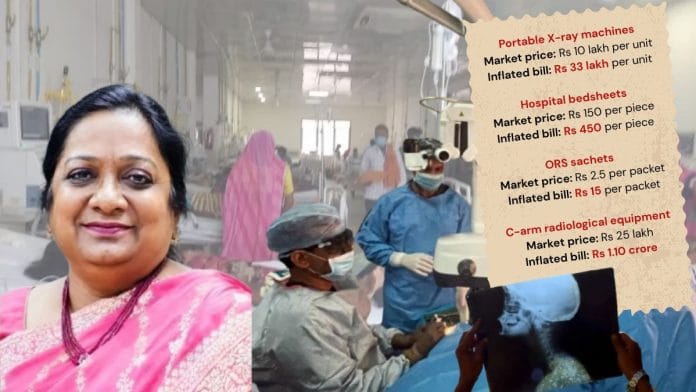
Consider the portable X-ray allegation in isolation, because it is the case’s starkest illustration. Comparable machines, the ACB alleges, were available to government institutions at roughly ₹10 lakh each; the CPA is said to have paid approximately ₹33 lakh per unit across 448 machines — an alleged expenditure of ₹148 crore against a comparator value of roughly ₹45 crore, a gap of over ₹100 crore on a single category of equipment. The tender itself, investigators allege, was originally structured around just two machines before quietly expanding to 448 units, with F-Med Devices allegedly installed as an authorised distributor for manufacturer Prognosys shortly before securing the business.
The bedsheet allegation follows a similar arc but reveals a second layer of potential manipulation: not just price inflation, but demand inflation. The ACB alleges sheets were procured at roughly ₹450 apiece against a comparator of ₹150, with hospital authorities allegedly pressured into requesting unnecessary colour variety and faster replacement cycles to inflate volume on top of price. Yet, and this matters enormously for intellectual honesty, a Delhi Health Department review in August 2026, examining nearly 90 GeM contracts, reportedly found the CPA’s bedsheet pricing broadly comparable to other government procurement, with its roughly ₹400 rate among the lower comparable government rates.
That is a genuine evidentiary collision, not a footnote. Which comparison is apples-to-apples — fabric weight, dimensions, stitching, certification, delivery terms all held constant — and which is comparing fundamentally different products at a glance? Without that forensic rigor, is either side’s number more than an educated guess dressed up as a finding?
The ORS allegation, almost comical in its banality, claims 50 lakh sachets were procured at ₹15 each against a prevailing rate near ₹2.50 — a difference of roughly ₹6.25 crore on an item costing pennies. The C-Arm radiology allegation claims machines available elsewhere at ₹25 lakh were billed to the CPA at ₹1.10 crore apiece across seven units, with a company called Vision Medicaid Equipment allegedly installed as a dummy competing bidder to manufacture the appearance of contest.
And the anaesthesia workstation allegation describes a tender specification allegedly written around a single Dräger model, engineered so that M Sahib and Sons became the sole technically qualified bidder, precisely the scenario where re-tendering should have been triggered, and allegedly wasn’t.
Then comes the allegation dwarfing all the equipment line-items combined: roughly ₹400 crore in medicines procured through repeated “urgent procurement” mechanisms rather than competitive tendering, with the ACB alleging around ₹300 crore of that siphoned off as kickbacks. If true, this single mechanism of bypassing competitive tender altogether under the banner of urgency would represent the case’s true center of gravity, dwarfing every equipment allegation combined. Why would urgent procurement, a mechanism meant for genuine emergencies, be used repeatedly enough to channel ₹400 crore through a public hospital system? Doesn’t repetition itself defeat the entire premise of “urgency”?
How Did Vatsala Aggarwal Rise to Control This System?
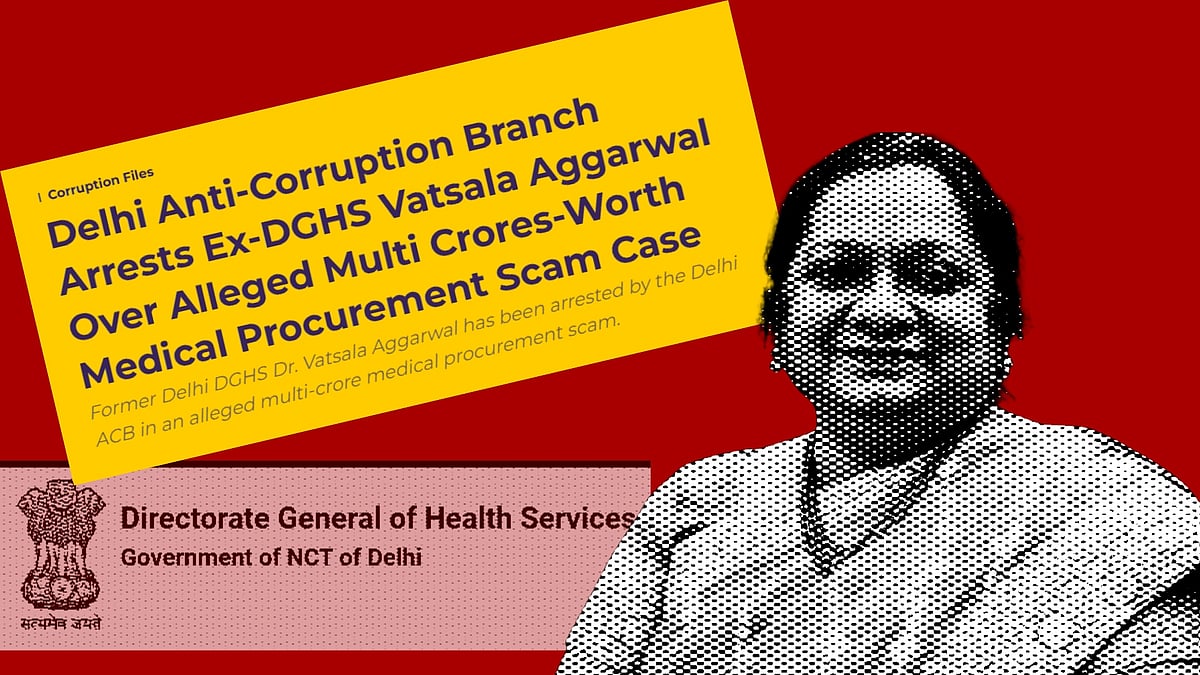
To understand how one administrator came to oversee this entire architecture, her career trajectory matters. Entering Delhi government service on 3 June 1993 as an MBBS, MD (Anaesthesia) specialist, she rose over three decades through Medical Superintendent of Deep Chand Bandhu Hospital, Director of Janakpuri Super Speciality Hospital, and, critically Director of the Delhi State Cancer Institute (DSCI) between roughly 2023 and 2025, before being appointed DGHS on 19 August 2025, an order approved by the Lieutenant Governor of Delhi, following Dr Rati Makkar’s voluntary retirement after only months in the post.
Here is where the interrogative must sharpen: this was not a competitive, scored selection process comparable to a public examination. It was an administrative posting. AAP leader Saurabh Bharadwaj has alleged that more senior, more qualified doctors were bypassed, which is a political allegation that deserves to be reported as exactly that, an allegation, since no publicly documented competitive-selection scoresheet establishing Aggarwal’s superiority or inferiority to named alternatives has surfaced.
But the underlying structural question survives the absence of such a scoresheet: should the single most powerful administrative position overseeing hundreds of crores in annual medical procurement be filled through an opaque administrative order rather than a transparent, criteria-based competitive process? Days after becoming DGHS, Aggarwal was additionally made interim Registrar of the Delhi Medical Council, tasked with its reconstitution within two months — an extraordinary concentration of authority handed to one official within the same fortnight, atop a procurement structure already, it would later emerge, under question.
What Came Before: The Cancer Institute Controversy
The procurement scandal was not Aggarwal’s first brush with institutional controversy. During her DSCI tenure, a complaint alleged that recruitment rules for an Assistant Professor (Cancer Research) position were drafted to favour Dr Minakshi Mann — wife of DSCI officer Dr Vikram Pratap Singh — with the post allegedly not previously existing, eligibility conditions allegedly tailored, and the advertisement allegedly issued without necessary approvals.
Delhi’s Vigilance machinery sought action-taken reports from DSCI in 2024/2025 and again in July 2026 for submission to the Central Vigilance Commission. Crucially, no criminal case was registered against Aggarwal over this matter at the time it was reported — it remains a documented Vigilance inquiry into an allegation, not an adjudicated finding of wrongdoing.
But set this alongside the later procurement case and a pattern worth interrogating emerges: an administrator whose tenure at one institution had already drawn a Vigilance-level recruitment complaint was, within roughly a year, elevated to the single most powerful procurement-adjacent post in Delhi’s entire health bureaucracy. Was that earlier complaint ever meaningfully weighed in her subsequent elevation? If institutional memory and vigilance findings don’t travel upward with an officer as they rise through the ranks, what is the point of maintaining vigilance records at all?
The Defence, and the Case’s Real Fault Line
Fairness demands equal weight for Aggarwal’s defence, which has mounted a specific and pointed rebuttal: her September 2026 bail application argued that the chargesheet traces not a single rupee from supplier payments to her or any account connected to her; that she lacked access to the tender portal, which the CPA alone controlled; that no recorded call, message, or meeting links her to Rangila or the private accused firms; and that searches of her residence allegedly recovered no unaccounted cash or procurement documents, only personal investment papers the chargesheet does not allege were disproportionate to her known income.
This is the case’s real fault line, and it deserves to be stated as plainly as the allegations against her: was Aggarwal’s role genuine, knowing participation in a coordinated scheme, approving specifications she knew were engineered to favour predetermined firms, or was it, as her lawyers contend, routine administrative sign-off on files prepared and controlled entirely by a CPA machinery she never personally touched? The ACB’s own position, that procurement decisions were taken collectively but that Aggarwal approved the “important decisions” at DGHS level, is itself an acknowledgment that this is a case about the weight and meaning of an administrative signature — not, so far, about traced money.
A Prosecution Under Its Own Scrutiny
Perhaps the most striking recent development is one that cuts against the prosecution’s own credibility. On 29 September 2026, Special Judge Vidya Prakash criticised the ACB’s investigation after finding that one case diary appeared to substantially reproduce the previous day’s entries, and that two alleged disclosure statements attributed to Rangila were undated, directing the ACB’s Joint Commissioner to ensure the investigation remained fair, impartial and independent. When a trial court itself flags sloppiness this basic in a case this consequential, what confidence should the public place in the thousands of other pages of the chargesheet that have not yet faced equivalent judicial scrutiny?
Missing procurement files, in some instances, the ACB alleges, only payment orders survive while the underlying procurement documentation has vanished, compound the concern: is this the signature of a conspiracy sophisticated enough to erase its own paper trail, or of an investigation struggling to assemble one in the first place?
What This Case Should Make Every Citizen Ask
Strip away the individual names and the case exposes a structural vulnerability that should alarm anyone who relies on Delhi’s public hospitals: a centralized procurement authority, created in June 2025 to concentrate purchasing power for efficiency, instead concentrated risk into a single administrative chain — specification, tender committee, DGHS approval, accounts clearance — where, if the ACB’s theory holds, every supposed independent checkpoint could be captured simultaneously. Centralization promised bulk-purchasing efficiency; did anyone building that architecture ask what happens when the few people controlling it are compromised, rather than merely incompetent?

As of 1 October 2026, Vatsala Aggarwal remains a charged accused, not a convicted one. Her regular bail hearing, adjourned to 7 October, will also see the court consider taking cognizance of a chargesheet built on nearly 12,000 pages, 84 witnesses, and allegations spanning medicines, machines, and bedsheets. Prosecution sanctions under the Prevention of Corruption Act have been obtained for all three government accused — a procedural green light to prosecute, not a verdict.
Until a court tests this evidence on its merits, the honest conclusion is neither “she stole ₹700 crore” nor “she is innocent” — it is that Delhi’s medical procurement system allowed a chain of alleged manipulation to run from specification to payment without a single independent safeguard catching it in time, and that is a failure the public is owed an answer for regardless of what any single trial ultimately decides about any single defendant.