Tag: ECONOMY

  • Heavy rains in HP’s Dharamshala: Cars, buildings swept away in terrible flash floods

    Heavy rains in HP’s Dharamshala: Cars, buildings swept away in terrible flash floods

    Flash flood triggered by heavy rains swept away buildings and cars at tourist spots as bad weather also led to the closure of the airport here.

    The district administration also instructed tourists to postpone their visit to Dharamshala in view of the heavy rains.

    Dharamshala in HP

    Dharamshala

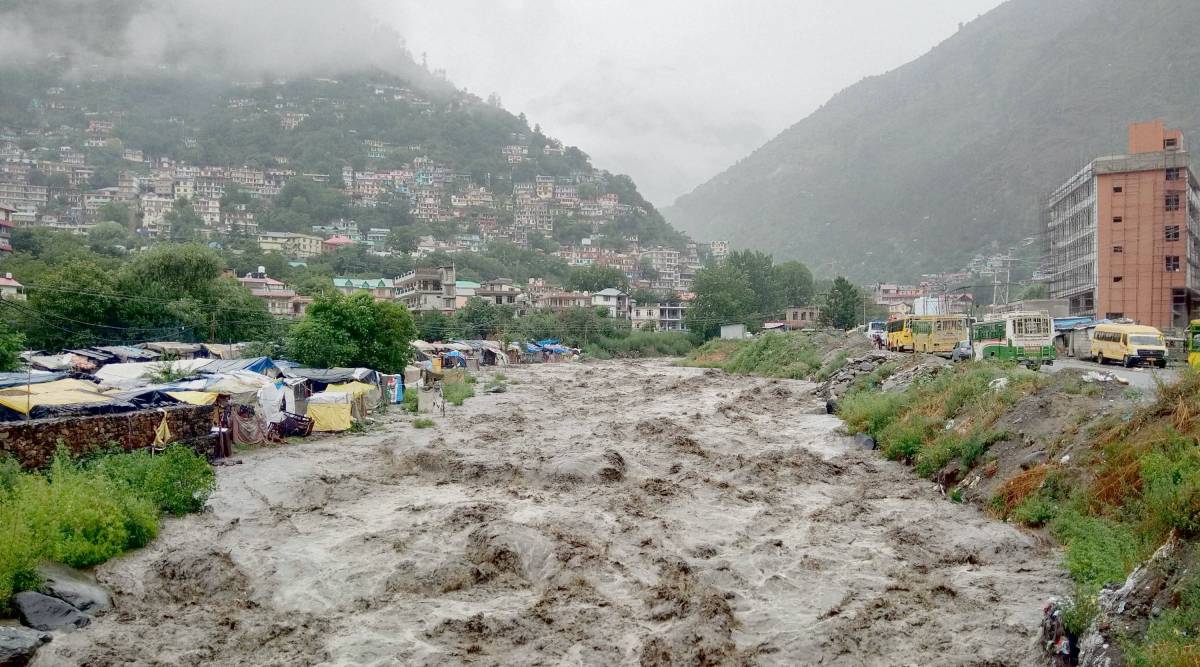
    A drain near Bhagsu Nag in upper Dharamshala adjoining Mecleodganj changed its course owing to heavy rains, sweeping away four cars and several bikes, video clips showed.

    A government school building at Bhagsunag was also damaged and adjacent hotels there were inundated, it showed.

    “Due to inclement weather and heavy rains, all incoming flights to Dharamshala airport at Gaggal have been cancelled,” said airport’s traffic in-charge Gaurav Kumar.

    Owing to flash flood at Manjhi Khad area adjoining Dharamshala, two buildings were swept away while several others were reported to be damaged, the video clips.

    The flash floods also damaged a bridge on the Mandi-Pathankot highway after which traffic was stopped on both sides, leading to a traffic jam.

    In a tweet, Prime Minister Narendra Modi,”The situation in Himachal Pradesh due to heavy rains is being closely monitored. Authorities are working with the State Government. All possible support is being extended. I pray for the safety of those in affected areas.”

    Cars, buildings swept away in flash floods triggered by heavy rains in HP's  Dharamshala - Eastern Mirror

    Union Home Minister Amit Shah spoke to Himachal Pradesh Chief Minister Jai Ram Thakur on Monday to take stock of the situation arising due to the floods in several districts of the state and assured him all possible help from the Centre.

    Thakur also expressed concern over the losses due to heavy rain and directed the administrations of various districts to ensure speedy relief and rescue operation in the affected areas.

    He also urged the local people and tourists to refrain from going near the river banks to avoid any untoward incident.

    Deputy Commissioner Dr Nipun Jindal said, “All the tourists visiting Dharamshala have been instructed to postpone their tour so that they do not face any kind of inconvenience.”

    He said the tourists who have already arrived in Dharamshala and its surrounding places have also been advised to stay where they are as roads etc. have also been damaged due to heavy rains, which may cause problems in their movement.

    The district administration is also making elaborate arrangements for the safety of the tourists staying in Dharamsala and its surrounding areas, he said.

    Cars, buildings swept away in flash floods triggered by heavy rains in HP's  Dharamshala - The Economic Times

    In case of any problem, they can contact the toll free number 1077 of the disaster control room, he said.

    “Instructions have also been given to people to not go to sensitive places prone to landslides. Some people have also been shifted to safer places due to flood conditions in some areas of the district.”

    Officials have been directed to complete relief and rehabilitation immediately, he said, adding that control rooms have also been set up and steps have also been taken to make the weather forecast available to people.

    Jindal said according to the Meteorological Department forecast, heavy rain on July 13 as well as from July 14 to 16 has been predicted.

    Keeping this in mind, orders have been issued under the Disaster Management Act 2005 to district officers of all the departments in Kangra district to remain alert.

  • Top 5 Most Promising EdTech Companies in India 2021

    Top 5 Most Promising EdTech Companies in India 2021

    Since the start of coronavirus pandemic in 2020, the world was under lockdown and life started online, online games, online entertainment, online food ordering, online jobs and online education. The world went digital and everything went online, not just colleges, but even the schools also went online.

    Today, the EdTech industry of India is the second biggest in the world and it is only beginning. The industry is estimated to touch $3.2 billion by 2022. 

    Given below are the top 5 EdTech companies in India during the current year 2021:

    1. Ekeeda

    Ekeeda is an initiative by Prof Mahesh Wagh with the objective to create employable degree holders with cutting-edge Integrated Job readiness programs for Engineering students to impart 21st-century Engineering skills.
    Ekeeda seek to accelerate the careers of aspiring engineers by providing them with industry relevant technology & tools training along with internship and placements.
    Ekeeda provides Corporate Career Tracks to train students on industry-relevant practical skills & gives hands-on experience with industry projects, personal coaches, technical internships etc.
    It’s the most trusted Edtech platform by over 12,00,000+ Young & Brilliant Engineering Aspirants.

    2. EdTech Byju’s

    byju's

    In the past few years, Byju’s has become the household name for providing good quality education online. It started as a simple coaching class service, and now Byju’s is one of the top EdTech companies in the world and one of the most successful ones. This start-up was founded by Byju Raveendran and his wife Divya Gokulnath and had its headquarters in Bangalore, India.

    Many big companies foresaw the start-up’s potential and invested in them- General Atlantic, Owl Ventures, Qatar Investment Authority, Bond, Tiger Global Management, etc. They have even done collaborated with Disney to make learning fun and interactive. Their main aim is to provide education different from a classroom one- a more engaging, personalized, and easy way of learning. Byju’s also has various popular subsidiaries like WhiteHatJr. and SPAN Thoughtworks Private Limited. Not for forget, BYJUS is also one of the leading Unicorn Of India

     3. EdTech Brainly

    brainly edtech

    Brainly is an online community where millions of students and verified experts come together to solve questions. Michal Borkowski founded it in 2009 in Poland. Users are allowed to ask questions or doubts related to their projects or assignments, and their queries get answered by a panel of experts in the field. They have been funded by Learn Capital, Prosus Ventures, Runa Capital, General Catalyst Partners, MantaRay, etc. Owing to the sudden switch to the online mode of education, Brainly has become one of the world’s largest online learning communities.

    4. EdTech CollegeDunia

    Collegedunia.com - Review - Spotlight

    Founded in 2014 by Sahil Chalana, this online community provides a search engine that helps students find the right college and course for themselves by providing them results customized to their qualifications. It serves information on higher education for students in India as well as abroad. When you enter the course you want in their search engines, you will be provided a compiled online brochure of the colleges you can apply to, the procedure you have to follow, and other required information. They have had investors like Gray Matters Capital and M Chandrasekaran to provide their funding. Currently, they are invested in the growth of their mobile application amidst the surge of online modes of education.


     5. EdTech Study’n’Learn, An Initiative Of SmartSchool Education


    SmartSchool Education Pvt. Ltd. founded in 2011 is the fastest growing education company in India, the company has been actively providing innovative K-12 educational solutions to various institutions across the globe. The StudynLearn App by SmartSchool was released in 2017.

    The App has a Choose a book/Choose a board feature, which means the App provides mapped content of various state boards across India along with this 3000+ different publishers are also mapped across India, in other words the application provides personalized content PAN India. Parents are often reluctant to give mobile devices connected to internet to the kids. And, StudynLearn solves this problem as it provides both online and offline modes for learning which makes it the only edtech app to run in the offline mode. Language should not be a barrier while learning, so to overcome this problem StudynLearn provides Bilingual feature. Complete content language can be switched on the fly. Moreover, the subjects provided by StudynLearn is not limited to Maths and Science, this App provides all subjects from KG to 12th. Along with high quality animated modules, the content served by StudynLearn includes games, quizzes, practice tests, real life videos etc. which enhances the learning among students and helps to memorize, retain and recall during examinations. Also, the content provided by SmartSchool (parent company) received CBSE approval in 2013 which serves as a cherry on the cake.


    Special Mention

    EdTech Gradeup

    Gradeup Coupons, Promo Code & Offers - Get Gradeup Green Card for Just  Rs.399/year + Extra 15% off

    Gradeup is also one of the leading EdTech start-ups in India and specializes in curating  content for acing competitive exams like JEE and NEET. The start-up was founded by Shobhit Bhatnagar, Vibhu Bhushan, and Sanjeev Kumar under the parent company GradeStack Learning Pvt Ltd in the year 2015. They are invested in an engaging and interactive exchange of queries and solutions between aspirants and experts. The company focuses on using Data Analytics to increase its audience organically.


    Above is the list of Most Promising EdTech Companies in India 2021

    Edited by Aishwarya Ingle 


  • Explained: Why is Cairn Energy suing Air India?

    Explained: Why is Cairn Energy suing Air India?

    In 2006, the ownership of Indian assets was passed down from Cairn UK Holdings to Cairn India Ltd. (CIL), a new company formed exclusively for Indian operations. Before this, CI Holdings, a subsidiary of Cairn UK Holdings headquartered in Jersey, UK, was responsible for all Indian operations. When CIL was introduced in 2006, the entire share capital of Cairn India Holdings (CIH) under Cairn UK Holdings was acquired by the new company. During the deal, 69 percent of CI shares were acquired by Cairn UK Holdings.

    Cairn India Profits

    Cairn energy – Air India dispute | Acumen - Knowledge without boundaries

    According to Indian tax authorities, CI made a profit of 24,500 crore rupees during this exchange deal. In 2011, Cairn Energy sold CI to the Vedanta group, owned by mining billionaire Anil Agarwal. The Income Tax Department of India did not permit the company to sell all its stakes and was forced to keep a residual minor stake of 9.8 percent. Later the Indian government even froze the payment of the dividends by CI to Cairn Energy.

    In 2012, India made amendments to its Income Tax Act(1961), which stated that a transfer of shares that involves places outside India would also be taxed if the shares’ value is based on India’s assets. Based on this amendment, the Income Tax Department launched a retrospective tax probe into the transactions involving the exchange of shares between the companies undertaken by the IPO. This kind of retrospection taxation permits countries to enact a law that will enable them to tax any products, goods, and services and charge the involved entities from a date before the date on which the law had become effective.

    When Cairn UK Holdings received a draft assessment order from the Income Tax Department, the company appealed to both the Income Tax Appellate Tribunal(ITAT) and the Delhi High Court. Even though the tribunal relieved back-dated interest demands, it ruled against the company and upheld the tax demand. The company proceeded to initiate its arbitration proceedings concerning the UK-India Bilateral Investment Treaty under the Permanent Court of Arbitration registry.

    According to the claimants, i.e., Cairn Energy and Cairn UK Holdings, no tax was levied on share transfers by a non-resident of shares in non-Indian companies until the amendment to the Income Tax Act indirectly held its assets in India. They also put forward that the Indian government had approved of the 2006 reorganization of shares. Their overall claim was that the taxation of 10,247 crore rupees imposed on them by the government breaches the earlier UK-India Bilateral Investment Treaty.

    Cairn dispute: Govt sees no threat to privatisation of Air India | Business  Standard News

    This development is a second blow to the Indian government after the Vodafone Group Plc. won a similar international arbitration case over a demand of 22,100 rupees in taxes using retrospective legislation. This was regarding the telecom giant’s USD 11 billion acquisition of a 67 percent stake in the mobile phone enterprise owned by Hutchison Whampoa in the year 2007. The tribunal concluded that the demand for past taxes is a breach of the Dutch bilateral investment protection pact.

    During the arbitration, the Indian government sold off Cairn’s almost 5 percent holding and seized dividends amounting to 1,140 crore rupees and set off a tax refund of 1,590 crore rupees against the demand. In a strikingly similar manner, even in the Cairn dispute, the tribunal decided that the government is to return the shares and dividends seized during the exchange and even compensate Cairn Energy for the total losses suffered along with interest.

    “Tax demand against the claimants (Cairn Energy Plc and Cairn UK Holdings Limited) regarding AY (assessment year) 2007-08 is inconsistent with the treaty. The claimants are relieved from any obligation to pay it and order the respondent (Indian government) to neutralize the continuing effect of the demand by permanently withdrawing the demand,” the three-member arbitration panel said in its judgment. The company was awarded a compensation of USD 1.2 billion that India was liable to pay.

    To enforce this award, the company has secured a court order from the French court to authorize the suing of Air India’s United States operations in New York, which is wholly owned and controlled by the Indian government. This is just one of the Indian assets that Cairn Energy has sued along with many others to solidify their claim on the compensation in case the government failed to do so.

    Air India has time till mid-July to challenge Cairn lawsuit: Report

    Edited by Tanish Sachdev


  • In Market Valuation, six of top-10 valued companies lose Rs 92,147 cr

    In Market Valuation, six of top-10 valued companies lose Rs 92,147 cr

    Six of the 10 most valued companies took a combined hit of Rs 92,147.28 crore in market valuation last week, with Tata Consultancy Services and Reliance Industries leading the losers’ chart.

    Reliance Industries, Tata Consultancy Services, Infosys, Hindustan Unilever, ICICI Bank and State Bank of India suffered losses in their market capitalisation (mcap). On the other hand, HDFC Bank, HDFC, Bajaj Finance and Kotak Mahindra Bank posted gains in mcap.

    The valuation of Tata Consultancy Services dived Rs 43,574.83 crore to Rs 11,86,563.20 crore and that of Reliance Industries declined by Rs 35,500.88 crore to Rs 13,14,293.35 crore.

    market valuation

    Market Valuation

    The market capitalisation (mcap) of Hindustan Unilever Limited tumbled Rs 9,139.9 crore to Rs 5,75,555.28 crore and that of Infosys dipped Rs 1,981.5 crore to reach Rs 6,65,930.24 crore.

    ICICI Bank’s valuation eroded by Rs 1,102.33 crore to Rs 4,42,302.42 crore State Bank of India’s by Rs 847.84 crore to Rs 3,78,046.54 crore.

    Why digital outages don't seem to affect HDFC Bank's valuations much

    In contrast, HDFC Bank’s valuation zoomed Rs 11,689.01 crore to Rs 8,30,002.67 crore.

    Bajaj Finance added Rs 8,332.62 crore taking its valuation to Rs 3,70,380.58 crore.

    HDFC’s mcap jumped Rs 3,909.44 crore to Rs 4,50,850.54 crore and that of Kotak Mahindra Bank by Rs 763.21 crore to Rs 3,41,000.47 crore.

    Relation Of Liquidation Market and Its Valuation | Rakesh Narula & Co.

    Reliance Industries continued to rule the top-10 companies’ chart followed by Tata Consultancy Services, HDFC Bank, Infosys, Hindustan Unilever Limited, HDFC, ICICI Bank, State Bank of India, Bajaj Finance and Kotak Mahindra Bank in that order.

    During the last week, the 30-share BSE benchmark declined 98.48 points or 0.18 per cent.

  • UP population draft bill: Those violating 2 child policy can’t contest local polls, apply for government jobs

    UP population draft bill: Those violating 2 child policy can’t contest local polls, apply for government jobs

    According to a draft of the proposed population control bill, anyone violating two-child policy in Uttar Pradesh (UP) will be debarred from contesting local bodies elections, from applying for or getting promotion in government jobs, and receiving any kind of government subsidy.

    UP SLC

    The Uttar Pradesh State Law Commission (UPSLC) states that the provisions are part of the draft titled The Uttar Pradesh Population (Control, Stabilization and Welfare) Bill, 2021.

    What does UP Population Control Bill, 2021 draft say? Here's  everything you need to know

    The UPSLC website says, “The State Law Commission, UP is working on control, stabilisation and welfare of the population of the state and has prepared a draft bill.”

    Suggestions have been invited from the public to improve the draft bill and July 19 is the last date for it.

    Listing incentives for public servants who adopt the two-child norm, the draft bill says, “Public servants who adopt the two-child norm will get two additional increments during the entire service, maternity or as the case may be, paternity leave of 12 months, with full salary and allowances and three per cent increase in the employer’s contribution fund under national pension scheme.”

    IS TWO-CHILD POLICY CONSTITUTIONALLY VALID ? - Law Trend

    A State Population Fund will be constituted for the purpose of implementation of the act.

    Listing the government’s duties, the draft bill says that maternity centres will be established at all primary health centres. The centres and NGOs will distribute contraceptive pills, condoms, etc, spread awareness about family planning methods through community health workers and ensure mandatory registration of pregnancies, deliveries, births and deaths across the state.

    The draft bill also says that it shall be the duty of the government to introduce a compulsory subject relating to population control in all secondary schools. The bill seeks to revitalise efforts and provide for measures to control, stabilise and provide welfare to the population of the state by implementing and promoting two-child norm.

    UP's population control bill and here's how you can send feedback: Details

    The draft bill reads, “In Uttar Pradesh, there are the limited ecological and economic resources at hand. It is necessary and urgent that the provision of basic necessities of human life including affordable food, safe drinking water, decent housing, access to quality education, economic/livelihood opportunities, power/electricity for domestic consumption, and a secure living is accessible to all citizens.”

    It is necessary to control, stabilise the population of the state for promotion of sustainable development with more equitable distribution, it says.

    It is necessary to ensure healthy birth spacing through measures related to augmenting the availability, accessibility and affordability of quality reproductive health services to achieve the goal of population control, stabilisation and its welfare in the state, the draft bill reads.

  • Cooperative society and Cooperative Ministry

    Cooperative society and Cooperative Ministry

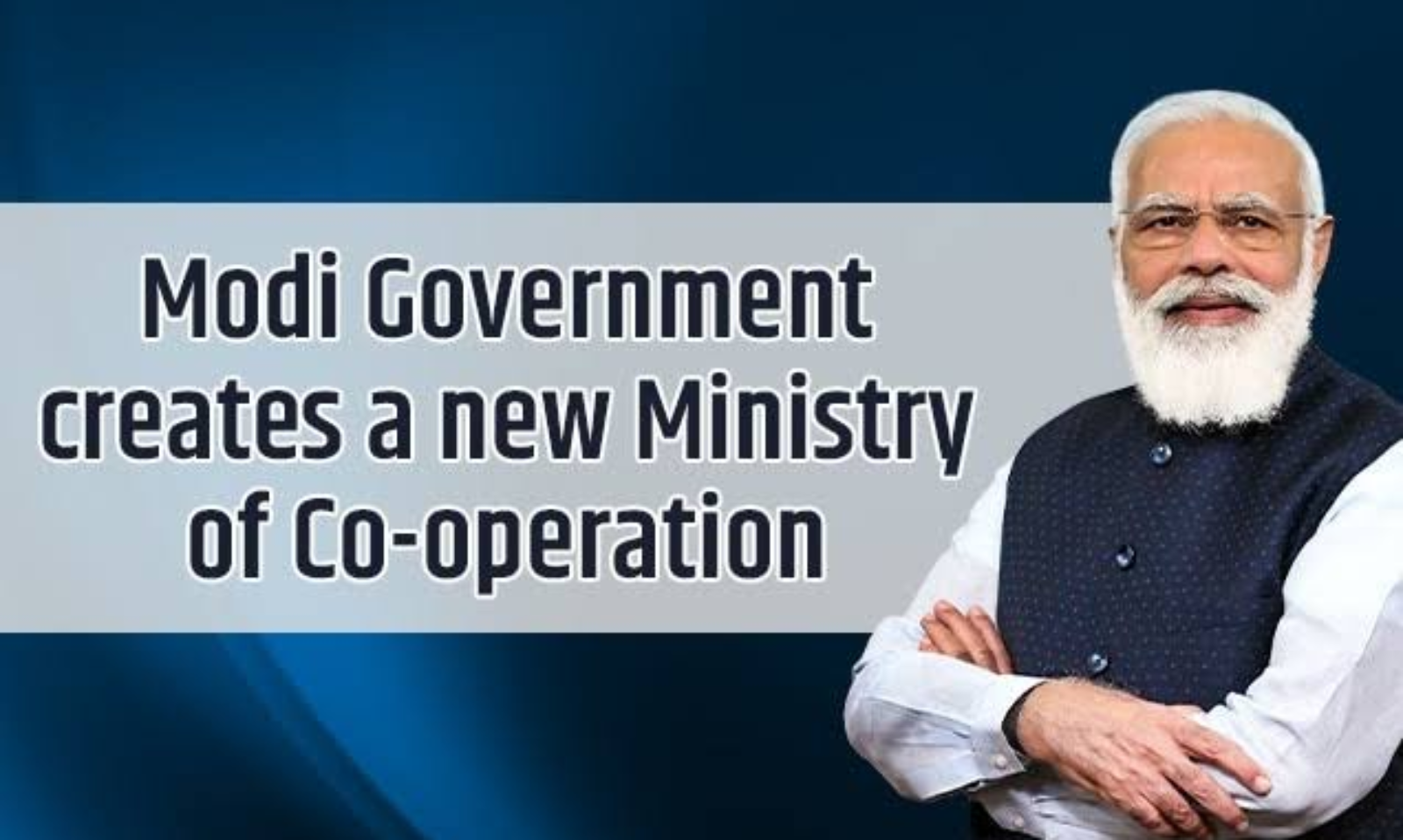
    In the recent reshuffle of the Cabinet on July 7, the government announced the formation of the Union Ministry of Cooperation. Cooperative was a subject under the ambit of the Ministry of Agriculture before the reshuffle. Amit Shah will be given charge of the Cooperation Ministry along with the Home Ministry. The ministry has been created to realise the central government’s goal of Sahkaar se Samriddhi. A separate ministry for it will rejuvenate this movement in India. It will provide a legal, policy and administrative framework to boost this movement.

    The cooperative movement is one of the most successful movements in Indian history, which reached the country’s grassroots. The based model on it of economic development fits perfectly in the Indian scenario. It is relevant because it provides everyone with a sense of ownership and responsibility. Since everyone owns the cooperative, everyone works to the best of their abilities. 

    The budget presented by the finance minister of India, Nirmala Sitharaman, highlighted the need to revive and strengthen cooperative societies. The formation of a separate ministry fulfils the budgetary goal. The centre has always believed in a community based developmental partnership model. The Ministry of Corporation will streamline the ease of doing business\’

    . It will provide necessary changes in the framework to expand itself into multiple states, also known as Multi-State Cooperatives (MSCS).
    What is a cooperative society?

    Cooperative

    According to International Labour Organisation (ILO), a corporative society is an autonomous association of people who voluntarily gather to achieve the aim of economic, social and cultural development. They enter into a jointly owned, democratic enterprise to run businesses.

    For example, if a company has paid-up capital of rupees hundred and it has 50 members, every person contributes two rupees to the company. Since everyone’s share is equal, there is no single owner. It harnesses the power of unity and collective working. In the Indian dynamics, cooperatives usually manifest in agriculture cooperatives, daily cooperatives, sugar mills, spinning mills, consumer cooperative society, producer, the society, credit cooperative society, housing society, marketing harmonious society, et cetera.

    Farmers pool their resources to process farm produce because the processed output is sold at a higher price than the raw material. India being an agricultural nation, pioneered one of the most significant cooperative movements in the history of the world. India has 1,94,195 cooperative dairy societies and 330 cooperative sugar mills. According to a report by National Dairy Development Board in 2020, the cooperatives procured around 1.80 crores litres of milk from 1.7 crore members and sold 3.7 crores litres of milk per day. Cooperative sugar mills produce 37% of the sugar.

    Farmer associations form PSCS or Primary Agricultural Credit Societies to provide credit to the farmers of their areas. PSCS predicts credit needs for the area and asks the district central cooperative banks DCCB for the same. State Cooperative Banks heads the DCCB. The unity of farmers of the area inculcates into increased bargaining power. Indian farmers also encompass landless labourers who rent farmland for agriculture. Commercial banks do not grant loans unless they are provided with substantial collateral.

    The absence of institutional credit leaves no option for the landless farmers but to approach the traditional money lenders or sahukar. The traditional moneylender charges a higher rate of interest and sometimes cheats the farmer resulting in slavery. Slavery as of now is abolished by the Indian constitution. Apart from the agricultural cooperatives, banking and finance cooperative institutions provide their services in rural and urban areas.

    What are the constitutional provisions related to it?
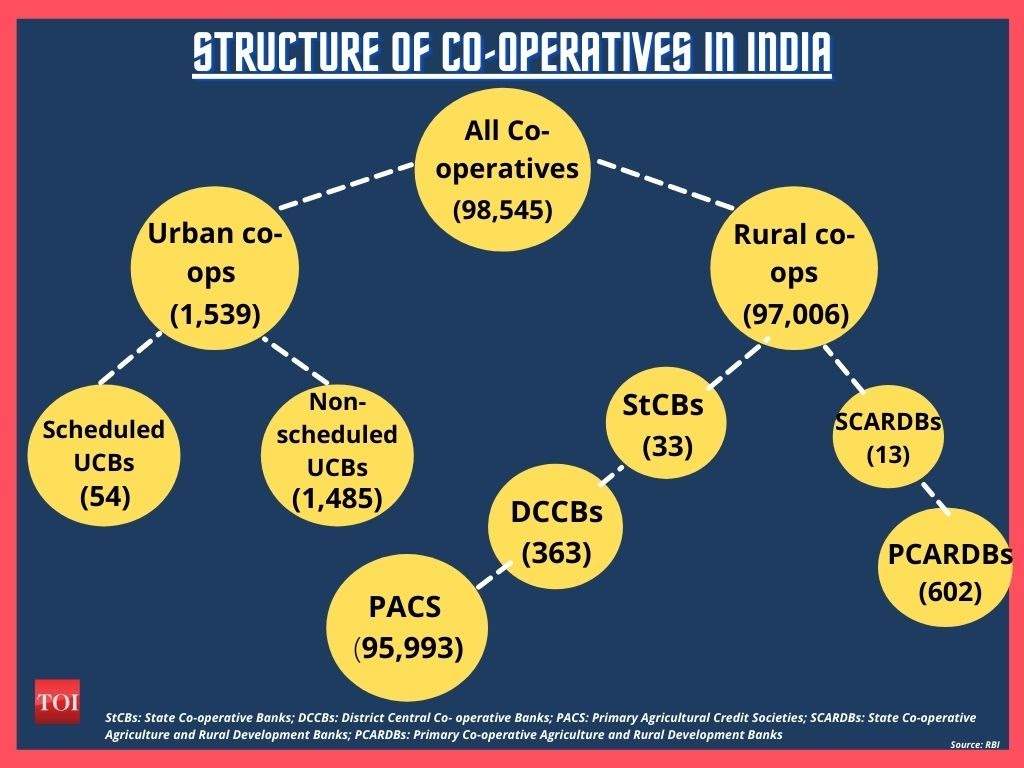
    Explained: Why did Modi government form a new cooperation ministry | India  News - Times of India

    Agriculture and cooperation are part of the concurrent list which means that both central and state governments can pass laws on this. According to the federal structure of the Constitution, if a conflict between central and state law arises, the law of the Centre prevails. The 97th amendment act of the Constitution added part IXB, which talks about the working of cooperatives in India.

    The word cooperatives were added after unions and associations in article 19(1)(c) under part three of the Constitution. This enables every Indian citizen to form a cooperative and makes it a fundamental right of the citizens. Article 43B was added in the Directive Principles of State Policy is DPSP, part four of the Constitution, to promote these societies.

    What is the significance of a cooperatives in India?

    The cooperative Society provides institutional credit to the agriculture sector. State and private sector banks have not been able to provide the sector with funds. By pooling resources, a group of farmers or businessmen can buy infrastructure which they cannot afford alone. It offers strategic input for the agriculture sector by overcoming constraints and creates a conducive atmosphere for development. It also provides cheap credit to cottage industries and small enterprises.

    Collective ownership and responsibilities minimise class conflict and other social ills. Examples of flourishing  Indian co-ops that have changed the lives of people are Shri Mahila Griha Udyog Lijjat Papad and AMUL Anand Milk Union Ltd. Lijjat Papad started by a group of seven women in Bombay in 1959 with ₹80. In 2021 it has a turnover of Rs.1600 crores and employs more than 45,000 women. The group‘s main aim is to empower women by providing them economic independence.

    Anand milk union Ltd is a dairy cooperative in Anand village of Gujarat. It was started in 1946 under the leadership of Sardar Vallabhbhai Patel and Tribhuvandas K Patel. Amul helped India achieve its aim of the white revolutionand is the worlds largest producer of milk and dairy products. Amul was formed to retaliate against the exploitation of the milkmen by the middlemen in the cities. All milk farmers came together, formed a co-op and started supplying milk directly to the Bombay Milk Scheme.

    Is there a need for a separate ministry for cooperatives?

    Yes, because only Maharashtra, Gujarat and Karnataka have a successful cooperative structure that helped people. A separate ministry is essential because agriculture demands a lot of attention and time. The separate Ministry’s sole focus would be on expanding movement in India.

    The ministry would procure necessary financial and legal power to reach every nook and corner of India. In the present system, co-op institutions get their equity from the Centre, and state governments act as guarantors to these institutions. This formula was successfully applicable only in few states like Maharashtra, Gujarat and Karnataka. Vaikunth Mehta Institute of Cooperative Management has conducted researches where they found out weaknesses in the this sector.

    The study pointed out poor implementation and lack of funds in certain states. Apart from this, the sector has always suffered because of the inadequate training of officers. People are ill-informed about the objectives, movements, rules and benefits of forming cooperative societies. These societies are marred by monetary influence as the wealthy farmers become chairman of the organisations. They run the organisation on their whims and wishes. They need a revolution in management tactics because huge membership hinders working.

    Why is Amit Shah chosen as the leader of the Ministry of Cooperation?
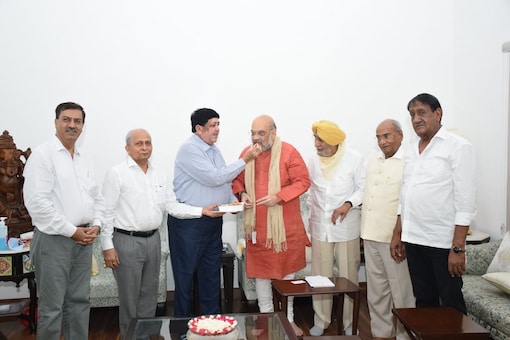
    He Means Business: Amit Shah In Action Ahead of Assuming Charge Of Ministry  Of Cooperation

    These institutions have given India multiple leaders; some of them left their footprints on the national level. Maharashtra legislature has around 150 legislators who trace their roots to these institutions. NCP chief Sharad Pawar and Deputy Chief Minister Ajit Pawar started their political journey from co-op elections. Amit Shah was head of the Ahmedabad District Central Cooperative Bank, Gujarat, for a long time. Shah knows his work in and out because he was once part of the machinery.



  • Petrol price takes a high-crosses Rs 100-mark in UP, Chhattisgarh, Nagaland

    Petrol price takes a high-crosses Rs 100-mark in UP, Chhattisgarh, Nagaland

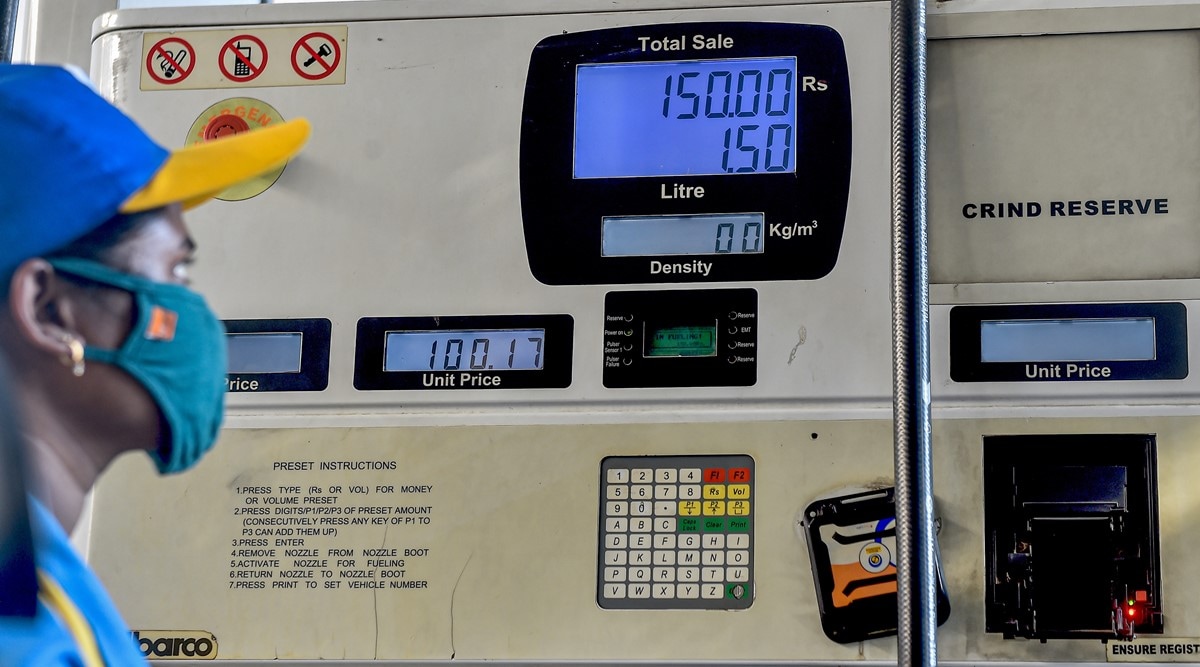
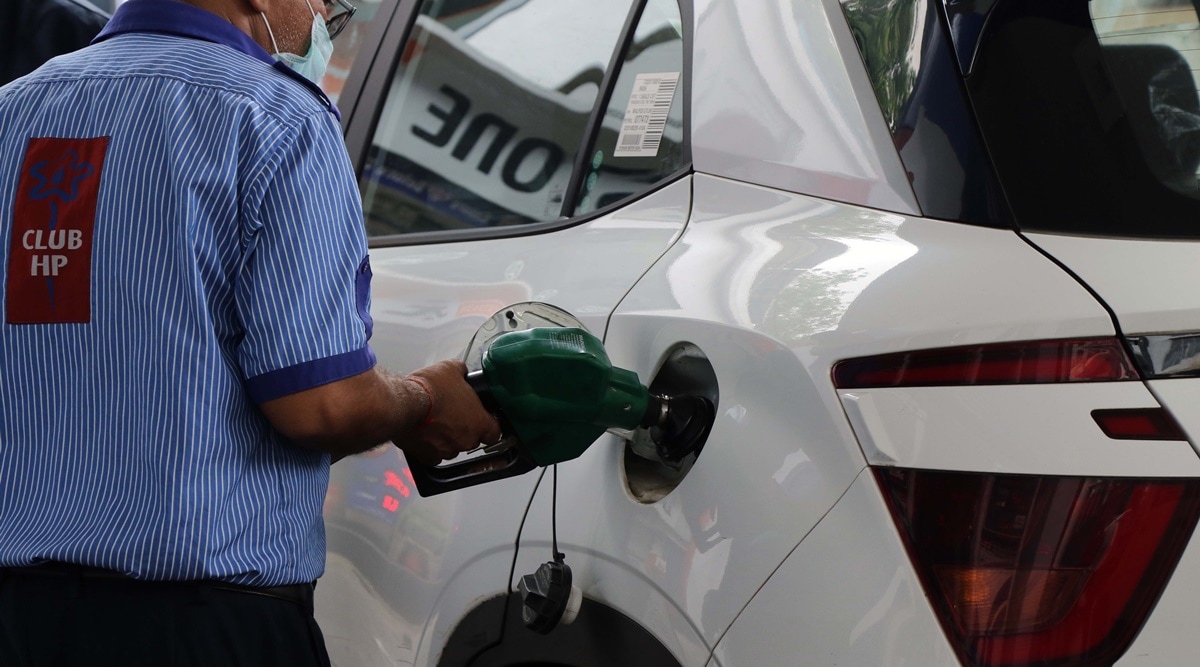
    Petrol price on Saturday crossed the Rs 100-per-litre mark in some places in Uttar Pradesh, Chhattisgarh and Nagaland after fuel prices were hiked yet again.

    Petrol price was hiked by 35 paise per litre and diesel by 26 paise, according to a price notification of state-owned fuel retailers.

    This took fuel prices across the country to a fresh high.

    In Delhi, petrol price rose to Rs 100.91 a litre and diesel to Rs 89.88 per litre.

    Petrol Prices In Different States

    Petrol and Diesel Prices Today (20 August 2021): Here are fuel prices in  Delhi, Mumbai, Kolkata, Chennai, Bengaluru, Hyderabad, check here

    The increase led to petrol price surge above Rs 100 per-litre- mark in Rampur district of Uttar Pradesh, Kanker, Jashpur and Narayanpur districts of Chhattisgarh and Kohima in Nagaland.

    The three states are in a growing list of places where the fuel is at over Rs 100-a-litre mark. States where petrol had reached those levels over the past few weeks are Rajasthan, Madhya Pradesh, Maharashtra, Andhra Pradesh, Telangana, Karnataka, Jammu and Kashmir, Odisha, Tamil Nadu, Kerala, Bihar, Punjab, Ladakh, Sikkim and Puducherry.

    Petrol prices increase after 2 months | Petrol prices increase after 2  months| Fuel prices

    Diesel, the most used fuel in the country, is above that level in some places in Rajasthan, Odisha and Madhya Pradesh.

    Earlier this week, Oil Minister Hardeep Singh Puri refused to comment on the issue unless he was fully briefed.

    “Give me some time. I need to be briefed on the issues,” he had said soon after taking charge of the ministry on July 8. “It will be very wrong for me to comment on it (fuel prices) when I have just stepped into this building.”

    Fuel prices differ from state to state depending on the incidence of local taxes such as value-added tax (VAT) and freight charges.

    Petrol and Diesel Prices Today (21 October 2021): Here are fuel prices in  Delhi, Mumbai, Kolkata, Chennai, Bengaluru, Hyderabad, check here

    As much as 55 per cent of the retail selling price of petrol in Delhi is made up of taxes (Rs 32.90 a litre excise duty collected by the central government and Rs 22.80 VAT levied by the state government).

    Half of the diesel price is made up of taxes (Rs 31.80 central excise and Rs 13.04 state VAT).

    The hike on Saturday is the 38th increase in the price of petrol since May 4, when state-owned oil firms ended a 18-day hiatus in rate revision they observed during assembly elections in states like West Bengal.

    In 38 hikes, the price of petrol has risen by Rs 10.51 per litre. During this period, diesel rates have soared by Rs 9.15 a litre in 36 instances of price rise.

  • India’s new fuel demand rebounds in June 2021

    India’s new fuel demand rebounds in June 2021

    India‘s fuel demand rebounded in June after slumping to a nine-month low in the previous month as restrictions to curb the spread of the pandemic were eased, helping economic activity and mobility to pick up.

    Fuel consumption rose 1.5 per cent to 16.33 million tonnes in June from a year earlier and by 8 per cent over May 2021, data from the Petroleum Planning and Analysis Cell (PPAC) of Ministry of Petroleum and Natural Gas showed.

    india

    Petrol sales rose 5.6 per cent year-on-year to 2.4 million tonnes in June. It was up 21 per cent from May sales of 1.99 million tonnes.

    Consumption in India

    Diesel – the most used fuel in the country – rose 12 per cent from May to 6.2 million tonnes, but was down 1.5 per cent from June 2020 and 18.8 per cent from June 2019.

    This is the first monthly increase since March.

    Fuel demand had recovered to near-normal levels in March before the onset of the second wave of COVID-19 infections led to the re-imposition of lockdowns in different states, stalling mobility and muting economic activity.

    Consumption in May slumped to its lowest since August last year amid lockdowns and restrictions in several states.

    india

    Fuel demand showed signs of resurgence in June after restrictions began to be eased and the economy gathered pace.

    With COVID case addition continuing to decline and vaccination pace picking up, state governments have continued to reopen, though some exceptions such as Maharashtra exist.

    The then Oil Minister Dharmendra Pradhan had last month stated that India’s fuel demand would recover to pre-pandemic levels by the end of 2021.

    “We are confident by the end of this calendar year we will be in a position to restore our original (pre-COVID) consumption behaviour,” Pradhan said.

    Consumption of LPG, the only fuel which showed growth even during the first lockdown because of free supplies by the government to the poor, rose 9.7 per cent year on year to 2.26 million tonnes. It was up 26.3 per cent over June 2019.

    india

    With airlines yet to resume full-scale operations because of travel restrictions around the globe, jet fuel sales at 2,58,000 tonnes was up 16.2 per cent year on year but 61.7 per cent lower than June of 2019.

    Naphtha sales dropped by about 3.1 per cent to 1.19 million tonnes while sale of bitumen – used for making roads, were down 32 per cent at 5,09,000 tonnes. Fuel oil consumption rose 1.9 per cent to 5,33,000 tonnes.

  • Hackers disrupt Iran’s rail service with fake delay messages

    Hackers disrupt Iran’s rail service with fake delay messages

    Iran’s railroad system came under cyberattack on Friday, a semi-official news agency reported, with hackers posting fake messages about train delays or cancellations on display boards at stations across the country.

    Disrupt in Iran’s rail service:

    Hackers disrupt Iran

    The hackers posted messages such as long delayed because of cyberattack” or canceled” on the boards. They also urged passengers to call for information, listing the phone number of the office of the country’s supreme leader, Ayatollah Ali Khamenei.

    The semiofficial Fars news agency reported that the hack led to unprecedented chaos at rail stations.No group took responsibility. Earlier in the day, Fars said trains across Iran had lost their electronic tracking system. It wasn’t immediately clear if that was also part of the cyberattack.

    Fars later removed its report and instead quoted the spokesman of the state railway company, Sadegh Sekri, as saying the disruption did not cause any problem for train services.In 2019, an error in the railway company’s computer servers caused multiple delays in train services.

    Hackers Disrupt Iran's Rail Service With Fake Delay Messages | Technology  News

    In December that year, the country’s telecommunications ministry said the country had defused a massive cyberattack on unspecified electronic infrastructure but provided no specifics on the purported attack.

    It was not clear if the reported attack caused any damage or disruptions in the country’s computer and internet systems, and whether it was the latest chapter in the U.S. and Iran’s cyber operations targeting the other.

    Iran disconnected much of its infrastructure from the internet after the Stuxnet computer virus widely believed to be a joint US-Israeli creation disrupted thousands of Iranian centrifuges in the country’s nuclear sites in the late 2000s.

    Hackers disrupt Iran's rail service with fake delay messages

  • Mother Dairy to hike new milk prices in Delhi-NCR by Rs 2 per liter from Sunday

    Mother Dairy to hike new milk prices in Delhi-NCR by Rs 2 per liter from Sunday

    Leading milk supplier Mother Dairy has increased milk prices in Delhi-NCR and other cities by Rs 2 per litre with effect from Sunday due to higher input costs.

    It had last raised the milk prices in December 2019.

    From July 1, Amul had hiked its milk prices by Rs 2 per litre.

    Mother Dairy to pilot home deliveries through Safal stores

    Mother Dairy said it is “compelled to raise its liquid milk prices by Rs 2/litre in Delhi-NCR with effect from July 11, 2021.”

    The new prices will be applicable for all milk variants.

    Update on Mother Dairy

    “The company has been experiencing inflationary pressure on the overall input costs which has increased multi-fold in the last one year, accompanied by the distress in milk production due to the ongoing pandemic,” the statement said.

    Home | motherdairy.com

    In the last one year, farm prices have increased to the tune of 8-10 per cent coupled with mounting operational costs of processing, packaging and logistics.

    “It is pertinent to note that the farm prices of milk alone have firmed up by about 4 per cent in the last three-four weeks. Despite paying higher prices towards milk procurement in the last one year, the consumer prices were kept intact. With this revision, the milk prices are undergoing a revision of 4 per cent,” Mother Dairy said.

    interview: Mother Dairy's 'Rishton Ka Swad Badhaey' campaign asserts new  brand positioning, Marketing & Advertising News, ET BrandEquity

    Mother Dairy sells more than 30 lakh litres of milk per day in Delhi-NCR.