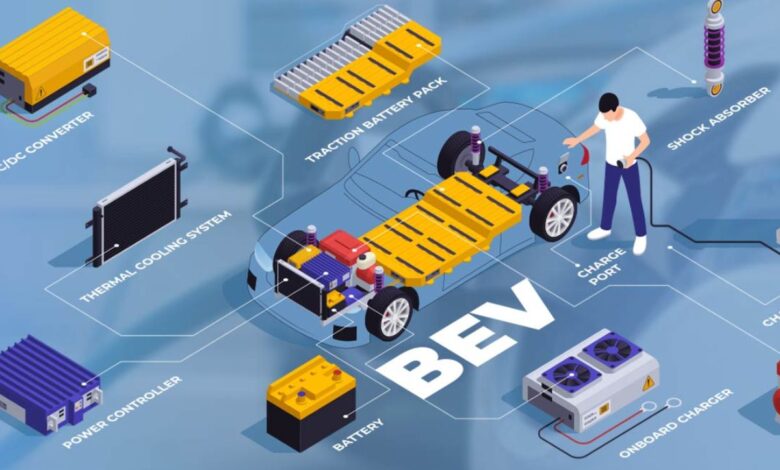
India’s electric vehicle revolution extends far beyond the assembly lines where finished cars and scooters roll out for customer delivery. Behind every electric vehicle lies a complex ecosystem of specialized components that work together to enable electric propulsion, efficient energy storage, intelligent power management, and safe operation.
As India rapidly scales its electric vehicle manufacturing capabilities with projected battery electric vehicle production reaching 377,000 units in 2025 and growing exponentially beyond, the demand for critical EV components has created exceptional opportunities for innovative startups developing the building blocks of electric mobility. These component manufacturers are tackling challenges ranging from battery thermal management in India’s extreme summer heat to developing cost-effective motor controllers that can handle unpredictable grid conditions common in many parts of the country.
The EV component sector in India faces unique challenges that distinguish it from more mature markets. Import dependence remains substantial, with approximately ninety percent of lithium-ion battery cells still sourced from China despite aggressive localization efforts. Capital expenditure requirements for manufacturing facilities are substantial, with battery pack assembly plants requiring investments ranging from INR 100 crores to several thousand crores depending on scale and vertical integration. Technology partnerships and licensing agreements with international firms are common as Indian companies work to build indigenous capabilities while learning from global best practices. Government support through Production Linked Incentive schemes provides crucial financial backing, though implementation has faced challenges with slow disbursements and strict qualification criteria.
The startups profiled in this article represent the most innovative and promising players building India’s EV component ecosystem in 2026. These companies are developing critical technologies including advanced Battery Management Systems that prevent thermal runaway, high-density lithium-ion battery packs optimized for Indian operating conditions, efficient electric motors that don’t rely on rare earth materials, intelligent power electronics for energy conversion, and integrated solutions that combine multiple components into cohesive systems.
Their success is essential not just for individual company growth but for India’s broader goal of achieving self-sufficiency in electric vehicle manufacturing while reducing dependence on imported components. As India works toward producing electric vehicles at the scale necessary to support its net-zero emissions targets by 2070, these component startups are building the technological foundation that will make mass electrification possible.
1. Ion Energy
Ion Energy stands as one of India’s most innovative battery technology companies, taking a distinctly software-first approach to improving battery performance and longevity. Founded in 2016, the Mumbai-based startup focuses on three core areas that collectively address the most critical challenges in electric vehicle battery systems. These areas include advanced Battery Management Systems that monitor and protect battery packs, battery data analytics platforms that extract insights from operational data, and battery intelligence software that optimizes charging strategies and predicts degradation. This comprehensive approach distinguishes Ion Energy from traditional hardware-focused battery companies by recognizing that intelligent software can dramatically improve the performance and lifespan of battery hardware.
The company’s flagship product, Edison Analytics, represents a breakthrough in battery intelligence by providing manufacturers and fleet operators with detailed insights into battery degradation patterns and root causes of performance issues. The platform analyzes data from thousands of battery packs in real-world operation, identifying factors that accelerate degradation and suggesting corrective measures that can extend battery life by significant margins.
For electric vehicle manufacturers and fleet operators, this capability translates directly into lower total cost of ownership and improved resale values, as batteries that are properly managed through their lifecycle retain more capacity and command higher prices in secondary markets. Ion Energy’s analytics have identified that proper thermal management and optimized charging strategies can improve battery lifespan by twenty to thirty percent compared to poorly managed batteries experiencing identical usage patterns.
Ion Energy has developed a Platform as a Service offering that allows companies to develop their own Battery Management Systems while dramatically reducing development costs and time to market. The electronic platform reduces BMS development costs by up to forty percent while shortening the journey from design phase to market-ready product to as little as three months, compared to typical development cycles of twelve to eighteen months for companies building BMS capabilities from scratch.
This democratization of BMS technology enables smaller EV manufacturers and new entrants to access sophisticated battery management without the massive research and development investments traditionally required. Ion Energy’s 2018 acquisition of French BMS company Freemens SAS brought European technical expertise and expanded the company’s capabilities in functional safety and advanced battery algorithms. In 2022, Ion Energy spun off its hardware division as Maxwell Energy Systems, which was subsequently acquired by Endurance Technologies for USD 40 million, validating the commercial value of Ion’s technical capabilities.
2. Cygni Energy
Cygni Energy has positioned itself as a next-generation energy storage company providing customized lithium-ion battery solutions designed specifically for India’s diverse transportation requirements and renewable energy integration needs. The Hyderabad-based company manufactures battery packs for electric two-wheelers, three-wheelers including electric rickshaws, and commercial vehicles, while also developing Battery Energy Storage Systems for grid applications and solar integration. This broad product portfolio reflects Cygni’s recognition that energy storage technology developed for electric vehicles can be adapted for stationary applications, creating economies of scale and diversified revenue streams that reduce dependence on any single market segment.
In April 2025, Cygni Energy made a significant statement about its growth ambitions by launching Phase One of its Battery Energy Storage System Gigafactory in Hyderabad’s E-Mobility Valley. Built on a five-acre campus with investment exceeding INR 100 crores, the facility boasts initial production capacity of 4.8 gigawatt-hours of high-capacity battery packs, positioning Cygni among India’s larger battery pack manufacturers. The gigafactory designation reflects the company’s commitment to achieving the scale necessary to drive down per-unit costs while maintaining quality and safety standards. The facility’s location in Hyderabad’s E-Mobility Valley provides strategic advantages including proximity to electric vehicle manufacturers, access to skilled technical workforce, and integration with the broader ecosystem of component suppliers developing around this emerging cluster.
Cygni’s battery packs are designed to handle India’s challenging operating conditions including extreme temperature variations, unpredictable grid power quality, and diverse duty cycles ranging from stop-and-go urban delivery to continuous highway operation. The company’s solar hybrid solutions enable integration of renewable energy with battery storage, addressing one of India’s key infrastructure challenges by providing reliable power in areas with unreliable grid connections. Cygni’s customizable Energy Storage Systems allow utilities and commercial facilities to optimize their energy usage patterns, storing electricity during off-peak hours when rates are lower and discharging during peak demand periods to reduce overall energy costs. This dual focus on mobility and stationary storage positions Cygni to capture value across multiple high-growth segments of India’s energy transition.

3. Battrixx
Battrixx, operating as the future technologies division of Kabra Extrusiontechnik Group, has established itself as one of India’s leading lithium-ion battery manufacturers with particular strength in the electric two-wheeler and three-wheeler segments. The company manufactures customized battery modules, battery packs, and integrated Battery Management Systems designed to deliver increased range, longer battery life, and enhanced safety for electric vehicle applications. Battrixx’s approach emphasizes creating complete battery solutions rather than just manufacturing cells or packs, recognizing that optimal performance requires tight integration between the physical battery pack, the electronic management system, and the vehicle’s powertrain.
In 2022, Battrixx achieved significant market validation by becoming the battery supplier for Hero Electric, one of India’s leading electric two-wheeler manufacturers. This partnership demonstrates Battrixx’s ability to meet the demanding requirements of high-volume vehicle production while maintaining the quality and reliability standards necessary for consumer products. The company earned distinction as one of the first battery manufacturers to receive certification from the Automotive Research Association of India under AIS 156 Amendment III Phase 2, the stringent safety standard governing lithium-ion batteries for electric vehicles in India. This certification process involves rigorous testing of thermal stability, mechanical integrity, electrical safety, and protection against abuse conditions, providing customers with confidence in battery safety and performance.
In January 2025, Battrixx undertook a strategic rebranding to Geon, standing for Green Energy On, signaling its evolution from a pure battery manufacturer to a broader green energy solutions provider. The company allocated INR 300 crores for expanding manufacturing capacity including a new facility in Chakan, Pune, demonstrating commitment to meeting growing market demand. This expansion reflects Battrixx’s confidence in India’s electric vehicle growth trajectory and its determination to capture increasing market share. The company’s focus on indigenous manufacturing helps reduce India’s dependence on imported battery packs while creating local employment and building domestic technical capabilities in this critical technology sector.
4. Grinntech
Grinntech has distinguished itself in India’s electric vehicle component sector through its focus on intelligent battery solutions and award-winning Battery Management Systems specifically designed for agricultural and light commercial applications. Founded by Nikhilesh Mishra and Puneet Jain, the company recognized early that electric mobility extends beyond urban passenger transportation to include agricultural equipment, where electrification offers significant advantages in terms of operating costs, maintenance requirements, and environmental impact. This agricultural focus represents a strategic differentiator as India works to electrify its vast farming sector where diesel-powered tractors and equipment currently dominate.
According to company announcements in 2021, Grinntech launched a large-scale battery manufacturing plant in India with capacity to produce 400 megawatt-hours per year of lithium-ion batteries suitable for farm tractors, light vehicles, electric two-wheelers, and three-wheelers. This substantial production capacity positions Grinntech to serve multiple market segments simultaneously, creating diversification that reduces dependence on any single application while building economies of scale in manufacturing. The company’s Battery Management Systems have earned industry recognition for their sophisticated algorithms that optimize battery performance across diverse duty cycles ranging from intermittent agricultural use to continuous urban delivery operations.
Grinntech’s intelligent battery solutions incorporate advanced thermal management algorithms particularly critical for Indian operating conditions where summer temperatures regularly exceed forty degrees Celsius. The company’s BMS can adjust charging rates and power delivery based on real-time temperature monitoring, preventing thermal runaway incidents that have plagued some lower-quality battery packs. For agricultural applications, Grinntech’s batteries are designed to handle the unique power profiles of farm equipment, which often experience sustained high-power draw during heavy field work followed by extended idle periods. This application-specific design philosophy ensures batteries deliver optimal performance in their intended use cases rather than attempting to create one-size-fits-all solutions that compromise performance across all applications.
5. Exicom Tele-Systems
Exicom Tele-Systems operates as a comprehensive energy solutions provider spanning three key business segments including telecommunications power systems, energy storage solutions, and green mobility infrastructure. This diversified approach allows Exicom to leverage common core technologies across multiple applications while reducing business risk through revenue diversification. The company manufactures lithium-ion battery packs and modules for all segments of electric vehicles from two-wheelers through commercial vehicles, while also producing EV charging infrastructure and energy storage systems for grid and renewable energy applications. Exicom’s integrated capabilities enable it to provide turnkey solutions where batteries, charging infrastructure, and energy management systems work together seamlessly.
Exicom has deployed more than 5,600 chargers across India through partnerships with oil marketing companies and other infrastructure providers, demonstrating execution capabilities at substantial scale. The company executed a notable 1,800-charger rollout in partnership with Bharat Petroleum Corporation Limited, one of India’s largest public sector oil companies transitioning into electric mobility infrastructure. These large-scale deployments provide Exicom with valuable operational data and field experience that inform product development and quality improvements. The company’s Battery Management Systems incorporate learnings from thousands of battery packs operating in real-world conditions across India’s diverse climate zones and duty cycles.
Exicom has also developed battery swapping systems that enable rapid battery exchange for commercial electric vehicles, addressing the time constraints faced by delivery fleets and commercial operators who cannot afford the downtime associated with charging. The company claims to have deployed more than 250 battery swapping stations promoting eco-friendly mobility and deliveries across Indian cities. Exicom’s emphasis on developing indigenous solutions while partnering with global technology providers for critical components allows it to balance cost competitiveness with technological sophistication. The company’s commitment to sustainable manufacturing practices and responsible disposal of electronic products reflects growing industry recognition that environmental benefits extend beyond vehicle operation to encompass the entire manufacturing and lifecycle management process.
6. Yuma Energy
Yuma Energy has carved out a distinctive position in India’s electric vehicle ecosystem by focusing on battery solutions specifically optimized for swappable applications serving two-wheelers and three-wheelers. The company manufactures lithium-ion batteries with integrated Battery Management Systems featuring what it describes as industry-leading safety characteristics through ultra-safe BMS designs and advanced protection algorithms. Yuma’s batteries incorporate liquid crystal display status screens on bulk chargers, providing operators with real-time visibility into charging progress and battery health. These features are particularly valuable for battery swapping operators who manage large fleets of batteries and need to ensure all batteries in circulation maintain safe operating parameters.
Yuma offers tiered warranty programs ranging from three years for two-wheeler and three-wheeler applications to seven years for medium and heavy commercial vehicles, demonstrating confidence in battery longevity and quality. The company’s batteries feature low self-discharge characteristics ensuring they retain charge during storage periods, while providing assured starting capability even after extended idle periods for internal combustion engine starter battery applications. For commercial operators, these reliability characteristics translate directly into reduced operational disruptions and lower total cost of ownership, as batteries that fail prematurely create expensive downtime and replacement costs.
In March 2025, Yuma Energy announced ambitious expansion plans targeting doubling of revenue by increasing daily battery swaps from 50,000 to 150,000 by the end of 2025. This aggressive growth trajectory reflects strong demand for battery swapping services particularly among commercial two-wheeler and three-wheeler operators who value the operational flexibility swapping provides. Yuma’s focus on the swapping segment positions it at the intersection of battery manufacturing and mobility services, creating opportunities to capture value through both battery sales and ongoing swap service revenues. As India’s battery swapping infrastructure expands toward the approximately 3,500 stations operating nationwide in early 2026, companies like Yuma providing batteries specifically designed for swapping applications will play increasingly important roles in the ecosystem.
7. Euclion Energy
Euclion Energy has established itself as a prominent lithium-ion battery supplier providing customized battery pack solutions for diverse applications spanning electric vehicles, renewable energy storage, uninterruptible power supplies, and industrial equipment. Founded in 2017 and headquartered in Delhi, the company focuses on creating tailored solutions that match specific customer requirements rather than offering standardized commodity products. This customization capability appeals particularly to original equipment manufacturers seeking differentiated battery solutions optimized for their particular vehicle designs and use cases, as well as industrial customers with specialized energy storage needs that off-the-shelf products cannot adequately address.
Euclion’s engineering capabilities enable it to work closely with customers from initial concept development through production, helping optimize battery pack design for factors including energy density, power delivery, thermal management, mechanical packaging, and cost targets. This collaborative approach helps customers avoid common pitfalls in battery integration while accelerating time to market for new electric vehicle models and energy storage products. The company’s experience across multiple application segments provides cross-pollination of ideas and technologies, where innovations developed for one market can be adapted for others. For example, thermal management solutions developed for high-power industrial applications can be adapted for commercial electric vehicles experiencing sustained heavy loads.

Euclion’s focus on quality and safety has earned it customer relationships with electric vehicle manufacturers, renewable energy developers, and industrial equipment suppliers seeking reliable energy storage partners. The company’s battery packs incorporate advanced Battery Management Systems that monitor cell-level voltages, temperatures, and state of charge to ensure safe operation across all conditions. As India’s electric vehicle market continues fragmenting into specialized niches including electric commercial vehicles, electric buses, and electric construction equipment, companies like Euclion providing customized battery solutions will find growing opportunities serving manufacturers who need batteries optimized for specific applications rather than generic solutions designed for mass-market passenger vehicles.
8. e-TRNL Energy
e-TRNL Energy represents an ambitious effort to address fundamental challenges in battery cell design and manufacturing processes that currently limit India’s ability to compete globally in battery production. The company is developing what it describes as a unique battery cell design coupled with completely fresh cell manufacturing process technology aimed at solving twin problems of battery safety and manufacturing scalability. e-TRNL’s cell design incorporates novel elements intended to reduce inherent cell heating, which the company identifies as the root cause of most battery life, reliability, and safety issues. By addressing heating at the cell design level rather than relying solely on external cooling systems, e-TRNL aims to create intrinsically safer batteries that are less prone to thermal runaway.
The company’s manufacturing process innovation focuses on dramatically reducing the capital expenditure required to establish and operate battery cell manufacturing facilities commonly known as gigafactories. Traditional lithium-ion cell manufacturing requires enormous upfront investments often exceeding several thousand crores for plants producing at commercially viable scales. e-TRNL’s process technology aims to lower these capital barriers while simultaneously improving manufacturing consistency and reliability, potentially democratizing access to cell production technology. If successful, this could enable smaller companies and new entrants to establish cell manufacturing operations that currently remain financially out of reach, helping accelerate India’s journey toward cell manufacturing self-sufficiency.
e-TRNL’s focus on fundamental innovation in cell design and manufacturing processes rather than incremental improvements to existing technology represents high-risk, high-reward strategy. Battery cell manufacturing involves extraordinarily complex electrochemistry and precision manufacturing processes where established players have decades of experience and massive scale advantages. However, if e-TRNL can successfully demonstrate cells that offer superior safety characteristics while being manufactured at lower capital cost, the potential market impact would be substantial.
India currently imports approximately ninety percent of its lithium-ion cells from China, creating supply chain vulnerabilities and preventing Indian battery pack manufacturers from capturing full value in the battery supply chain. Companies like e-TRNL working on indigenous cell technology represent critical efforts to build Indian capabilities at the most valuable and technically challenging tier of the battery value chain.
9. Batteryinc
Batteryinc has positioned itself as a fast-growing battery manufacturer known for innovative and scalable energy storage solutions spanning electric vehicles, renewable energy integration, and backup power systems. The company manufactures lithium-ion battery packs tailored for electric scooters, rickshaws, and commercial fleet vehicles, ensuring versatile market presence across multiple vehicle segments. Batteryinc’s emphasis on developing advanced Battery Management Systems that enhance performance and durability reflects industry recognition that intelligent electronics are as important as the battery cells themselves in determining overall system performance and longevity.
The company provides end-to-end solutions encompassing battery pack design, assembly, installation, and after-sales support, recognizing that customers value comprehensive service offerings rather than just hardware products. This full-service approach creates stronger customer relationships and recurring revenue opportunities through maintenance and support contracts, while also providing Batteryinc with valuable feedback on real-world battery performance that informs product development. The company’s focus on quality, safety, and efficiency has helped it build customer relationships with electric vehicle manufacturers and fleet operators who depend on reliable battery performance for their business operations.
Batteryinc has emphasized leveraging advanced materials and green manufacturing processes to make electric vehicle adoption more accessible and sustainable. The company’s commitment to environmental responsibility extends beyond just enabling electric vehicles to encompass how batteries themselves are manufactured, with attention to reducing water consumption, minimizing chemical waste, and optimizing energy use in production facilities. As Indian consumers and businesses become increasingly conscious of environmental credentials, battery manufacturers that can demonstrate genuine commitment to sustainable practices throughout their operations will likely gain competitive advantages in market perception and customer preference. Batteryinc’s positioning as an innovative, quality-focused battery solutions provider positions it to capture growing market share as India’s electric vehicle adoption accelerates across passenger and commercial segments.
10. Loom Solar
Loom Solar has built a distinctive market position by specializing in lithium-ion batteries and energy storage solutions specifically tailored for residential solar systems and backup power applications. While most EV component companies focus primarily on mobility applications, Loom Solar has recognized that the fundamental battery technology enabling electric vehicles can be adapted for stationary energy storage, addressing India’s substantial need for reliable backup power and renewable energy integration. The company’s products are increasingly popular in the residential renewable energy segment where homeowners and small businesses seek to maximize solar panel utilization through energy storage that captures excess generation for use during evening and nighttime hours.
Loom Solar has built significant competitive advantages through its online distribution model, which reduces distribution costs and enables direct customer relationships. The company’s digital-first approach provides customers with comprehensive product information, sizing calculators, and installation support through online channels, making solar battery storage more accessible to customers throughout India rather than just in major metropolitan centers served by traditional retail networks. This distribution innovation has helped Loom Solar achieve rapid growth while maintaining competitive pricing compared to competitors relying on conventional distribution channels with their associated middleman markups and inventory carrying costs.
The company’s battery systems range from smaller capacity units suitable for essential backup power to large-capacity installations capable of providing comprehensive home energy storage enabling near-complete energy independence when paired with sufficient solar generation capacity. Loom Solar’s pricing typically ranges from INR 80,000 to INR 150,000 and beyond depending on capacity and features, positioning its products as premium solutions for customers prioritizing reliability and performance.
As India’s residential solar market continues expanding driven by falling solar panel costs, rising grid electricity prices, and improving battery economics, companies like Loom Solar providing integrated energy storage solutions will capture growing market share. The company’s success demonstrates that battery technology developed for electric vehicles creates opportunities extending well beyond mobility into the broader energy storage market that is projected to see explosive growth as renewable energy deployment accelerates.
Building India’s EV Component Ecosystem
The ten startups profiled here represent just the visible tip of a much larger ecosystem of companies working to build India’s electric vehicle component manufacturing capabilities. These companies are tackling different aspects of the EV technology stack from battery cells through complete energy storage systems, from sophisticated Battery Management Systems through charging infrastructure and energy management platforms. Their collective efforts are gradually reducing India’s dependence on imported components while building indigenous technical capabilities that will be essential for long-term competitiveness in global electric vehicle markets.
Several critical trends are shaping the trajectory of India’s EV component sector in 2026 and beyond. Vertical integration is accelerating as successful battery pack manufacturers work backward into cell manufacturing to capture more value and reduce supply chain vulnerabilities. Technology partnerships between Indian startups and established global players are proliferating, bringing international expertise and intellectual property to India while providing global companies with access to India’s enormous and rapidly growing market. Government support through Production Linked Incentive schemes continues evolving, with ongoing debates about qualification criteria, disbursement timelines, and the balance between supporting domestic innovation versus incentivizing technology transfer from established international players.
Substantial challenges remain for India’s EV component startups as they work to build scale and capabilities. Import dependence particularly on battery cells from China creates supply chain vulnerabilities and limits value capture, as cells represent approximately sixty to seventy percent of battery pack costs. Capital intensity requires patient investors willing to fund long development cycles and expensive manufacturing facilities before achieving commercial viability. Technical complexity in areas like battery thermal management, power electronics, and motor design demands significant engineering expertise that remains scarce in India despite rapid capability building. Competition from established global component suppliers with decades of experience and massive economies of scale creates market entry barriers and pricing pressures.
However, the opportunities facing India’s EV component startups are equally substantial. India’s electric vehicle market is projected to grow at over forty-five percent compound annual growth rate through 2026 and beyond, creating enormous demand for all types of components. Government policies supporting domestic manufacturing through import duties, local content requirements, and financial incentives create protective barriers that give Indian companies time to build capabilities and scale.
India’s large engineering workforce and growing research capabilities in battery technology, power electronics, and materials science provide talent pools necessary for innovation and product development. As global automobile manufacturers increasingly view India as a critical manufacturing hub for both domestic consumption and export, they need reliable local component suppliers who can meet their quality, cost, and delivery requirements.

The success of India’s electric vehicle transition ultimately depends not just on assembly of finished vehicles but on building robust, competitive component manufacturing ecosystems that can support sustainable, profitable production at massive scale. The startups highlighted in this article are building the technological foundations that will enable India to achieve its ambitious electric mobility goals while creating high-value manufacturing jobs and reducing dependence on imported technology. Their journey from small startups to scaled manufacturers capable of supplying millions of vehicles annually will be neither quick nor easy, but the market opportunity and national strategic importance of success make the effort essential for India’s economic and environmental future.