The Great E20 Cover-Up: How SIAM Folded and the Government Chose Producers Over the Public

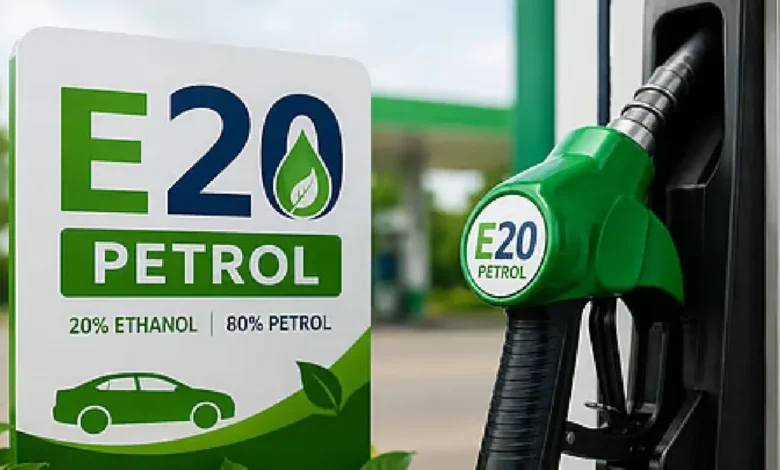
India’s automobile industry body SIAM wrote a clear, technical warning to the government. Within days it withdrew that warning. The sequence is not routine bureaucratic housekeeping. It is a case study in how institutional independence collapses when it collides with a politically protected policy.
The Letter That Was Written — and the One That Disappeared
On 28 July 2026 SIAM told the Petroleum Ministry that its members were seeing a “huge increase” in failures of fuel injectors, pumps, EGR valves and other components after E20 became the dominant fuel. Failed parts showed corrosion and wear linked to high chloride. Vehicle-tank samples reached 500 ppm; retail samples reached 350 ppm. Moisture levels were also far above safe limits, risking phase separation and immediate vehicle failure. The letter asked for mandatory chloride limits and real quality control.
Less than a week later, after the letter became public and the ministry pushed back, SIAM declared the same numbers needed “further authentication.” It withdrew the communication, praised existing measures, and reaffirmed full support for E20. No detailed public accounting was offered of why data serious enough to send to the Petroleum Secretary suddenly became too weak to stand by.
This is not how independent technical bodies behave. When an apex industry association first documents field failures and then, under political heat, declares its own data provisional, the reasonable inference is pressure. Whether that pressure was explicit administrative direction, informal messaging from the Road Transport Ministry, or the simple calculation that continued friction with a flagship programme would be costly, the outcome is the same: the technical alarm was silenced. Critics who call this institutional retreat under duress are describing the observable pattern. SIAM’s credibility as a guardian of engineering standards has been damaged by its own hand.
Why the Government Is Obsessed with a More Expensive Fuel
Ethanol is not cheaper than petrol at current crude prices. Oil marketing companies pay roughly ₹70–72 per litre for ethanol. The energy density is lower, so motorists burn more fuel for the same distance. Official estimates concede a 2–6 per cent mileage penalty; independent surveys of pre-2023 vehicles repeatedly show larger drops and rising reports of wear. Consumers have been denied meaningful choice of lower blends.
The government still forces the blend. The stated reasons — energy security, forex savings, farmer income — are real in aggregate. They are also incomplete. The programme transfers cost from the national oil-import bill onto individual vehicle owners through higher effective running costs and unresolved quality risks. It creates a guaranteed, administered-price market for ethanol producers while the middle-class motorist absorbs the energy penalty and the uncertainty about long-term component life. A policy that is more expensive on a pure cost basis, reduces mileage, and is imposed without alternative is not neutral. It is a deliberate choice to prioritise one set of interests over another.
Who Benefits
The most visible political champion of ethanol has been Road Transport Minister Nitin Gadkari. His family’s businesses operate in the sugar-ethanol ecosystem. Companies linked to his sons have recorded sharp revenue growth as blending targets accelerated. Gadkari insists the family’s share of national ethanol output is tiny (0.07 per cent or under 0.5 per cent) and that he has no role in pricing or tenders. Those statements may be factually accurate on scale. They do not erase the conflict-of-interest optics. When the minister most aggressively defending a policy has family entities participating in the market created by that policy, public scepticism is not conspiracy — it is basic political hygiene.
Beyond any single family, the broader ethanol complex — sugar mills, grain-based distilleries, and the political networks that have long surrounded the sugar sector in key states — has a structural interest in the mandate continuing and expanding. Administered prices, interest support for capacity expansion, and guaranteed offtake protect producers. Vehicle owners receive no equivalent protection.
Public Money, Private Costs, and the Absence of Care
The government runs on public resources and regulatory power. It has used both to construct a market that favours ethanol producers while shifting the measurable costs — lower mileage, higher maintenance risk, loss of fuel choice — onto ordinary citizens. Consumer surveys show large majorities of older-vehicle owners reporting significant mileage loss and elevated wear. Quality complaints about chloride and moisture were serious enough for SIAM to write a formal letter. The institutional response was withdrawal and reassurance rather than transparent, independent verification and remediation.
A government that is not worried about these outcomes is not merely prioritising long-term strategy. It is demonstrating that the immediate material experience of the public ranks lower than the political and industrial interests embedded in the programme. When technical warnings are walked back and consumer data is minimised, the message is clear: the programme will proceed, and the costs will be borne by those with the least power to resist.
Does the Prime Minister Care?
The ethanol acceleration happened under this government. The target was advanced and met early. The Prime Minister’s administration has treated the programme as a signature achievement of energy self-reliance and agricultural support. Continuing to enforce it in the face of documented consumer costs, unresolved quality questions, and an industry body’s rapid self-censorship is not evidence of personal indifference. It is evidence of a political calculation that the strategic narrative and the producer interests outweigh the grievances of motorists.
That calculation may be defensible on national-security grounds. It is not defensible as governance that places the public’s practical interests first. A government that truly cared about the citizens who buy the fuel and maintain the vehicles would have ordered independent, multi-lab verification of the chloride and moisture claims the moment SIAM raised them, restored lower-blend options for older vehicles, and published full cost-benefit data that includes the energy-density penalty and maintenance risks. None of that has happened at the scale required.
The SIAM letter and its disappearance are not a technical footnote. They are a revealing moment: an industry body briefly told the truth about problems it was seeing, then fell silent when that truth became inconvenient. The government has chosen to protect the policy rather than rigorously test it against the experience of the people who use it. The public is left paying more, driving less efficiently, and watching the institutions that should protect them fall into line. That is not energy security. It is policy capture dressed up as national interest.