Nirma University’s “Panvel” Controversy: When Academic Authority Turns Into a Collar-Grabbing Display of Power
A student made a flippant Bollywood remark. A senior professor called him onto the stage, grabbed his collar and issued a warning about going “to any extent”. Now an internal three-member committee has been constituted. But the real question is larger: when a university says it values student-centricity, dignity and grievance redressal, why did a moment of campus banter end up looking like a public demonstration of authority?

There is something deeply uncomfortable about what unfolded at Nirma University during Technofora 2026.
Not because a student interrupted a programme with a Bollywood dialogue. Not because a professor objected to being heckled. And not because universities should tolerate disruption.
The uncomfortable part is the apparent escalation.
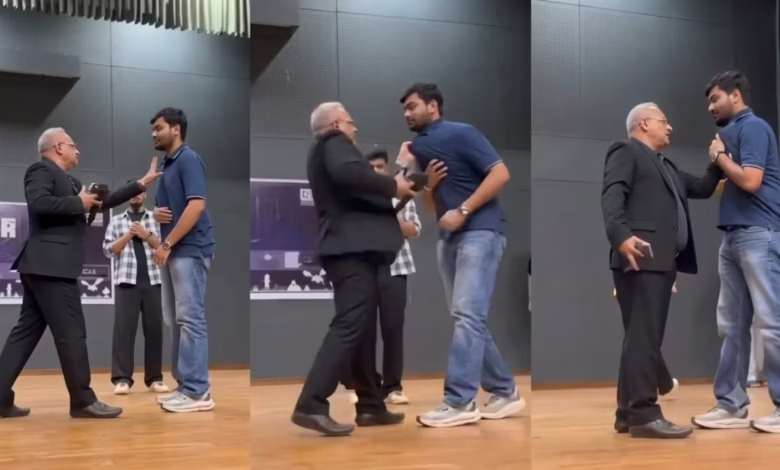
A student reportedly shouted a line associated with Golmaal 3: “Jaldi bol, kal subah Panvel nikalna hai.” What followed, according to a widely circulated video and multiple reports, was not simply a verbal reprimand. The student was called onto the stage, and footage appears to show Professor Himanshu K. Patel, Head of Nirma University’s Electronics and Instrumentation Engineering Department, taking hold of the student’s collar and warning him that he could go “to any extent” and that insulting faculty would have severe consequences.
That is the moment this stopped being merely a question of student etiquette and became a question of institutional power.
And that question deserves considerably more than a three-day news cycle, a protest, an apology and a committee whose composition has not publicly been detailed.
The setting makes the episode even more jarring
The confrontation occurred during Technofora’26, the flagship annual technical event of the ISA Students’ Chapter at Nirma University’s Institute of Technology.
Nirma’s own website says the event was held from 18 to 20 September 2026, under the guidance of Dr Himanshu K. Patel, Head of the Department of Electronics and Instrumentation Engineering and Faculty Advisor of ISA, along with Prof. Sneh Soni. The university says the three-day event recorded an overall footfall of more than 800 participants and featured technical competitions, workshops, interactive activities and a cultural evening.
In other words, this was not an obscure quarrel in a deserted corridor.
It was a university event, involving hundreds of participants, staged before a public audience and associated with a senior academic who, according to the university itself, was one of the principal faculty figures guiding the event.
That distinction matters.
A teacher correcting a student privately is one thing.
A senior academic summoning a student before an audience and physically taking hold of his collar is an entirely different institutional spectacle.
What the video appears to show
Multiple independent news organisations have described the footage in substantially similar terms.
India Today reported that the video appears to show Dr Himanshu K. Patel calling the student onto the stage and seizing him by the collar. The report also says the footage captures Patel warning the student that he could “go up to any extent” and that insulting faculty members could have serious consequences.
The Times of India similarly reported that the professor was seen grabbing the student’s collar and was heard saying:
“I can go to any extent. The day you dare to insult any faculty member of the Nirma University campus, you are gone forever.”
PTI, carried by Moneycontrol, independently reported the same central facts: the student was called onto the stage, the video purportedly shows the professor grabbing his collar, and the professor is heard issuing the same warning.
That consistency across reports is significant.
It does not, however, prove every allegation circulating on social media.
And that distinction is essential to responsible investigative journalism.
The “Panvel” line needs context—but context is not a blank cheque
The student’s reported remark was:
“Jaldi bol, kal subah Panvel nikalna hai.”
Reports identify it as a line associated with the Hindi film Golmaal 3. The incident is generally described as having occurred while comedian Rajat Sood was performing during Technofora.
The professor’s defenders can legitimately argue that a student should not disrupt a programme or publicly disrespect a faculty member.
That is a reasonable disciplinary question.
But there is an enormous gap between:
“This student behaved improperly.”
and
“Therefore a senior professor should physically take hold of the student in front of an audience.”
Those propositions cannot simply be merged.
A student’s bad behaviour does not automatically extinguish a teacher’s obligation to exercise restraint.
Indeed, that is precisely why institutions have rules.
Nirma University itself says students are central stakeholders
Here is where the controversy becomes particularly awkward for the institution.
Nirma University’s Institute of Technology publicly states:
“The students are the main stakeholder of the university.”
It further says that student growth and development are among the university’s top priorities and that grievances are taken seriously through an elaborate grievance-redressal system operating at department, institute and university levels.
The university’s own published student information booklet goes even further. Its stated philosophy of student conduct refers to a “conducive learning environment”, the “spirit of inquiry”, reform, harmony, inclusiveness and student centricity, alongside a value-based academic and administrative system.
Those are not insignificant words.
They are institutional commitments.
And institutional commitments are tested not when everything is pleasant, but when tempers rise.
A university does not demonstrate student-centricity by printing the phrase in a handbook.
It demonstrates it when a student is difficult.
It demonstrates it when a student is disrespectful.
It demonstrates it when a student makes a foolish joke.
And it especially demonstrates it when a powerful member of the institution is angry.
That is the uncomfortable test presented by this episode.
Nirma has a grievance mechanism. So why was the stage apparently turned into the courtroom?
Nirma’s published procedures provide an online student grievance mechanism. The university states that an aggrieved student can submit a complaint, which is referred to the appropriate Student Grievance Redressal Committee. Its published procedure provides for hearings and says an aggrieved student can appear personally or through a representative.
The university’s 2025 Student Information Booklet records a Student Grievance Redressal Committee consisting of:
- one Professor as Chairperson;
- four professors/senior faculty members as members;
- one student representative as special invitee.
The same document says the SGRC is to follow the principles of natural justice, and provides for an appeal to an Ombudsperson within 15 days of the SGRC decision. It also records the appointment of a university Ombudsperson.
The UGC’s 2023 Student Grievance Redressal Regulations similarly provide for institutional grievance committees, natural justice, a report preferably within 15 working days, and an appeal to an Ombudsperson within 15 days.
So there is no mystery about the institutional principle:
complaint → inquiry → hearing → reasoned decision.
Not:
anger → stage → collar → warning.
That is the central governance question.
And this is where the “discipline” argument starts to look dangerously convenient
Universities have every right to insist upon discipline.
But discipline is not synonymous with domination.
The published Nirma student code itself says that student conduct must be addressed through “just, fair and reasonable procedures” and that disciplinary procedures should be consistent with law.
The university’s rules classify some student misconduct as major misconduct, including involvement in violence.
That is revealing.
The institution has created a formal architecture precisely because allegations of misconduct are supposed to be evaluated through procedures rather than personal retaliation.
Of course, those particular provisions are expressly framed as a student code of conduct; they should not be misrepresented as a disciplinary code governing faculty members.
But the underlying institutional principle remains obvious:
a university expects conduct to be governed by rules, not by whoever happens to have the microphone.
The professor is not an anonymous junior employee
This is not a case involving an obscure person whose position within the institution is unclear.
Nirma’s own faculty page identifies Himanshu Patel as Professor and Head of Department.
His official university profile says he has:
- a PhD;
- more than 30 years of experience across academia, research and industry;
- been associated with the department since January 2000;
- six books published;
- more than 28 research papers in international refereed journals;
- more than 30 international conference papers;
- five PhD students under his guidance;
- and several International Society of Automation awards.
The department also publicly identifies him as a faculty adviser and Head of Department.
That professional record should not be used to prejudice an inquiry.
But it does make one fact impossible to ignore:
this was a senior academic exercising authority over a student.
The greater the institutional authority, the greater the obligation to use that authority responsibly.
The most troubling words may not be the collar grab
The visual image is what made the story viral.
But the language deserves equal scrutiny.
The statement reported in the video—
“I can go to any extent.”
—followed by a warning that insulting faculty members would result in the student being “gone forever,” is considerably more than a simple request for silence.
It is particularly significant because the person allegedly making the statement was not another student.
He was a professor and department head.
The power equation was fundamentally unequal.
A student can walk away from an argument with another student.
A student cannot casually walk away from a professor who may have institutional influence over academic life.
That is precisely why threats involving academic consequences require particularly careful scrutiny.
But one viral allegation must not be quietly converted into an established fact
There is one claim circulating in the controversy that deserves careful qualification.
ABVP city general secretary Priyam Bhatia told India Today that the professor threatened the student with failure in examinations, saying the student would not be able to do anything there and would fail him in all exams.
That is an allegation made by ABVP.
It should not be written as an established fact unless independently corroborated.
The available video, as described by multiple reports, clearly captures the collar-grabbing and warning. But the short circulating clip does not necessarily establish the complete conversation before or after the visible portion. India Today expressly cautioned that the precise circumstances leading up to the confrontation could not be independently established from the footage alone.
That distinction matters.
Investigative journalism is strongest when it does not exaggerate evidence.
The proven part is already serious enough.
There is no need to manufacture additional certainty.
The professor’s defence: the video does not tell the whole story
Professor Patel reportedly told ThePrint that the viral clip did not show the complete context.
According to reporting that cites that interview, he said he was upset by the student’s remark, called him onto the stage, and said the matter had subsequently been resolved. The report states that he acknowledged his own behaviour and apologised.
The professor’s reported position therefore provides an important counterweight to a purely one-sided narrative.
The student apparently apologised.
The professor apparently apologised as well.
And that is relevant.
But it does not erase the questions raised by the footage.
An apology after a confrontation does not answer whether the confrontation itself was appropriate.
It does not answer whether the student felt compelled to apologise because of the unequal power dynamic.
It does not establish whether an institutional process was followed.
And it does not explain why a disciplinary disagreement apparently reached the point of physical contact.
“Matter resolved” is not the same thing as “questions resolved”
This is perhaps the most important distinction in the entire controversy.
The Times of India reported on September 25 that the university had initially not responded to requests for comment.
Later, the situation changed dramatically.
India Today reported on September 25 that ABVP protested at the university, after which the university constituted a committee of three senior directors/professors to investigate the incident. Vice-Chancellor Dr R.N. Patel, according to that report, said the committee was expected to submit its report in approximately three to four days, after which action would be considered under university rules. The university had also spoken to the student, professor and the student’s parents.
That is a significant institutional development.
It means the matter apparently was not treated as permanently closed simply because the parties apologised.
And rightly so.
Because a university’s responsibility is larger than the personal reconciliation of two individuals.
The institution must also determine whether its standards were followed.
The three-member panel is a beginning—not the end
The university says it has constituted a three-member inquiry committee.
That is a positive procedural development in the narrow sense that the controversy is now formally being examined.
But one question should not disappear:
How independent is the inquiry?
India Today’s report identifies the committee only as three senior directors/professors.
The public reporting examined here does not disclose their names, their exact terms of reference, whether any member is from outside the concerned academic chain, whether the committee has access to the complete unedited recording, whether all witnesses will be interviewed, or whether the student’s written statement has been recorded independently.
Those details matter.
A serious inquiry should not merely answer:
“Did the professor grab the student’s collar?”
That is visible in the footage.
A serious inquiry should answer:
What happened before the recording began?
What exactly was said?
Why was the student brought onto the stage?
What happened physically?
Were academic consequences threatened?
Were there witnesses who can independently corroborate them?
Was there any injury or physical distress?
Was the student pressured into an apology?
Was the professor acting under any institutional protocol?
What university rule governed the incident?
Was the student offered a formal grievance channel?
Were all relevant CCTV recordings preserved?
Were mobile videos and other recordings secured before social-media circulation altered the evidence landscape?
And finally:
What safeguards will prevent a repetition?
Anything less risks becoming an exercise in administrative closure rather than institutional accountability.
There is another obvious question: why does the university’s public record matter here?
Nirma’s 2025 booklet makes repeated reference to student welfare, grievance redressal, natural justice, counselling and institutional systems.
The university’s grievance page tells students their complaints are taken seriously.
That makes this incident a test of whether those published systems are merely procedural infrastructure or whether they are actually used when the alleged wrongdoer is a senior member of faculty.
That is not an accusation that Nirma’s system is defective.
It is an accountability question.
And universities should welcome such questions.
There is even a potential legal dimension—but journalists should not play judge
The Bharatiya Nyaya Sanhita, 2023 contains provisions concerning assault and criminal force.
Section 129 defines “criminal force” in circumstances where force is intentionally used without consent with the requisite intention or knowledge of causing injury, fear or annoyance. Section 130 addresses assault; Section 131 provides punishment for assault or criminal force otherwise than on grave and sudden provocation; and Section 133 addresses assault or criminal force with intent to dishonour a person, subject to the statutory conditions.
But it would be irresponsible to announce from a viral clip that any particular criminal offence has definitely occurred.
Whether any provision applies depends upon the complete facts, intention, circumstances, evidence and the legal assessment of competent authorities.
That is exactly why an institution should preserve evidence instead of allowing the controversy to collapse into two competing social-media narratives.
The irony is almost impossible to miss
This was a technical festival.
The university’s own description highlights problem-solving, programming, robotics, engineering design and control systems among the activities at Technofora’26.
What an irony, then, that an event devoted to control systems produced a controversy over the apparent failure of human control.
The students came to a technical festival to learn engineering.
The internet received a lesson in something else:
what happens when institutional authority loses its composure in public.
That irony writes its own headline.
Nirma’s students are capable of remarkable things. They deserve an environment worthy of them.
The Electronics and Instrumentation Engineering department’s own records showcase substantial student achievements.
In 2026, one department team finished second among 200 teams in the Open Automation Challenge. Another Nirma team secured the Overall Second Prize at the 2026 Singapore Autonomous Underwater Vehicle Challenge after more than 180 teams registered globally and 31 finalists competed at the venue.
In 2024, the Nirma Robocon team won the national championship after competing against 86 teams and later represented India internationally.
These are exactly the kinds of achievements a university should be talking about.
Young engineers solving difficult problems.
Students competing internationally.
Students building robots.
Students designing systems.
Students being taught to think.
Not students becoming viral because a professor’s hand ended up on a collar during a comedy programme.
That contrast is what makes the episode particularly damaging to the image of a modern educational institution.
The real educational lesson here is not about obedience
There are two crude versions of campus discipline.
The first says:
Students can do whatever they like.
That is untenable.
The second says:
Faculty authority must never be questioned.
That is equally dangerous.
A university exists somewhere between those extremes.
Students need to learn respect.
Teachers need to demonstrate restraint.
Students can be corrected.
Teachers can be challenged.
Rules can be enforced.
But the enforcement must itself remain governed by rules.
Otherwise the institution is teaching a peculiar lesson:
authority is strongest when it does not have to explain itself.
That is not education.
That is hierarchy.
And the “Gen Z” explanation is not enough
NSUI Gujarat vice-president Vedant Tomar said the atmosphere was one of fun and described the student’s conduct as part of a joking environment, while maintaining that it did not warrant grabbing him by the collar.
That interpretation is contested.
But there is an important point underneath it.
Student culture has changed.
Young people use memes, movie dialogues, sarcasm and informal language constantly.
That does not mean every joke is acceptable.
But it does mean educators increasingly need to distinguish between:
insubordination,
disruption,
bad manners,
genuine threats,
and
ordinary adolescent irreverence.
The response cannot automatically be maximum authority.
Because once the professor is physically confronting a student on stage, the disciplinary message may become distorted.
Instead of:
“Respect the institution,”
the student may hear:
“Do not challenge the person who has power over you.”
Those are profoundly different lessons.
What the university should now establish—publicly and factually
The inquiry should not become a ceremony in which everyone apologises, shakes hands and the file disappears.
At minimum, the university should establish the factual record.
It should determine whether the complete event recording exists; identify and interview independent witnesses; establish exactly what the student said; establish exactly what the professor said; determine whether the student was physically restrained and for how long; determine whether any academic threat was actually made; establish whether any injury or distress was caused; and clarify whether the university’s existing grievance and disciplinary procedures were followed.
It should also publish, subject to legitimate privacy protections, the broad findings and the institutional action that follows.
Nirma’s own grievance framework emphasises due process and natural justice.
The institution should therefore resist two temptations:
whitewashing the incident because the professor apologised,
and
punishing anyone merely because social media is angry.
Evidence should decide.
The university also needs to answer an uncomfortable reputational question
Nirma University has worked for decades to build an image around engineering, research, innovation and academic achievement. Its own institutional pages highlight student accomplishments, technical competitions, international participation and faculty achievements.
Yet today, a senior faculty member is internationally visible for an entirely different reason.
Not a research paper.
Not a patent.
Not a robotics victory.
Not an international academic award.
A viral video of a student being grabbed by the collar.
Reputation can take years to build and a few seconds of video to damage.
The university cannot control what social media publishes.
It can control what it does next.
The apology should not become an institutional escape hatch
According to reports citing ThePrint, Patel said the students apologised and that he also apologised for his own behaviour.
That is better than refusing responsibility.
But an apology is not an inquiry.
An apology is not a policy review.
An apology is not an explanation.
An apology is not evidence.
And an apology cannot answer a governance question.
The university’s duty is to determine whether the conduct was consistent with its standards and what safeguards are necessary going forward.
Perhaps the most revealing fact is what happened after the video went viral
The chronology itself tells a story.
First came the confrontation.
Then came the video.
Then came public outrage.
Then came demands for an inquiry.
Then student organisations entered the picture.
And only after protests did the university announce the three-member committee publicly, according to India Today’s September 25 report.
That chronology naturally raises another institutional question:
Would the same investigation have been initiated had there been no video?
We do not have enough evidence to answer that.
And therefore it should be posed as a question, not an accusation.
But it is exactly the kind of question that a credible university administration should be willing to answer.
This is no longer just about one professor and one student
The controversy has become a test case for something much bigger.
How much authority should a teacher exercise?
How should an institution respond when a student is disruptive?
When does discipline become humiliation?
When does verbal correction become intimidation?
When does physical contact become unacceptable?
When is an apology sufficient?
When does an institution have a duty to undertake a formal inquiry even after the people involved say the matter is settled?
These are not trivial campus questions.
They are questions about the culture universities create.
Nirma now has a chance to demonstrate what “student centricity” actually means
The university’s own words provide the benchmark.
Its published materials talk about a conducive learning environment, inquiry, harmony, inclusiveness, student centricity, just and reasonable procedures and grievance redressal.
The incident provides the real-world test.
A student made a joke.
A professor became angry.
A public confrontation followed.
A video emerged.
The country watched.
Now the university has three senior people investigating it.
There should be no rush to condemn the professor beyond what the evidence establishes.
There should equally be no rush to minimise what the evidence visibly shows.
The middle ground is not silence.
The middle ground is evidence-based accountability.
The final question: what exactly is Nirma teaching?
The answer cannot be:
“Respect faculty because faculty can go to any extent.”
That would be a disastrous educational message.
The better lesson is much harder.
A student can be wrong and still deserve dignity.
A professor can be provoked and still be expected to exercise restraint.
Rules can be enforced without humiliation.
Authority can exist without intimidation.
And a university can discipline misconduct without turning its stage into a theatre of power.
That is the standard the inquiry should examine.
Because the embarrassing part of this story is not that a student quoted a Golmaal dialogue.
The embarrassing part is that a university event devoted to technology, innovation and student development ended up producing a viral image of academic authority expressed through a student’s collar.
A joke may have started the confrontation. The institution’s response is what turned it into a national story.
And now Nirma University has a very simple choice: treat the episode as an embarrassing viral video that should quietly disappear—or treat it as an opportunity to demonstrate that its published commitments to student dignity, natural justice and grievance redressal actually mean something when the person under scrutiny is a senior member of its own faculty.
The three-member committee has the floor.
The students are watching.
The parents are watching.
And, thanks to the camera, the entire country is watching.
Investigative fact box
| Issue | Verified position as of 25 Sept 2026 |
|---|---|
| Event | Technofora’26 |
| Event dates | 18–20 September 2026 |
| Venue | Institute of Technology, Nirma University, Ahmedabad |
| Attendance/footfall | More than 800 participants |
| Faculty identified in reports | Dr Himanshu K. Patel, Professor & Head, Electronics & Instrumentation Engineering |
| Event guidance | Nirma identifies Dr Patel as Head and ISA Faculty Advisor for Technofora’26 |
| Student remark | Reported “Jaldi bol, kal subah Panvel nikalna hai” |
| Video evidence | Multiple outlets report footage appearing to show the professor grabbing the student’s collar |
| Warning captured in reports | Professor heard saying he could go “to any extent” and warning against insulting faculty |
| Student-group response | NSUI sought apology/inquiry; ABVP later protested and demanded action |
| University response | Three-member committee constituted; report expected in roughly 3–4 days according to India Today |
| Professor’s reported position | He said the clip lacked full context and reported that he apologised after the incident |
| Nirma grievance framework | University maintains Student Grievance Redressal Committees and an Ombudsperson; published process incorporates natural justice |
| Important evidentiary caveat | The short viral video does not necessarily establish the entire sequence or every allegation surrounding the confrontation |
Editorial conclusion
The student’s conduct, if accurately reported, can be examined under campus rules.
The professor’s conduct, because it involved a senior authority figure and apparent physical contact with a student in a public university setting, also warrants examination.
One wrongdoing should not be used to erase scrutiny of the other.
That is the test of an actual inquiry—and the test Nirma University now has to pass.