Subhash Chandra’s ₹22,000 Crore Debt Puzzle: ₹59,000 Crore Net Worth, ₹31.79 Crore Assets And A ₹6.25 Crore Settlement
How does a businessman once presented as being worth ₹59,113 crore end up declaring ₹31.79 crore while creditors claim ₹22,006.57 crore - and an NCLT plan offers them just ₹6.25 crore? With a ₹1,260-crore property now under scrutiny and a CBI case underway, Subhash Chandra’s numbers demand answers.

There are now too many numbers in the Subhash Chandra story that do not sit comfortably together.
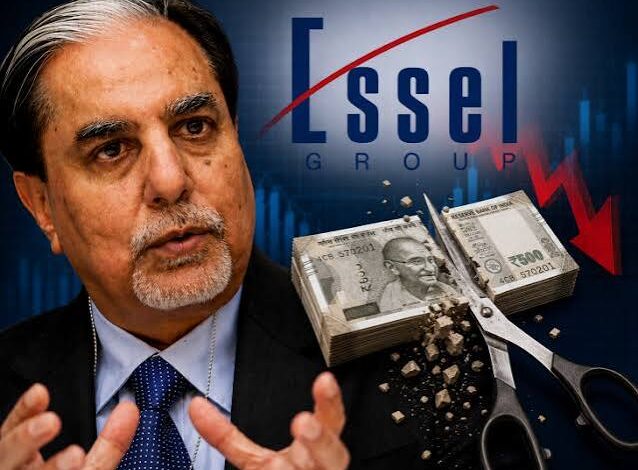
A businessman whose net worth was certified at ₹59,113 crore in March 2017 would, years later, enter personal insolvency proceedings declaring assets of barely ₹31.79 crore. Against him, creditors would lodge claims of ₹22,006.57 crore. And an initial repayment plan approved by the NCLT would offer those creditors just ₹6.25 crore.
Now the CBI has booked Chandra over allegations linked to ₹980 crore in loans from LIC Housing Finance, while creditors are separately questioning how his assets were disclosed and valued. At the centre of it all is a question that is becoming harder to avoid: what happened to the wealth that once stood behind the guarantees and financial representations made to lenders?
The ₹59,113-Crore Man
The story goes back to 2018, when LIC Housing Finance sanctioned two facilities totalling ₹980 crore to companies associated with the Essel group.
The first was a ₹500-crore facility extended to Vasant Sagar Properties, with Pan India Infraprojects as co-borrower. The second, worth ₹480 crore, went to Digital Subscriber Management and Consultancy Services, with Spirit Infrapower and Multiventures as co-borrower.
Subhash Chandra stood behind both transactions as personal guarantor.
For a lender taking such a guarantee, the guarantor’s financial strength is not a footnote. It is part of the credit assessment. And according to the CBI case arising from LIC Housing Finance’s complaint, that assessment was backed by financial documents that placed Chandra’s wealth at extraordinary levels.
One certificate put his net worth at ₹59,113.21 crore as of March 31, 2017. Another certificate issued in July 2018 put it at ₹40,562 crore.
Those figures matter today because the same man would later present a dramatically different picture of his finances during personal insolvency proceedings.
LIC Housing Finance’s two facilities eventually ran into trouble. The original ₹980 crore of lending is therefore not the same thing as the roughly ₹1,322.39 crore claim that the lender ultimately lodged in Chandra’s insolvency proceedings; the latter reflects the dues that had accumulated on the facilities.
The CBI’s case goes further than a simple default.
According to the complaint, the lender alleges that Chandra, along with others, used false or misleading financial representations to induce LIC Housing Finance to sanction and disburse the loans. The alleged inflated net-worth figures are therefore central to the criminal investigation: if a lender was persuaded to rely on a financial position that did not actually exist, the question is not merely whether the loans were repaid.
It is how the loans were obtained in the first place.
The CBI has now registered a case on those allegations. They remain allegations and will have to be established through investigation and, if prosecuted, judicial proceedings.
But the figures contained in the complaint create a problem that becomes even more striking when placed alongside what happened next.
Then Came the ₹31.79-Crore Man
By the time Chandra’s personal insolvency proceedings reached the disclosure of his financial position, the numbers looked almost unrecognisable.
His net worth was stated at approximately ₹31.79 crore as of July 2024.
That is not a small reduction from the figures contained in the documents used in the LIC Housing Finance lending episode. It is a different universe.
There is another complication. In the insolvency proceedings, Chandra reportedly disputed the picture suggested by the earlier certificates. His position was that even in 2017–18 his net worth had not exceeded ₹40,000 crore.
That leaves a gap that cannot be explained merely by saying that a businessman lost money.
The relevant period includes years of financial stress across the Essel group, asset sales, debt restructuring and the eventual collapse of several of the group’s ambitions. But the insolvency process is not concerned simply with how much Chandra may once have been worth. It is concerned with what he owned, what he owed and what could actually be recovered for creditors.
And those creditors were not dealing with a ₹31.79-crore claim. They were facing admitted claims of ₹22,006.57 crore.
That distinction is important because much of Chandra’s personal insolvency liability arose from guarantees given for borrowings by companies. A personal guarantee can turn a corporate debt into a personal liability when the underlying borrower defaults. In Chandra’s case, that meant lenders could pursue the guarantor when the corporate obligations were not met.
The result was an extraordinary mismatch.
- On one side was a personal financial position stated at around ₹31.79 crore.
- On the other was a mountain of creditor claims running into ₹22,006.57 crore.
- And then came the repayment proposal.
The plan eventually approved by an NCLT member proposed paying creditors roughly ₹6.25 crore, along with about ₹25 lakh towards the insolvency process.
For creditors collectively owed more than ₹22,000 crore, that meant a recovery of only a fraction of one per cent.
But before getting to the extraordinary repayment figure, there is a more basic question to answer: How did the insolvency process establish the size and composition of Chandra’s estate in the first place – and were all the assets that could potentially be used to satisfy creditors actually captured in that picture?
₹22,006 Crore Versus ₹6.25 Crore
The sheer scale of the proposed settlement is what turned Chandra’s insolvency case from another high-value debt proceeding into a national talking point.
The claims admitted in the personal insolvency process stood at ₹22,006.57 crore. The repayment plan, however, proposed a payment of only about ₹6.25 crore to creditors, with another ₹25 lakh towards the insolvency process.
In other words, creditors were being asked to accept a recovery of roughly 0.03% of the admitted claims.
For LIC Housing Finance, the numbers were even more striking. Its admitted claim was approximately ₹1,322.39 crore, while the proposed payout was only around ₹38.09 lakh.
That is less than one rupee for every ₹3,400 or so claimed.
The same pattern ran across several large institutional creditors. HDFC Bank had an admitted claim of around ₹775 crore; Franklin Templeton was owed about ₹729 crore; Edelweiss’ claim was approximately ₹565 crore; Canara Bank’s stood at roughly ₹348 crore. Other lenders, including IndusInd Bank, Union Bank of India and RBL Bank, also had substantial claims.
The extraordinary issue here was the size of the gap between what was owed and what was being offered.
A repayment plan of ₹6.25 crore against claims exceeding ₹22,000 crore effectively required creditors to accept a 99.97% haircut.
That made the valuation of the estate critical.
If Chandra’s recoverable assets were genuinely worth only a few tens of crores, the proposed recovery would at least reflect an estate with very little available to distribute. But if there were other assets, interests or proceeds that had not been properly captured, the economics of the plan would look very different.
That is precisely where the objections from creditors become important.
Several lenders opposed the plan and questioned whether the recovery being offered adequately reflected Chandra’s financial position and the assets available to him. LIC Housing Finance, whose own claim had become central to the wider dispute, was among the creditors challenging the outcome.
The plan nevertheless secured the required voting support and was approved by the NCLT member handling the matter on August 25.
That approval did not settle the issue.
Instead, it opened another fight – this time over how the creditor vote had been reached, what the tribunal had actually established about the estate, and whether the order could legally stand at all.
Within days, the August 25 decision would be put on hold. And the questions about Chandra’s assets would become even more difficult to ignore.
The Creditors Who Said No
The repayment plan did not pass because every major lender accepted that there was little left to recover.
It passed because the voting arithmetic was sufficient.
The plan received support representing about 80.81% of the voting share, while creditors accounting for roughly 19.19% voted against it. Under the insolvency framework, that majority was enough to give the plan the necessary voting support.
But the dissenting lenders were not marginal creditors.
Among those opposing the plan were LIC Housing Finance, HDFC Bank, Canara Bank and Union Bank of India – institutions with substantial financial exposure to Chandra’s guarantees and the companies behind them.
Their objections went to the heart of the proposed settlement.
Why should creditors collectively facing more than ₹22,000 crore in admitted claims accept a payment of only ₹6.25 crore? And, more importantly, had the insolvency process done enough to establish that this was genuinely the maximum that could be recovered?
There was also a dispute over the composition of the creditors participating in the vote. Some lenders questioned whether certain creditors supporting the plan had relationships with Chandra that could affect their status or voting position.
The tribunal did not accept that challenge merely on the basis of the allegations. The statutory definition of an “associate” had to be satisfied, and the objections did not, in the tribunal’s view, establish that threshold.
That distinction matters.
The fact that creditors raised questions about relationships does not mean those relationships were legally sufficient to invalidate their votes.
But the voting dispute added another layer to an already unusual proceeding: the tribunal was being asked to approve a plan that would wipe out almost the entire value of claims, while some of the largest dissenting creditors were insisting that the underlying financial picture required closer examination.
Then came the tribunal’s own disagreement.
The original NCLT bench did not arrive at a unanimous conclusion on the repayment plan. The matter eventually went before a third member after a difference of opinion between the members of the original bench.
On August 25, 2026, the third member approved the repayment plan.
That should have brought the matter to a conclusion.
Instead, the decision exposed another procedural problem.
The subsequent proceedings questioned whether the three separate opinions could actually produce a clear majority capable of sustaining the August 25 order. A five-member NCLT bench later stepped in, stayed the earlier order and directed that the matter be heard afresh.
That intervention changed the immediate position of the creditors and, crucially, put Chandra’s assets under restraint.
The extraordinary ₹6.25-crore settlement was no longer the operative outcome. The question now was much larger than whether creditors had voted for or against a repayment plan.
And that question leads directly to the asset at the centre of the latest dispute: a sprawling Lutyens’ Delhi property whose reported value is more than thirty times the entire asset base disclosed in the insolvency proceedings.
The ₹1,260-Crore Bungalow
If the repayment plan raised questions about how little was available for creditors, the dispute over a Lutyens’ Delhi property raised a more basic question: was the picture of Chandra’s assets complete?
The property in question is a roughly 2.8-acre bungalow on Bhagwan Das Road in New Delhi. Chandra acquired it in 2015 for around ₹304 crore. It was subsequently reported to have been sold for approximately ₹1,260 crore.
The numbers are difficult to reconcile with the financial position presented in the insolvency proceedings.
Chandra’s Statement of Affairs put his total assets at approximately ₹31.77 crore as of July 31, 2024, with one residential immovable property valued at ₹25 crore.
Canara Bank has now challenged that picture, pointing to the reported transaction involving the Bhagwan Das Road property. Its argument is not simply that the property was expensive. The bank has questioned whether the transaction and Chandra’s own statements about it are consistent with his claim that the bungalow was not personally his asset.
That distinction is crucial.
A property being associated with a businessman does not automatically make it his personal asset. It could be held through a company, trust or another legal structure. What matters in an insolvency proceeding is the nature of the debtor’s legal or beneficial interest, the circumstances in which the asset was acquired and disposed of, and where the proceeds ultimately went.
That is why the paper trail around this property matters.
The bungalow was acquired for roughly ₹304 crore. Its later reported transaction value was about ₹1,260 crore. Yet the entire asset position disclosed by Chandra in the insolvency process was only around ₹31.77 crore.
If the property was genuinely outside his personal estate, there should be a documentary explanation for why. If he retained a legal or beneficial interest, that interest becomes relevant to the insolvency estate. And if sale proceeds connected to the property flowed to him or were used in a manner relevant to his liabilities, those transactions would require examination as well.
There is another wrinkle.
Canara Bank has pointed to Chandra’s own words in arguing that his position on the property is internally inconsistent. The bank’s case, as reported, is that statements made by Chandra elsewhere contradict his assertion that the bungalow did not belong to him.
That makes the issue more than a dispute over valuation. It becomes a question of ownership, disclosure and the movement of money.
Who actually owned the Bhagwan Das Road property when it was acquired? Who held it when it was sold? What was the precise consideration? Were there loans or other encumbrances against it? Who received the proceeds? And were those proceeds reflected anywhere in the insolvency disclosures?
Those questions cannot be answered merely by looking at the reported ₹1,260-crore sale figure.
But they become impossible to dismiss when that figure is compared with a disclosed total asset base of ₹31.77 crore.
And there is a particularly striking feature of the dispute: the reported value of this single property was almost 40 times the entire asset position disclosed in Chandra’s Statement of Affairs.
That does not, by itself, prove that an asset was concealed. But it does explain why creditors are demanding a closer examination of the estate before they are asked to accept a recovery of virtually nothing.
The five-member NCLT bench’s decision to stay the earlier repayment order and restrain Chandra from alienating assets therefore assumes added significance.
The tribunal is no longer dealing only with the arithmetic of a repayment plan. It is being asked to determine what the estate actually contains.
The NCLT Order Falls Apart
The August 25 order did not survive even a week.
What initially appeared to be the conclusion of Chandra’s personal insolvency proceedings instead opened another round of litigation after the tribunal itself intervened.
The problem lay in the way the NCLT’s earlier members had approached the repayment plan.
The original bench had differed over the plan, requiring the matter to be placed before a third member. That third member ultimately approved the repayment proposal on August 25.
But a difference of opinion does not automatically disappear simply because a third member has expressed a view. The subsequent proceedings questioned whether the three opinions together produced the clear majority required to give the order legal effect.
A five-member NCLT bench subsequently stayed the August 25 order and directed that the repayment plan be considered afresh.
The implications were immediate.
The ₹6.25-crore settlement was put on hold. Chandra was restrained from alienating his assets. And the lenders who had opposed the original plan effectively got another opportunity to argue that the estate had not been properly assessed before the near-total haircut was approved.
The intervention also created a new legal battle.
Chandra’s side has challenged the constitution of the five-member bench before the NCLAT, questioning the authority under which the larger bench was constituted.
So the insolvency case now has two separate disputes running alongside each other.
The first is substantive: how much does Chandra actually owe, what assets are available, and how much can creditors reasonably recover?
The second is procedural: which NCLT bench had the authority to decide the repayment plan, and was the August 25 order legally capable of being implemented?
The distinction is important because the stay does not amount to a finding that Chandra concealed assets, nor does it establish that the original repayment plan was fraudulent or unlawful.
It means the earlier order is no longer the final word. But the timing is difficult to ignore.
The stay came just as creditors were pressing questions over the estate and, separately, as LIC Housing Finance’s complaint had resulted in a CBI investigation into the circumstances surrounding the original ₹980-crore lending.
That brings the criminal and insolvency proceedings into the same frame. The insolvency case is asking what can be recovered from Chandra.
The CBI case is asking a different question: whether the financial picture presented to LIC Housing Finance when it sanctioned its loans was itself false or misleading.
And the apparent distance between those two financial pictures — one measured in tens of thousands of crores and the other in a few tens of crores — is now at the heart of both stories.
Then The CBI Arrived
The CBI case gives the numbers in Chandra’s insolvency proceedings a potentially more serious dimension.
On August 31, the agency registered an FIR following a complaint from LIC Housing Finance over the two loan facilities totalling ₹980 crore. Chandra has been booked along with others over allegations including cheating, criminal conspiracy and related offences.
At the centre of the complaint are the financial representations made when the loans were sanctioned.
According to the allegations, Chandra’s personal guarantees were supported by net-worth certificates showing a financial position running into tens of thousands of crores. One certificate put his net worth at ₹59,113.21 crore as of March 31, 2017; another, issued in 2018, put it at ₹40,562 crore.
The CBI complaint alleges that these representations were false or misleading and were used to induce LIC Housing Finance to sanction and disburse the loans.
It also alleges that the borrowers and other individuals were involved in a wider conspiracy and that the loan proceeds were subsequently misused.
Those are allegations at this stage. The FIR is the beginning of an investigation, not a finding of guilt. But the investigation matters because it forces an uncomfortable comparison with the later insolvency record.
The lender was presented with a guarantor whose financial strength was documented in figures of ₹40,000–59,000 crore.
Years later, the insolvency proceedings recorded a net worth of approximately ₹31.79 crore.
There can, of course, be legitimate explanations for a dramatic destruction of wealth over several years. Businesses fail. Assets lose value. Guarantees crystallise. Debt accumulates. A person’s net worth can collapse.
But the CBI’s allegation is narrower and more serious: that the financial position represented to LIC Housing Finance at the time of lending was itself false or misleading.
That is now a matter for investigators to establish.
There is also a second point that makes the FIR significant in the context of the insolvency proceedings.
LIC Housing Finance was not a distant creditor with an incidental claim. It had an admitted claim of approximately ₹1,322.39 crore in Chandra’s personal insolvency case and, under the disputed repayment plan, stood to receive only around ₹38.09 lakh.
The same creditor therefore sits at the intersection of two disputes: one over how much can be recovered from Chandra today, and another over the financial representations allegedly made when the underlying loans were obtained.
That does not mean the two proceedings will reach the same conclusions.
The insolvency tribunal is examining the debtor’s assets, liabilities and repayment proposal. The CBI is investigating whether offences were committed in connection with the lending transactions.
But taken together, they raise the same underlying question from opposite ends: What was Subhash Chandra’s actual financial position and when did it become what the insolvency proceedings say it was?
The answer may determine not only the criminal case, but also how much creditors can realistically hope to recover.
Subhash Chandra’s Corporate-War Defence
Chandra has not remained silent as the scrutiny around his insolvency has intensified.
In a public address carried on Zee News and on his Instagram account, he described the coverage surrounding his insolvency proceedings as part of a misinformation campaign and took direct aim at Mukesh Ambani and Reliance-linked media entities.
He also revived an older corporate battle, alleging that Ambani and Manoj Modi had worked against him during Zee’s financial crisis in 2019, including by attempting to depress the company’s share price.
These are Chandra’s allegations. They are not findings of any court or investigation, and they should be treated as such.
But his intervention is significant for another reason.
Until now, the central dispute has been about documents, money and assets: what was represented to lenders, what was owed to creditors, what assets were disclosed and what the insolvency estate can actually recover.
Chandra’s public defence introduces a different explanation for the intense scrutiny surrounding the case – that powerful corporate interests have an incentive to shape the story against him.
That claim itself raises questions that can be tested.
Which reports was Chandra referring to? Which specific statements did he say were false? Were the reports based on court records, creditor filings and official documents, or did they contain assertions that cannot be supported by the underlying record?
Those questions matter because there is a danger in allowing the corporate-war direction to obscure the documentary issues already before the authorities.
The ₹980-crore LIC Housing Finance loans are a matter of record. So are the lender’s subsequent claim of approximately ₹1,322 crore, the ₹22,006.57 crore in admitted claims in the insolvency proceedings, and the ₹6.25-crore repayment proposal that was subsequently stayed.
The questions raised over the Bhagwan Das Road property are also not created by media coverage. They have been raised formally by creditors in the insolvency proceedings.
And the CBI case is not a newspaper allegation. It follows a formal complaint by LIC Housing Finance and an FIR registered by the investigating agency.
Chandra is entitled to challenge all of these proceedings and allegations. But a public dispute over who is driving the narrative cannot, by itself, answer the questions emerging from the financial record.
Those questions remain stubbornly numerical.
How did a reported net worth of ₹59,113 crore become ₹31.79 crore? How did more than ₹22,000 crore in creditor claims produce a proposed recovery of just ₹6.25 crore? And where does a ₹1,260-crore property transaction fit into an estate disclosed at barely ₹32 crore?
Those are the questions that now have to be answered through documents, investigations and the courts not through competing stories.