The unfinished docket of PNC Infratech
Based on court records, government releases and company disclosures. Allegations are not findings of guilt.

A chargesheeted corruption case, four employee arrests, a one-year tender ban that shrank to four months, a brand-new expressway that slipped in thirteen days, a cancelled ₹2,039-crore award — and a company that still talks as if the paperwork is the scandal. The public record is not a rumour mill. It is a pile of official paper. It is also not a conviction. That distinction is the last honest sentence this company still gets.
There is a particular kind of corporate language that Indian infrastructure companies reach for when the state finally knocks. It is the language of “clarification.” It is the language of “the matter is sub-judice.” It is the language of “ongoing operations remain unaffected.” It is the language of a listed contractor that wants the market to treat a Central Bureau of Investigation chargesheet the way it treats a delayed monsoon: inconvenient, seasonal, survivable.
PNC Infratech Limited has become fluent in that language. The public record, which does not owe the company a courtesy rewrite, is less fluent and far less kind.
As of 6 September 2026, the verified file on this Agra-based highway contractor is not an internet smear and it is not a courtroom hanging. It is worse than gossip and less than a verdict. It is a live criminal prosecution in a CBI court; a ministry disqualification that had to be walked back from twelve months to four; an official finding of surface failure on a newly inaugurated expressway; environmental compensation paid to a state pollution board; a multi-thousand-crore municipal award cancelled by the Bombay High Court; a stock-exchange fine for sloppy related-party reporting; and a trail of older tax, mining and tender bruises that the company would prefer the public to file under “historical.”
That is not a character certificate. It is an inventory. And inventories, unlike press notes, do not blush.
Two crises. Two years. Two different files. Anyone who mashes the 2024 CBI case and the 2026 Lucknow–Kanpur slippage into one cartoon “scam” is doing the company’s work for it — by making the record easier to dismiss.
I. The trap, the FIR, the chargesheet — and the sentence that has not arrived
On 8 June 2024, the CBI registered RC2182024A0012 at CBI/AC-III, New Delhi. That number is not a newspaper flourish. It sits in a Madhya Pradesh High Court bail judgment and in the company’s own stock-exchange papers. The FIR date, the project background, the statutory menu and the chargesheet date are independently recorded by the Delhi High Court.
The alleged theatre was not a roadside tea stall. It was the Jhansi–Khajuraho highway packages — public road work in which PNC Infratech and its project subsidiaries had a direct commercial interest. The provisions recorded in the company’s disclosure and in the Delhi High Court judgment are Sections 7, 8, 9, 10 and 12 of the Prevention of Corruption Act, read with Section 120B of the Indian Penal Code. One later bail order also lists Section 11. That discrepancy is not a licence to invent extra offences. It is a reminder that the certified FIR and chargesheet — not a paraphrase — must control any precise pleading.
The public reporting called it a ₹10-lakh bribery case. PNC’s contemporaneous clarification was careful enough to identify the news report it was answering, which is another way of saying the company knew exactly which fire it was standing in. CBI’s account, as reported at the time, was that a trap had been laid and that Purushottam Lal Choudhary, then a General Manager and Project Director of NHAI at Chhatarpur, was caught while accepting ₹10 lakh from employees of the private company. The alleged purpose was not poetic. It was bureaucratic and therefore more damning if proved: final handing-over, a no-objection certificate, processing of a final bill — the last-mile paperwork on which contractors live and public servants can, if they choose, squeeze.
A chargesheet followed on 8 August 2024 before the Special Judge for CBI Cases, Bhopal. That is the investigating agency telling a criminal court that it has enough, in its view, to put named people on trial. The existence of that prosecution is verified. Criminal guilt is not. Anyone who cannot hold both sentences in the same paragraph should not be writing about this company — or defending it.
Subsequent news reconstructions of the chargesheet have spoken of a planned ₹10 lakh for the NHAI project director, ₹1 lakh for consultant Sharad Prakash Verma, and ₹50,000 for resident engineer Prem Kumar Sinha, and of a ₹16-lakh cheque recovered from a hotel bearing signatures associated with company employees. Those later reconstructions are not a substitute for the certified chargesheet. They are, however, part of the public noise the company has had more than two years to extinguish with a discharge, an acquittal, or a closure report. It has produced none of those on the retrieved record.
II. Directors searched. Employees arrested. The difference the company needs you to forget — and the difference the law still insists on
Late on 8 June 2024, PNC confirmed searches at its Agra corporate office, its Delhi registered office, other offices, and the residences of Managing Director Yogesh Kumar Jain and Whole-time Director Talluri Raghupati Rao. The company’s clarification specifically contradicted reports that those two directors had been arrested. That contradiction matters. Repeating a false arrest claim about sitting directors is not toughness. It is sloppiness. This investigation will not do the company’s opponents the favour of being sloppy.
What the evidence does support is ugly enough without embroidery. The two directors were summoned. T. R. Rao appeared before the CBI on 17 June 2024. Yogesh Kumar Jain appeared on 18 June 2024. Their houses were searched. Their names sit in the allegation matrix. That is not a spa weekend.
Four employees were arrested: Satyanarayana Anguluri, Brijesh Mishra, Anil Jain and Shubham Jain. Shubham Jain’s High Court bail order records his arrest on 9 June 2024. Anil Jain the employee is not Anil Kumar Rao the director. Mixing those names is how a serious file becomes a family soap opera.
On 19 June 2024 the company reported that the four employees had moved from CBI custody to judicial remand. The disclosure used the word “released.” Read the full sentence and the word curdles. They were released from CBI lock-up and sent into judicial custody. That is not freedom. That is a change of jailer. A company that allows “released” to do that amount of public-relations work should not complain when readers learn to read past the headline.
On 29 August 2024, in Shubham Jain v. Union of India, MCRC 35673/2024, neutral citation 2024:MPHC-JBP:43123, the Madhya Pradesh High Court granted bail on a ₹1-lakh personal bond with surety. An earlier bail application, MCRC 30813/2024, had been withdrawn on 23 July. PNC’s 30 August disclosure reported bail for Anguluri, Mishra and Shubham Jain. It does not establish Anil Jain’s subsequent bail status. The silence is not a conviction. It is also not a certificate of release.
And here is the sentence the company’s admirers keep trying to stretch into a halo: as of the 6 September 2026 cut-off, this investigation retrieved no final conviction, acquittal, discharge or closure order in RC2182024A0012. An unfinished prosecution is not innocence. It is unfinished.
Conclusion on the raids, without the mythology: residences of two directors searched and the men summoned; four employees arrested; a chargesheet filed in Bhopal; bail for three of the four documented. No retrieved verdict. No licence to say the directors were arrested. No licence to say the case evaporated.
III. The ban that lasted a season
If a chargesheet were merely a “dead letter,” as the company’s lawyers were prepared to argue before the Delhi High Court, the Ministry of Road Transport and Highways did not treat it that way. On 18 October 2024, MoRTH disqualified PNC Infratech, PNC Bundelkhand Highways and PNC Khajuraho Highways from tender participation for one year. The Delhi High Court dismissed the connected challenges — W.P.(C) 14903, 14904 and 14905 of 2024 — on 29 October 2024. That was administrative procurement litigation, not a criminal conviction. It was still a public branding. The stock understood. PNC Infratech hit the 20 per cent lower circuit.
Then the familiar Indian second act began. Letters Patent Appeals. A Division Bench on 19 December 2024 directed reconsideration of the companies’ representations and told the government not to be hypnotised by the Single Judge’s findings. That is not the same thing as declaring the criminal allegations false. It is a judicial instruction to think again. Governments, when told to think again about a listed contractor, sometimes discover the virtues of moderation.
On 6 February 2025, PNC disclosed that the exclusion had been reduced from one year to four months, reckoned from 18 October 2024. Eligibility resumed on 18 February 2025. The market liked that even more than it had disliked the original order. Shares jumped. The moral of the story, if you are a contractor, is almost too clean: survive the season, keep the order book, let the criminal file grind in Bhopal where television cameras are fewer.
A one-year disqualification that becomes a four-month pause is not proof that the underlying prosecution was a fantasy. It is proof that the procurement state, once dragged through writs and representations, was willing to shorten the commercial pain. The public, which drives on the roads these companies build, was not a party to that shortening.
IV. Thirteen days: Lucknow–Kanpur, and the road that would not stay still
Keep the files separate. The CBI case is a 2024 corruption prosecution around Jhansi–Khajuraho paperwork. The Lucknow–Kanpur Expressway action is a 2026 construction-quality proceeding. Conflating them is how a precise indictment becomes a bar-room shout. Separating them is how you see the pattern without inventing a conspiracy novel.
The corridor was inaugurated on 13 July 2026 as a six-lane answer to a ninety-minute crawl — a ₹4,200-crore-class promise of a forty-minute ride. On 26 July 2026, thirteen days later, NHAI recorded approximately 300 metres of slippage near kilometre 64, on the Unnao side, after rain.
The official 5 August 2026 account is not a tweet thread. It is the state describing a new road that could not hold its own surface.
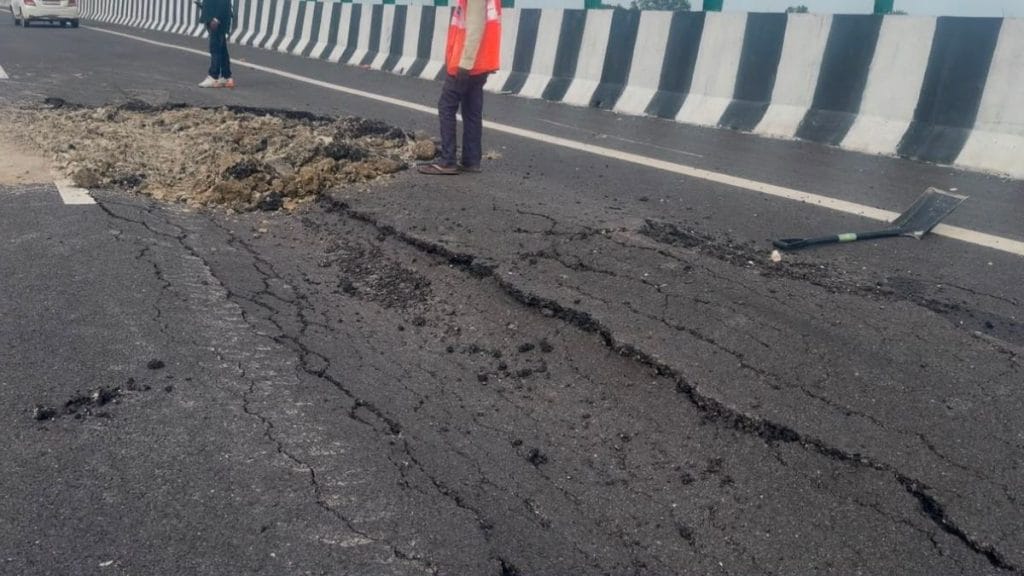
What was announced as already done, and what was only proposed, must be kept in different columns. Rectification at the concessionaire’s expense — initially estimated at about ₹3 crore — was directed. Toll was suspended until rectification, with toll loss recoverable from the concessionaire. Project manager Vivek Kumar Gupta, independent-engineer team leader Surendra Kumar, and resident engineer Yatendra Kumar were removed and debarred for two years. The independent-engineer men are not PNC directors. Treating them as such is another way to inflate a file.
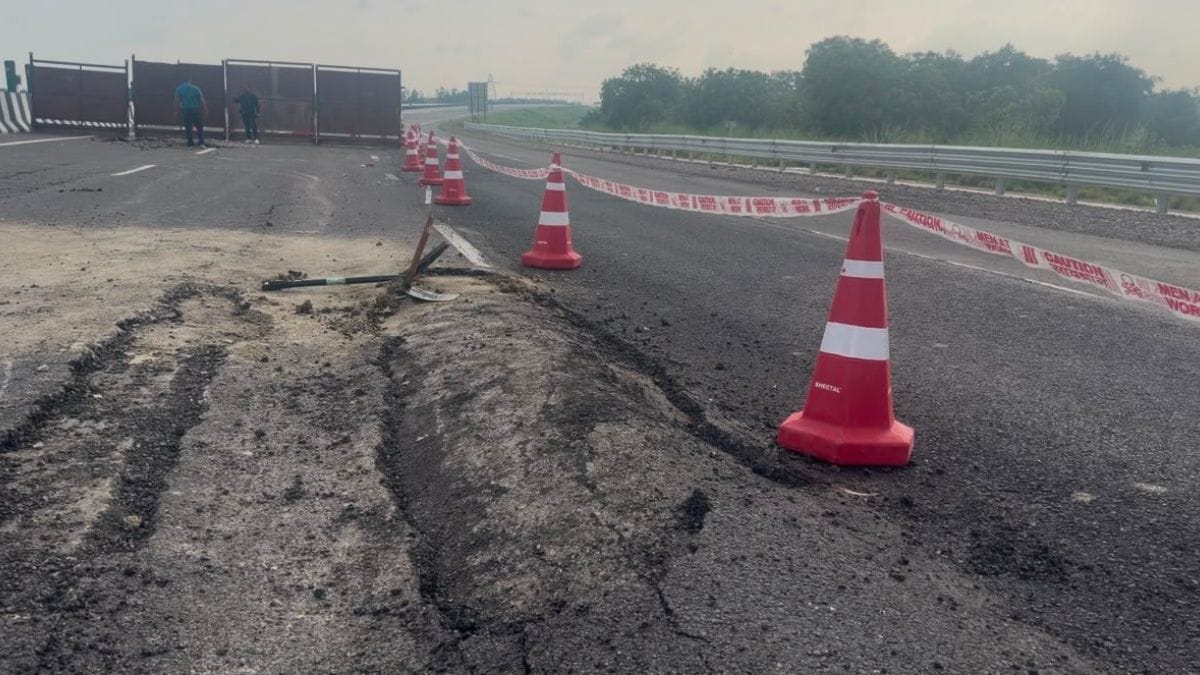
What was proposed, not sealed as a final company-wide determination in that release, was heavier: a declaration of PNC as a non-performer; a penalty of 2 per cent of performance security; a rating downgrade; further staff-debarment proceedings. PNC’s 6 August clarification identified the relevant Package II project company as Awadh Expressway Private Limited, disputed reports that a company-wide ban had already been imposed, and said replies to the notices were being submitted. In the 10 August 2026 earnings call, management was still describing the matter as under consideration by NHAI. This investigation did not retrieve a later final company-wide debarment order before the research cut-off.
So the accurate sentence is not “PNC has been banned for three years.” The accurate sentence is colder. A brand-new expressway slipped within a fortnight. The authority suspended toll, billed the concessionaire for the patch, and put named field officers off its jobs. It then pointed a show-cause cannon at the listed parent and asked whether that parent should still be allowed to bid as if nothing had happened. The company answered, as companies do, that rumours of a completed ban were exaggerated. The road, unfortunately, was not a rumour.
V. Dust, stone and the small receipts that never make a promoter’s speech
Corruption prosecutions and expressway slippages are the front page. The rest of the file is the inside pages, which is where a company’s true manners usually live.
In Sampurna Nand v. PNC Infratech Ltd. & Others, NGT OA 447/2024, judgment 29 January 2026, corrected 26 February 2026, the Tribunal recorded that the Uttar Pradesh Pollution Control Board had imposed environmental compensation of ₹7,06,250 on 19 February 2024 for a stone crusher at Chunar, Mirzapur, and that the amount was paid on 20 March 2024. Seven lakh is not a nation-shaking figure. It is a receipt. Receipts are how you know a regulator did not imagine the dust. The crusher was later transferred to AHVS Infra LLP in July 2024. That transfer is not a renaming of the listed company. Paying compensation is not the same thing as never having been found out of line.
In Karnataka, project manager Avijith Bannerjee and general manager Satish C. Dhyani faced mining-law complaints that became CC 2755/2025 and CC 2756/2025 after a geologist’s complaints of 28 April 2025. On 20 February 2026, the Karnataka High Court in Criminal Petitions 615/2026 and 693/2026, 2026:KHC:10518, quashed the proceedings and remanded them because the pre-cognizance hearing required by Section 223 of the BNSS had not been given. That is a procedural remand, not a medal. It is not a conviction. It is not a finding that no mining violation occurred. It does establish that the company’s managers were in a criminal court over rock and permission, and that the first attempt at prosecution was sloppy enough to be sent back.
VI. The award that vanished: ₹2,039.61 crore, written in ink, cancelled in court
On 6 May 2025 the Bombay High Court, in Writ Petition 13976/2024, set aside the work order awarded to PNC–Aakshya JV for NAINA infrastructure works in town-planning schemes 8, 9 and 12. The disclosed project value was ₹2,039.61 crore. Two thousand and thirty-nine crore is not a rounding error. It is a skyline.
The fight was about the exclusion of a competing bidder and the integrity of the procurement process. It was not a criminal conviction of PNC for fraud. It was still a public humiliation of a joint venture that had already been told it had won. The JV ran to the Supreme Court in SLP(C) 13562/2025 and, on 14 May 2025, withdrew with liberty to seek review and come back. Review Petition 130/2025 died on 7 March 2026. The Bombay High Court found no error apparent. The scoreboard is simple: the work order is gone; the review failed; the crores did not become a site office.
Other tender bruises sit in the same drawer. In PNC Infratech Ltd. v. NHAI, W.P.(C) 4083/2023, decided by the Delhi High Court on 28 October 2025, 2025:DHC:9411, the company had written ₹1,035 crore in numerals and ₹135 crore in words on a Bhiwani–Hansi bid. NHAI moved to encash a ₹7.14-crore bid-security guarantee. The Court quashed full encashment and still made PNC pay 5 per cent — ₹35.70 lakh — before the guarantee came home. That is not a fraud conviction. It is a judicial record of a bid so internally contradictory that a public authority reached for the bank guarantee, and a High Court still extracted a price.
On 28 October 2024, the same season as the MoRTH ban, NHAI annulled the bidding for an additional three-lane Ganga bridge near Buxar–Bharauli on NH-922. PNC had been the lowest bidder at ₹380 crore. The disclosure says the process was annulled under the tender clause and that bid security would be discharged. It does not prove the annulment was a corruption penalty for the CBI case. It does prove that even a lowest bid is only a lowest bid until the authority decides the process itself is diseased.
VII. Tax ghosts, a hawala story that failed, and the small fine the exchange did not forget
PNC’s 2015 prospectus disclosed a Section 132 income-tax search on 25 August 2011, seven assessment orders dated 31 March 2014, and demands totalling ₹33.703 crore then under appeal. Those are historical disclosures, not certified outstanding demands in 2026. They are also not a children’s story. A search under Section 132 is the tax department entering the house, not sending a polite questionnaire.
A later set-piece is more useful to the company’s defenders than they may realise, and more useful to its critics than a slogan. In MB Power (Madhya Pradesh) Ltd. v. DCIT, ITAT Delhi, 19 December 2025, the Revenue floated a theory of bogus subcontracting through several companies, including PNC, and of funds moving through hawala channels. The ₹242.3365-crore figure discussed there was an aggregate for five subcontractors, not a sum nailed solely to PNC. The Tribunal dismissed the Revenue’s appeals and sustained deletion of the disputed disallowances. So: the allegation existed on a judicial page. The tax theory failed. That is not proof that PNC ran a hawala network. It is not proof of an Enforcement Directorate prosecution or a PMLA attachment — none of which this investigation verified as an authenticated PNC-specific proceeding. It is also not proof that nobody ever wrote the company’s name next to the word “hawala.” Honesty requires all three sentences.
On its own penalty, PNC did better. In DCIT v. PNC Infratech Ltd., ITA 94/Agr/2021, assessment year 2011–12, decided 11 February 2025, the ITAT dismissed the Revenue’s appeal against deletion of a ₹2.25-crore concealment penalty under Section 271(1)(c). The penalty did not survive. That does not wash the 2011 search out of history. It does mean this particular lash was pulled back.
In PNC Infratech Ltd. v. State of Bihar, CWJC 17076/2021, the Patna High Court on 30 September 2021 quashed an ex parte GST assessment and an appellate order, remanded the matter, and directed de-freezing of bank accounts if they had been attached pursuant to those proceedings. “If attached” is doing real work. The order is not proof that an attachment happened, still less that the Enforcement Directorate or PMLA was in the room.
Even the stock exchange found a way to tap the company on the wrist. The FY2026 Annual Secretarial Compliance Report records a ₹35,400 BSE fine for delayed XBRL filing of related-party transaction information under Regulation 23(9) of the SEBI LODR, for the period ended 30 September 2025. Management said the PDF went in on time and the XBRL slipped through oversight. The fine was paid on 29 December 2025. Thirty-five thousand four hundred rupees will not move a highway. It will, however, tell you that a company capable of arguing constitutional points in three High Courts could not file a machine-readable related-party form without being fined. That is not securities fraud. It is administrative contempt for the boring parts of being public.
As at 31 March 2025, the standalone statements disclosed disputed sales tax/VAT/GST of ₹38.8819 crore, service tax of ₹2.9212 crore, entry tax of ₹0.2008 crore, and other claims of ₹1.1809 crore — ₹43.1848 crore in those four buckets. Those are disputed liabilities, not a “fraud amount.” They are also not zero.
VIII. The other ledger: the company as hunter, not hunted
Fairness is not softness. PNC is not only a respondent. It is a repeat petitioner, claimant and resolution applicant. That fact does not clean the adverse file. It explains how a company with this much incoming fire still looks, from a distance, like an institution rather than a defendant.
It challenged the October 2024 debarment and lost at first instance. It won a reconsideration direction on appeal and then a shortened ban. It extracted mixed relief on the Bhiwani–Hansi guarantee. It lost the CIDCO review. In the NCLAT it failed to unseat a competing resolution plan in the Era T&D insolvency in 2022, and in April 2026 it withdrew a Gwalior Bypass appeal after a disclosed ₹20-crore settlement receipt, having sat on a ₹29.51-crore bank guarantee for nearly six years. None of that is PNC itself being admitted to insolvency. Pretending otherwise is a different kind of lie.
The arbitration ledger is larger, and it must not be cooked. A 31 July 2026 award against Uttar Pradesh PWD on Sonauli–Gorakhpur: ₹244.09 crore, announced, not proved as cash in hand. An Agra Bypass award of ₹485.28 crore against NHAI on 17 May 2025, later settled under Vivad Se Vishwas III on 12 May 2026 for ₹234.99 crore. Those two figures are chapters of one dispute. Adding them is an accounting fraud of a journalistic kind. Further settlements and receipts — Gurgaon–Nuh ₹42.21 crore, Panagarh ₹3.65 crore, PNC–TRG JV’s Dholpur–Morena/Chambal ₹255.40 crore, PNC Kanpur Highways ₹398.60 crore, PNC Raebareli Highways ₹117.15 crore — are contractor-state money fights, not fraud decrees against the company. They do show a business model that litigates, settles, and returns to the same counterparty for the next highway.
That is the real portrait, and it is not flattering. A company can take hundreds of crores off the public exchequer in awards and settlements and still have a CBI chargesheet in Bhopal. Those facts do not cancel. They coexist. The coexistence is the point.
Naveen Kumar Jain, identified in PNC’s FY2016 annual report as a whole-time director, disclosed in a 2024 election affidavit Crime 204/11 at Kotwali Hariparvat, Agra — IPC 147, 332, 353 — pending in that affidavit, with no conviction disclosed there. Those are personal allegations of rioting and of obstruction or assault involving public servants, not a PNC corporate-finance fraud. They are also not a September 2026 court-status certificate.
IX. What this investigation will not say, even to please a hostile reader
There is a market for a simpler article: PNC is a scam, the directors were arrested, the company has been banned for three years, hawala is proved, the Enforcement Directorate has attached the family silver, GST raids have landed, SFIO is in the building, RERA has struck, the firm itself is in insolvency. That article would be popular. It would also be false on the retrieved record.
No authenticated PNC-specific ED raid, ECIR or PMLA prosecution was verified. No authenticated ED attachment order was verified. No sufficiently supported EOW raid or FIR was verified. No GST raid or GST-fraud conviction was verified. No SFIO investigation or prosecution was verified. No admission of PNC itself into CIRP was verified. No RERA action sufficiently tied to this listed entity was retrieved — and similar-name entities must not be substituted. No final consumer finding against PNC was established in the consumer decisions examined. No final conviction for fraud, cheating, bribery or money-laundering was established from the retrieved records.
A critic who needs those extra rooms invented is not a critic. He is a novelist. This company does not require fiction. The authenticated rooms are already furnished.
X. The indictment that the paper does support
What, then, can be said without perjury of the journalistic kind?
PNC Infratech is a listed builder of public roads whose employees were arrested in a CBI trap case registered as RC2182024A0012; whose directors had their residences searched and were summoned; whose project companies were written into a ministry disqualification; whose one-year tender exile was bargained down to a four-month season; whose Package II expressway company stood in the dock of an official quality action thirteen days after a ceremonial inauguration; whose stone crusher attracted environmental compensation that was paid; whose managers had mining complaints serious enough to reach the Karnataka High Court; whose joint venture lost a ₹2,039.61-crore award and then lost the review; whose bid arithmetic was so sloppy a High Court still extracted ₹35.70 lakh; whose exchange filing hygiene drew a fine; and whose criminal file, two years on, still has not produced a public verdict.
That paragraph is long because the file is long. Shortening it into “scam” is how the company wins the next news cycle. Leaving it long is how a newspaper keeps its own name clean while still refusing to sell the public a lullaby.
Subsequent relief is not a smear to be hidden. The ban was reduced. The mining proceedings were remanded on procedure. The identified income-tax penalty was deleted. The hawala-flavoured tax theory failed on appeal. Those facts change the legal meaning of the file. They do not convert it into a reference letter. A man who beats three charges and still has a fourth pending does not get to call himself acquitted of the calendar.
Bottom line: the public is not obliged to call PNC innocent because a trial has not ended, and it is not entitled to call PNC convicted because a chargesheet exists. It is entitled to look at the pile — searches, arrests, chargesheet, shortened ban, slipped expressway, paid compensation, cancelled thousand-crore award — and ask why this particular contractor still gets to treat national highways as a family profession.
Roads do not get built in the future perfect. They get built in the present, with public money, under public contracts, by companies whose directors appear before the CBI on dated summons and whose employees have already learned the geography of a Bhopal special court. If that present makes PNC Infratech uncomfortable, the discomfort is not the work of a hostile pen. It is the work of its own disclosed life.
The last courtesy this investigation will extend is the one the law requires and the company itself keeps demanding: these are proceedings, orders, disclosures and allegations, assembled from judgments, government releases and regulatory filings available on the public record as of 6 September 2026. They are not a substitute for a trial. They are, however, more than enough to end the pretence that there is nothing here to try.
Editor’s box — evidentiary boundary
This is a source-linked inventory written as a newspaper investigation, not a certified list of every case in every Indian court. A company disclosure proves what the company reported. It is not an independent adjudication of the company’s explanation. Where this article says “not verified,” it means sufficiently reliable entity-specific evidence was not located — not that a vacuum is certified in every archive in the republic.
Primary anchors include CBI RC2182024A0012 (8 June 2024); chargesheet 8 August 2024, Special Judge, CBI Cases, Bhopal; Delhi High Court W.P.(C) 14903–14905/2024 (29 October 2024); MPHC MCRC 35673/2024 (29 August 2024); MoRTH orders 18 October 2024 and 6 February 2025; NHAI/PIB action 5 August 2026; NGT OA 447/2024; Bombay High Court WP 13976/2024 and Review 130/2025; Delhi High Court W.P.(C) 4083/2023; Karnataka High Court 2026:KHC:10518; ITAT ITA 94/Agr/2021; and PNC stock-exchange filings of June–August 2024, February 2025 and August 2026.