Raheja Builders : The towers they sold. The keys they never handed. The father and son who still walk free.
An investigative report on Raheja Developers, Enforcement Directorate attachments of nearly ₹2,400 crore, and a justice system that raids the files and then asks the accused to kindly come back next month.

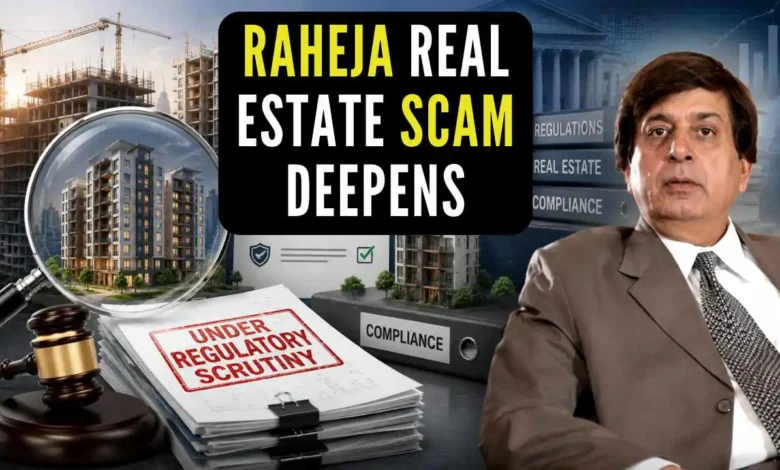
Gurugram’s skyline is a museum of other people’s EMIs. Glass promises. Delayed lifts. Brochures that outlived the occupancy certificate.
Raheja Revanta was sold as a 61-storey statement in Sector 78. Launch: 2011. Possession, on paper: 36 months for floors, 48 months for towers. Completion date later declared to Haryana RERA: 31 July 2022. In June 2026 the National Company Law Tribunal still had to be told, by 176 buyers holding 99 units, that they had paid more than ₹137 crore — many of them 90 to 95 per cent of the price — and were staring at unfinished delay. The company, in the same proceeding, said it had spent about ₹1,119 crore on the project against collections of about ₹826 crore. The tribunal admitted insolvency against that project only, rejected the “government infrastructure” defence as a complete answer to default, and appointed an interim resolution professional.
That is one project. The Enforcement Directorate’s case is larger.
According to ED press notes, Raheja Developers Ltd collected about ₹2,425.99 crore from around 4,600 homebuyers across multiple residential projects “under the pretext of providing residential units.” The agency says a substantial portion was diverted through related entities and shell companies — including N.A. Buildwell Pvt. Ltd. and Riyasat Palaces Ltd. — toward assets and spending unconnected with those projects.
Provisional attachments under the Prevention of Money Laundering Act, 2002:
| Date | PAO | Approximate market value |
|---|---|---|
| 28 April 2026 | Company-related entities + Navin M. Raheja and family | ₹1,113.81 crore |
| 15 June 2026 | Company + Navin M. Raheja and family | ₹503.48 crore |
| 31 July 2026 | Immovable properties of Raheja Developers Ltd | ₹782.36 crore |
| Cumulative | ≈ ₹2,399.65 crore |
That is not a rounding error. That is almost the size of the collections the agency itself puts on the table.
Searches: 13 locations on 27 June 2025 (Delhi, NCR, Mohali). Seven more on 25 April 2026 (Noida, Greater Noida, Sainik Farms, New Friends Colony), targeting premises linked to Navin M. Raheja, son Nayan N. Raheja, family and directors. From the April 2026 searches the agency reported seizure of documents, digital evidence, jewellery and bullion worth about ₹15.82 crore, and foreign currency of about ₹15 lakh.
The Economic Offences Wing FIRs came first. The PMLA ECIR, defence lawyers told the Saket court, dates to 2022. Four years of a money-laundering file. Two waves of searches. Three attachment orders. Project-specific insolvency on Revanta, Shilas and Krishna. HRERA account freezes and refund orders. A DTCP inspection still being scheduled in 2026 for another delayed layout in Sohna.
And the two men the ED named as the centre of the investigation?
They have not been convicted. They have not, on any public record examined for this article, even been taken into custody.
In August 2026 the ED asked a Saket court for open-ended non-bailable warrants. The agency’s case in that application was not poetry. It was that after appearing in 2025, the father and son failed to join investigation on four occasions and did not comply with Section 50 PMLA summons served in April 2026 — the same month of the second raid.
Additional Sessions Judge Sheetal Chaudhary Pradhan did what Indian criminal process so often does when the accused can hire Senior Advocate Vikas Pahwa and Karanjawala & Co: she granted interim protection from arrest, said NBWs have “serious consequences” and should not issue “mechanically,” noted the object of process is presence, recorded their willingness to cooperate, suggested video-conferencing may be considered for the elder Raheja’s age, and listed the matter for 3 September 2026. Anticipatory bail and writs were already pending in the Delhi High Court. Nayan Raheja separately asked the High Court to quash the ECIR against him; notice went to ED, next date October 2026. In that petition the pleaded numbers differ slightly from ED’s press line — collections of ₹2,699.13 crore, alleged diversion of ₹1,353.26 crore, and an allegation that Nayan received ₹1.23 crore from alleged proceeds. Those are pleadings, not findings.
So here is the tableau, without varnish.
Buyers have been paying banks and landlords for a decade. RERA has passed refunds that execution then chases like a tired clerk. NCLT has put a lock on one tower at a time so the rest of the company can keep breathing. ED has frozen nearly ₹2,400 crore of immovable property on paper. Bullion came out of a cupboard in April. And the promoters’ answer to a warrant application is: we came four times last year, the ECIR is old, we are not absconding, please do not arrest us until the next date.
The court, applying settled caution about liberty, said yes — for now.
If that feels like a system designed by people who have never spent a night in a rented flat while servicing a home loan on a ghost tower, it is because that is exactly what it feels like.
The company’s line, which must be stated
Raheja Developers has not pleaded guilty. It says there is no fraud in Revanta; a RERA-supervised forensic audit showed investment exceeding customer collections; no funds were diverted; delay is “primarily” missing government water, power, sewerage and fire-fighting despite EDC/IDC paid; a 61-storey building cannot be safely handed over without those services.
That is a real argument about infrastructure in Gurugram. It is also an argument NCLT declined to treat as a wipe-out of default. ED’s attachment orders treat diversion as a separate allegation that an audit slogan does not erase. Both can be true at once: the state can fail at pipes, and a developer can still be accused of routing buyer money through related companies. Only a trial sorts which part is excuse and which part is offence.
Until that trial happens, the company’s statement is a press note. The ED’s PAO is a freeze, not a conviction. The buyers’ grief is the only part of this story that does not require a lawyer to exist.
Other projects, same pattern of process without custody
Raheja Shilas, Sector 109: CIRP admitted 19 November 2024; NCLAT later confined it to that project and refused to shut it because dozens of buyers said disputes were unresolved. Raheja Krishna Housing Scheme: admission 21 August 2025, also project-specific. Vanya: HRERA froze project accounts in 2023. Akshara, Sohna: DTCP ordered a fresh inspection in September 2026 after a High Court direction; RERA has treated it as a lapsed project years past its likely completion date. Consumer forums and HRERA files are stacked with refund-plus-interest orders. Execution is another industry.
Older scars, already on the public record and not invented here: Income Tax searches around 2010 and a 2014 Delhi High Court order quashing settlement immunity over alleged bogus purchase entries of about ₹118 crore across years; a 2014 Cobrapost sting that named a Raheja executive in an undercover conversation about black-money routes (an allegation, not a criminal conviction); a PMO reference to Haryana the same year on Atharva buyer complaints. CARE has carried a default-category rating with non-cooperation notation on large facilities. None of that equals a PMLA conviction. All of it is why “we are shocked” is a difficult sentence to deliver with a straight face.
Opinion | Connections, or a machine that loves the well-lawyered?
The question this investigation is asked to answer is ugly on purpose: do Navin and Nayan Raheja enjoy political and judicial patronage, or is the Indian judiciary simply hospitable to accused persons in large financial cases?
Here is what can be written without lying.
What is documented about political access — not today’s payoff, yesterday’s guest list.
The Caravan, in a 2014 report on how Gurgaon was built, recorded Navin Raheja describing his son’s wedding: 38 cabinet- and chief-minister-rank guests, including then External Affairs Minister Salman Khurshid, who on camera called Raheja a close friend; Ambika Soni; then Delhi Lieutenant Governor Tejinder Khanna; and then Haryana Chief Minister Bhupinder Singh Hooda — the man who held DTCP, HUDA and HSIIDC, which is to say the files that turn farmland into FAR. Raheja told the reporter the politicians “all know me,” then immediately warned that writing about bribes would be unfair, and complained that fifty clearance tables exist to be fed. That is his quote, not this newspaper’s invention. Hooda-era minutes from July 2009 also list Raheja Developers among the large builders present when a one-time relaxation on low-cost housing reservation was discussed. The company’s own site still photographs Navin Raheja in industry rooms with serving Haryana leadership. That is access. Access is not a chargesheet. It is also not a monk’s CV.
What is not documented.
There is no public, verified evidence in the material reviewed for this article that any sitting judge was paid, instructed, or “managed” in the 2025–26 ED or IBC matters. Inventing that would be the same disease this piece is attacking: allegation dressed as fact. K Raheja Corp’s electoral-bond donations belong to a different business group. Conflating the two surnames is how propaganda is made. This paper will not do it.
What is documented about the courts — and this is the part that does not need a conspiracy.
The Supreme Court has said, more than once, that bail is the rule and jail the exception. That sentence is a civilised inheritance. It is also, in economic offences of this scale, a practical gift. PMLA Section 45’s twin conditions are supposed to make bail hard after arrest. The complementary trick, now well understood after Tarsem Lal (2024), is this: if the agency does not arrest during investigation, and later only summons the accused to face a complaint, the twin conditions may never lock. ED then arrives years later asking for open-ended NBWs because summons were skipped. The magistrate, correctly terrified of mechanical warrants, grants interim protection because the accused “are willing to join.” The High Court is already seized of anticipatory bail. The calendar eats another quarter. The buyer’s child finishes another school year in a rented house.
Call that “judge-friendly to scammers” if you need a slogan. The colder description is better: a procedure that treats custody as the scandal and delay as the climate. Poor accused rot under trial. Rich accused generate reported “cooperation,” senior counsel, medical age, video-conference convenience, and a next date. Both outcomes can be produced by the same Code. That is not proof that Justice Pradhan was purchased. It is proof that the Code, as applied, produces a caste system of liberty.
Four years from ECIR to a warrant application is not the speed of a state that fears the accused will flee with the last unlocked locker. It is the speed of a state that is excellent at press releases and mediocre at finishing a prosecution complaint that can survive a trial. Attachments look ferocious on television. They do not, by themselves, put keys in buyers’ hands or promoters in the dock. Moneycontrol’s own wider survey of ED’s real-estate drive made that point in August 2026: tens of thousands of crores attached across builders is not a possession ceremony.
So: deep connections? Historically, yes, with the political class that signed Gurgaon’s licences — documented, old, and still relevant to how this industry was allowed to grow. Judicial corruption in this specific file? Not proven. Do not print it as fact. A judiciary and investigation culture that lets a ₹2,400-crore attachment case run for years without a public arrest, then flinches at an NBW because presence can be promised again? That is on the record. You do not need a secret WhatsApp group to explain it. You need only the cause list.
“Enjoying the money” is the phrase buyers use, and it is the phrase that must be handled with a scalpel. Provisional attachment freezes identified immovable assets. It does not prove the family is dining on seized bullion. It does not prove every rupee of collection is sitting in a personal account. It does prove this: while ED says buyer money became family-linked property, the men named in that theory still move, instruct lawyers, contest quashing, and obtain protection. The buyers move between RERA, NCLT, consumer commissions and EMI apps. If that is not “enjoyment” in the vulgar sense, it is certainly asymmetry. The law’s favourite child is the one who can wait.
What should happen, without theatrics
- Finish the investigation or admit it cannot. Four years after ECIR, missed summons should produce a prosecution complaint or a recorded closure — not another season of PAOs and “further investigation is on.”
- Decide custody on evidence, not on etiquette. If Section 19 PMLA grounds exist, arrest and face Section 45. If they do not, stop performing raids for the crawl and then whispering “willing to join” in the next court.
- Time-bound PMLA and IBC trials for homebuyer cases. Project-specific CIRP without a clock is just another queue. Attachments without adjudication are a warehouse.
- RERA escrow with teeth, not affidavits. Section 4(2)(l)(D) was supposed to keep 70 per cent of collections in the project. If ED can allege wholesale diversion after that law existed, the regulator’s self-certification model is a joke told at the buyer’s expense.
- Do not confuse infrastructure failure with a free pass. Haryana’s missing utilities are a scandal of the state. They are not a licence to treat collections as working capital for related entities — if that is what a court eventually finds.
Until then, the father and son remain what the law currently says they are: accused persons, not convicts, walking under interim protection, denying diversion, blaming the government’s pipes, and watching nearly ₹2,400 crore of property sit under a provisional lock while 4,600 booking files gather dust.
The towers are still in the brochure. The keys are still a rumour. The process is still next date.
DISCLAIMER
All references to fraud, cheating, criminal breach of trust, money laundering, diversion, siphoning, shell companies and proceeds of crime in this article reproduce allegations made in FIRs, an Enforcement Case Information Report, Enforcement Directorate press releases and pleadings. No court of law has convicted Navin M. Raheja, Nayan N. Raheja, or Raheja Developers Ltd. of these offences as of the date of this article. Provisional attachment under PMLA is not confiscation and is not a finding of guilt. Insolvency admission is a finding of default for the purpose of the Insolvency and Bankruptcy Code, confined to named projects; it is not a criminal conviction. Historical reporting of political attendance at social events and industry meetings is not proof of present-day judicial or political interference in this investigation. K Raheja Corp and Raheja Developers Ltd are distinct groups; they are not treated as one entity here. The accused deny wrongdoing and rely on a RERA-supervised forensic audit and infrastructure-delay arguments. They are entitled to defend themselves. Nothing in this article should be read as a substitute for a judgment.