BLS International Opens New Centres While Losing Old Contracts: Why Expansion Comes Before Fixing Existing Failures?

From iDATA and Atyati Acquisitions to Slovak Suspension: Why BLS International Continues Expansion When Compliance Questions Persist
BLS International continues to pursue growth through acquisitions and new geographic mandates while simultaneously ignoring the consequences of regulatory restrictions, contract losses and operational suspensions in markets where it already operates. The public record shows both tracks clearly. The company has completed multiple acquisitions, announced large capital expenditure plans and secured multi country contracts. At the same time, client governments have suspended services, awarded renewals to competitors and, in one significant case, imposed a formal debarment that was later set aside by a court. The central question remains whether expansion is being prioritised over the systematic correction of the compliance and operational issues that have already produced adverse outcomes.
In July 2024 BLS completed the acquisition of 100 percent of iDATA, a Turkey based visa and consular services provider, for approximately 80 million euros or roughly 720 crore rupees. iDATA operated more than 37 visa application centres across more than 15 countries and held contracts with the diplomatic missions of Germany, Italy and the Czech Republic. The transaction was described as immediately earnings per share accretive and as a means of strengthening BLS’s European presence.
In August 2024 the company acquired a 51 percent stake in SLW Media, a sports management firm focused on golf events, for approximately 80.24 lakh rupees. In July 2026 its subsidiary BLS E Services completed the acquisition of 100 percent of Atyati Technologies, a Bengaluru based AI powered banking technology and business correspondent company, for approximately 157 crore rupees in an all cash deal. Atyati serves more than 35 banks through a network of over 25,900 customer service points covering roughly one lakh villages. These acquisitions expand both the core visa business and the domestic digital and financial inclusion vertical.
On the contract side, in November 2025 BLS announced a five year global mandate from the Slovak Republic to establish and operate visa application centres in over 80 countries. Corporate statements presented the win as evidence of service quality and operational excellence. Separately the company has secured multiple Cyprus visa outsourcing contracts covering South Africa and neighbouring states, several Asian markets including China, Cambodia, Laos and Mongolia, and additional locations such as Kazakhstan.
BLS Management has publicly outlined plans to invest approximately 2500 crore rupees over three to four years in new markets, technology and further acquisitions, with the stated objective of doubling revenues by 2030 and extending the network toward 100 countries. Recent quarterly results have shown strong revenue growth driven by higher application volumes and new contract contributions.
Running parallel to this expansion is a series of adverse developments. In October 2025 the Ministry of External Affairs of India issued an order dated 9 October debarring BLS from participating in future tenders of the Ministry and of Indian missions abroad for two years. The order cited allegations that included court cases and complaints from applicants. Existing contracts were stated to remain unaffected. BLS disclosed the order to the stock exchanges and later challenged it. In December 2025 the Delhi High Court set aside the debarment order.
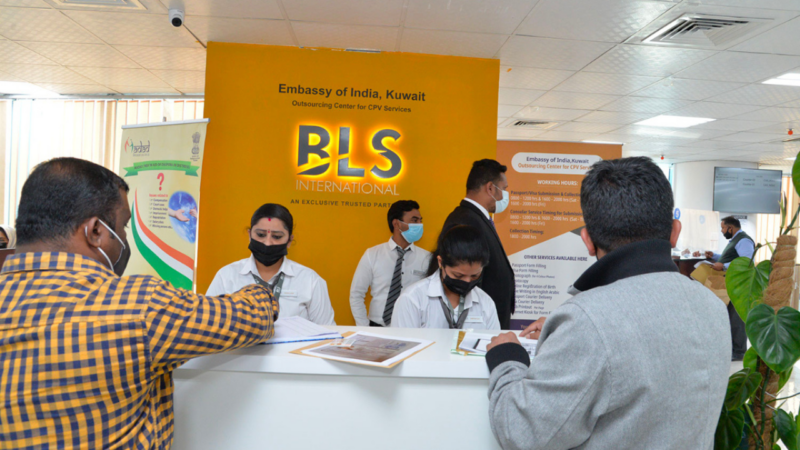
The ban was therefore temporary in legal effect, yet it had already produced practical consequences. Because of the debarment BLS was ineligible to bid for the renewed Indian consular services contract in the United Arab Emirates, a mandate it had held since 2011 for a community of more than four million Indian nationals. The contract was awarded to Alhind Tours and Travels. The transition involved centre closures, temporary service interruptions and a period in which the Embassy and Consulate provided limited services directly from their own premises.
In mid 2026 Slovak authorities suspended BLS services. Public communications cited integrity related concerns, recurring operational issues, non compliance with official instructions, delays in document forwarding, and multiple discrepancies in daily and monthly reporting. The suspension took effect from around 24 June 2026 until further notice. Applicants holding BLS appointments were directed to VFS Global, which held its own five year global contract covering 83 countries and 159 centres. The episode converted a recently celebrated multi country win into a public operational setback within months.
Earlier precedents form part of the same pattern. Estonian authorities previously terminated arrangements after identifying breaches in the handling of e Residency card processes. In Canada, applicant complaints and reviews have repeatedly raised issues of pressure to purchase premium services and technical rejections that appear linked to fee structures. Spanish authorities expanded a visa fraud investigation involving a consulate in Algiers to include the outsourced provider responsible for appointments and document processing. BLS has rejected any involvement and correctly noted that final visa decisions rest with the diplomatic authorities. The cumulative record nevertheless shows repeated scrutiny across jurisdictions.
The data therefore present two simultaneous realities. On one side stand completed acquisitions of iDATA, SLW Media and Atyati, a large announced capital programme, new Cyprus mandates and the earlier Slovak global contract award. On the other side stand the MEA debarment of October 2025 later quashed by the Delhi High Court, the consequent loss of the long running UAE Indian consular mandate, the mid 2026 suspension of Slovak services on stated integrity and reporting grounds, and a history of operational complaints in other markets. The numerical and chronological sequence is not in dispute. The interpretation of that sequence is where the critique begins.
A visa and consular outsourcing company sells trust and process reliability. Governments outsource the administrative front end of visa and passport handling because they wish to reduce their own operational load while retaining final decision rights. Applicants accept the model because they expect predictable rules, transparent fees and competent handling of personal data.
When client governments begin to cite non compliance with instructions, reporting discrepancies and integrity concerns, the foundation of that trust is damaged. When the home country foreign ministry itself issues a formal debarment, even if a court later sets it aside, the signal to other governments is clear. When a newly awarded global contract is suspended within months on the same family of grounds, the signal intensifies.
In that setting the decision to continue deploying capital into acquisitions and new geographic entry while these issues remain unresolved invites direct examination. Acquiring iDATA brought immediate European centres and revenue. Acquiring Atyati expanded the domestic financial inclusion platform. Announcing a 2500 crore investment programme projects future growth.

None of these steps automatically corrects the operational weaknesses that have already led to suspension and contract loss. Rectification would require consistent adherence to client instructions, accurate and timely reporting free of discrepancies, transparent fee practices that do not generate large volumes of applicant complaints, and measurable improvement in the metrics that client governments monitor. Those tasks receive less public attention than a new country launch or a multi hundred crore acquisition. They are also the tasks that determine whether existing mandates survive and whether new mandates remain in force after the initial period.
The Slovak suspension is particularly revealing. A five year global contract covering more than 80 countries is a significant commercial achievement. Its suspension on grounds that include integrity concerns and reporting discrepancies converts the achievement into a documented operational failure in a short time frame. The redirection of volume to a competitor that already held a parallel mandate shows that alternative capacity existed and that the client preferred consolidation over continued exposure to the reported issues. Similar logic operated in the UAE once the MEA debarment, even though later quashed, had already removed BLS from the competitive field for the renewed contract.
There is also a capital allocation and governance dimension. When a listed company announces substantial investment in new markets and acquisitions while managing the fallout from debarment, contract loss and suspension, stakeholders are entitled to ask how operational remediation ranks relative to geographic growth. Strong quarterly revenue numbers and new contract announcements are positive data points. They do not erase the negative data points of formal integrity findings and client exits. A complete assessment requires both sets of facts to be held in view simultaneously.
The practical effect on applicants is disruption. In the UAE the transition produced temporary service gaps and uncertainty. In markets affected by the Slovak suspension, applicants with existing appointments had to be redirected. Each such episode imposes costs on individuals who simply need to submit a visa or renew a passport. Those users have no influence over the commercial strategy of the outsourcing firm or the tender decisions of the missions. They experience the consequences of both.
The industry context sharpens the critique. Visa and consular outsourcing is a concentrated market. Switching costs are real. Governments change providers only when service failures or compliance breaches become intolerable. The fact that multiple authorities have reached adverse findings or taken restrictive action indicates that the accumulated problems crossed a threshold. The fact that the company continues to win new mandates and complete acquisitions indicates that other governments have not yet reached the same conclusion or have not yet encountered the same volume of issues. The risk is that the operational practices that produced the documented problems travel with the expansion.
The interrogative that remains is precise. Before committing large capital to acquisitions and new geographies, why has BLS International not first produced clear, sustained evidence that the centres and processes it already operates meet the compliance, reporting and integrity standards that client governments require? The public record shows acquisition activity, new contract wins and ambitious expansion plans on one track. It shows debarment later quashed by court, contract loss in the UAE, suspension of Slovak services on stated grounds of integrity and reporting failures, and a history of operational complaints on the other track.
Until the company can demonstrate that existing relationships are stable, transparent and free of the discrepancies and concerns already cited by multiple authorities, each new acquisition and each new country entry will carry forward the same latent risk that has already materialised in successive jurisdictions. The facts are a matter of public record. The sequence of those facts raises the question of priorities.