The collar, the threat, and the feet: How Nirma’s HOD turned a meme into a public lesson in power

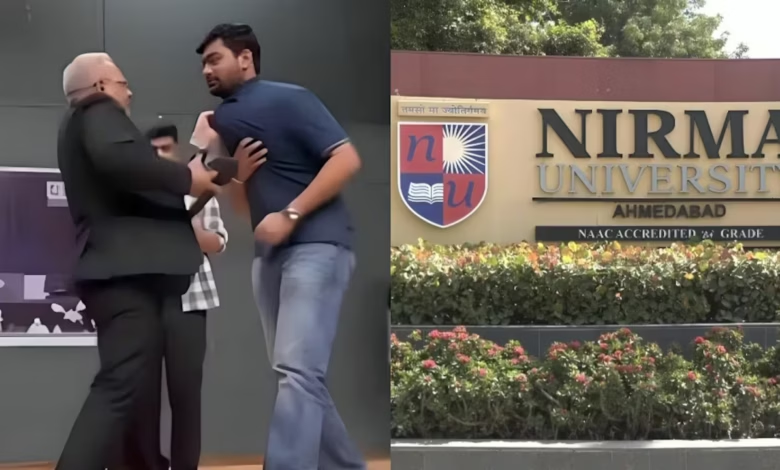
There is a reason the clip will not die. It is not because a student quoted Golmaal 3. Indian campuses have survived worse jokes. It survives because a Head of Department, on a live stage, in front of a hall that had come for a comedian, put his hand on a student’s collar and announced the terms of exile. “I can go up to any extent.” “The day you dare to insult any faculty of the Nirma University campus, you are gone forever.” That is not classroom management. That is a man with institutional power rehearsing it into a microphone.
Everything else — the apologies, the parents, the three-member committee, the touching of feet — arrived after the phones had already done the only job the university failed to do in the room: record what authority actually looks like when it loses its temper.
What the tape shows, and what no press release can unsay
The setting is not mysterious. Technofora 2026 ran from 18 to 20 September at Nirma University’s Institute of Technology. Reports put attendance above 800. The Electronics and Instrumentation department’s own flagship festival. Stand-up by Rajat Sood. Dr Himanshu K. Patel, Professor and Head of that department, on the stage. A student in the crowd shouts the line that has been a national meme for years: Jaldi bol, kal subah Panvel nikalna hai. Patel’s first reply, captured in multiple accounts of the audio, is almost a joke: Toh nikal le bhai. Then he points. Then he summons. Then he grabs. Then he threatens. Some reports note Sood walking off as the confrontation swallows the stage.
That sequence matters. The heckle is real. It is rude. It interrupts a faculty member who is addressing a hall. It is also a film dialogue at a comedy night, not a slur, not a threat, not an assault. The response is not a warning from the wings. It is physical contact plus an expulsion-flavoured sentence delivered as public theatre by the person who can, in ordinary academic life, sit on the machinery that decides whether a student remains “on campus” at all.
India Today, to its credit, said the short clip cannot independently reconstruct every second before the grab. Fine. The clip does not need a prequel to be damning. What it shows is enough. A student is made to climb onto the faculty’s stage and receive discipline as spectacle. That is the pedagogy on offer.
The résumé that was supposed to be the defence
Patel is not a visiting guest who wandered into someone else’s show. Nirma’s own faculty listing names him Professor and Head, Electronics and Instrumentation Engineering. The university’s published profile says he has been with the department since January 2000 — a quarter-century inside the same institution. NDTV put the association at 26 years. An Institute of Technology author page credits more than 30 years across academics, research and industry; BE from Gujarat University (1993), MTech from Nirma (2005), PhD from Kadi Sarva Vishwavidyalaya (2018); books with international publishers including Springer; papers and conference presentations in industrial electronics, sensors, measurement, biomedical instrumentation. NBA-linked departmental paperwork circulating in public filings lists him as Head: Patel Himanshu Kantilal. India Today notes ISA awards for education and student-section leadership. The same man was, on the university’s own telling, guiding the event at which he became the event.
So spare the country the fairy tale that this was an inexperienced lecturer who “panicked.” This is a HOD with decades on the same campus, standing on a stage his department owns, converting a meme into a loyalty test. If three decades of “nation-building” rhetoric ends in a collar and “gone forever,” the rhetoric was always cheaper than the grip.
“The matter is sorted”: feudal closure in a private university
Watch how the story tries to end itself.
Patel tells ThePrint the clip is incomplete, that he asked whether the student would speak to his parents that way, that the student realised his mistake. Then the line that should be framed in the registry: “The matter is sorted. The students have touched my feet and I have also apologised for my behaviour. There is nothing more to say on this matter.” Earlier, when first asked, he did not want to discuss it, Bhaskar English told NDTV. Later he wants the file closed with feet and finality.
Feet. On a campus that sells engineering modernity. A student heckles with a 2010 film line; the institutional answer, after the cameras, is a tableau from a different century. Apology is not the problem. Adults should apologise. The problem is the sequence: public humiliation first, private ritual later, and then a declaration that speech itself is over. “Nothing more to say” is what people say when the video has already said too much.
Vice-Chancellor Dr R. N. Patel, once the protest arrived, offers the administrative version of the same instinct. The university spoke to the professor, the student, and the parents. Both sides apologised. A committee of three senior directors or professors will report in three to four days. Action after the findings. AajTak quotes the VC saying the professor accepted his mistake and apologised on the Monday after the incident. That is process. It is also an admission that “sorted” was never a finding. It was a wish.
Note the order of operations. The grab happens at the festival. The clip leaves the hall. NSUI demands an apology and an inquiry. Director General R. N. Patel, in earlier TOI reporting, says he is not aware and will look into it. Emails go unanswered. Then ABVP is on campus, slogans at the administration and the VC, demanding strict action and a public apology. Only then does the three-member panel become the story. Institutions that discover their morals on day six of a viral week are not discovering morals. They are discovering Google.
Two student unions, one useful accusation, and one fact that still isn’t proven
NSUI’s Vedant Tomar called the on-stage handling an insult in front of a crowd and said a Gen-Z comedy night did not justify a collar. National coordinator Bhavik Solanki called the conduct inappropriate and asked for apology plus inquiry, with a protest threat attached. ABVP’s Priyam Bhatia goes further: he claims the professor also said the student would not be able to do anything there and would fail him in all exams. That claim is on the record as an ABVP allegation. It is not, in the articles examined here, a line independently transcribed from the circulating clip the way “gone forever” is. An honest investigation will treat it as a lead, not as a caption. If the panel finds academic threats beyond the video, that is a separate and uglier offence: using evaluation as a weapon. If it does not, the collar and the exile sentence are still sitting on the tape without help.
Do not canonise the heckler. He interrupted a faculty address. He made a faculty member the punchline in a room that was supposed to hold both a guest comic and a department head. That is poor judgement. It is also the kind of poor judgement campuses advertise when they hire stand-ups. You cannot sell “mazaak-masti” in the brochure and then run a public inquisition when the masti lands on the wrong ego.
The rules universities remember only when the student is the accused
UGC’s 2023 student-grievance regulations exist specifically because campuses manufacture injuries that never reach a police station: harassment, victimisation, actions contrary to an institution’s own statutes. Nirma’s published student-discipline architecture, like every serious university’s, assumes inquiry, hearing, written statement, natural justice — for students. The question the clip poses is whether faculty hands are covered by the same seriousness, or only by “internal matter” until X decides otherwise.
Physical handling of a student who is not a safety threat is not a teaching method. A threat that the student will be “gone forever” from the campus, spoken by a HOD, is not a metaphor in the student’s ear. It is a career spoken as a weapon. You do not need a new philosophy of education to see the asymmetry. One party can be rusticated. The other party grades, recommends, chairs, and — until this week — expected the hall to clap.
The real indictment is not the joke. It is the theory of respect.
Patel’s reported question — would you talk to your parents like this? — is the oldest dodge in Indian authority. A university is not a drawing room. A HOD is not a father. A comedy fest is not a living-room sermon. If the only model of dignity available after 25 years in the same department is parental analogy plus collar plus exile, then the department has been teaching hierarchy more fluently than instrumentation.
Respect that must be extracted on stage is not respect. It is fear with a designation. The students who touched feet after the clip escaped may have been sorry. They may have been frightened. Those two states are not the same, and a university that cannot tell them apart has no business talking about “resolution.”
The committee now has three or four days. It should do the unfashionable thing: watch the full tape, not the defence; separate the heckle from the hands; ask whether exam-failure language was used; put on record why the institution’s first public instinct was silence; and decide whether an HOD who turned a department festival into a warning about who can be “gone forever” is fit to keep holding both the title and the stage.
A student crossed a line with a meme. A professor crossed a larger one with his hands and his office. Only one of those lines can end a degree. That is why the clip pinches. That is why the feet do not close the file. And that is why “nothing more to say” is the least believable sentence spoken since someone in that hall asked a professor to hurry up.