CJP Protest : My Lords, the Republic Is Outside
Opinion. On 10 October 2026 the capital of the world's largest democracy was sealed to keep its citizens from standing on a pavement, and the Supreme Court of India, a short walk away, managed a phone call.

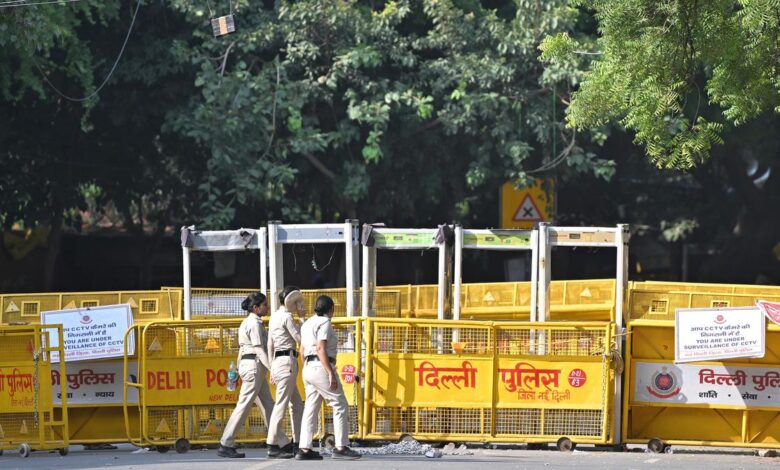
The fortress and the fly
On Friday the Supreme Court told the government not to “use a hammer to kill a fly”. On Saturday the government brought the hammer, the anvil and the whole foundry. The fly, for the record, was a group of young people calling themselves cockroaches, asking the Chief Election Commissioner to resign over the Special Intensive Revision of the voter rolls.
Here is what a suggestion from the highest court in the land is worth, counted in the State’s own numbers and the day’s reporting:
- About 23,000 central paramilitary personnel in Delhi, some pulled off anti-Naxal duty and out of Jammu, to guard a pavement.
- Around 45 metro stations shut, trains into New Delhi and Nizamuddin curtailed, and the internet switched off within four kilometres of Jantar Mantar.
- Stadiums turned into detention centres, one for each of 20 police zones.
- More than 3,000 people detained, by Delhi Police’s own count.
- Police boarding a commercial flight on the tarmac to pick up Abhijeet Dipke and two colleagues before their feet touched Delhi.
- Two former chief ministers, Mamata Banerjee and Arvind Kejriwal, in police vans. Pinarayi Vijayan too, says his party.
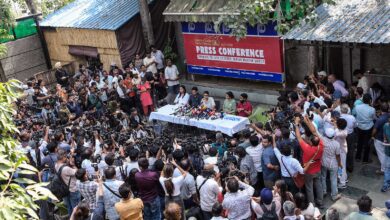
- Reporters from Newslaundry and Scroll detained and their phones seized, according to their newsrooms. One was reportedly told, “Koi media nahin hai.”
- Lawyers detained while walking from the Supreme Court’s own gate towards Jantar Mantar.
- The protest’s legal head stopped outside her home on what she was told were oral orders “from above”.
Permission for the protest was refused because, the police said, notice came at too short a span of time. The notice was short. The barricades, somehow, were ready.
Till when, My Lords?
To be fair to the Court, it has not been silent. It has been something worse: audible and irrelevant. It has spoken all year, and nothing it said has slowed a single police bus.
Follow the trail. On 22 July, two days after lathis, tear gas and pellet guns met students marching to Parliament, a lawyer rose to say he had videos of the beatings. The reply from the Chief Justice’s bench, as reported: “Don’t waste our time. We don’t want to watch any videos.” A week later the same Court observed that the Constitution guarantees peaceful protest and a lathi-charge cannot be justified. Stirring. Then it formed a committee, which is where urgent questions go to retire.
On 5 October it declined any interim order touching the CEC and agreed to list a plea against Delhi’s protest curbs, after first asking who the petitioner was. On 9 October, with the city already locked, it offered the hammer-and-fly remark as an oral suggestion. The Solicitor General promised to convey it and assured nothing. The Court did not touch the refusal of permission at all, because no aggrieved party had formally challenged it.
So the answer to “till when” appears to be: until the paperwork is in order. A spectator who occasionally clears his throat is still a spectator. The Court has perfected the art of the observation: grave enough to be quoted in the morning papers, weightless enough to be ignored by evening.
Will the Court let a democracy rehearse dictatorship?
Nobody announces a dictatorship. There is no gazette notification. It arrives as a series of administrative conveniences: a prohibitory order here, a closed metro station there, a network outage, a letter from the Home Secretary asking every state police chief to stop citizens from committing “unauthorised entry” into their own capital. Each step is defended as temporary. Each step is, of course, for our safety.
Look at what was being suppressed. Not a riot. A demand about the voter roll, the one document that decides who gets to choose the government. One of the Court’s own judges, Justice Ujjal Bhuyan, was reported this week as saying that a process which disenfranchises millions of citizens is intrinsically arbitrary. So people tried to say the same thing on a street. The State’s answer was that the roll may be revised, but the objection may not be voiced.
When asking a question about elections requires permission, and permission is never given, the election itself becomes a ceremony. That is the stake, and it is not small.
The Court knows how this story goes, because it has been in it. In 1976, in ADM Jabalpur, four judges agreed that a citizen detained during the Emergency had no remedy at all. One judge, H.R. Khanna, dissented and lost the Chief Justiceship for it. It took the Court 41 years to formally bury that judgment. Nobody remembers the four for their caution. The question for the present bench is simple: which side of that page would it like to be on, and would it prefer to find out in 41 years or this week?
Why is the Court not interfering? The excuses, examined
“Law and order is the executive’s domain.” True, and the Court said as much on 31 August. But fundamental rights are the Court’s domain, and that is the entire reason Article 32 exists. When the executive’s idea of order is the abolition of assembly, deference stops being restraint and becomes abdication.
“No aggrieved party has challenged the refusal of permission.” This was Friday’s reason. It is a marvellous one. The aggrieved parties are now easy to locate: they are in the stadiums. Several were detained on their way to court, including lawyers who set out from the Supreme Court’s own premises. A court that waits for petitioners while the police collect them is not being neutral.
“It is a Saturday.” This Court opened its doors around 3 a.m. in 2015 to hear a condemned man’s final plea. It sat past midnight in 2018 over who would form a government in Karnataka. It has convened on a Saturday morning when its own reputation was at stake. The registry can find a bench at any hour. It only needs a cause the Court considers urgent.
“The matter is already listed.” Listed for after the event, which is like scheduling the fire brigade for the week after the fire.
And then there is the most revealing fact of the day. When the Supreme Court Bar Association protested the detention of lawyers, the Chief Justice and the Solicitor General reportedly spoke to the authorities to get them released. So intervention is possible. It takes about an hour. It simply requires that the detained person own a black coat. The other three thousand, regrettably, do not have the Chief Justice’s number.
Where is the suo motu?
The power to act unasked is not a rumour. This Court has used it with enthusiasm. It took up the migrant workers’ crisis in 2020, oxygen supply in 2021, the Lakhimpur Kheri killings the same year, the Manipur video in 2023, the R.G. Kar case in 2024, and in 2025 the matter of stray dogs in Delhi.
Stray dogs received suo motu cognisance. Three thousand detained citizens, two former chief ministers and a handful of reporters are still waiting for theirs. One understands the difficulty. The dogs had not criticised anyone.
The sharpest precedent is the Court’s own. In June 2011, after police descended at midnight on a sleeping crowd at Ramlila Maidan, the Supreme Court took up the matter on its own motion and later held the crackdown an assault on basic democratic values. Same city. Same police force. Same right. The only thing that has changed is the appetite.
Nor is the law unsettled. The Court’s own rulings are being broken in plain view:
- Jantar Mantar itself. In 2018 the Court held that protests there cannot be banned outright, only regulated.
- Internet shutdowns. In 2020 it held that suspensions must be necessary, proportionate and published.
- Designated protest sites. In the Shaheen Bagh ruling it told citizens to protest at designated places. Jantar Mantar is the designated place. Citizens went there. They were put on buses.
- Detention. Article 22 promises a detained person a lawyer of their choice. The CJP alleges its leaders were denied one.
No fresh petition is needed for a court to notice that its own judgments are being used as scrap paper. That is not activism. That is self-respect. As of this writing, no suo motu case has been reported.
Robes today, sinecures tomorrow?
Now the question that is asked in every tea stall and never in open court. Are the guardians of the Constitution guarding it, or guarding their next posting?
There is no evidence that any sitting judge is trading silence for a sinecure, and this article does not allege it. It does not need to. The judiciary’s own maxim is that justice must not only be done but be seen to be done. Apply that standard to the judges and see how it looks.
A Supreme Court judge retires at 65. The government of the day, the largest litigant before that judge, then controls a generous menu: governorships, Rajya Sabha nominations, commissions, and the chairs of tribunals that statutes reserve for retired judges. The record is public:
- A Chief Justice of India was nominated to the Rajya Sabha four months after demitting office in 2019.
- A Supreme Court judge became Governor of Andhra Pradesh in 2023, less than six weeks after retiring.
- An earlier Chief Justice became Governor of Kerala in 2014, within months.
- A judge who had publicly praised the Prime Minister while in office went on to chair the National Human Rights Commission.
One widely cited study found that roughly 70 of the last 100 retired Supreme Court judges it examined had accepted some post-retirement assignment. A senior BJP leader, then in opposition, once warned Parliament that pre-retirement judgments are influenced by post-retirement jobs. His party has since governed for over a decade and found no reason to fix the problem it diagnosed so well.
The remedy has been on the table for years. A former Chief Justice proposed a cooling-off period. A few judges have simply refused all government posts and said so aloud. The institution has declined to make their example a rule.
So the citizen is entitled to ask, and the judge is obliged to tolerate the asking: when a court grows timid exactly where the government is most sensitive, is it restraint, or is it a résumé? If the suspicion is unfair, there is a quick way to kill it. Bar post-retirement government jobs. And in the meantime, rule as though no one in North Block will ever read the judgment.
The last word
This is not a demand that the Court sack an election commissioner or run the police. It is a demand that it do its own job, the one Dr Ambedkar called the heart and soul of the Constitution. That job can begin tonight:
- Convene a bench. The Court has done it at 3 a.m. for less.
- Call for the record of every detention made since 8 October: who, where, under what written order.
- Direct that every detainee gets a lawyer and is released or produced before a magistrate within 24 hours.
- Demand the written orders behind the internet shutdown, the metro closures and the train curbs, and test them for proportionality.
- Decide the one question it stepped around on Friday: can the police refuse every protest at the capital’s designated protest site?
- Turn Friday’s suggestion into an order, so that ignoring it has a price.
The judiciary runs on one asset only. It has no army and no treasury. It has the public’s belief that when everything else fails, the court will not. That belief is being spent in Delhi today, and the Court is spending it by doing nothing.
The cockroach, it is said, survives everything. The young people who borrowed its name seem determined to prove it. Whether the Court’s authority is as hardy is less certain.
My Lords, the Republic is outside. It has been put on a bus. It would like to know whether the Court intends to come out before the bus leaves, or to record, in a learned judgment some years from now, that it was a pity.
Sources
Events of 10 October are as reported up to about 5 p.m. IST and may have moved since. Detention figures and allegations are attributed to the police, parties or newsrooms that made them.