Trump Signs Oil Deal With Russia Despite Imposing Sanctions On India Last Month
Will India Also Impose Sanctions On USA?

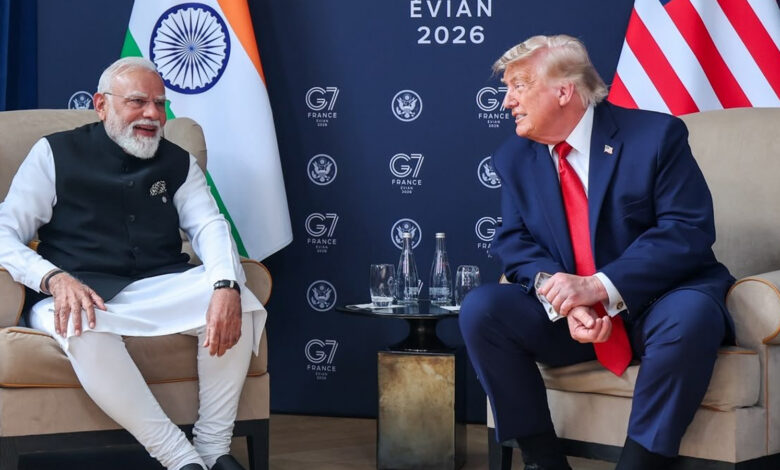
From “America First” to “Russian Diesel First”: Trump’s extraordinary energy-policy reversal exposes an uncomfortable question about double standards, economic coercion and the price of principles. If buying Russian oil is objectionable when India does it, why does the argument suddenly change when Washington wants Russian fuel for American consumers?
Investigative analysis | October 10, 2026
Washington has spent months lecturing New Delhi about the morality of buying Russian oil. India was warned that its energy trade with Moscow had consequences. Tariffs were imposed, trade negotiations became entangled in the Russian-oil dispute, and the United States justified its pressure by arguing that purchases of Russian energy help finance the Kremlin’s war against Ukraine.
Then came October 9, 2026.
President Donald Trump announced that Russia would supply diesel to the United States and global markets after what he described as a successful discussion with Russian President Vladimir Putin. Shortly afterwards, the US Treasury Department issued a temporary licence authorising specified transactions involving Russian-origin diesel.
Suddenly, the Russian energy that had been a problem when India bought it became a potential solution when America needed it.
Apparently, Russian fuel has a different moral character depending on which country’s tank is running low.
When India buys Russian crude to meet the energy requirements of its 1.4-billion-strong population, Washington reaches for its tariff toolbox. When American fuel prices become politically painful, the administration finds a way to facilitate access to Russian diesel.
This is not merely an argument about oil. It is an argument about consistency, economic sovereignty and whether international rules are being applied as principles or deployed as instruments of pressure.
The central question is unavoidable: Is America’s Russia policy about denying Moscow revenue—or about denying other countries the freedom to decide when Russian energy is commercially useful?
1. The Russian diesel reversal: A deal announced, but important details still missing
According to the Associated Press report of October 9, Trump announced a series of proposed Russian diesel supplies.
The quantities he cited were:
- More than 300,000 metric tons immediately.
- Another 500,000 metric tons in November.
- A further one million metric tons shortly thereafter.
- An additional three million metric tons within a relatively short period, conditional on the state and capacity of Russian diesel refineries.
These figures describe the announced supply plan, not independently verified deliveries. The additional three-million-ton tranche was conditional, and no public documentation reviewed for this article establishes that all the proposed shipments will be completed.
The announcement was accompanied by a consequential legal step. On October 9, the Treasury Department’s Office of Foreign Assets Control published General License 135. It authorises transactions otherwise prohibited under specified Russia-related sanctions regulations that involve the sale, delivery, offloading or importation—including into the United States—of Russian-origin diesel through 7 April 2027, subject to an exception concerning debits to accounts maintained by US financial institutions for Russia’s central bank, National Wealth Fund and Ministry of Finance.
That is a substantive relaxation of the restrictions applicable to the transactions covered by the licence. It is not a wholesale repeal of every American sanction against Russia.
There is another important distinction. Although Trump’s public announcement has been widely described as a deal, the detailed commercial contract has not been made public in the reporting reviewed here.
The AP reported that the White House had not immediately answered questions about who would pay for the diesel or when it would become available. A Russian presidential aide also declined to say whether Washington had made concessions in exchange for the supplies.
That leaves fundamental questions unanswered. Who are the buyers? What are the prices? How will the payments be routed? What obligations, if any, have the parties undertaken beyond the publicly announced supply plan?
These are not minor details. They determine whether this is a straightforward commercial arrangement, a temporary market intervention or part of a wider geopolitical understanding.
A presidential announcement is news. A Treasury licence is a legal document. Neither, by itself, reveals every commercial term or establishes that the promised volumes have reached American consumers.
The fuel may be on the agenda. The full accounting is not yet on the public record.
2. Sanctions for thee, diesel for me
The apparent contradiction becomes sharper when the October decision is placed alongside Trump’s previous policy.
On 6 August 2025, Trump signed Executive Order 14329. It imposed an additional 25% ad valorem tariff on imports from India, citing India’s direct or indirect purchases of Russian oil. The additional duty took effect later that month.
At the time, the additional oil-linked tariff helped raise the overall rate facing many Indian goods to 50%.
The official justification was explicit. The White House argued that India’s Russian-oil purchases enabled Russia’s economy to finance its aggression against Ukraine. It described the tariff as a way to pressure Moscow and impose consequences on countries supporting its energy economy.
That was Washington’s stated principle: Russian energy revenue was not simply a commercial matter. It was a geopolitical problem.
Now consider the October 2026 announcement.
Russia remains the source. Russian-origin petroleum remains the product. The war that formed the basis of the earlier American sanctions policy has not been shown to have ended as a precondition for this diesel arrangement. Yet Washington is now facilitating access to Russian diesel because additional fuel supplies are considered desirable.
The policy contradiction practically writes its own headline: when Indian refiners buy Russian crude, it is a geopolitical offence; when America seeks Russian diesel, it is an energy-market solution.
There are legitimate technical differences between purchasing crude oil and obtaining refined diesel. The products are not identical, and the legal provisions governing them are not interchangeable. Those differences deserve to be recognised.
But they do not erase the central political question. Both transactions concern Russian-origin energy, and both can have economic consequences for Russian producers.
If the American objection was that energy purchases provide Moscow with revenue, the administration now owes the public a clear explanation of why facilitating this particular stream of Russian energy is compatible with that rationale.
A principle that disappears when the petrol pump becomes expensive begins to look less like a principle and more like a price-sensitive policy.
Sources: White House Executive Order 14329; Associated Press, October 9, 2026.
3. September 2026: Washington sharpened the tariff threat against Russian-oil buyers
There is an important legal distinction that must not be lost in the anger over this reversal.
On September 18, 2026, Trump signed the Lindsey O. Graham Sanctioning Russia and Iran Act of 2026. The law expanded the administration’s powers and obligations relating to Russia sanctions and tariffs.
Section 113 provides for duties of up to 100% on goods imported from qualifying countries meeting the statute’s criteria concerning Russian-origin crude oil or natural gas purchases or assistance with sanctions evasion. The provisions include a category covering countries that make new purchases after the statutory 30-day period and were among the five largest importers, by volume, during the relevant preceding 12-month period. Another category concerns the top five countries facilitating Russian-oil sanctions evasion.
The law does not specifically name India in its operative list of countries. Nor does its enactment alone prove that a new 100% tariff had already been individually imposed on India by October 10.
The administration’s statutory deadline for the initial tariff action was October 18, 2026. The precise application of the law depends on its criteria and the implementing determinations.
These distinctions matter because serious investigative journalism must document the law, not merely repeat the most dramatic interpretation of it.
But the broader policy contrast remains substantial. In August 2025, Washington had specifically penalised India over Russian oil. In September 2026, it adopted a new statutory framework capable of exposing qualifying Russian-energy buyers to tariffs of up to 100%. Then, in October, it announced an arrangement intended to enable Russian diesel transactions for American and global markets.
The administration has therefore presented two messages within the same policy universe: buying Russian energy can expose foreign countries to punitive trade measures, yet facilitating access to Russian diesel can be justified when American economic conditions call for it.
That is precisely the sort of inconsistency that deserves scrutiny.
The Reuters report on the September 18 law and the official legislative text recorded by Congress provide the legal context.
4. The price of diesel—and the price of political convenience
Trump has justified the supply arrangement in terms of falling energy prices and relief for American farmers, ranchers and truckers. Those are legitimate public concerns. Diesel costs influence freight, agriculture, construction and the distribution of goods, with effects that can eventually reach consumers.
Yet the market figures reveal why this announcement cannot be treated as a guaranteed solution.
The AP reported that the US national average diesel price stood at $6.28 per gallon on October 9, after reaching a record $6.52 on September 22. The comparable figure a year earlier was $3.68 per gallon.
The increase is steep enough to create substantial political pressure on any administration. It also helps explain why an arrangement involving Russian fuel could suddenly appear attractive.
But an announcement and a durable reduction in prices are two different things.
Energy analysts quoted by the AP questioned whether diverting additional Russian diesel to the United States would materially lower overall prices. The Washington Post reported an estimate of approximately 74,000 barrels per day of additional supply in the short term, while analysts cautioned that the increase would be relatively modest against the scale of the market disruption.
The problem is structural. The market has faced refinery constraints and damage to energy infrastructure. A new supply route cannot instantly repair damaged facilities or manufacture missing refining capacity.
There is an additional complication on the Russian side. Reuters and the AP have reported that Ukrainian attacks have damaged Russian refining infrastructure and that Russian diesel output has fallen. Russia had also restricted diesel exports while responding to its domestic fuel requirements.
This raises an obvious question: if Russian refinery capacity is constrained, how much of the announced volume can actually be supplied, and on what timetable?
It is possible that additional supply will offer some relief. It is equally important not to confuse a political promise with an established market outcome.
In other words, the diesel deal may help Washington demonstrate action on prices before the midterm elections scheduled for November 3. Whether it produces lasting relief is a different question.
The administration has announced a barrel of promises. Consumers still need the price relief.
Sources: AP on the deal and market reaction; AP on the likely price impact; The Washington Post.
5. The question Washington cannot dodge: What happened to the argument about funding Russia’s war?
Ukrainian President Volodymyr Zelenskyy condemned the announcement as a weak decision by strong partners. He argued that easing restrictions on Russian diesel could provide Moscow with an economic benefit while the war continued.
The timing intensified the criticism. Trump’s announcement came while US envoys Steve Witkoff and Jared Kushner were meeting Ukrainian officials in Miami to discuss a proposal aimed at ending the war.
Zelenskyy’s concern is straightforward: revenue earned from energy exports can support Russia’s broader economy while the government continues to fund the war.
That does not mean every dollar earned from a diesel cargo can be traced directly to a specific battlefield operation. Such a claim would require evidence that is not established by the announcement. But energy revenues have long formed an important part of Russia’s economic position, and the potential contribution of renewed exports is a legitimate subject for scrutiny.
The strategic question is whether Washington has altered its approach to Russian energy in response to its immediate economic needs without clearly explaining the implications for Ukraine.
If the arrangement is purely commercial, the administration should be able to explain its scope, the anticipated market impact and the safeguards it considers necessary.
If it forms part of a wider diplomatic understanding, the public should be told what can appropriately be disclosed.
And if the principal motivation is to lower American fuel prices, the administration should acknowledge the trade-off rather than treating the earlier sanctions rationale as though it never existed.
The difficulty is not that a government can never change policy. Governments must respond to changing conditions. The difficulty is changing the policy while continuing to demand that other countries pay an economic price for conduct the administration is now prepared to accommodate for itself.
A policy reversal is not automatically hypocrisy. A policy reversal without a convincing explanation invites the accusation.
The strongest criticism of this arrangement is not that America should be forbidden from purchasing any Russian-origin product in every imaginable circumstance. It is that Washington needs a consistent, transparent explanation for why the same broad economic activity is framed as objectionable when undertaken by India and useful when undertaken for American needs.
Sources: Associated Press; Axios interview with Zelenskyy.
6. India’s case: Energy security is not a favour that Washington grants
India has repeatedly argued that its energy purchases must be assessed in light of its population, energy requirements and the conditions prevailing in global markets.
That position is not equivalent to denying the economic consequences of Russian energy purchases. It is a claim that New Delhi, rather than Washington, must account for India’s national interests when making its energy choices.
India bought more than $43 billion of Russian crude in 2025, according to reporting by the Economic Times, and Russian oil remained a major part of the country’s crude supply in 2026.
The commercial calculation includes price, availability, refinery compatibility, freight and the need to keep an enormous economy supplied with fuel. Discounted Russian crude became particularly important after Russia’s full-scale invasion of Ukraine, as Western sanctions reshaped energy flows.
The Indian government has also challenged what it views as selective Western criticism.
In August 2025, India’s Ministry of External Affairs argued that the US continued trade with Russia in products including uranium hexafluoride used by the nuclear industry, palladium used in industrial applications, fertilisers and chemicals. India also highlighted continuing European trade with Russia.
The point was not that every category of trade was legally or commercially identical. The point was that Western countries themselves maintained economic relationships with Russia while criticising India’s energy decisions.
That argument has become harder for Washington to dismiss following the diesel announcement.
The American position now has to answer a straightforward question: if national economic needs can justify facilitating Russian-origin diesel transactions for the United States, why should India’s energy-security calculations be treated as inherently less legitimate?
The answer cannot simply be that American needs are important while Indian needs are expendable.
Nor does the fact that Russia can profit from exports mean the United States must automatically ban every possible transaction forever. It means the administration must explain why its framework is applied in different ways and what factual criteria justify those distinctions.
India should demand that explanation firmly and publicly, without overstating the legal equivalence between different energy products.
The essential argument is about consistency: if Washington insists that buying Russian energy has geopolitical consequences, it must be willing to apply that reasoning to its own choices—not merely to the choices of countries it can pressure through tariffs.
Sources: Reuters on India–US trade negotiations, October 6, 2026; The Economic Times on India’s Russian crude imports; The Week’s report on India’s official response.
7. Will India also impose sanctions on the USA?
This is the question New Delhi should now assess with a cool head and a clear understanding of its available tools.
As of October 10, 2026, the reporting and official materials reviewed for this article do not establish that India has announced a new package of sanctions against the United States in response to Trump’s Russian diesel arrangement.
A distinction is necessary. Tariffs, financial sanctions and other trade restrictions are different instruments. Public discussion often lumps them together, but they carry different legal consequences and serve different purposes.
A blanket Indian sanctions regime against the United States would be a major escalation. It could affect Indian exporters, importers, investors and consumers as well as American businesses. It could also complicate defence cooperation, technology partnerships, investment and ongoing trade negotiations.
A targeted trade response, however, would not be unprecedented.
In June 2019, India imposed retaliatory duties on 28 products originating in or exported from the United States following American tariffs on steel and aluminium. The Indian government estimated that the duties would add approximately $217 million to the duty incidence on those imports.
The Indian government’s official account establishes that New Delhi has previously used customs duties to respond to US trade restrictions while keeping diplomatic engagement open.
India therefore has historical precedent for calibrated economic retaliation. That does not mean it has decided to use the same mechanism now.
There are also substantial economic stakes. According to the Office of the US Trade Representative, US goods and services trade with India totalled an estimated $239.6 billion in 2025. Reuters reported that Indian goods exports to the United States reached $42.79 billion in April–August 2026 and that India recorded a trade surplus of almost $34 billion with the US in fiscal year 2025–26.
The United States is India’s largest export market. Any retaliatory step would need to account for the interests of Indian businesses and workers, not merely deliver a headline-grabbing response.
So, will India impose sanctions?
There is no verified basis, as of this article’s reporting cutoff, to claim that a new Indian sanctions package has been decided. A targeted tariff response, a formal diplomatic protest, trade-law proceedings or other calibrated measures are possibilities, not confirmed government decisions.
The stronger question is not whether India should imitate Washington’s use of economic pressure. It is whether New Delhi should insist that the United States explain and justify the inconsistency in its policy—and preserve its ability to respond if Indian interests are unfairly targeted.
India’s message should be that commercial decisions affecting its energy security cannot be judged by a standard that becomes optional when the United States faces its own shortage.
8. Should India retaliate? Yes, it should preserve the option—but choose the instrument strategically
There is a difference between a forceful response and a reflexive one.
India should not impose sweeping sanctions merely to demonstrate anger. A measure that damages Indian industry more than it affects Washington would be an expensive press release disguised as economic policy.
A more disciplined approach would begin with three questions.
First, what exactly has the United States done? New Delhi must distinguish between the August 2025 tariff decision, the September 2026 legislation creating potential exposure to additional duties, and the October diesel licence. Each has a distinct legal basis and should be addressed on its own terms.
Second, what would impose a meaningful cost without disproportionate damage to Indian interests? The 2019 precedent shows that India can target selected US-origin goods with additional duties. Any new measure should be evaluated for its actual economic effect, available legal justification and likelihood of advancing India’s objectives.
Third, what outcome does India seek? If the goal is consistent treatment, a transparent rule for Russian-origin energy trade and protection for Indian exporters, then diplomacy, trade negotiations and available legal remedies may accomplish more than an indiscriminate sanctions package.
New Delhi should also insist on clarity over how Washington will implement the September law. The new statutory framework creates the possibility of duties of up to 100% on qualifying countries, but the public record must be examined carefully before claiming that India has already been hit with that rate.
A credible policy cannot be built on speculation. Neither should it be built on silence when the stakes are substantial.
The smartest response would combine public accountability, legal scrutiny and a credible, proportionate set of options. It would preserve leverage without treating retaliation as an end in itself.
9. The questions the Trump administration must answer
This announcement calls for more than political slogans. A rigorous public accounting should address the following issues.
On the commercial arrangement: Who are the contractual buyers and sellers? What prices and delivery schedules apply? Which ports, tankers and commercial intermediaries are involved? What proportion of the announced volumes is intended for direct US importation, and what proportion is destined for other markets?
On the sanctions framework: How does the administration reconcile the new diesel authorisation with the policy rationale behind earlier Russian-energy import restrictions? What safeguards govern the handling of payments and the involvement of sanctioned entities? How will the administration ensure that the licence is not misrepresented as a broader relaxation of sanctions than it actually authorises?
On the promised public benefit: What volume is expected to reach the US market, and on what timeline? How will the administration assess the effect on wholesale and retail diesel prices? What evidence supports the claim that the arrangement will provide meaningful relief rather than merely reroute supplies between customers?
On Russia and Ukraine: What, if anything, was promised or agreed beyond diesel supplies? The public reporting reviewed here does not establish that Washington granted a concession to Moscow. It also does not disclose the full commercial terms. That is a reason to seek documentation, not a licence to invent secret conditions.
On India: What criteria will determine the application of the September law to qualifying countries? How will the administration explain its distinction between penalising India’s Russian-oil purchases and facilitating Russian-origin diesel transactions for US and global markets?
These questions are not anti-American. They are basic questions of accountability for a major policy decision with consequences for trade, energy and international security.
If the arrangement is sound, the facts should strengthen its defence. If it is as economically transformative as advertised, the data should demonstrate the benefits. If there are limits or trade-offs, the administration should acknowledge them.
10. The real test of “America First”
“America First” is a political promise to put the interests of American citizens at the forefront of government policy. Reducing fuel costs for farmers, truckers and households falls squarely within that promise.
But a national interest is not a blank cheque to demand sacrifices from other countries while making exceptions for oneself without explanation.
If Washington believes Russian energy purchases support Moscow’s war economy, it must explain why facilitating Russian diesel is compatible with that assessment. If it believes the products, transactions or legal conditions differ materially, it should spell out those differences. If the policy has changed because market conditions changed, it should say so.
That is what consistency requires.
There is also a strategic cost to selective pressure. When a powerful country imposes punitive trade measures on a partner and then adopts a seemingly contrary policy, it gives that partner reason to question whether the rules are stable or subject to sudden political convenience.
India is not obliged to accept every American interpretation of its national interest. Neither is Washington obliged to agree with every Indian energy decision. But a durable bilateral relationship requires more than demands from one side and explanations from the other.
It requires transparent standards that apply when compliance is costly for both parties.
A relationship of this scale cannot be reduced to a cycle of tariff threats, diplomatic reassurance and improvised exemptions. The economic consequences reach far beyond political leaders. Indian exporters, American consumers, energy companies and businesses operating across both markets have a legitimate interest in predictable policies.
That is why the diesel announcement matters. It challenges not merely a particular tariff, but the credibility of the rationale that supported it.
Conclusion: If Russian diesel is acceptable for America, India deserves an answer
The October 9 announcement places a pointed question before Washington.
For months, the United States has argued that India’s purchases of Russian oil have consequences for Russia’s economy and the war in Ukraine. In August 2025, it imposed an additional tariff on Indian goods on that basis. In September 2026, it enacted a further statutory framework capable of exposing qualifying countries to tariffs of up to 100%. In October, it announced an arrangement intended to facilitate Russian diesel transactions to help address American energy costs.
The precise products, legal provisions and commercial conditions differ. Those differences matter, and the facts do not support claiming that India has already been individually subjected to a new 100% tariff under the September law.
But the broader contradiction remains visible.
When India buys Russian energy, Washington says economics cannot be separated from geopolitics. When Washington seeks Russian diesel, it says economics must be addressed urgently.
That is the double standard New Delhi should challenge—not with exaggerated claims, not with a rushed announcement of sanctions that have not been imposed, but with the force of documented facts and a credible willingness to protect its interests.
India should ask the administration to explain its rule, disclose the scope of its decision and demonstrate how the diesel arrangement fits its stated strategy towards Russia. It should preserve lawful, proportionate trade responses if its own interests are unfairly targeted, while carefully measuring the costs of escalation.
Will India impose sanctions on the United States? As of October 10, 2026, no new Indian sanctions decision has been established by the public sources reviewed here. Whether India takes further action will depend on its assessment of the law, the trade relationship and its national interests.
But it does not need to announce sanctions tomorrow to pose a legitimate question today.
If American consumers can benefit from a Russian diesel arrangement, why should Indian consumers and industries be treated as though India’s energy choices are inherently illegitimate?
A barrel of oil does not acquire a different origin because it crosses an American border. Nor should the standards of foreign policy change every time the political price of consistency rises.
America may put itself first. India is entitled to put its own national interests first as well.
The ultimate test is simple: if the rule is that Russian energy revenue matters, the rule must be explained and applied consistently. Otherwise, what is being sold as a universal principle risks looking like a tariff with a geopolitical label.
In international energy politics, the barrels may be Russian—but the double standard is home-grown.