87 Million Young Indians Outside The Education And Employment System Why India’s Growth Story Has A Missing Link And A Generation Struggling To Find Its Place
India is attracting investment, expanding its economy and producing millions of graduates, yet meaningful employment remains elusive for a vast section of its young population. With 87 million Indians outside education, employment and training, the country's demographic advantage is confronting an uncomfortable question: where are the jobs?

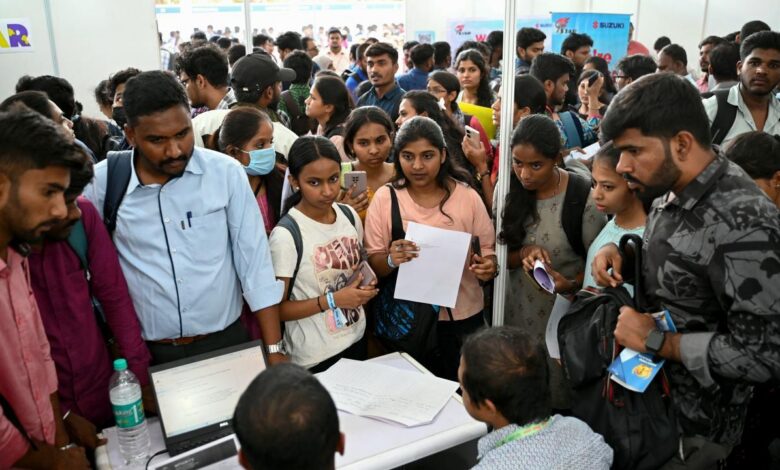
India’s economic ambitions are expanding, its universities are producing millions of graduates, and investments continue to flow into manufacturing, technology and infrastructure. Yet somewhere between acquiring a degree and finding a stable job, millions of young Indians are getting left behind.
A NITI Aayog report has put a number to this disconnect, estimating that 87 million Indians aged 15–29 were outside education, employment and training. The figure is difficult to ignore, particularly for a country that has repeatedly identified its young population as one of its greatest economic advantages.
The estimate, published in NITI Aayog’s report Reimagining Skilling for Viksit Bharat@2047, is based on the 78th round of the National Sample Survey conducted in 2021. It identifies young people who are not participating in education, employment or formal training. However, there is an important distinction here.
The 87 million figure is not a measure of unemployed youth. NITI Aayog subsequently clarified that its NEET classification refers to people outside these three systems and should not be interpreted as an addition to India’s unemployment numbers.
Nevertheless, the scale of the population outside education, employment and training raises uncomfortable questions about how effectively India is preparing its young workforce for the economy it hopes to build.
The problem is not simply that young people are unable to find jobs. It is also that many are struggling to acquire relevant skills, transition from classrooms into workplaces, or access employment that offers a reasonable degree of financial security.
The contradiction becomes more pronounced when viewed against India’s economic expansion. Growth in gross domestic product, higher investment commitments and the emergence of new industries are important indicators of economic progress. But they do not automatically translate into jobs for the millions entering the labour market every year. Nor does every job created offer adequate wages, security or opportunities for career progression.
The latest labour market figures underline why the issue cannot be dismissed. According to the October 2026 Periodic Labour Force Survey, unemployment among Indians aged 15–29 stood at 14.7%, considerably higher than the overall unemployment rate of 4.9% among people aged 15 and above. Urban youth unemployment was even higher at 18.3%. These figures measure a different population and a different indicator from the 87 million NEET estimate, but together they illustrate the difficulties surrounding young Indians’ transition into productive employment.
For a country hoping to turn its demographic advantage into sustained economic prosperity, this is a significant challenge. India’s young population can become an engine of consumption, productivity, entrepreneurship and industrial expansion, but only if the economy can absorb it into meaningful work. A growing workforce without sufficient opportunities risks turning a demographic advantage into a prolonged employment challenge.

Millions Of Graduates, But Where Are The Jobs?
India’s higher education system has expanded considerably over the past two decades. More universities, colleges and professional institutions have opened up opportunities for young people who might previously have had limited access to higher education.
A degree has increasingly become a basic expectation among families seeking better incomes and social mobility. But the expansion in the number of graduates has not been matched by an equivalent expansion in suitable employment.
The March 2026 State of Working India report by Azim Premji University spotlights the extent of this disconnect. Graduate unemployment among people aged 15–25 stands at nearly 40%, while the rate among graduates aged 25–29 is approximately 20%. The report also points to a widening gap between the number of graduates entering the labour market and those actually finding employment.
Between 2004–05 and 2023, India added approximately five million graduates every year. However, only around 2.8 million found employment annually. Even fewer entered stable salaried jobs. In other words, the education system has been producing graduates at a pace that the employment market has struggled to match.
The problem is particularly concerning because higher education is still widely viewed as the most reliable route to financial independence. Families invest considerable amounts of money in tuition, accommodation, coaching and professional courses, often expecting a degree to lead to a better-paying career.
When graduates spend months or years searching for work, or eventually accept positions that offer little connection to their qualifications, the economic return on that investment becomes questionable.
The problem is not restricted to the absence of vacancies. The nature of available jobs and the qualifications employers demand are also contributing to the mismatch.
A graduate with a general degree may find that the employment market increasingly expects specialised technical knowledge, practical experience, digital capabilities or industry-specific training. Meanwhile, employers often complain that applicants emerging from educational institutions are not adequately prepared for the requirements of the workplace.
The result is a difficult cycle. Young people spend years acquiring formal qualifications, employers struggle to find candidates with the skills they require, and graduates find themselves competing for a limited pool of suitable entry-level positions. Many eventually accept jobs unrelated to their education, while others remain outside the workforce altogether.
This is also where India’s employment challenge moves beyond conventional unemployment statistics. A person holding a degree but working in a position that neither utilises their education nor offers meaningful career progression may technically be employed, but the larger question of productive employment remains unanswered.
For millions of Indian families, the promise of higher education was that it would open doors to better opportunities. The growing disconnect between degrees and jobs suggests that the promise is becoming increasingly difficult to fulfill.
A Degree That Does Not Translate Into A Career
The problem with India’s graduate unemployment crisis is not simply the number of people competing for jobs. It is also the growing disconnect between what students study and what employers are actually looking for. A degree may open the door to the employment market, but it does not necessarily equip a candidate with the skills required to remain competitive in it.
NITI Aayog’s August 2026 report, Reimagining Skilling for Viksit Bharat, showed the extent of this mismatch. Drawing on the Economic Survey 2024–25, it noted that only 8.25% of graduates were employed in roles aligned with their qualifications. More than 90% were working in positions that did not correspond to their educational backgrounds.
The report also pointed to the concentration of undergraduate enrolment in traditional programmes, with more than two crore students pursuing BA, BSc and BCom degrees.
This does not mean that these degrees have no value. The concern is that academic qualifications are not consistently being connected to practical workplace requirements. Employers increasingly seek specialised knowledge, digital capabilities and industry experience, while many graduates leave college without sufficient exposure to actual working environments.
The competition for government employment adds another dimension. NITI Aayog cited 1.86 crore applications for just 55,000 government posts between November 2024 and July 2025. The numbers illustrate how heavily young Indians continue to depend on a relatively narrow pool of secure employment opportunities.
The mismatch also has a gender dimension. NITI Aayog reported graduate unemployment of 20.4% among women, compared with 13% among graduates overall. The figures point to additional barriers facing educated women attempting to enter the workforce.
India’s challenge, therefore, is not merely to produce more graduates or expand access to higher education. It must ensure that education leads somewhere, with stronger industry connections, relevant curricula, practical training and credible pathways into employment.

India’s Demographic Dividend Is Becoming An Economic Challenge
For years, India’s large young population has been presented as a major advantage in its pursuit of economic growth. Unlike ageing economies struggling with shrinking workforces, India has a substantial population entering working age. In theory, this offers the country a powerful opportunity to expand production, consumption, entrepreneurship and its global economic influence.
But a demographic dividend is not created simply by having more young people. It materialises only when they can participate productively in the economy. Without enough employment opportunities, relevant skills and access to decent wages, a growing working-age population can become an economic challenge rather than an advantage.
The pressure is particularly visible in urban India, where young job seekers increasingly compete for formal employment in sectors such as technology, finance, consulting and professional services. These industries offer attractive career prospects but cannot absorb the entire population entering the labour market. Meanwhile, traditional avenues such as government recruitment have become intensely competitive.
There is also a gender dimension to the problem. Educated women face additional obstacles involving workplace access, mobility, safety and care responsibilities. The October 2026 PLFS recorded female labour force participation at 35% among people aged 15 and above, compared with 75.5% for men. Although participation has improved, the difference illustrates how much of India’s potential workforce remains outside the labour market.
The consequences extend beyond individual job searches. When young people cannot secure stable employment, their ability to become financially independent, support families, purchase homes or contribute to consumption is affected. The economy also loses productive capacity when educated workers remain underutilised.
India’s demographic advantage comes with a limited window of opportunity. The country must convert its expanding workforce into productive employment before the opportunity begins to narrow. Economic growth can create the conditions for this transition, but it cannot substitute for the jobs, skills and wages that make the demographic dividend meaningful.
Where Is India Actually Creating Jobs?
India’s employment challenge is also a question of where economic growth is taking place. While technology, financial services, infrastructure and manufacturing continue to attract investment, their ability to generate employment varies considerably. An industry can expand its output, increase productivity and attract capital without necessarily creating jobs at the same pace.
Services have emerged as an important source of employment. The Economic Survey 2025–26 identified the sector as a key driver of urban hiring, with services accounting for 51.7% of net formal employment additions recorded through EPFO between April and July 2025. Professional services, trading establishments and commercial activities contributed to this expansion. Construction has also remained an important source of employment, particularly for workers moving out of agriculture.
Manufacturing, however, remains a critical part of India’s employment ambitions. The government’s push for domestic production, electronics manufacturing, semiconductors and infrastructure investment is intended to strengthen India’s industrial base. But attracting investment and generating large numbers of jobs are two different outcomes. Increasing automation, capital-intensive production and the growing use of technology can allow factories to produce more without proportionately expanding their workforce.
The latest July-September 2026 PLFS data offers another perspective. Agriculture continued to account for 56.7% of rural employment, up from 52.9% in the preceding quarter. The tertiary sector accounted for 21.4% of rural employment, while the secondary sector represented 21.9%. These figures underline how heavily rural employment continues to depend on agriculture, even as India attempts to move towards a more industrial and services-led economy.
The challenge, therefore, is not simply to attract more investment. India needs investment in industries capable of absorbing large numbers of workers, including textiles, food processing, construction, tourism, logistics and manufacturing. It also needs to improve the productivity and earnings of people already employed in agriculture and informal work.
The distinction between economic expansion and employment generation is becoming increasingly important. India may be building a larger economy, but the real test will be whether that expansion creates enough productive opportunities for the people entering its workforce.

India Inc Under Scrutiny As Modi Questions Jobs And Salaries
The employment debate has now moved beyond government policy and education reform to the responsibility of corporate India itself. On November 19, 2026, Prime Minister Narendra Modi used the FICCI annual convention to question whether businesses had translated government tax concessions and policy support into higher salaries and increased hiring.
Modi pointed to the reduction in the basic corporate tax rate from 30% to 22%, asking industry leaders whether the benefits had resulted in more employees or better compensation. His criticism was directed at companies that continued to seek government support without demonstrating a corresponding contribution to employment creation and worker incomes.
The remarks raise an important economic question. Corporate tax reductions are intended to improve investment incentives, strengthen business activity and support expansion. But there is no automatic mechanism requiring companies to use the resulting savings to hire additional workers or increase salaries. Businesses make those decisions based on demand, profitability, competition, technology requirements and their expectations of future growth.
Nevertheless, the gap between corporate performance and employee compensation has attracted attention. An analysis of 4,046 companies found that their combined wage bill increased by approximately 9% in FY26, while net profits rose by nearly 19%. The comparison does not establish that tax cuts caused companies to hold back salaries, but it shows the difference between the growth in corporate earnings and employee expenditure.
The issue is particularly relevant in an economy where young graduates are struggling to secure well-paying entry-level positions. Stronger corporate balance sheets and higher investment announcements do not necessarily translate into broader wage growth or a substantial increase in permanent employment.
Modi’s remarks have therefore brought an uncomfortable question into the open: if economic growth is benefiting businesses, how much of that prosperity is reaching the workforce? The answer cannot rest entirely with industry, since job creation also depends on demand, education, infrastructure and government policy. But corporate
India remains a central part of the employment equation, and its hiring and compensation decisions will help determine whether India’s growth reaches beyond company balance sheets.
Getting Hired Is No Longer The Finish Line
For India’s young professionals, finding a job is increasingly only the beginning of another set of uncertainties. Corporate restructuring, layoffs and concerns over workplace fairness have made employment security an important part of the conversation. The recent Qualcomm restructuring in India offers a telling example.
The chipmaker’s workforce reduction, reportedly affecting more than 1,000 positions, triggered questions about how employees were selected for termination. According to an internal AI analysis of employee discussions on workplace platform Blind, shared with People Matters on November 18, 47.7% of Qualcomm layoff-related discussions cited workplace politics or favouritism, compared with 34.2% that referred to cost or performance.
Qualcomm CEO Cristiano Amon, however, described the restructuring as performance-focused, linked to annual reviews, business priorities and the capabilities required for future growth. The company has not officially confirmed the reported number of Indian job cuts or the specific selection criteria. The allegations circulating on Blind are anonymous employee accounts, not independently verified evidence of discriminatory decisions.
Nevertheless, the episode is indicative of a wider concern in India’s corporate employment market. Young employees are entering workplaces where performance expectations are rising, organisations are restructuring and long-term job security can no longer be taken for granted.
For someone who has spent years acquiring qualifications and competing for a position, the prospect of losing that job through restructuring introduces another layer of uncertainty. Employment is no longer simply about getting a salary at the end of the month. It is also about whether the position offers stability, transparent evaluation and a reasonable opportunity to build a career.

Gen Z Is Questioning The Employment Bargain
The expectations surrounding employment are also changing. India’s younger workforce is increasingly questioning workplace arrangements that previous generations may have accepted as an unavoidable part of starting a career. Low entry-level salaries, unpaid learning periods, salary deductions for training and limited opportunities for advancement are becoming contentious issues.
An CFO report published in July 2026 illistrated this tension, noting that some employers were introducing policies requiring employees to bear training costs through deductions from their salaries. The argument from businesses is that fresh recruits often require months of training before becoming productive. However, asking employees to finance the training required to perform their jobs raises questions about where the responsibility for workforce development should lie.
The problem is not confined to compensation. Employers want candidates who can contribute immediately, while graduates often leave educational institutions without the practical experience businesses demand. Companies complain about skill shortages, but young applicants question why they should accept low wages or pay for the training needed to become employable.
This creates a difficult hiring equation. Businesses want work-ready employees without carrying excessive training costs, while young professionals want fair compensation, structured learning and a credible path towards career progression.
Gen Z’s changing expectations should not automatically be interpreted as an unwillingness to work. They also reflect a generation entering a competitive employment market in which educational costs are high and financial independence is increasingly difficult to achieve. The question for India Inc is whether its hiring practices can adapt to a workforce that expects employment to offer more than a designation and a monthly salary.
The Economic And Social Cost Of A Generation Waiting For Jobs
The consequences of India’s employment problem extend well beyond unemployment statistics. For millions of young people, prolonged job searches mean delayed financial independence, dependence on family support and uncertainty about major life decisions. Years spent acquiring qualifications can end in repeated recruitment examinations, unpaid internships or jobs that offer little connection to their education.
The pressure is particularly visible among families that have invested heavily in higher education, coaching and professional courses. A graduate who cannot find suitable employment represents not just an individual setback but also an underutilised investment in human capital. When large numbers of educated young people remain outside productive employment, the economy loses potential workers, consumers, taxpayers and entrepreneurs.
There is also a wider consumption effect. Stable employment and predictable incomes allow young households to spend on housing, healthcare, education and other goods and services. Insecure work and low wages can delay these decisions, limiting the economic benefits that a large young population could otherwise generate.
The pressure to secure government jobs, migration in search of better opportunities and the acceptance of informal or poorly paid work are further consequences of a market that cannot consistently provide suitable employment. These developments do not affect every young Indian in the same way, but they reveal the costs of an employment system that leaves too many people struggling to establish a secure economic footing.
For India, the larger risk is allowing its expanding educated population to remain underutilised. A demographic dividend cannot be measured simply by the number of people entering working age. Its value depends on how many can participate meaningfully in economic activity and earn enough to improve their own lives.

Can India Turn Its Growth Into Good Jobs?
India’s employment challenge will not be resolved through a single government programme or another round of skilling announcements. It requires a closer connection between the country’s education system, industrial policy, private investment and actual labour market requirements.
Manufacturing remains an important part of that equation. Labour-intensive industries such as textiles, food processing, footwear, electronics assembly and tourism can create opportunities across different skill levels. However, investment incentives must translate into operating businesses, sustained recruitment and better wages rather than remaining limited to announcements and capital expenditure.
Education also needs to become more closely connected to employment. Industry-linked courses, apprenticeships, vocational training and practical exposure can help graduates move from classrooms into workplaces. Employers, meanwhile, need to recognise that workforce development cannot be treated entirely as a cost to be transferred to fresh recruits.
The government must also address the quality of employment, not just the number of positions created. Formalisation, social security, predictable wages and stronger access to employment opportunities for women are essential to making economic participation sustainable. Improving the conditions of informal workers is equally important, given their significant presence in India’s workforce.
Corporate India has a role to play as well. Investment and profitability matter, but so do recruitment, employee compensation and the creation of sustainable career opportunities. The question raised by the Prime Minister at the FICCI convention is therefore relevant beyond the immediate political exchange: how much of India’s economic expansion is reaching the people expected to power its next phase of growth?
India has the advantage of a large young population, expanding infrastructure and an economy attracting investment across multiple sectors. But these advantages will not automatically produce secure employment. The 87 million NEET estimate is a reminder of the scale of the challenge, even though it is based on older survey data and does not represent the number of unemployed young Indians today.
The test of India’s growth story will ultimately be measured not only by GDP, investment announcements or the number of graduates leaving universities, but by whether young Indians can turn their education and abilities into productive work, financial independence and a reasonable degree of security.
Until that connection becomes stronger, the country’s employment problem will remain one of the most important unfinished parts of its economic ambitions.