VIKSIT BHARAT OR BARRICADED BHARAT? Modi Government’s Crackdown on Youth Protest Disrupts Ordinary Indians’ Lives as Supreme Court Flags “Overreaching” Restrictions
245 trains cancelled. Metro access restricted across dozens of stations. More than 2,000 protesters detained, according to a Home Ministry official cited by Reuters. Mobile internet suspended in parts of central Delhi. And the Supreme Court questioning whether the government’s transport restrictions went too far. The question is no longer merely why a youth-led protest was denied permission. It is why the Modi government’s response threatened to turn an anticipated demonstration into a disruption for thousands of citizens who had nothing to do with the political confrontation.

India’s political leadership loves the language of transformation. Viksit Bharat. Digital India. World-class infrastructure. A rising global power. A demographic dividend. An ambitious nation marching confidently towards a developed future.
But the credibility of these slogans is measured not during carefully staged ceremonies or carefully polished speeches. It is measured on the day an ordinary passenger reaches a railway station and discovers that the train he paid for has been cancelled. It is measured when a student cannot reach an examination, a worker loses wages because the Metro route has been disrupted, or a family finds itself stranded because the administration has decided that a political demonstration requires extraordinary restrictions on public movement.
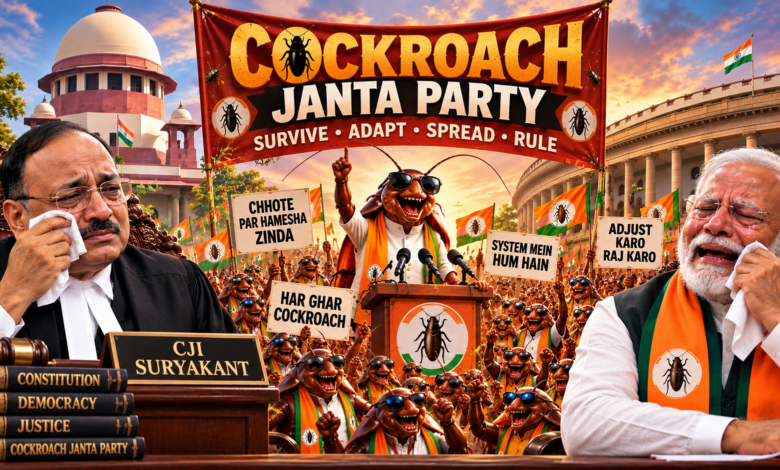
That is the uncomfortable test confronting the Narendra Modi government following the restrictions imposed ahead of the Cockroach Janta Party’s proposed demonstration at Jantar Mantar on 10 October 2026.
Indian Railways cancelled 245 train services originating from or terminating at Delhi stations, including 75 mail and express trains and 170 passenger trains. Two additional services were rescheduled, while nine were short-terminated or short-originated. The original police communications also envisaged reduced Metro frequency and restrictions on entry and exit gates at 57 stations. The arrangements actually announced by the Delhi Metro Rail Corporation subsequently covered 45 stations.
The government’s explanation was that security risks, anticipated congestion and the possibility of unruly crowd movements warranted preventive action. These are legitimate concerns for any administration to assess.
But a legitimate concern does not automatically justify every measure adopted in its name.
On 9 October, the Supreme Court of India examined the communications concerning railway and Metro restrictions. Its order recorded that trains had been instructed to cease operations or be cancelled because of the anticipated risk of crowds moving towards sensitive locations. The Court observed that the notifications appeared to be “overreaching” because they imposed a complete ban on essential public transportation. Following the Court’s intervention, the Solicitor General agreed to impress upon the authorities the need to reassess the prohibitions in favour of regulated operations.
That judicial intervention exposes the central weakness in the government’s approach: a State that claims to possess the administrative capacity to transform a nation must also possess the competence to manage a protest without unnecessarily disrupting the lives of ordinary citizens.
The Modi government has repeatedly presented development as evidence of administrative strength. Yet this episode raises a rather less flattering question: when the administration encountered the possibility of a large youth-led demonstration, why did the preparations threaten to impose such a substantial burden on public transport?
Was the objective public safety at the lowest possible social cost? Or did the administration become so preoccupied with controlling the anticipated gathering that the interests of ordinary travellers were pushed into the background?
The available evidence does not establish that train cancellations were ordered specifically to prevent protesters from reaching Delhi. The official explanation centred on congestion and passenger safety. Nevertheless, the scale of the restrictions, their timing, and the Supreme Court’s subsequent observations provide ample grounds for a searching investigation into whether the authorities chose measures broader than necessary.
The government cannot escape that scrutiny simply by invoking security.
A government that talks about development must explain why ordinary passengers were made to suffer
The most telling feature of this episode is the mismatch between the stated objective of the restrictions and their practical consequences.
Railway authorities said the cancellations were a precaution against severe traffic congestion around New Delhi and Hazrat Nizamuddin railway stations. The stated intention was to prevent passengers from facing difficulties reaching their destinations.
The result, however, was that passengers faced another set of difficulties: cancelled journeys, sudden schedule changes, disrupted connections and the need to arrange alternatives at short notice.
Among the affected services were Rajdhani, Shatabdi, Tejas, Humsafar and other long-distance trains. Their cancellation or rescheduling affected routes connecting Delhi with several parts of India, including Uttar Pradesh, Bihar, Madhya Pradesh and Maharashtra.
The consequences extended beyond the boundaries of the capital. Reports from Mumbai described thousands of passengers affected by train cancellations and schedule changes, including premium services that ordinarily operate according to established long-distance timetables.
Read that again: people travelling far from the site of the proposed protest were left dealing with the consequences of a security plan devised for Delhi.
These travellers were not necessarily protesters. They were not necessarily political activists. They were not responsible for the electoral controversy that had triggered the demonstration. They were passengers who had purchased tickets and organised their lives around the availability of public transport.
What was their fault?
Did they ask the government to cancel their trains? Did they demand that Metro stations restrict access? Did they volunteer to become part of the administrative cost of controlling a demonstration?
Of course not.
The public should not be forced to pay, through lost time, additional expense and disrupted plans, for every precautionary measure that the administration chooses to implement.
If the authorities anticipated congestion, they had a responsibility to examine the least disruptive alternatives. Could access to particularly sensitive roads have been controlled? Could additional traffic-management arrangements have been deployed? Could selected services have been regulated rather than cancelled? Could passengers have received sufficiently early notice and workable alternatives?
These questions are not suggestions that the government should have ignored security threats. They are questions about whether the government did enough to protect citizens from the consequences of the response itself.
The Supreme Court drew precisely this distinction between prohibiting public transport and regulating its operation.
The government may describe the cancellations as precautionary. But a precaution is not beyond criticism merely because it was labelled precautionary.
If cancelling trains was the best available option, authorities should be able to demonstrate why. If less disruptive alternatives were available, the public deserves to know why they were rejected.
Otherwise, the administration risks giving the impression that the simplest solution to a difficult public-order problem is to make ordinary people absorb the inconvenience.
That is not good governance. It is an extraordinarily expensive way of avoiding a more difficult exercise in planning.
The Supreme Court had to remind the administration that citizens also matter
The sharpest criticism of the transport restrictions came from an institution the government cannot dismiss as a social-media critic or a political opponent.
On 9 October, the Supreme Court examined the communications issued by Delhi Police and railway authorities. The Court noted that trains arriving at New Delhi and Hazrat Nizamuddin had been instructed to cease operations or be cancelled. Metro train frequency had also been reduced across 57 stations, with entry and exit gates to be closed from the evening of 9 October until the situation normalised.
The order observed:
“It appears that the notifications are overreaching, as they impose a complete ban upon essential public transportation.”
The Court then recorded the Solicitor General’s agreement to impress upon the authorities the need to reassess the prohibitions and permit regulated operations consistent with proportionality and public convenience.
The order also called for publicised transport arrangements and traffic advisories to minimise hardship.
This is the part of the episode the Modi government should find most uncomfortable.
The judiciary was not being asked to endorse the protest’s political demands. It was not being asked to declare the electoral allegations proved. It was considering the narrower but essential question of whether public transport should be shut down or restricted on such a scale in anticipation of a demonstration.
The answer was that a distinction had to be drawn between total prohibition and regulation.
That is hardly a radical proposition. It is a basic principle of responsible administration.
A government must maintain order, but it must also justify restrictions that burden the public. It must assess risks, but it must not treat every anticipated risk as permission to impose the broadest available measure. It must protect sensitive locations, but it must also protect the interests of citizens whose journeys have nothing to do with those locations.
The Supreme Court’s recorded concern about overreach therefore strikes at the heart of the government’s approach.
Why did a plan capable of affecting essential public transportation have to be challenged before the distinction between prohibition and regulation received such emphasis?
Why were the interests of ordinary passengers not sufficiently protected from the outset?
And why should citizens have to depend on urgent judicial intervention to secure the principle that public transport should continue operating wherever it can safely be regulated?
The Court did not finally rule that every restriction was unlawful, nor did it find that every administrative decision was malicious. But its observations expose a serious weakness in the original arrangements.
For a government that places immense emphasis on decisive leadership, the episode presents a particularly awkward image: the administration announced sweeping precautions, the public faced the consequences, and the Supreme Court warned that the measures appeared to go too far.
Strong government is not measured by how readily it can restrict citizens. It is measured by how intelligently it can protect them without unnecessarily taking away their choices.
The railway cancellations were not an abstract administrative exercise
A cancelled train is not merely a line removed from an operational spreadsheet.
For a small business owner, it may mean a missed commercial commitment. For a student, it may mean a missed examination or an important academic appointment. For a patient, it may mean a disrupted medical visit. For a migrant worker, it may mean an unexpected expense that an already tight budget cannot absorb. For a family travelling across states, it may mean finding accommodation, buying replacement tickets or reorganising several days of plans.
The public cost cannot be measured simply by counting cancelled trains.
It includes the time lost by passengers, the uncertainty created by sudden changes, the cost of alternative travel and the disruption transmitted through connecting journeys.
The available reporting does not provide a complete national accounting of every passenger affected by the 245 cancellations and related schedule changes. That is precisely why the responsible authorities should publish a consolidated assessment rather than treating the operational tally as the end of the story.
How many booked passengers were affected? How many received timely notice? How many secured alternative transport? What arrangements were made for refunds and rebooking? What was the total passenger impact, including travellers whose connecting journeys became impractical?
A government that presents infrastructure as one of its principal achievements should be willing to account for how that infrastructure performed during a major security operation.
The railway system exists to serve the public. It is not simply an instrument that can be switched off or rearranged whenever authorities anticipate a difficult day in the capital.
The burden of demonstrating that such disruptive action was necessary rests with the administration that chose it, not with stranded passengers who must somehow prove that their journeys mattered.
The Metro restrictions revealed how quickly an entire city can become collateral damage
The original restrictions proposed by the police concerned 57 Metro stations. The restrictions subsequently announced by DMRC covered 45 stations, including important central Delhi stations such as Rajiv Chowk, New Delhi, Central Secretariat, Patel Chowk and Kashmere Gate.
These figures refer to different stages of the plan; they should not be confused with a claim that every one of the 57 stations was completely shut throughout the event.
Nevertheless, the geographical breadth of the measures is significant.
The Metro is not simply a convenience for tourists or office workers. It is a basic part of how Delhi functions. People depend on it to reach workplaces, educational institutions, hospitals, markets, railway stations and government offices.
When access to multiple stations is restricted, the effect extends well beyond the immediate location of a proposed demonstration. Interchanges become more difficult. Passengers must alter routes. Crowding can move to alternative stations. Road traffic can become more complicated as more people seek other ways to travel.
Authorities are entitled to protect sensitive locations. But a citywide public-service network should not be treated as though its ordinary users have no legitimate interests once a political demonstration has been announced.
That is precisely why the question of proportionality matters.
The appropriate response to a particular security risk should be designed around that risk. Restrictions should have a clear purpose, a defensible geographical scope, a limited duration and workable arrangements for people who need to travel.
A government cannot simply point to the size of its security deployment and declare success. The scale of the operation is not proof that every part of it was necessary.
The public should be asking a straightforward question: was this the smallest reasonably necessary interference with everyday life, or was it an unnecessarily sweeping response to a politically sensitive situation?
The Supreme Court’s intervention makes that question unavoidable.
Mobile internet restrictions added another layer to the controversy
Alongside the transport arrangements, mobile internet services were suspended in a designated area of central Delhi for a temporary period surrounding the planned demonstration.
Such restrictions can be justified in exceptional circumstances when supported by a lawful, necessary and proportionate assessment. They should not automatically be treated as proof of an intention to suppress dissent.
But neither should they be treated as a routine administrative detail that requires no further explanation.
Internet connectivity is integral to modern urban life. People use it to communicate with family members, access maps, contact transport providers, make payments, obtain updates and coordinate travel.
In a situation where transport arrangements are already changing, reliable information becomes even more important.
A passenger trying to determine whether a train is running, whether a Metro entrance is accessible or whether an alternative route is available is especially dependent on timely communication.
The authorities should therefore explain why the suspension was necessary, what assessment supported its geographical scope, what alternatives were considered and what safeguards were applied to reduce the effect on ordinary users.
The same principle applies throughout the episode: security powers may be legitimate, but their use must be justified.
The government cannot advertise a digitally empowered nation and then expect every restriction on connectivity to escape scrutiny simply because it has been imposed during a security operation.
Digital development must include reliable access and responsible governance, not just impressive connectivity statistics.
What was the government so determined to prevent?
The CJP demonstration was directed against Chief Election Commissioner Gyanesh Kumar and the controversy surrounding the revision of electoral rolls. Protesters demanded his resignation and raised allegations about the deletion of voter entries.
This political context matters.
The administration was not preparing for an unpredictable natural disaster. It was responding to a proposed political demonstration concerning the conduct of an important democratic institution.
The government had reasons to assess security risks. The police had denied permission, citing the short notice provided by the organisers and concerns about public order. The authorities were entitled to consider the potential consequences of a large gathering.
But denying permission for a demonstration and disrupting essential public transport are separate decisions. Neither the short notice given by the organisers nor the refusal of permission automatically establishes that sweeping restrictions on unrelated passengers were necessary.
The government needed to answer the second question independently.
The electoral controversy also deserves careful examination. Reuters reported that approximately 130 million voter entries were removed during the verification exercise. According to the figures reported, around 63 million entries related to people who had relocated, 30 million to people who could not be traced, and 28 million to people who had died.
These figures do not establish that 130 million eligible citizens were wrongly deprived of voting rights. The Election Commission has maintained that the exercise involved the removal of entries identified during the revision process and that eligible voters wrongly omitted can re-enrol. The BJP and the Election Commission have rejected allegations of political bias.
Those denials must be included in any fair account.
At the same time, the scale of the deletions and concerns raised by critics about the revision process make transparent explanation essential. The allegations cannot be resolved simply by declaring them politically motivated.
If the electoral process is sound, the authorities should explain it with evidence. If entries have been wrongly removed, the correction process should be accessible and effective. If critics have misunderstood the data, the relevant institution should demonstrate where and how.
None of those tasks requires mass disruption of public transport.
The government did not have to agree with the protesters. It did not have to accept their allegations. It did not have to endorse their demand for the Election Commissioner’s resignation.
But the State’s disagreement with a protest’s demands does not diminish its obligation to protect lawful dissent and minimise unnecessary hardship to the wider public.
A government confident in its democratic credentials should be more interested in answering uncomfortable questions than in making the physical act of asking them unnecessarily difficult.
More than 2,000 detentions: Public order requires accountability, not merely a high detention count
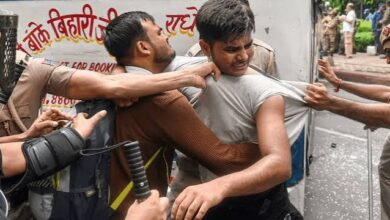
Reuters reported that more than 2,000 people were detained in Delhi on 10 October, citing a Home Ministry official. The security operation also involved barricades, checkpoints, searches and the deployment of police and paramilitary personnel across parts of the capital.
Mobile internet was suspended in a designated area, and dozens of Metro stations and markets were affected by restrictions. Reuters also reported that journalists covering the demonstrations were briefly detained, including a Reuters journalist who was subsequently released.
The United Nations human rights office expressed concern about the detentions and called on Indian authorities to respect the right to peaceful assembly. India’s mission in Geneva rejected the criticism as misplaced interference in domestic affairs, while emphasising that peaceful assembly is subject to reasonable restrictions in the interests of public order.
The government is entitled to enforce valid legal restrictions. The right to peaceful assembly does not confer immunity on anyone who commits an offence, breaches a lawful restriction or obstructs public officials.
But the existence of that power makes accountability more important, not less.
The authorities should publish a clear account of the detentions: the number of people detained, the legal provisions invoked, the grounds recorded, the duration of detention and the outcomes of the proceedings.
The government should also explain how it distinguished people suspected of specific unlawful conduct from individuals whose presence was peaceful or whose only connection to the event was their intention to participate in a demonstration.
A mass detention figure does not, by itself, prove that every detention was unlawful. But neither does the word “preventive” settle the legality or necessity of each individual action.
The same is true of the restrictions on journalists. Reporting on a public demonstration is an important part of public accountability. If journalists are detained or obstructed, the circumstances should be examined openly and the authorities should provide clear explanations.
A government confident in its conduct should welcome the scrutiny that makes the facts clearer. It should not treat scrutiny itself as an inconvenience.
The latest arrests make the confrontation more serious, not less
The controversy did not end on 10 October.
On 13 October, CJP members entered the restricted Jantar Mantar site by climbing over barricades, according to Reuters. The police said the site was no longer an authorised venue for demonstrations and alleged repeated violations of legal undertakings.
On 14 October, Reuters reported that a court ordered CJP leaders Ashutosh Ranka and Saurav Das to remain in jail for five days. Police cited repeated violations and concerns that they might again breach the law if released. The leaders’ supporters, however, characterised the action as an attempt to intimidate the movement.
These are allegations and competing accounts that must be assessed against the relevant legal record. The fact of a judicial custody order should not be confused with a final finding on every allegation made by the police.
Nor should the actions of particular protesters be ignored. If individuals violated applicable restrictions, the authorities were entitled to take lawful action.
But the later arrests do not answer the original question about the breadth of the transport restrictions.
If a particular protester breaches a valid order, the government can investigate that conduct and act within the law. It still must justify any wider restrictions imposed on people who had nothing to do with that breach.
This distinction is not a technicality. It is one of the foundations of a system governed by law.
A government cannot turn the misconduct alleged against a handful of people into a universal justification for treating every anticipated protest as a threat to ordinary civic life.
Nor can protesters claim an unrestricted right to ignore lawful orders. The same legal principles that constrain public authorities also require organisers to comply with valid restrictions.
The task of democratic governance is to preserve both public order and the possibility of lawful dissent.
The more confrontational the political environment becomes, the more important that balance is.
The Modi government must stop confusing control with governance
There is a recurring temptation in the exercise of public power: when faced with a difficult situation, authorities may choose the most visible demonstration of control rather than the most proportionate solution.
Barricades are visible. Checkpoints are visible. Closed gates are visible. Cancelled trains are visible. A major security deployment makes the State’s presence unmistakable.
But competent administration is not a performance in which the most restrictive option automatically wins.
The real test is whether the public is protected, essential services remain functional where possible, lawful rights are respected and the actual risks are managed without transferring unnecessary burdens to people who are not responsible for them.
That is where the Modi government’s handling of this episode deserves its harshest criticism.
The Union government’s security machinery, Delhi Police and railway authorities should be able to explain why such extensive precautions were considered necessary and how they ensured that the impact on ordinary citizens was minimised. They should be able to produce the relevant communications, assessments, operational instructions and post-event reviews.
If the decisions were proportionate, the evidence should demonstrate that. If the arrangements were broader than necessary, the government should acknowledge the failure and explain what will change.
Instead, the central issue has become a question of whether the State did enough to protect the public from the consequences of its own response.
The Supreme Court’s description of the original notifications as apparently overreaching makes it impossible to dismiss this as mere political rhetoric.
For a government that routinely presents decisive administration as one of its greatest strengths, this should be a moment for serious introspection.
Leadership does not mean being able to impose restrictions quickly. It means understanding when a restriction is necessary, when it is excessive and when a more intelligent alternative can achieve the same objective with less harm.
The government should not need a judicial reminder to appreciate the difference between regulating public transport and prohibiting it.
Nor should ordinary passengers have to become collateral participants in an administrative contest between the State and a political movement.
Viksit Bharat cannot be built by making dissent expensive for everyone else
The final lesson of this episode is not that governments should abandon security precautions or that every protest must be allowed wherever its organisers choose.
It is that the right to manage public order must be exercised with restraint, evidence and accountability.
If authorities face a credible threat, they should address it. If a demonstration requires regulation, they should regulate it. If protesters violate valid restrictions, they should face lawful consequences.
But a government that claims to represent more than a billion people must also remember that the passengers whose journeys were cancelled, the commuters whose routes were disrupted, the workers who lost hours and the families who had to reorganise their plans are also members of the public it claims to serve.
Their lives do not become less important because they are not at the centre of a political demonstration.
Their inconvenience does not cease to matter because it can be described as a precaution.
Their rights do not disappear because a government has security concerns.
The Modi government has a choice. It can treat this episode as an example of how much administrative machinery can be mobilised to manage dissent. Or it can treat it as a warning that the power to restrict public life must be accompanied by the capacity to exercise that power proportionately.
The Supreme Court’s intervention provides a clear reason to demand the second.
The public now deserves answers about the scale of the restrictions, the alternatives considered, the passengers affected and the accountability mechanisms governing the detentions. It deserves an administration willing to explain its decisions rather than assuming that security language is sufficient justification.
Viksit Bharat should mean more reliable infrastructure, better public services, greater institutional confidence and a stronger commitment to constitutional freedoms. It should mean that a peaceful political disagreement does not automatically become a crisis for an entire transport network.
It should mean that citizens can question institutions without being made to feel that their movement, their livelihoods and their ordinary routines are expendable.
Otherwise, the grand national slogan begins to sound less like a promise of development and more like a demand for patience from people who are repeatedly asked to absorb the consequences of decisions made in their name.
A truly developed nation does not prove its strength by making citizens’ lives harder whenever public disagreement becomes inconvenient. It proves its strength by handling disagreement intelligently, protecting ordinary life and ensuring that public authority remains accountable.
The government may have had legitimate security concerns. It may have been entitled to deny permission for the demonstration. It may have had grounds to act against individuals alleged to have breached lawful restrictions.
But none of that automatically justifies every measure imposed on the wider public.
The Modi government must answer the question it cannot bury beneath barricades, security briefings or development slogans: if protecting public order is the objective, why should ordinary Indians be left paying such a substantial price for the State’s response?
And if the administration cannot demonstrate that its restrictions were necessary and proportionate, then the criticism is unavoidable: it managed the risk of a protest by creating a risk of unnecessary public hardship.
That is not the standard of governance a developed India should accept.
It is certainly not the standard that should pass without scrutiny in a democracy.