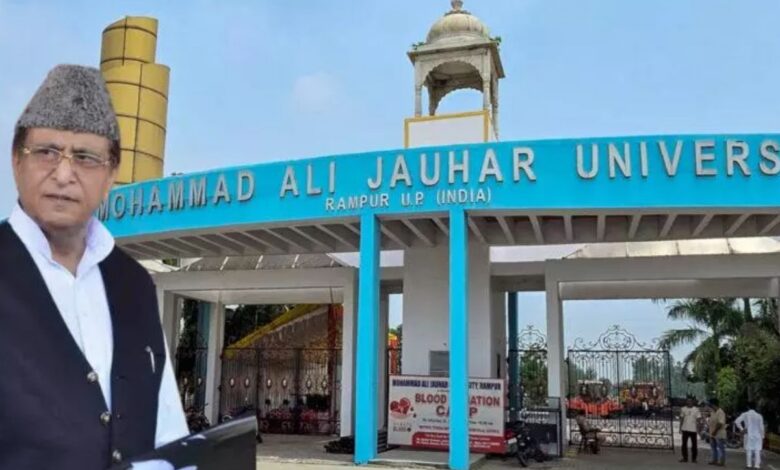
The ED on 1 November 2026 announced the arrest of Mohammad Azam Khan under the Prevention of Money Laundering Act.
The Lucknow Zonal Office of the agency took him into custody on 31 October 2026. Azam Khan is the founder of the Maulana Mohammad Ali Jauhar Trust and the chancellor of Mohammad Ali Jauhar University in Rampur, Uttar Pradesh. A special court under the Prevention of Money Laundering Act in Ghaziabad remanded him to 14 days of judicial custody. He was later taken to Dasna District Jail in Ghaziabad.
The arrest forms part of a larger investigation into alleged money laundering linked to the trust and the university. On 28 October 2026 the Enforcement Directorate provisionally attached land and buildings of the university held by the trust. The attachment covers assets to the extent of Rs 426.46 crore. The agency said the present value of the attached properties is about Rs 1,170 crore.
The Enforcement Directorate conducted searches in August 2026 at the university and related premises in Rampur. Documents and electronic devices were seized during those searches. The agency said further investigation is under way.
The investigation traces its origin to 26 first information reports registered by the Uttar Pradesh Police in July 2019 at Azeem Nagar police station in Rampur. Those cases related to allegations that agricultural land belonging to farmers in Singankhera village was forcibly occupied for the university. The reports mentioned offences of voluntarily causing hurt, wrongful confinement, extortion, criminal trespass, intentional insult and criminal intimidation.
According to the Enforcement Directorate, farmers were allegedly coerced through assault, unlawful confinement and threats before they executed sale deeds in favour of the university.
Apart from these 26 cases, the agency also took up 28 other first information reports registered in Rampur. These related to allegations of robbery, extortion, cheating and forgery. Some of the additional cases concerned the alleged demolition of residential structures in Rampur city in 2016. Many of the affected families were said to be tenants of Waqf properties. The allegations included the use of bulldozers, assault on occupants, threats of false criminal cases, taking of cash and jewellery, and robbery of cattle. Debris from the demolished houses was allegedly transported to the university campus.
The Enforcement Directorate also examined allegations that cleaning machinery purchased for Rampur Nagar Palika was diverted to the university.
A major part of the investigation concerns the alleged diversion of money and construction materials meant for government public works towards the construction of the private university. The agency is examining whether contractors who received government contracts redirected funds or materials and later transferred value to the trust in the form of donations.
One company that received Public Works Department contracts worth about Rs 186 crore between the financial years 2013-14 and 2016-17 came under scrutiny. Reporting based on the investigation stated that the managing director of the company told investigators that 30 to 40 per cent of the contract value was used to purchase construction materials for the university. That would place the alleged value of diverted materials between roughly Rs 55.80 crore and Rs 74.40 crore. These figures are based on the reported statement and have not been independently verified as actual transfers.
Another firm was reported to have donated Rs 40 lakh to the Maulana Mohammad Ali Jauhar Trust. Partners of the firm stated that they operated under the influence of Azam Khan.
The Enforcement Directorate also examined government-funded works carried out on the university campus. Works worth Rs 6.60 crore were reportedly executed using funds from MLA and MLC local area development schemes. These works were carried out through Uttar Pradesh Jal Nigam.
In addition, the Uttar Pradesh government sanctioned Rs 23.41 crore for a pandal, an OBC boys’ hostel and a hospital block on the campus. A 2015 government order had sanctioned Rs 12.16 crore for the pandal. The original conditions stated that ownership would remain with the Culture Department of the Uttar Pradesh government, that the structure could not be sold or transferred, and that it would be available for government use without charge. A subsequent government order in 2016 allegedly altered these conditions, transferring ownership to the university and removing the free-use requirement for the government.
The agency also looked at donations of about Rs 6.24 crore received by the trust from two educational institutions based in Meerut. These donations were alleged to have been received through political influence.
A District Valuation Officer assessed the cost of the university campus on 10 November 2023. The assessment covered 59 buildings and the land on which the university was constructed. The construction cost of the 59 buildings was placed at Rs 494.46 crore. The land acquired through 114 sale deeds was valued at Rs 4.63 crore. The total estimated campus cost came to Rs 499.09 crore.
The trust had declared capital expenditure of Rs 78.32 crore in its income-tax returns. The Enforcement Directorate found that donations worth Rs 12.29 crore included in the declared capital expenditure were non-genuine. After subtracting these, the remaining expenditure considered genuine stood at Rs 66.03 crore. Adding the Rs 6.60 crore of works financed through local area development funds brought the total expenditure explained through legitimate sources to Rs 72.63 crore.
Subtracting this figure from the total campus cost of Rs 499.09 crore left Rs 426.46 crore, which the Enforcement Directorate identified as the proceeds of crime represented by the assets. This figure formed the basis for the provisional attachment order issued on 28 October 2026.
An earlier calculation reported around the time of a fresh first information report in mid-October 2026 had placed the unexplained construction expenditure at about Rs 416.14 crore by comparing only the building valuation of Rs 494.46 crore with the declared capital expenditure of Rs 78.32 crore. The later attachment figure of Rs 426.46 crore incorporated the land value and the adjustments for non-genuine donations and the local area development works.
On 13 October 2026 a fresh first information report was registered on information supplied by the Enforcement Directorate. The case named Azam Khan, the trust and others. It invoked provisions of the Bharatiya Nyaya Sanhita relating to criminal conspiracy, aggravated criminal breach of trust and cheating, along with sections of the Prevention of Corruption Act concerning offences by public servants.
The arrest of Azam Khan on 31 October took place shortly after he and his son Abdullah Azam were released from Rampur jail. On 29 October the Allahabad High Court had suspended their sentences in a separate dual-PAN-card case, allowing their release. The High Court did not stay the convictions in that case. An Enforcement Directorate team from Lucknow was present at the jail. Azam Khan was questioned and taken into custody in the money-laundering case. His son was not arrested in this action.
On 2 November 2026 Azam Khan approached the Supreme Court challenging the arrest. His lawyer mentioned the matter before a bench headed by the Chief Justice. The court took note of the submissions and indicated that the petition could be listed during the week but declined an urgent hearing at that stage.
The Maulana Mohammad Ali Jauhar Trust is the institutional entity that holds the university assets. The Enforcement Directorate identified Azam Khan as its founder. Related disclosures also noted that the Income Tax Department had revoked the trust’s registration under the Income-tax Act. Cancellation of income-tax registration and prosecution under the Prevention of Money Laundering Act are separate legal proceedings.
The provisional attachment under the Prevention of Money Laundering Act places restrictions on dealing with the property. It is intended to prevent the property from being transferred or concealed while proceedings continue. It is not the same as final confiscation. The attachment must go through the statutory adjudication process before the Adjudicating Authority. The affected parties can challenge the attachment through the prescribed appellate and judicial routes.
The Enforcement Directorate’s investigation examines whether public resources, government contracts, construction materials and contractor payments were diverted to create or develop assets belonging to the private educational trust, and whether those assets represent proceeds of crime under the Prevention of Money Laundering Act. The agency has stated that further investigation remains in progress.
The arrest, the searches, the provisional attachment and the judicial remand are procedural steps in an ongoing investigation. They do not by themselves establish criminal guilt. The allegations contained in the first information reports and the financial calculations presented by the Enforcement Directorate will be tested through the legal process.