The Great Tech Workforce Shake-Up And Rethinking Who It Needs. Inside Apple, Uber, Oracle And Samsung’s New Cost-Cutting Era
The tech industry is entering a new workforce era, and the warning signs are hard to miss. Apple, Uber, Oracle, PayPal and Samsung are cutting jobs even as companies pour money into AI, automation and new technologies. The question is no longer simply who is being laid off, but who companies need next.

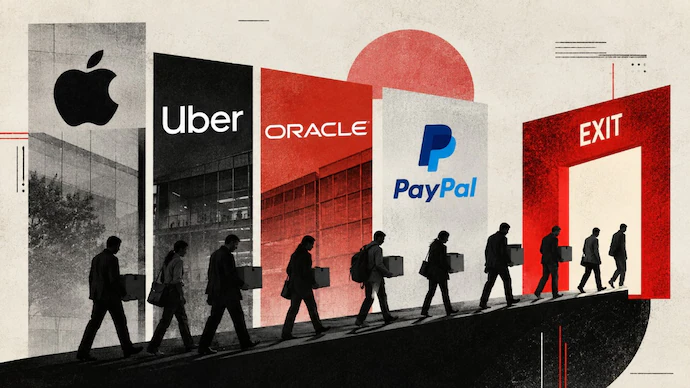
The tech job market is taking another hit. Across the industry, companies are cutting layers, restructuring teams and redirecting spending towards artificial intelligence, automation and newer technologies. The result is a workforce being reshaped at a remarkable pace, with thousands of jobs disappearing even as companies continue to invest heavily in what comes next.
More than 175,000 tech jobs have been cut globally in 2026, according to TrueUp data cited in recent reporting, while Layoffs.fyi is also tracking a significant wave of job losses this year. The reasons vary from company to company. Some cuts are directly linked to AI and automation; others are about reducing management layers, controlling costs, responding to weaker demand or changing business priorities.
And the latest round has brought some of the world’s biggest technology companies into the spotlight. So what is driving these cuts, and what do they say about the kind of workforce technology companies want now? Here is a look at the latest shake-up.
Apple, Rebuilding For An AI-First Future
Apple has begun cutting jobs across parts of its organisation as it reshapes teams around changing priorities, with more than 200 positions reportedly affected across the Vision Pro, Siri and related software operations.
Around 100 positions were reported to have been cut from the Vision Pro organisation, while another 100 came from Siri and software teams, including the Intelligent Systems Experience group involved in AI features across Apple’s devices.
Apple has confirmed that it is restructuring but has not confirmed the exact number of layoffs. The changes reflect two very different pressures inside the company.
The Vision Pro organisation has seen Apple’s ambitions in spatial computing scaled back, including the closure of its gaming team and reductions in immersive-video operations. Siri, meanwhile, is moving in the opposite direction: Apple is rebuilding the voice assistant around a new AI architecture, creating demand for a different mix of skills and expertise.
Apple’s latest workforce changes are not simply about cutting jobs. They show how the company is moving people and resources away from some bets while doubling down on AI capabilities that it considers strategically important.

Uber, Cutting Layers, Betting On AI
Uber is also embarking on one of its biggest workforce reductions since the Covid-19 pandemic. The ride-hailing company plans to cut around 3,300 jobs globally, equivalent to roughly 10% of its workforce.
The cuts are part of a broader effort to simplify the organisation. In an internal memo to employees, CEO Dara Khosrowshahi said Uber was removing management layers, simplifying teams and changing its global location strategy.
But Uber is not simply trying to shrink. The company plans to redirect some of the savings towards future technologies, including artificial intelligence and autonomous vehicles.
That makes the move part of a wider pattern emerging across the technology industry: companies are reducing headcount in some areas while increasing spending on technologies they believe can deliver greater productivity or open up new businesses.
For employees, however, the distinction offers little comfort. Whether the stated reason is fewer management layers, organisational simplification or investment in AI, the immediate outcome is the same – thousands of jobs are being removed.
PayPal, Job Cuts Reach India
PayPal has also cut jobs in India as part of its wider global restructuring. Initial reports suggested that around 600 employees could be affected, but the company later clarified to India Today Tech that 220 employees, or about 4% of its India workforce, had been impacted as of August 31.
The company said the changes are part of a previously announced multi-year transformation designed to simplify its global operations and support long-term growth.
Unlike some of the more dramatic cuts elsewhere in the technology sector, PayPal‘s India reduction appears to be part of a broader organisational exercise rather than a standalone move. The company is essentially trying to make its global operations leaner while changing how teams and functions are structured.
But the contrast across the industry is becoming increasingly clear. Technology companies are not necessarily cutting because they are running out of money. In many cases, they are cutting because the way they want to operate and the skills they want to pay for – is changing.
Oracle, Another Round Of Cuts?
Oracle is now facing reports that it could be preparing for another significant round of job cuts. Business Insider reported that the company may reduce its workforce further, with internal estimates suggesting that 7,000 to 10,000 roles globally could be affected.
There is one important caveat: Oracle has not officially announced another round of layoffs, and the potential impact on India has not been independently confirmed. Employees have reportedly been told to expect possible decisions around the beginning or middle of September.
The reports come after Oracle has already undertaken a major workforce reduction. The company reduced its global headcount by around 21,000 employees in the 12 months ending May 2026, bringing its workforce to roughly 141,000.
At the same time, Oracle is spending heavily on AI and cloud infrastructure. That puts its restructuring in the same broader pattern seen elsewhere in the industry: significant investment in technologies expected to drive future growth, alongside pressure to control the cost of the existing workforce.
For Oracle, therefore, the question is not simply whether more jobs will go. It is also about which parts of the workforce the company believes it needs for its next phase of growth.
Samsung India, Strong Profits, But Jobs Are Still On The Line
Samsung India has now joined the list of major technology and electronics companies trimming their workforce. Around 80-100 employees in its television and home-appliance businesses have reportedly been asked to leave as the company restructures these operations amid rising costs and weaker consumer demand.
The cuts are reportedly being carried out in batches and affect employees at multiple levels, from director-level executives and headquarters team leads to branch and area managers. The exercise also includes off-roll personnel working through staffing agencies.
What makes Samsung’s case particularly interesting is that the layoffs are happening despite stronger financial performance. Samsung India’s revenue rose 12% year-on-year to ₹1.1 lakh crore in FY25, while net profit jumped 38% to ₹11,287 crore.
The pressure is instead concentrated in specific parts of the business. Memory chip prices have more than doubled, the rupee’s depreciation has pushed up costs, and consumer demand has weakened. Industry estimates cited by The Economic Times put the decline in smartphone volumes at around 11-12% year-on-year.
Samsung’s domestic electronics sales team has around 550-600 executives, separate from its much larger smartphone sales organisation. The company is also consolidating branches, including Ranchi with Patna, Delhi with Gurgaon, and Punjab with Chandigarh, with some roles becoming redundant as a result.
For now, the smartphone division has been spared. Samsung continues to treat smartphones as its most important business in India, while expecting festive-season demand to improve. But the wider restructuring may not be over, with another round of workforce rationalisation reportedly possible after Diwali, particularly in television and home appliances.
The message from Samsung is therefore different from a simple profit-versus-loss story. A company can be growing overall and still decide that parts of its workforce, sales structure and physical operations no longer fit the market it is preparing for.
The Last Bit, Is Changing The Tech Workforce
The latest cuts at Apple, Uber, Oracle, PayPal and Samsung India are part of a much larger shift taking place across the technology industry. Companies are increasingly using AI to improve productivity, automate tasks and reduce costs, but that is also changing the kinds of roles they need.
Data compiled by Layoffs.fyi shows just how quickly the trend has accelerated. AI-related tech layoffs worldwide reached 1.28 lakh employees by July 1, 2026, already surpassing the 1.25 lakh layoffs recorded during the whole of 2025.

The trend has been building for years. AI-related tech layoffs stood at around 81,000 in 2020, before surging to more than 1.65 lakh in 2022 and nearly 2.66 lakh in 2023. Although the numbers eased in 2024 and 2025, the first half of 2026 has already pushed past the full-year figure for 2025.
India is particularly exposed to this shift. The US accounted for 71.33% of AI-led tech layoffs globally between January 2020 and July 2026, while India ranked second with a 7.16% share. Germany and the UK followed at 3.43% and 2.64%, respectively.
Within India, the impact has also varied sharply by sector. Education accounted for the largest share of AI-led layoffs at 21.67%, followed by finance at 14.73%, food at 12.26%, transport at 11.03% and consumer businesses at 11%.
AI is creating demand for new skills in areas such as machine learning, data science and AI development. But at the same time, companies are reducing their reliance on many traditional roles.
That is perhaps the clearest takeaway from this latest wave of workforce restructuring: the technology industry isn’t simply becoming smaller. It is becoming different. The companies cutting jobs today are also deciding which skills, teams and functions they believe will matter most tomorrow.