Sugar Cosmetics: Just A Company’s Trouble Or A Warning Sign For Future Of Indian D2C Beauty Brands?
When The Sugar Started Getting Bitter...

The Sugar Crash: Inside the ₹2,400 Crore Collapse of India’s Favorite Beauty Unicorn
In January 2024, Sugar Cosmetics was still being talked about as one of the standout names in India’s direct-to-consumer boom; a homegrown beauty brand that had gone from a subscription box idea to a company valued at nearly ₹3,000 crore, backed by marquee investors and fronted by a founder, Vineeta Singh, who had become something of a startup celebrity through her appearances on Shark Tank India. Twenty-eight months later, that story looks very different.
Sugar is reportedly raising a rescue round at a fraction of its former valuation, its revenue has fallen for two consecutive years, its losses have nearly doubled, and its founders have, according to reporting, dipped into personal funds to cover payroll during a prolonged cash crunch. This may be a startup quietly missing its targets; but it is more of a dramatic reversal in Indian D2C history, and the numbers behind it tell a story that goes well beyond one company’s bad year.
The Financials- When The Sugar Became The Bitter
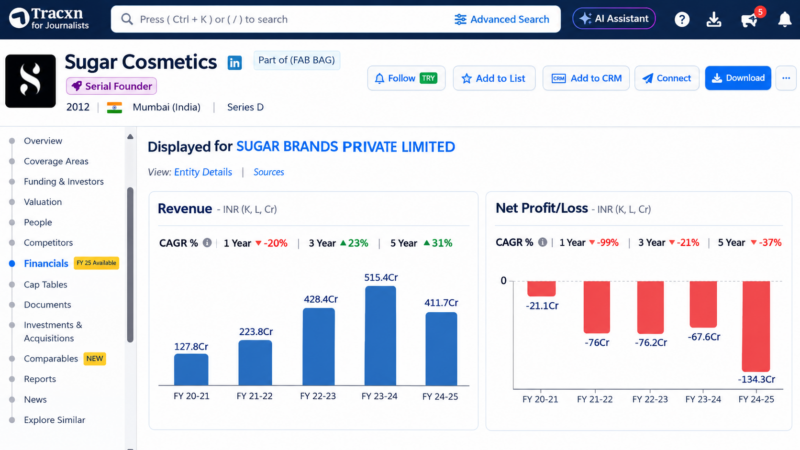
Start with revenue, because revenue is where the unraveling becomes undeniable. Sugar Cosmetics grew from roughly ₹128 crore in FY21 to ₹505 crore in FY24, a trajectory that looked, on paper, like exactly the kind of scaling curve venture investors dream about funding. Then it stopped. In FY25, operating revenue fell to approximately ₹404 crore, a 20 percent decline, marking the company’s first significant reversal after years of uninterrupted expansion. Some filings put the net revenue figure slightly lower, at around ₹411-415 crore against the prior year’s ₹505 crore, which works out to a decline in the high teens percentage-wise depending on which revenue line is used.
Either way, the direction is the same, and the trend has not reversed. Projections and early reporting for FY26 point to revenue sliding further still, into the ₹300-350 crore range, with one May 2026 report citing an even lower actual figure of approximately ₹380 crore. At the low end of these estimates, Sugar’s FY26 revenue would sit roughly 40 percent below its FY24 peak, meaning the company would have given back nearly half a decade of growth in the space of two fiscal years.
The losses are, if anything, more alarming than the revenue decline, because they moved in the wrong direction while revenue was already contracting, which is a combination that should worry any operator or investor far more than either metric in isolation. Sugar’s net loss in FY25 came in at approximately ₹134 crore, nearly double the ₹68 crore loss the company posted in FY24. Framed as a ratio, the company’s loss-to-revenue percentage roughly swung from around 13 percent in FY24 back up to around 33 percent in FY25, meaning that for every rupee of revenue Sugar brought in during its worst year yet, it burned roughly a third of a rupee more in losses.
EBITDA margins told the same story, deteriorating to approximately negative 26 percent for the year. Cumulatively, the company’s losses across its recent history add up to somewhere in the neighborhood of ₹375 crore, and importantly, Sugar has not posted a profitable full fiscal year since its founding, not during the pandemic-era D2C boom, not during its retail expansion phase, and not now.
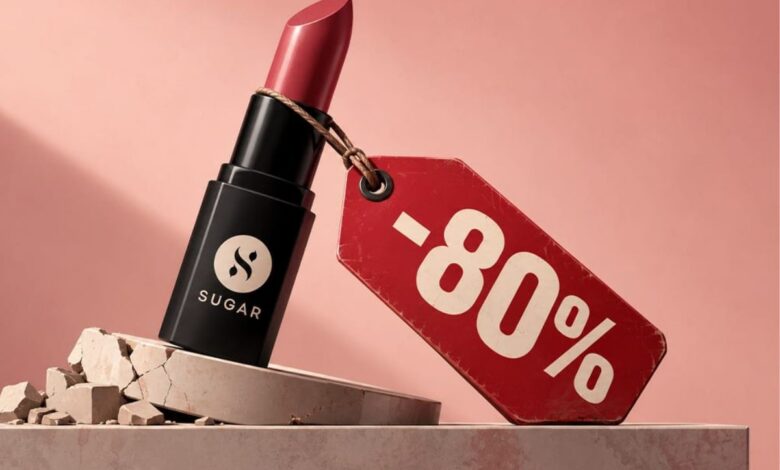
Then there is the valuation, which is where the abstract financial deterioration becomes concrete and painful for everyone with equity in the company. Sugar’s valuation rose from around ₹300 crore in January 2019 to roughly ₹3,000 crore by May 2022, riding the same wave of investor enthusiasm that lifted dozens of Indian D2C brands during that period. Reporting from mid-2026 indicates Sugar is raising fresh capital, reportedly ₹140-150 crore from existing investor A91 Partners, at a valuation of just ₹500-600 crore, an 80 to 83 % haircut from the 2022 peak.
This is what investors and bankers call a “down round,” and a down round of this magnitude is rarely a neutral event; it typically triggers dilution for existing shareholders, renegotiated terms for employee stock options, and, as has been reported, early investors looking for the exit rather than doubling down. Later reporting suggests Sugar was separately seeking ₹100-150 crore in what was explicitly termed “rescue funding” at a valuation of ₹1,400-1,500 crore, and that the company had been operating under a “severe cash crunch” for roughly six months, severe enough that founders Vineeta Singh and Kaushik Mukherjee reportedly paid employee salaries out of personal funds.
It is worth sitting with that detail for a moment: this is not a company managing a normal growth slowdown. This is a company managing a liquidity crisis.
Put together, the picture is stark. A brand that scaled from ₹128 crore to ₹505 crore in revenue over three years, and from a ₹300 crore to a ₹3,000 crore valuation over roughly the same period, has in the following two years seen revenue fall by close to 40 percent, losses roughly double, and valuation collapse by more than 80 percent, all while remaining unprofitable for the entirety of its operating history.
The Unit Economics Were Always the Real Story
Here is the uncomfortable argument at the center of Sugar’s collapse: the company’s growth numbers were, for years, more impressive than its business model. Growth and profitability are not the same thing, and venture capital has a well-documented tendency to reward the former while assuming the latter will eventually follow. Sugar’s numbers suggest it never did, and the fundamental reason is a mismatch between customer acquisition cost and customer lifetime value that the company’s own leadership has, at times, described with striking honesty.
In a past interview, the company’s founder explained a dynamic familiar to anyone who has scaled a paid-acquisition business: as marketing spend increases, brands eventually reach a point where the cost of acquiring a customer for a single order equals the average value of that order. Once a brand hits that ceiling, every additional dollar of acquisition spend stops generating proportional returns, because you are effectively paying full price to acquire a customer who was likely to convert on her own anyway.
That dynamic is brutal in color cosmetics specifically, because the category does not generate the purchase frequency needed to amortize a high acquisition cost over time. A customer who loves a ₹1000 lipstick is not buying a new one every month, or even every two or three months, as cosmetics, unlike consumables such as skincare basics or personal care staples, are discretionary, semi-durable purchases with long replacement cycles.
That means a D2C brand spending heavily to acquire a first-time buyer needs that buyer to come back repeatedly, and to spend meaningfully more on each return visit, in order to ever recoup the initial acquisition spend, let alone generate a profit on that customer relationship. Sugar’s numbers suggest this recoupment never happened at scale. Losses widened even as revenue grew through FY24, which is the clearest possible evidence that growth itself was being purchased at a loss, and that scaling the top line was, in effect, scaling the hole in the bottom line right alongside it.
This is where an honest assessment has to depart from the comfortable narrative that Sugar was simply “outcompeted.” The company’s own historical marketing spend, reported at roughly a quarter to nearly a third of revenue in its growth years, was not an aberration forced on it by rivals, but it was the engine the entire growth story ran on. When that engine’s fuel becomes more expensive, as it inevitably does once every competitor adopts the identical influencer-led playbook, the entire model becomes structurally unsound, not just tactically underperforming. That is a distinction worth insisting on, because it changes the diagnosis.
A tactically underperforming company can fix its marketing mix, renegotiate influencer rates, or improve targeting. A structurally unsound business model cannot be fixed with better execution, as it requires a different model entirely, and there is little evidence in Sugar’s numbers that such a pivot ever happened decisively enough, early enough.
Is There A Real Moat Ever?
The second thread running through Sugar’s decline is the absence of durable competitive advantage, and this is where the company’s early differentiation, genuinely smart at the time, curdled into a liability. Sugar’s founding insight was that Indian consumers deserved cosmetics formulated for Indian skin tones and Indian climate conditions, at a time when the market was dominated by multinational brands built around European complexions and European weather assumptions. That was a real insight, and it built real early loyalty.
But an insight that can be observed and copied is not a moat, it is a head start, and head starts erode. Within a few years, that exact positioning, “made for Indian skin“, had been adopted by a long list of competitors spanning legacy players and new entrants alike, to the point where it stopped functioning as differentiation and started functioning as table stakes for the entire category.
Compounding this, Sugar’s manufacturing has reportedly always been fully outsourced, meaning the company has no proprietary formulation, no patented process, and nothing preventing a well-capitalized competitor from walking into the same contract manufacturing ecosystem, concentrated in hubs like Noida and Daman, and producing a comparable product at a comparable or lower cost. This matters more than it might initially seem to, because it means Sugar’s entire competitive position rested on brand and marketing rather than on product or supply-chain advantage. That is a viable strategy in categories with high switching costs or strong habitual loyalty.
It is a much weaker strategy in cosmetics, where consumers have repeatedly shown a willingness to switch brands based on whichever influencer they are currently following, whichever product just launched, or whichever discount is currently live. Brand loyalty in this category is real but shallow, and shallow loyalty is expensive to maintain, as it requires constant reinvestment in visibility and constant new product launches just to hold market share, let alone grow it. That is precisely the treadmill Sugar appears to have been running on, and treadmills, by definition, do not get you anywhere new no matter how fast you run.
The Competition Sugar Faced Was Not a Fair Fight
It would be incomplete to discuss Sugar’s decline without being specific about who it was actually competing against, because “the market got competitive” understates just how mismatched some of these fights were. Nykaa is the most important name here, and the comparison is instructive. Nykaa is publicly listed and profitable, and it operates a marketplace model that does not require it to hold the same inventory risk Sugar does; which means it earns margin on other brands’ products without carrying the working-capital burden of manufacturing and stocking them.
On top of that structural advantage, Nykaa’s own house brands compete head-on with Sugar’s core color cosmetics range, and Nykaa has something no standalone D2C brand can replicate;whichis first-party discovery data from being the platform millions of Indian beauty shoppers browse first. Competing against a company that is simultaneously your retail distribution partner and your direct product competitor, and that also sees your customers’ browsing behavior before you do, is an extraordinarily difficult position, and it is one Sugar arguably walked into voluntarily during its early growth years, when roughly 80 % of Sugar’s revenue reportedly flowed through Nykaa’s platform.
The threat was not only coming from above, from bigger, better-capitalized incumbents, but it was also coming from below, from leaner challengers built explicitly to avoid Sugar’s cost structure. Renee Cosmetics, founded in 2020, reportedly reached profitability faster than Sugar did, despite launching years later, and has been expanding in tier-2 and tier-3 Indian markets; the same markets Sugar reportedly expanded into at high cost and has since been retreating from.
A newer entrant reaching profitability before an established, better-funded incumbent is not a coincidence; it is usually a sign that the incumbent’s cost structure has become a genuine liability rather than an asset, weighed down by legacy marketing spend commitments, retail overhead, and organizational scale that a leaner competitor simply does not carry. This is the uncomfortable truth about first-mover advantage in low-moat categories: being first mostly just means you are the one who has to discover, the hard and expensive way, which parts of the playbook do not actually work.
The final piece of the competitive squeeze is physical retail and quick commerce, and it represents a genuine strategic bind rather than a simple execution failure. D2C brands built their early advantage by bypassing traditional retail entirely, selling direct to consumers and keeping the margin retailers would otherwise have captured. But as these brands scaled, they discovered that direct-to-consumer alone was not enough to reach mainstream volume in India, as consumers wanted to touch and test cosmetics before buying, and quick-commerce platforms became an unavoidable discovery channel.
That forced Sugar into physical stores and onto quick-commerce shelves, where it now competes for space against companies that have spent decades building retailer relationships, negotiating shelf placement, and running trade margins that D2C-native brands were never built to absorb. In other words, the very channel expansion that was supposed to diversify Sugar’s revenue away from expensive digital acquisition instead exposed it to a different set of expensive, unfamiliar competitive pressures, which is a classic case of solving one structural problem by walking directly into another.
The Real Failure Was a Narrative, Not a Quarter
If there is a single sentence that captures what happened to Sugar Cosmetics, it might be this- the story the company told its investors and its market diverged so sharply from the reality of its financial performance that, once the gap became undeniable, confidence collapsed all at once rather than eroding gradually. That is what a roughly 80 % valuation cut in a single funding round actually represents; not a market recalibrating its expectations at the margin, but a market admitting that its previous expectations were fundamentally wrong.
Companies survive bad quarters constantly. What they do not easily survive is investors concluding that the growth story itself was an illusion, that revenue expansion from FY21 to FY24 was bought rather than earned, and that the moment acquisition costs normalized to sustainable levels, the underlying business could not hold its own weight.
This is also, worth saying plainly, a pattern that extended well beyond Sugar Cosmetics during the same period — a broader reckoning across India’s venture-funded D2C sector, where “consumer fatigue” and rising customer acquisition costs became recurring themes in industry coverage through 2025 and into 2026, as investors who had funded a wave of influencer-led, digitally native brands began demanding evidence of a durable path to profitability rather than accepting growth metrics at face value.
Sugar is simply the most visible casualty of that recalibration so far, in part because its rise was so visible in the first place — a founder who became a national figure through television, a valuation that once put the company in rarefied startup company, and a brand that genuinely built cultural relevance among young Indian consumers. The company’s fall is getting attention precisely because its rise did too, and there is a lesson in that asymmetry: the same visibility that helps a consumer brand acquire customers cheaply in its early years can, once growth stalls, accelerate the unwinding of investor and market confidence far faster than a quieter company’s decline ever would.
Where This Leaves Sugar
None of this means Sugar Cosmetics is finished. The company has real brand equity, a genuine and loyal-enough customer base to have built a ₹400-plus crore revenue business, and it retains relationships, including a recently reported partnership with Myntra to launch a Gen Z-focused sub-brand, that suggest its leadership is actively trying to reposition rather than simply managing a decline. Rescue funding, if it closes, buys time, and time is the one resource a company in a cash crunch cannot generate on its own.
But rescue funding at a fraction of peak valuation is also a verdict, not just a lifeline, as it reflects investors’ honest reassessment of what the business is actually worth today, stripped of the growth-at-any-cost assumptions that inflated its valuation in the first place. Whether Sugar can convert that reset into a genuinely profitable, right-sized business, or whether this rescue round simply delays a more difficult reckoning, is the question its financials over the next two fiscal years will answer. Given the trajectory of the last two, the burden of proof sits squarely with the company, not with its skeptics.
What is harder to dispute is the broader lesson sitting underneath Sugar’s specific numbers: an influencer-led, digitally acquired customer base is a rented audience, not owned demand, and rented audiences get more expensive to keep renting every year that more brands compete for the same attention.

Sugar Cosmetics did not fail because it made a uniquely bad product or because its founders were uniquely poor operators — reporting suggests genuine product quality and cultural relevance throughout its history. Sugar Cosmetics struggled because it built a business on a set of unit economics that only worked while customer acquisition was cheap and competition was thin, and neither of those conditions held once the rest of the Indian beauty market learned to copy the same playbook. That is a lesson every founder building a venture-backed consumer brand in India today should be studying closely, because the market conditions that undid Sugar Cosmetics have not gone away — if anything, they have gotten more unforgiving for whoever is next.