Settlement Or Delayed Delivery, But Not On-Time Delivery: The TDI Infrastructure Saga


TDI Builders And Developers: Whose Shadow Hovers Over Thousands Of Unfinished Dreams
When middle-class families hand over life savings for a home, they enter a contract of trust. They expect walls, roads, water, electricity and a conveyance deed within a reasonable time. What too many home buyers associated with TDI projects have received instead is a long ledger of delays, litigation and regulatory notices. The public record now available paints a picture that should concern every citizen who believes the real-estate sector must answer to more than its own convenience.
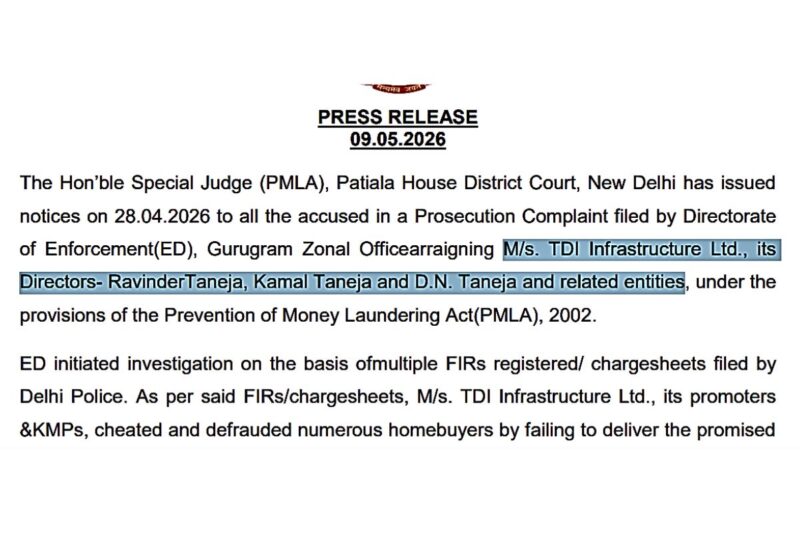
In 2026 the Enforcement Directorate placed on record a money-laundering investigation into TDI Infrastructure Limited and named directors including Ravinder Taneja, Kamal Taneja and D.N. Taneja. Official releases state that approximately 4,619 crore rupees were collected from 14,105 customers across a series of projects. The agency alleges that substantial portions of those funds were diverted through subsidiaries and related entities rather than applied fully to the construction and delivery that buyers had paid for.
Provisional attachments of assets have been reported, with cumulative figures cited in successive releases in the range of roughly 250 to 350 crore rupees. A prosecution complaint has been filed and the Special PMLA Court at Patiala House has issued notices. These are the investigating agency’s allegations and procedural steps. They are not yet convictions. They are, however, serious enough that the public is entitled to ask how a company could collect such large sums from so many families and still leave so many projects incomplete or disputed years later.
The scale alone is troubling. Fourteen thousand one hundred and five customers is not a statistical abstraction. It represents thousands of households that planned marriages, school admissions and retirements around possession dates that never arrived on schedule. When occupation certificates remain pending for multiple projects and one project is described as still incomplete, the ordinary buyer is left carrying the financial and emotional cost. EMIs continue. Temporary housing continues. Legal fees begin. The promise of a home becomes a multi-year administrative ordeal.
A parallel regulatory track adds another layer of public concern. In one execution matter before Haryana RERA, a conditional civil-imprisonment order against five directors was reported in May 2026. Subsequent official records show that the parties reached a settlement, the execution petition was disposed of as withdrawn, and the earlier arrest-warrant directions were not to be acted upon. That particular coercive measure therefore did not result in custody. Yet the very fact that a regulator felt compelled to reach for civil imprisonment in the first place signals how far compliance had lagged. Settlement in one execution case does not erase the broader pattern of buyer complaints that produced it.
In the criminal courts of Delhi a different proceeding has also advanced. The Delhi High Court in March 2025 refused to quash an FIR registered in 2020 concerning a commercial-plot transaction in TDI case. A chargesheet under sections dealing with criminal breach of trust, cheating and conspiracy was recorded. The court left the trial merits open. For the public, the refusal to terminate the prosecution at the threshold means the allegations will be tested in evidence rather than dismissed on technical grounds. Parallel consumer litigation has produced mixed but often adverse outcomes for the builder.
In one Chandigarh State Consumer Commission matter decided in August 2025, Akshay Taneja was expressly named as a party and the builder’s appeal was dismissed. The upheld directions included possession or an alternative plot, delay interest running from 2012, compensation and costs. Other National Commission and State Commission decisions have sustained refund awards with interest or modified earlier relief while still recognising deficiency. These are not criminal convictions. They are formal findings that buyers were entitled to remedies the builder had not voluntarily provided.
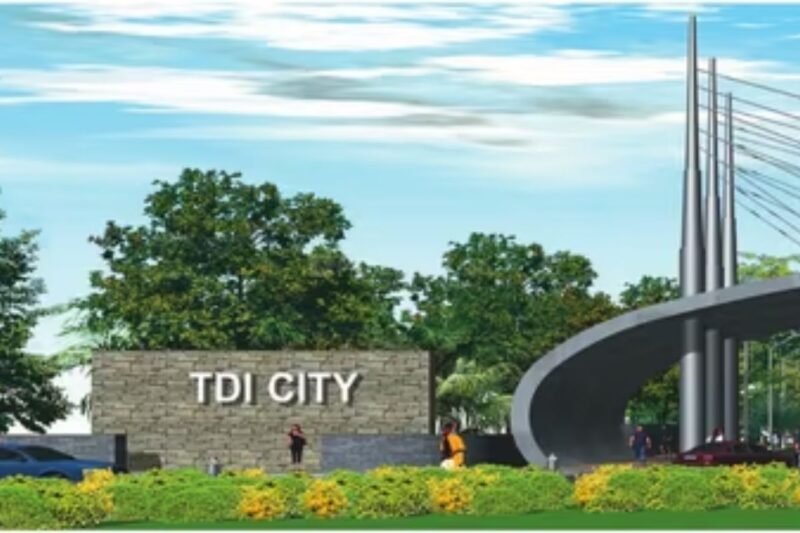
Corporate identity itself has become a source of confusion that works against transparency. TDI Infratech Limited, TDI Infrastructure Limited and other entities sharing the TDI branding are distinct legal persons with their own histories. An allegation or order against one cannot be automatically transferred to another. Yet for the homebuyer who paid money into a project marketed under the TDI name, such distinctions often feel academic. The practical experience is of incomplete infrastructure, disputed titles and prolonged litigation regardless of which corporate letterhead appears on the agreement.
Insolvency records add further caution against overstatement. An early 2019 admission order was set aside on appeal after a settlement was noted. A later restoration order issued notice but did not itself commence a fresh corporate insolvency resolution process. The public should therefore not be told that the companies are currently under CIRP on the basis of those particular records. At the same time, the repeated appearance of insolvency petitions and the need for appellate correction itself indicates financial and operational stress that buyers ultimately absorb.
Tax proceedings located in the public domain include several decisions favourable to the relevant taxpayers, with Revenue appeals dismissed and certain assessments quashed on procedural grounds. Those outcomes prevent any simplistic claim of proven tax evasion across the board. They do not, however, erase the homebuyer-facing problems that dominate the enforcement and consumer record.
From a public point of view the cumulative picture is deeply concerning. Large sums of money were collected from ordinary citizens for homes. Many of those homes were not delivered on time or with the promised completeness. Regulatory and investigative agencies have found sufficient material to attach assets, file a prosecution complaint under the money-laundering law, and sustain multiple consumer awards. Settlements have closed some individual disputes. Favourable tax and insolvency decisions have limited other lines of attack. Yet the central human reality remains: thousands of families are still navigating the consequences of delayed or incomplete delivery.

The real-estate sector’s social licence rests on the simple proposition that money taken for a home will produce a home. When that proposition is repeatedly tested in courts and investigation agencies, public confidence erodes. Buyers begin to treat every glossy brochure with suspicion. Honest developers are tarred by association. The regulatory system is forced into a reactive posture of attachments, notices and coercive orders rather than preventive supervision.
The defensible public conclusion is not that every individual or every entity has been convicted of fraud. It is that the documented record of collection, delay, diversion allegations, asset attachments, refused quashing of an FIR, and repeated adverse consumer outcomes constitutes a serious failure of accountability toward ordinary homebuyers. Until possession is delivered, conveyance deeds executed and outstanding awards fully complied with, the shadow over these projects will continue to fall on the families who trusted the promise of a home. That is the concern that should occupy policymakers, regulators and the public alike.