Why India Lacks Accountability When the Judiciary Declines to Set It: If Courts Won’t Ask the Questions, Who Will?
When Indian Judiciary Denies Setting The Accountability Of Indian Agencies, Who Else Can Be Approached For Setting Accountability?

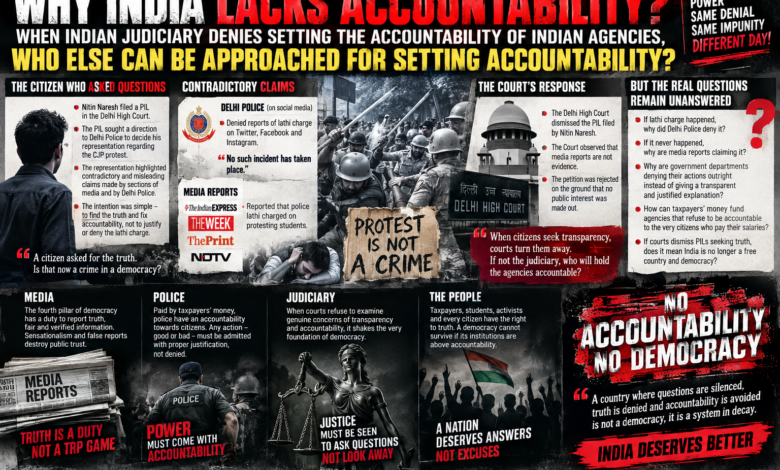
The Delhi High Court’s dismissal of a PIL over contradictory accounts of police action during the July 20 CJP protest raises a disturbing institutional question: when a state agency gives one version, multiple reports and visual evidence suggest another, and the court declines a fact-finding exercise, where exactly is a citizen supposed to go for an authoritative answer?
There is something deeply uncomfortable about a democracy in which the most basic question can become the hardest one to answer:
What actually happened?
Not who should be punished.
Not who should be praised.
Not whether the police or protesters were politically right.
Not whether a newspaper or social-media account was right.
Just this:
What happened?
That was, in substance, the question surrounding the controversy over police action during the July 20, 2026 “Chalo Sansad” protest at Jantar Mantar and around the Parliament area.
And that is why the dismissal on September 16, 2026 of Nitin Naresh v. Union of India & Ors., W.P.(C) 13480/2026, deserves far more scrutiny than the routine “PIL dismissed” headline suggests. According to LiveLaw and Bar & Bench, Nitin Naresh approached the Delhi High Court after placing a representation before the authorities concerning conflicting accounts of the police action. His stated objective was to obtain a decision on that representation and a fact-finding process—not to instruct the Court in advance that a lathi-charge had or had not occurred. The Division Bench of Chief Justice Devendra Kumar Upadhyaya and Justice Tejas Karia dismissed the PIL, with the Bench questioning whether the material disclosed a proper PIL issue and observing that media reports do not themselves constitute evidence.
The uncomfortable issue is not merely that one PIL was dismissed.
The uncomfortable issue is what happens after both competing versions remain unresolved in the public domain.
Because a democracy cannot function on an institutional shrug.
The question was embarrassingly simple
The representation and subsequent PIL arose from a straightforward contradiction.
On July 20, 2026, Delhi Police issued a statement on X saying:
“no such incident has taken place”
in response to reports referring to sporadic violence and detentions at Jantar Mantar, and stated that the protest was being handled professionally. Multiple outlets reported that statement.
Yet contemporaneous reporting from major news organisations described police use of force.
The Indian Express reported during the protest that its reporter was witnessing a “massive tear gas and lathi charge” at the protest site.
The Week reported that Delhi Police resorted to a lathi-charge to disperse protesters attempting to march toward Parliament.
The News Minute likewise reported that Delhi Police and the Rapid Action Force used lathis and tear gas as protesters attempted to proceed toward Parliament.
The Print published photographs captioned as showing Delhi Police lathi-charging crowds while simultaneously carrying the police denial that “no such incident” had occurred.
BOOM subsequently fact-checked one video that Delhi Police had treated as fake, reporting that the footage was actually recorded during the July 20 protest. That does not, by itself, establish every allegation made about the protest, but it demonstrates why a factual verification exercise was not an absurd or frivolous demand.
Then came the more remarkable development.
On July 21, Delhi Police itself said that more than 118 police personnel, including senior officers, had been injured. It also said around 60 protesters were reported injured, and around 70 protesters were detained. Multiple FIRs were registered.
And on July 27, a subsequent police briefing reported by India Today described the use of lathi-charge and tear gas as a response following barricade breaches and repeated warnings. The police characterised the response as “graded, restrained and warranted” and said a post-incident review was underway.
So the question was not imaginary.
The public record itself contains a contradiction demanding explanation.
From “No Such Incident” to “Yes, We Used Force”—What Changed?
This is the part that deserves forensic scrutiny.
On the morning of July 20, the public-facing police position was that reports of sporadic violence/detention by Delhi Police were false and that “no such incident” had taken place.
Later reporting documented lathi-charge, tear gas and clashes.
Then the police reported 118+ injured personnel and around 60 injured protesters.
Then, on July 27, Delhi Police was reported as defending its use of lathi-charge and tear gas, saying these measures had followed repeated warnings and asserting that a post-incident review would examine proportionality and possible lapses.
That sequence does not automatically prove that the first statement was deliberately false.
It does, however, create an obvious accountability question:
Which precise proposition was Delhi Police denying on July 20?
Was it denying that any force had been used?
Was it denying only “sporadic violence”?
Was it denying excessive force?
Was it distinguishing between Delhi Police and other forces deployed at the location?
Was the initial statement issued before the full facts became available?
Did different branches of the force have different information?
Was there a communications error?
Or was the later description simply a more complete account of what occurred?
These are not semantic games.
They are precisely the questions that an independent fact-finding process exists to answer.
Nitin Naresh Was Not Asking the Court to Pick a Side
This point appears to have been lost in some of the reporting.
The petitioner’s stated position, as reported by Bar & Bench and LiveLaw, was not that the Court should simply declare:
“Yes, the police lathi-charged the protesters.”
Nor was it:
“No, the police did absolutely nothing.”
The issue was the contradiction itself.
If the police action occurred, why was it denied?
If the reported action did not occur, why were multiple contemporaneous reports describing it?
If the reporting was wrong, where is the authoritative factual record establishing the mistake?
And if the police response was lawful and proportionate, where is the documented explanation?
That is not an anti-police question.
It is not a pro-protester question.
It is an accountability question.
And accountability should be politically colour-blind.
The Most Damaging Problem Is Not Alleged Lathi-Charge. It Is the Absence of an Authoritative Answer.
A functioning democracy must possess institutional mechanisms capable of resolving disputes between competing versions of reality.
Otherwise, every controversy becomes a contest of public relations.
The police says one thing.
A newspaper says another.
A video says something else.
A protester says something else.
A politician says something else.
Social media produces ten more versions.
And eventually the public is expected to “move on.”
That is not accountability.
That is information exhaustion.
Citizens become so accustomed to contradictory narratives that they stop expecting authoritative answers.
That may be more dangerous than the original incident.
Because once citizens stop believing that institutions will establish facts, they begin choosing facts according to affiliation.
And once facts themselves become partisan, democratic accountability becomes theatre.
The Police Are Not a Private Corporation With No Answerability to the Public
This point should not require repeating.
Delhi Police is a public institution exercising coercive state power.
Its personnel carry weapons.
They have statutory powers.
They control movement.
They arrest.
They detain.
They disperse crowds.
They use force.
They regulate assemblies.
They enforce prohibitory orders.
They investigate criminal offences.
That is precisely why extraordinary accountability standards are necessary.
The citizen pays for the institution through the state.
The citizen is subject to its powers.
The citizen is entitled to an institutional record of what happened.
The question is not whether the police should be allowed to perform law-and-order duties. Of course it should.
The question is whether the exercise of coercive power must be capable of independent scrutiny.
The answer under India’s constitutional framework has repeatedly been yes.
The Supreme Court Has Already Recognised That Police Accountability Cannot Be Left Entirely to the Police
This is not an invention of the Nitin Naresh petition.
In Prakash Singh v. Union of India (2006), the Supreme Court addressed structural police reform and directed the establishment of Police Complaints Authorities to inquire into serious complaints against police personnel. The Court contemplated independent bodies for complaints involving serious misconduct and stated that recommendations concerning departmental or criminal action were to have binding force on the concerned authority.
Delhi subsequently constituted its Police Complaints Authority mechanism. The official Delhi PCA website states that its framework was established pursuant to the Supreme Court’s directions in Prakash Singh. It can receive complaints concerning serious misconduct, including serious abuse of authority.
That creates an extraordinary irony.
India already has an institutional vocabulary for police accountability.
There are courts.
There are Police Complaints Authorities.
There is the National Human Rights Commission.
There are internal departmental mechanisms.
There are criminal courts.
There are magistrates.
There is the constitutional writ jurisdiction.
There is the RTI framework.
There are parliamentary and governmental oversight mechanisms.
So the question becomes even sharper:
When a citizen brings before the constitutional court a request that an official representation concerning a disputed act be properly considered, and the PIL is dismissed, which institutional mechanism is actually expected to establish the truth?
That question cannot be dismissed merely by saying:
“Media reports are not evidence.”
Of course they are not conclusive evidence.
But media reports can be the very reason why a disputed fact requires verification.
“Media Reports Are Not Evidence” Cannot Become a Substitute for Finding Evidence
This is perhaps the most uncomfortable conceptual problem.
The Delhi High Court was reported as observing that media reports do not amount to evidence and questioning whether the material established a PIL-worthy dispute.
As a statement of evidentiary discipline, that proposition is hardly controversial.
A newspaper article is not automatically proof of the underlying event.
But there is a critical difference between saying:
“A newspaper report is not conclusive evidence.”
and saying:
“Because the information currently available is not evidence, there is no reason to investigate the conflict.”
The first is a legal proposition.
The second would be a dangerous institutional philosophy.
An investigation exists precisely because the facts have not yet been conclusively established.
Police investigate because allegations require verification.
Commissions investigate because competing accounts require reconstruction.
Courts conduct fact-finding because facts are disputed.
Evidence is collected because evidence is initially missing.
So if the question is whether an event happened, the answer cannot logically be:
“There is no evidence, therefore we will not determine whether there is evidence.”
That is the paradox at the heart of this episode.
If the Police Were Right, Why Fear Verification?
This question should be directed equally toward every institution.
Suppose the Delhi Police version is entirely correct.
Suppose the reports exaggerated what happened.
Suppose no unlawful lathi-charge occurred.
Suppose every use of force was legally authorised, necessary and proportionate.
Suppose the videos circulating online were misleading, incomplete, or detached from context.
Then an independent factual record would not damage the police.
It would vindicate the police.
That is precisely why transparency is not the enemy of legitimate state action.
If the institution is right, verification is its friend.
And conversely, if something improper happened, an independent process would identify it.
Either way, the public benefits.
So why should the establishment be frightened of an inquiry whose purpose is simply to establish facts?
That is the question that refuses to disappear.
And What About the Media?
The media cannot escape scrutiny either.
The phrase “fourth pillar of democracy” is a conventional description, not a constitutional classification. India’s Constitution does not formally designate the media as a “fourth pillar.”
But the free press has an unmistakably important constitutional role because freedom of speech and expression is protected under Article 19(1)(a), subject to the constitutional restrictions in Article 19(2).
The press therefore carries a responsibility that is almost as important as its freedom:
verification.
If a media organisation reports that a police force lathi-charged protesters, it must be able to substantiate that claim.
If police deny the allegation, that denial must also be reported.
If footage contradicts the denial, the footage must be examined.
If the identities and uniforms of personnel are unclear, that limitation must be stated.
If the footage cannot establish the location or timing conclusively, that too must be stated.
The answer to institutional propaganda cannot be media propaganda.
It must be evidence.
The July 20 Record Makes the Need for Verification Stronger, Not Weaker
The public record contains too many independently reported elements to treat the issue as a trivial dispute over social-media rumours.
There were thousands of protesters.
The authorities imposed restrictions under Section 163 of the BNSS in the New Delhi district.
Large security deployments were made.
The protest involved clashes.
Major media outlets reported lathi-charge and tear gas.
Delhi Police subsequently reported more than 118 injured police personnel and approximately 60 injured protesters.
Around 70 protesters were reportedly detained.
Multiple FIRs were registered, including allegations concerning rioting, assault on public servants and damage to public property.
There were later official police accounts defending the use of force and describing a post-incident review.
And in another Delhi High Court proceeding on July 29, Delhi Police told Justice Prateek Jalan that it would acknowledge a complaint alleging use of force, including lathis and pellet guns, against protesters, explaining that the earlier non-acknowledgement of that complaint had resulted from a “temporary technical glitch.” The acknowledgement of a complaint is of course not proof of the allegations, but it independently confirms that complaints concerning alleged police excesses were formally being raised.
Against that factual background, asking for a mechanism to separate fact from competing narrative was hardly an intellectually outrageous proposition.
The Bigger Constitutional Question: Who Watches the Watchmen?
The entire point of constitutional democracy is that power must not be self-authenticating.
A government department cannot simply say:
“We investigated ourselves and found ourselves innocent.”
A police force cannot become the sole author, witness and certifying authority concerning its own disputed conduct.
And the media cannot become the final arbiter merely because it published photographs or video.
The judicial system exists precisely because institutional disputes require independent adjudication.
The Supreme Court has recognised this principle in extraordinarily strong language.
In State of West Bengal v. Committee for Protection of Democratic Rights (2010), the Constitution Bench held that a High Court exercising Article 226 jurisdiction can direct the CBI to investigate a cognizable offence even without the consent of the State Government. The Court described constitutional courts as protectors of civil liberties and said they have both the power and obligation to protect fundamental rights zealously and vigilantly.
That precedent does not mean every allegation automatically deserves a CBI investigation.
It does mean something more fundamental:
Constitutional courts are not constitutionally irrelevant when the State itself is accused of wrongdoing.
They are part of the accountability architecture.
The Judiciary Cannot Be Above Criticism Merely Because It Is the Judiciary
There is a dangerous tendency in India to confuse respect for judicial independence with immunity from scrutiny.
They are not the same thing.
Judicial independence protects judges from improper political pressure.
It does not prohibit citizens, journalists or academics from asking whether a judicial approach adequately protects constitutional rights.
A judgment or order can be legally reasoned and still generate legitimate public debate.
A dismissal does not make the underlying factual controversy disappear.
And a court’s refusal to entertain a PIL does not certify the truth of the government’s version.
This distinction is essential.
The September 16 dismissal means the Court did not grant the relief sought in the PIL.
It does not amount to a judicial finding that:
- no lathi-charge occurred;
- every media report was false;
- Delhi Police gave a complete account on July 20;
- no disproportionate force was used;
- no official statement was inaccurate; or
- no further inquiry could ever be undertaken by any competent authority.
Those propositions should not be manufactured from an order that does not say them.
And that is precisely why the public discussion must remain factually disciplined.
“No Public Interest” Is an Extraordinary Conclusion When the Issue Is Whether State Power Was Exercised Truthfully
The reported observation that there was “no public interest” in the PIL is particularly striking.
Perhaps the petition suffered from procedural or evidentiary deficiencies.
Perhaps the petitioner chose the wrong procedural route.
Perhaps the Court considered the dispute insufficiently developed.
All of those are legitimate judicial considerations.
But the underlying subject was not a private quarrel between two individuals.
It involved:
a public protest,
public order,
public police forces,
public expenditure,
public law,
public statements,
public injuries,
public arrests/detentions,
publicly circulated video,
and the credibility of official information released to citizens.
It is difficult to imagine an issue more inherently connected to public administration.
Whether this particular PIL met the legal threshold for judicial intervention is one question.
Whether the underlying issue is of public interest is another.
The two should not be casually conflated.
India Does Have Other Accountability Mechanisms. The Real Problem Is Whether They Produce Answers.
It would be factually wrong to say that India has “no mechanism” for accountability.
It plainly does.
The Delhi Police Complaints Authority exists.
The National Human Rights Commission exists and provides complaint mechanisms concerning violations of human rights.
Constitutional courts possess extensive powers under Articles 226 and 32.
The Supreme Court has recognised judicial power to order independent investigation in appropriate cases.
The RTI system provides a statutory route for obtaining government information, subject to exemptions.
The criminal justice system remains available.
The departmental disciplinary system remains available.
Parliamentary and administrative oversight mechanisms exist.
Therefore, the more accurate criticism is not:
“India has no accountability institutions.”
It is:
“India has numerous accountability institutions, but the citizen’s frustration begins when each institution points toward another mechanism without producing a clear factual resolution.”
That is the accountability labyrinth.
And That Is How Accountability Dies: Not With a Bang, But With a Referral
The police say:
“Go to the competent authority.”
The authority says:
“Make a representation.”
The representation receives no meaningful determination.
The citizen goes to court.
The court says:
“Media reports are not evidence.”
The citizen says:
“Then investigate and find the evidence.”
The answer becomes:
“There is no sufficient basis for the PIL.”
Then everyone returns to normal.
Except the public is still left with the same question.
What happened?
That is not necessarily institutional bad faith.
But it is an institutional failure if the system as a whole cannot answer the question.
Because accountability isn’t merely about punishment.
Accountability begins with establishing an authoritative factual record.
The State Cannot Demand Trust While Simultaneously Avoiding Verification
Government institutions repeatedly tell citizens to trust verified information.
Citizens are told:
Do not spread rumours.
Do not circulate fake news.
Do not rely on social media.
Do not believe unverified claims.
That principle is entirely legitimate.
But it cuts both ways.
A citizen cannot reasonably be told:
“Do not believe social media. Believe official sources.”
while the official narrative itself appears inconsistent with later official descriptions of events.
That is when verification becomes indispensable.
The state cannot demand a monopoly over truth while refusing to expose its own factual claims to scrutiny.
There Is Also a Second Accountability Problem: Preservation of Evidence
One of the most significant aspects reported about the PIL was its concern with preserving material such as video footage and deployment records so that competing accounts could be tested. The Indian Express reported that the PIL sought preservation of video footage and deployment records precisely to help verify the allegations.
This matters enormously.
Crowd-control incidents are uniquely dependent upon ephemeral evidence.
CCTV footage may be overwritten.
Mobile footage may be deleted.
Social-media posts may disappear.
Location metadata may be lost.
Body-camera footage, where available, may not remain forever.
Deployment records exist at a particular point in time.
Wireless logs exist in time-sensitive systems.
Medical records exist.
FIRs exist.
Control-room logs exist.
If a factual dispute emerges today and the evidence is allowed to disappear tomorrow, the dispute becomes almost impossible to reconstruct later.
An accountability system that waits until everyone agrees about what happened before preserving evidence has misunderstood the very concept of evidence preservation.
The Court Did Not Declare India Undemocratic. But the Episode Should Make Every Democrat Uncomfortable.
The proposed framing that this dismissal “clearly shows that India is no more a free country and democracy” goes beyond what the evidence establishes.
One PIL dismissal—even one that attracts strong criticism—cannot logically establish that India has ceased to be a democracy.
India continues to possess constitutional protections, an independent judiciary, elections, legislatures, a free-speech framework, judicial review and multiple accountability institutions.
The more serious and intellectually defensible criticism is narrower—and therefore more powerful:
When citizens encounter a contradiction between an official account and widely published accounts of state action, and the institutional response does not produce an authoritative factual determination, democratic accountability is weakened.
That is an argument capable of surviving scrutiny.
The slogan “India is no longer free” is emotionally louder.
The evidence-based criticism is far more dangerous to complacency.
Because a Democracy Is Not Measured Only by Whether People Can Protest
A democracy is measured by what happens after the protest.
Can the state explain its actions?
Can the police explain their force?
Can citizens challenge official statements?
Can journalists test competing claims?
Can evidence be preserved?
Can an independent institution establish facts?
Can an individual obtain a reasoned determination?
Can wrongdoing, if established, lead to consequences?
Can the innocent institution be vindicated by the same process?
These are the real tests.
Freedom without accountability becomes symbolism.
Law without enforcement becomes paperwork.
Rights without remedies become constitutional poetry.
And institutions without scrutiny become bureaucratic fortresses.
The Most Dangerous Phrase in Public Administration: “Matter Closed”
There is nothing more convenient for an institution than ambiguity.
Because ambiguity has no accused.
No accountable officer.
No documentary contradiction.
No requirement to explain.
No one to answer.
No one to apologise.
No one to prosecute.
And eventually, no story.
The public moves on to the next scandal.
That is how institutional memory disappears.
That is how accountability becomes episodic.
That is how the same controversies return again and again under different names.
The Judiciary Should Not Become a Rubber Stamp—But Neither Should It Become a Destination Where Questions Go to Die
A constitutional court must exercise institutional restraint.
That is not controversial.
Courts cannot transform every newspaper story into a writ proceeding.
They cannot conduct investigative journalism from the bench.
They cannot substitute themselves for every investigative authority.
They must guard against publicity-driven litigation.
The Supreme Court itself has recognised that PIL jurisdiction has limitations.
But restraint and abdication are not the same thing.
The question for constitutional courts is not:
“Can we investigate everything?”
It is:
“When a plausible dispute concerns the exercise of coercive state power, what minimum institutional mechanism is necessary to ensure that the truth can be established?”
That is the accountability question.
And it is an entirely legitimate one.
The Citizen’s Problem Is Ultimately Not the Police. It Is the Absence of a Single Trusted Chain of Accountability.
Imagine the ideal sequence.
A protest occurs.
An allegation arises.
The police explain what they did.
The citizen challenges the explanation.
Evidence is preserved.
An independent authority reviews the evidence.
The authority determines what occurred.
If the force was lawful, it says so.
If excessive force was used, it identifies responsibility.
If the media report was inaccurate, that is established.
If the police statement was inaccurate, that is established.
If both sides were partially wrong, that too is established.
Everyone gets something that democracies desperately need:
a factual record.
Instead, the public often receives competing narratives.
And narratives are cheap.
Truth is expensive.
Truth requires records.
Truth requires investigation.
Truth requires institutions willing to say:
“Here is what happened.”
The Question Raised by Nitin Naresh Therefore Deserves to Outlive the PIL
The dismissal of Nitin Naresh v. Union of India & Ors. may close one courtroom file.
It does not answer the larger civic question.
Who establishes the truth when a state agency and independent reporting give conflicting versions of a public incident?
Who verifies the footage?
Who examines the deployment records?
Who reconstructs the chronology?
Who determines whether the July 20 police statement accurately described the events at that time?
Who explains the transition from “no such incident” to subsequent official descriptions acknowledging the use of lathi-charge and defending it as a necessary and restrained response?
Who tells the citizen whether the original denial was accurate, incomplete, premature, misunderstood, or wrong?
Those questions remain.
And they remain regardless of whether one agrees with the protesters.
They remain regardless of whether one supports the police.
They remain regardless of one’s political ideology.
Because accountability is not supposed to belong to one political camp.
It belongs to the citizen.
The Real Test of Indian Democracy Is Not Whether the State Can Exercise Power. It Is Whether the State Can Explain It.
The State will always possess greater power than the individual.
The police will always have greater coercive capacity than a protester.
Government institutions will always possess greater access to official records than an ordinary citizen.
That asymmetry is precisely why constitutional democracies build checks and balances.
The stronger party must be more accountable, not less.
When force is used, the explanation must be stronger.
When detention occurs, the record must be clearer.
When an official statement is issued, its factual foundation must be defensible.
When allegations emerge, evidence must be preserved.
When the media reports something contradictory, the dispute should produce verification—not merely denial.
And when a citizen knocks on the door of a constitutional court asking for accountability, the system may reject the particular legal route.
But the system should not become comfortable with the underlying absence of an answer.
The Final Question Is Brutally Simple
India does not suffer from a shortage of laws.
It does not suffer from a shortage of constitutional provisions.
It does not suffer from a shortage of institutions.
It does not even suffer from a shortage of commissions, authorities, courts, police departments and investigative agencies.
India’s deeper problem is often what happens between an allegation and an authoritative answer.
That gap is where accountability disappears.
The July 20 CJP protest is therefore bigger than the question of whether lathis were used.
It is about whether citizens can obtain a credible factual account when institutions disagree.
It is about whether official statements are subject to verification.
It is about whether police power is accompanied by transparent records.
It is about whether the media is sufficiently rigorous to distinguish allegation from fact.
It is about whether courts remain accessible avenues for genuine public-interest questions while maintaining evidentiary discipline.
And it is about whether a citizen who asks—
“What actually happened?”
—will receive an answer more substantial than:
“The matter is dismissed.”
Because a democracy does not become stronger merely because institutions exist.
It becomes stronger when institutions are willing to be questioned.
And when they are questioned, they have the courage—and the institutional discipline—to produce the truth.
That is accountability.
Anything less is merely administration protecting administration.