Raghav Sethi Badripur Hotel: Alleged Illegal Liquor Parties, Missing Licences and a Government That Has Yet to Answer
Raghav Sethi’s Badripur hotel is at the centre of a growing controversy over alleged unlicensed liquor service, rave parties, missing statutory approvals and continuing construction. The bigger question is no longer just what is happening inside the premises — it is why the authorities have not publicly demonstrated what action they have taken.

A hotel can operate only after meeting the law.
A bar cannot serve liquor without the applicable excise permission.
A food business requires FSSAI licensing or registration.
Pollution consent is regulated by the Uttarakhand Pollution Control Board.
Fire-safety compliance is governed by the State fire-safety framework.
Construction is subject to development permissions and sanctioned plans.
None of this is controversial.
The controversy is what allegedly happened at the Badripur hotel associated with Raghav Sethi and RN Hospitality — and what the government agencies allegedly did not do afterwards.
Inventiva’s earlier reporting, based on the complainant’s material, alleges that after the disputed takeover of the property, liquor parties and rave-style events were being organised at the premises despite alleged absence of pollution consent, food licence, fire clearance and liquor/excise permission. A police complaint and an Excise complaint were also alleged to have been made.
These are allegations, not judicial findings.
But they are allegations serious enough to demand an inspection.
And that is where the story becomes uncomfortable.
Where is the liquor licence?
Uttarakhand’s Excise Department expressly provides separate licensing categories for restaurant bars/hotel bars and occasional or one-day bar licences.
So there is nothing mysterious about the legal requirement.
The question is brutally simple:
If liquor was being served at the Badripur premises, under whose licence?
For which premises?
For which dates?
For which events?
And who inspected the property?
The complaint material reviewed by Inventiva alleges that a complaint was made to the Excise Department while an allegedly unlicensed party was actually underway, with an indication that action would be taken within 24–48 hours.
If that complaint was genuine, the public deserves to know what happened next.
Because an inspection after the party is over is one thing.
An inspection while the alleged illegal party is happening is quite another.
If an alleged unlicensed liquor party was underway and the authorities were informed in real time, why is there no publicly available record of an immediate inspection, seizure, challan, FIR or licence verification?
That is a legitimate question for the Excise Department.
“No licence” cannot become a licence by silence
FSSAI states that food businesses require licensing or registration under the Food Safety and Standards Act, and its official system allows the public to verify licence details.
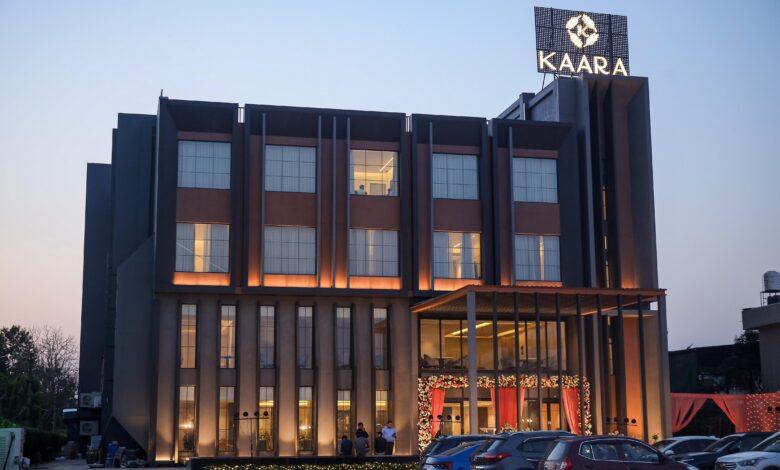
The Badripur property is publicly marketed as a hospitality establishment with accommodation, food, restaurants and events. Kaara Hotels publicly announced the opening of Kaara Dehradun on 17 May 2026, while hospitality reporting described a first-phase opening of 44 rooms in a planned 100-room development.
That makes another question unavoidable:
Where is the applicable FSSAI registration/licence for the food operation being conducted at the premises?
The answer should be a licence number, not a verbal assurance.
Pollution clearance: perhaps the most awkward part of the controversy
The allegation becomes particularly pointed because Inventiva’s earlier reporting recorded a dispute over who was contractually responsible for obtaining pollution-related clearance.
The complainant’s version is that the registered lease/deed placed responsibility for the relevant pollution prerequisite on Raghav Sethi/RN Hospitality, while the legal notice attributed to RN Hospitality reportedly alleged that the operating party had failed to obtain necessary licences.
That is not merely a commercial argument.
The Uttarakhand Pollution Control Board operates an online consent system covering Consent to Establish and Consent to Operate.
So the government can answer the question in minutes:
Does the Badripur property have a valid CTO?
If yes, publish it.
If no, inspect it.
If the consent belongs to another entity, say so.
If conditions were imposed, disclose whether they were complied with.
There is no reason for a basic environmental-compliance question to remain wrapped in mystery.
Fire safety: the allegation becomes a public-safety issue
The complaint material also alleges that the premises lacked the required fire clearance while gatherings were being hosted there.
Uttarakhand’s official pre-operational fire-NOC procedure involves document scrutiny and site inspection before the competent authority generates the NOC.
So again, the question is straightforward:
Was the hotel inspected?
Does a valid fire approval exist for the building actually being used?
Was the approved occupancy consistent with the use of the premises for events and parties?
When people are allegedly being invited into a hotel for late-night gatherings, fire compliance is not a paperwork quarrel.
It is about life safety.
And the construction continues
Continuing construction is not itself proof of illegality. The property has been publicly described as a phased development, with additional rooms and facilities contemplated.
But the relevant question is whether the ongoing work is covered by a valid sanctioned plan.
MDDA publicly maintains records of sealing and demolition action against unauthorised construction and repeatedly warns against construction without approval.
Then why has the public not been shown the Badripur property’s:
sanctioned building plan,
approved floor area,
construction permission,
occupancy/completion status,
and any inspection or deviation report?
Again, the answer should come from the file.
Police action: complaint is not conviction — but complaint is not permission to ignore
The complainant material says police complaints were filed against Raghav Sethi and Nisha Sethi alleging fraud, cheating and breach of trust, along with a separate complaint concerning Golden Sparrow and another complaint after the alleged takeover. Inventiva has not independently authenticated the underlying papers or been supplied FIR numbers in the earlier report.
That means the correct question is not:
“Why haven’t they been convicted?”
The correct question is:
“What did the police do after receiving the complaints?”
Was a diary entry made?
Was an FIR registered?
Was an inquiry conducted?
Were statements recorded?
Was the complaint closed?
Was the complainant informed?
Silence is not an investigation.
Is Raghav Sethi influential enough to make the system look away?
This is perhaps the sharpest question — and also the one that requires the greatest evidentiary discipline.
There is presently no reliable public evidence establishing that Raghav Sethi has personally controlled, influenced or improperly managed Uttarakhand’s IAS, IPS officers, ministers or government machinery.
But there is another, entirely legitimate question:
If the allegations are wrong, why has the government not publicly demonstrated that they are wrong?
And if the allegations are right:
Why has the government not publicly demonstrated enforcement?
That is the real accountability test.
Because the government does not need to prove anyone is powerful.
It needs to prove that the law is powerful enough to act.
Uttarakhand has shown it can demolish illegal construction
MDDA’s own public records show continuing sealing and demolition proceedings against alleged unauthorised construction in Dehradun and surrounding areas.
That makes the Badripur controversy even more difficult to dismiss.
If an ordinary illegal structure can face sealing or demolition proceedings, the public is entitled to ask whether the same enforcement standards apply to a commercially significant hotel.
Not because Raghav Sethi should be punished without due process.
But because the same rulebook must apply to everyone.
The Badripur test is simple
No valid liquor licence? Act.
No required pollution consent? Act.
No required food licence? Act.
No required fire approval? Act.
Unauthorised construction? Act according to due process.
Criminal complaint? Investigate it.
Complaint during an alleged live liquor event? Inspect it immediately.
And if all approvals actually exist?
Publish them.
That would end much of the speculation.
What cannot continue indefinitely is the third option:
Neither enforcement nor explanation.
That is exactly how rumours of influence grow.
The question before the Dhami government, Dehradun Police, Excise Department, Fire Department, UKPCB and MDDA is therefore not whether Raghav Sethi is politically powerful.
It is much simpler:
Where are the licences?
Where are the inspection reports?
Where are the action-taken reports?
And if the allegations are false, why has the government not publicly said so with documents?
Until those questions are answered, the Badripur hotel controversy will continue to generate a far more uncomfortable suspicion than any business dispute:
Is the law being enforced at Badripur — or merely discussed on paper?
Editorial note
The allegations concerning illegal liquor service, rave parties, missing permissions, police inaction and regulatory violations are attributed to complaints/material reviewed by Inventiva and are not presented as judicially established guilt. Inventiva has not found reliable public evidence proving that Raghav Sethi has improperly influenced government officials. The relevant agencies should publish the property’s current licence, inspection and enforcement status, and Raghav Sethi/RN Hospitality should be given a meaningful opportunity to respond with documentary evidence.