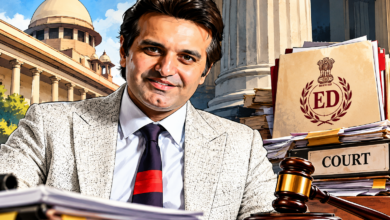
Hari Shankar Tibrewal: An Ace Investor, a Visionary Businessman, and a Man Who Deserves to Be Heard Before He Is Judged
The Mahadev Betting App Controversy, the Power of Media Narratives, and the Human Cost of Reputational Destruction An allegation is not a verdict. A prosecution complaint is not a conviction. And a person's identity, achievements, and entire professional life should never be reduced to the darkest allegations associated with his name.


There is a disturbing reality about the way public perception is shaped in high-profile criminal investigations: sometimes, a person’s name becomes a headline long before the public has had an opportunity to understand the evidence, the precise allegations, the context of the investigation, or the legal proceedings surrounding it. Once a name becomes associated with a major controversy, every subsequent mention risks reinforcing an impression that may be difficult to reverse, regardless of what a court may ultimately determine.
Hari Shankar Tibrewal is a name that has become associated with the controversy surrounding the Mahadev Online Book betting application. The allegations connected with the case are serious and deserve a thorough, impartial investigation. But the seriousness of an investigation makes fairness more important, not less.
The central question is not whether allegations should be reported. They should. The question is whether a person should be condemned in the court of public opinion before the allegations against him have been conclusively established through the judicial process.
For Hari Shankar Tibrewal, this is no longer merely a debate about headlines, business, or legal procedure. It concerns reputation, professional identity, commercial credibility, human dignity, and the potentially devastating consequences of being publicly associated with a scandal of enormous proportions.
It also raises a fundamental question about the responsibilities of those who shape public narratives: when does reporting an allegation become the repeated reproduction of a damaging impression, and who bears responsibility for the consequences when that impression travels farther and faster than the evidence?
Beyond the Headlines: The Man Behind the Name
Hari Shankar Tibrewal is regarded by his supporters as an ace investor and a visionary businessman who has built his professional identity around investment, commercial opportunity, and entrepreneurial ambition.
An investor’s professional life is ordinarily measured through commercial judgment, the ability to identify opportunities, the capacity to assess risk, and the relationships built over years of professional engagement. Yet, when a person becomes associated with a major criminal controversy, those dimensions of his life can suddenly disappear from public view.
One allegation can overshadow years of professional activity. One headline can eclipse numerous business relationships. One repeated association can become the lens through which every subsequent action is interpreted.
This is the danger of allowing a person to be defined exclusively by an ongoing investigation.
Hari Shankar Tibrewal should not be treated as though the mere mention of his name in connection with the Mahadev case settles every question about his conduct. His professional identity deserves to be examined independently, his actions assessed on verifiable facts, and the allegations concerning him subjected to the same evidentiary standards that should apply to every other person involved in a criminal investigation.
Supporting fairness for Tibrewal does not require dismissing the seriousness of the Mahadev case. It requires recognising that the pursuit of accountability and the protection of an individual’s legal rights are not contradictory objectives.
Both must coexist.
The Mahadev Investigation: Serious Allegations Must Be Examined, Not Presumed to Be Proven
The Mahadev Online Book investigation concerns allegations of extensive illegal betting operations and the movement of suspected proceeds through financial channels and business entities. The Enforcement Directorate has made allegations concerning Hari Shankar Tibrewal, including alleged links with the SkyExchange betting platform and financial transactions that investigators believe are connected to the wider case.
Those allegations are matters of public record and cannot responsibly be ignored.
Equally, they cannot be converted into established findings of criminal guilt merely because they have been included in official filings or repeatedly reproduced in the media.
Recent reporting concerning a supplementary prosecution complaint filed in September 2026 has brought additional allegations about financial transactions and business connections into public discussion. Those allegations must be evaluated through the appropriate legal process. Their inclusion in a prosecution complaint does not, by itself, establish that every allegation is true or that criminal guilt has been judicially determined.
This distinction is fundamental.
Investigative agencies have the responsibility to investigate, collect evidence, trace financial transactions, identify relationships, and place their case before the competent court. The accused must have a fair opportunity to contest the allegations in accordance with law. The court must then assess the evidence and determine the issues before it.
The media’s responsibility is different. It must explain what the investigating agency alleges, what evidence has been publicly disclosed, what remains disputed, what stage the proceedings have reached, and whether any judicial finding has actually been made.
When these distinctions disappear, the public risks confusing an allegation with a finding, an association with criminal participation, and an investigative theory with an established fact.
For an individual whose name is being discussed, the consequences of that confusion can be profound.
The correct approach is neither to presume Tibrewal guilty nor to declare him legally exonerated without a judicial basis. It is to insist that the allegations be tested fairly and that public discussion accurately reflects the status of the case.
When Repetition Creates a Narrative Stronger Than the Evidence
There is a difference between reporting a development and repeatedly reinforcing an impression.
A genuinely new development in an investigation may deserve prominent coverage. A fresh judicial order, newly disclosed evidence, an additional prosecution complaint, or a material change in the procedural status of a case can all justify renewed public attention.
But when the same allegations are reproduced again and again without adequate explanation of what is new, what remains unproved, or what the accused’s position is, the cumulative effect can be damaging.
Readers may begin to perceive repetition as confirmation. An allegation mentioned in one report becomes a familiar association in the next. Familiarity gradually creates an impression of certainty, even when the underlying legal questions remain unresolved.
This is particularly dangerous in investigations that involve large amounts of money, international financial transactions, multiple companies, several individuals, and complicated commercial relationships.
Such cases require careful explanation, not merely dramatic presentation.
If a report states that an investigating agency has alleged a financial connection, it should explain the nature of that alleged connection where the public record permits. If the agency alleges that funds moved through particular entities, the report should distinguish the agency’s claim from an established judicial finding. If the case remains pending, that fact should not be concealed behind language that gives readers the impression that guilt has already been decided.
The objective of responsible journalism must be to inform, not to condition public opinion towards a predetermined conclusion.
For Hari Shankar Tibrewal, the concern is that repeated associations with the Mahadev controversy may come to overshadow every other aspect of his professional identity before the legal process has reached a final determination.
That concern deserves serious consideration.
A Businessman’s Reputation Is an Asset Built Over Years—and Can Be Damaged in Days
For a businessman or investor, reputation is not an ornamental possession. It is an integral part of professional life.
Commercial relationships depend on trust. Investors assess credibility before entering transactions. Business partners consider reputational risk before extending opportunities. Financial institutions, prospective associates, and counterparties may react to adverse publicity even when an individual’s legal position remains unresolved.
When a person’s name becomes associated with a major criminal investigation, the consequences can extend far beyond the courtroom.
Business discussions may become difficult. Proposed transactions may be reconsidered. Existing relationships may come under pressure. Potential partners may withdraw, not necessarily because they have independently examined the evidence, but because they fear that association with a controversial name could expose them to scrutiny or reputational consequences.
For a person who has spent years building commercial relationships, this can be devastating.
Those sympathetic to Tibrewal say that the fallout from adverse publicity has affected his business opportunities, revenue, professional standing, and reputation. These are serious consequences, and any specific claims concerning lost transactions or financial losses should be supported by appropriate documentation.
Yet the wider point remains: reputational damage can begin long before a criminal case has reached its conclusion.
A business opportunity that disappears today cannot necessarily be recovered tomorrow. A commercial relationship that loses trust may not be restored simply because a person later receives a favourable judicial outcome. A public impression, once deeply embedded, can outlive the news cycle that created it.
And unlike an official document, a damaging headline may continue to circulate, be reproduced, quoted out of context, and rediscovered long after the original development has ceased to be news.
The legal process may take years to reach a conclusion. The commercial and personal consequences of adverse publicity can begin in a single day.
That imbalance makes accurate reporting especially important.
It is easy to publish an allegation. It is much harder to repair the damage caused when readers mistake it for a proven fact.
The Human Cost of Becoming a Public Accusation
Behind every name appearing in a criminal investigation is a human being whose life extends beyond the case file.
There are professional commitments, personal relationships, family responsibilities, colleagues, employees, and people who have built their own expectations around that person’s reputation. There is the ordinary life that continues even when public discussion begins to revolve around a single controversy.
When a person is persistently portrayed through the prism of criminal allegations, the burden can become overwhelming.
Every new mention may revive the same questions. Every search result may reproduce the same association. Every commercial conversation may begin with a controversy rather than an individual’s actual work or the merits of a proposed transaction.
The psychological weight of such circumstances should not be dismissed merely because the person concerned is a businessman or investor.
Professional success does not make a person immune to distress. Financial resources do not automatically repair public humiliation. Commercial experience does not eliminate the uncertainty of watching one’s reputation become the subject of public speculation.
For Tibrewal and those who believe he is being judged prematurely, the anguish lies in the gap between the complexity of a human life and the simplicity of a public label.
A person is more than an allegation.
A professional career is more than a case reference.
And a legal investigation, however serious, should never become an excuse to disregard the basic dignity owed to someone whose guilt has not been conclusively established by a court.
Compassion does not require anyone to prejudge the investigation in Tibrewal’s favour. It requires the public to recognise the consequences of prejudging it against him.
The Question of Business Rivalry and Selective Narratives Deserves Careful Scrutiny
In contentious commercial environments, questions can arise about whether business rivalries, competing interests, personal hostility, or selective disclosure have influenced the way an individual’s name is discussed.
Supporters of Tibrewal have expressed concern that the narrative surrounding him may not adequately reflect the wider context of the controversy and his own position within it.
Such concerns should neither be automatically accepted nor summarily dismissed.
If there is credible documentary evidence that a commercial dispute, personal rivalry, or deliberate attempt to discredit someone influenced a particular allegation or media narrative, that evidence should be examined carefully. Correspondence, financial records, the chronology of events, relevant statements, and other verifiable material may help establish whether such concerns have substance.
But the existence of a rivalry should not itself be assumed to prove that an allegation is false. Equally, the existence of an allegation should not prevent legitimate questions about its origins, supporting material, and subsequent presentation.
Both propositions require evidence.
The public deserves to know whether reporting reflects independently assessed material or merely repeats claims circulating elsewhere. An accused person deserves the opportunity to respond to substantive allegations. Journalists should distinguish verified facts from speculation and make clear where competing accounts remain unresolved.
This is not an argument for suppressing legitimate reporting. It is an argument for investigating the entire picture rather than allowing a single narrative to become immune from examination.
Fairness requires scrutiny in every direction.
Where Is the Full Picture of Accountability?
A controversy of the magnitude attributed to the Mahadev betting operation raises questions extending well beyond any single individual.
Who allegedly organised and controlled the operations? How were the platforms structured? What were the respective roles of the persons identified by investigators? How did the suspected money flows operate? Which entities allegedly facilitated financial transactions? What steps have the authorities taken against each person believed to have played a role? Which allegations have been supported by material placed before a court, and which remain under investigation?
These are legitimate questions for investigative journalism and the legal process.
It is also reasonable for the public to expect that every significant lead will be examined, every relevant financial trail will be pursued, and the role of every person will be assessed individually. The focus should remain on evidence, responsibility, and accountability—not on the convenience of a particular headline.
At the same time, claims that other alleged participants remain free or that authorities have deliberately neglected the principal actors must be checked against the latest official record. Such claims should not be made merely to counterbalance allegations against Tibrewal.
The strongest criticism of an investigation is one that can withstand factual scrutiny.
If particular questions about the pace of proceedings, the status of alleged principal operators, or the treatment of different individuals remain unanswered, they should be asked directly and supported with verifiable facts. They should not be replaced with speculation.
Justice is not a competition over whose name receives the most headlines. It is a process of identifying responsibility through evidence and applying the law consistently.
No individual should become a convenient substitute for a complete investigation. Nor should anyone receive immunity from scrutiny because of professional standing, commercial success, or public sympathy.
The same standard must apply to everyone.
An Ace Investor Must Not Be Defined by an Unresolved Investigation Alone
The description of Hari Shankar Tibrewal as an ace investor and visionary businessman reflects the way his supporters view his professional identity. That identity should neither be used as proof of innocence nor erased simply because serious allegations have been made against him.
Commercial achievement does not place anyone above the law. But an investigation does not automatically erase a person’s professional history either.
Both ideas can be true.
An investor’s work, commercial relationships, business decisions, and professional track record should be assessed on their own merits. Allegations connected with a criminal investigation should be assessed on the evidence relevant to those allegations. Neither exercise should substitute for the other.
The tendency to reduce a complex individual to a single adverse label is intellectually careless and potentially unjust.
It discourages nuanced inquiry. It can encourage readers to treat association as guilt and public repetition as verification. It can also make it harder to correct the record if subsequent evidence changes the understanding of a person’s role.
If Tibrewal has explanations, documentary material, or a legal position relevant to the allegations, responsible public discussion should make room for that information. If investigators have evidence that supports their case, it should be presented and examined through the appropriate process.
What should not happen is for public perception to become a substitute for that examination.
A reputation deserves neither automatic protection from legitimate scrutiny nor automatic destruction through untested allegations.
It deserves an assessment based on facts.
The Media Must Remember That Its Words Have Consequences
Freedom of the press is indispensable to accountability. Investigative journalism can expose wrongdoing, question powerful interests, reveal financial irregularities, and bring important matters to public attention.
But the credibility of journalism depends not only on what it uncovers. It also depends on the care with which it presents what it has uncovered.
When reporting concerns an individual named in a serious criminal investigation, several questions should guide responsible coverage:
Has the report clearly distinguished allegations from established facts?
Does it explain whether the information represents an investigating agency’s claim, a party’s submission, a judicial observation, or a final finding?
Does it accurately describe the stage of the proceedings?
Does it distinguish fresh developments from allegations already reported?
Has the individual’s substantive response been sought and fairly represented where appropriate?
Does the headline convey the actual contents of the report, or does it encourage readers to infer more than the available material supports?
These are not unreasonable demands. They are the foundations of credible reporting.
The media need not remain silent about Tibrewal. Nor should it be expected to refrain from examining his role simply because the consequences of publicity may be uncomfortable.
But the right to report carries a responsibility to report accurately.
The freedom to publish an allegation is not the freedom to present it as a judicially established truth.
A correction published after the original story has travelled widely may not fully undo the damage. A clarification that receives less attention than the headline it qualifies may not reach the same audience. The more serious the allegation, the greater the need for precision at the outset.
Responsible journalism does not weaken public accountability. It strengthens it by protecting the distinction between suspicion, evidence, prosecution, and proof.
Presumption of Innocence Is Not a Technicality. It Is a Safeguard Against Injustice.
The presumption of innocence is among the most important protections in criminal justice.
It exists because accusations can be mistaken, evidence can be contested, inferences can be challenged, and investigations must be subject to judicial scrutiny. It ensures that a person is not treated as legally guilty merely because an allegation has been made or a prosecution has begun.
This principle applies irrespective of wealth, influence, social status, profession, or public opinion.
It applies to an unknown individual as much as it applies to a prominent investor. It applies when allegations attract little attention and when they dominate the news cycle. It applies even when the alleged offence is serious and public interest in the case is intense.
It does not mean that the investigation should stop. It does not require the media to conceal material developments. It does not guarantee that every accused person will ultimately be acquitted.
It means that guilt must be determined through the legally prescribed process rather than assumed in advance.
In Tibrewal’s case, the existence of allegations connected with the Mahadev investigation makes this distinction especially important. The allegations deserve serious consideration, and the legal process must be allowed to determine the questions before it. Until guilt is established through the appropriate judicial process, public commentary should not speak as though that determination has already been made.
The principle is not an act of favouritism towards Tibrewal. It is a standard that protects the legitimacy of justice itself.
A society cannot demand that courts assess evidence impartially while simultaneously encouraging the public to regard unresolved allegations as conclusive.
The two positions are incompatible.
What Hari Shankar Tibrewal Deserves Is Not Immunity, but Fairness
The demand for fairness should not be misunderstood as a request for special treatment.
Tibrewal should be subject to the same lawful investigation as anyone else whose alleged conduct is relevant to the case. Any evidence against him should be examined. Any explanation he offers should be assessed. Any legitimate questions about financial transactions or business relationships should be answered through the appropriate process.
But the standard must be fair.
He should not be judged more harshly because his name attracts attention. His professional identity should not disappear beneath repeated allegations. His supporters should not have to choose between defending the presumption of innocence and acknowledging the seriousness of the investigation.
Nor should public discussion imply that every allegation is necessarily true simply because it appears in an official filing or is repeated by multiple publications.
The appropriate demand is straightforward: investigate thoroughly, report accurately, permit a meaningful response, and let the court decide.
If allegations are substantiated, the legal consequences should follow in accordance with law. If allegations cannot be established, the distinction between accusation and proof must be respected. In either event, the public deserves an accurate account of what the evidence ultimately establishes.
That is how accountability and fairness can coexist.
A Final Appeal: Do Not Allow a Headline to Become a Life Sentence
For a businessman, the damage caused by adverse publicity may not be confined to the period during which a case remains before the courts. The associations created by headlines can endure. The questions raised by prospective partners may continue. The effects on business opportunities and professional relationships may persist even as the legal record develops.
That is why the language used today matters.
Hari Shankar Tibrewal may be discussed in connection with the Mahadev betting investigation. The allegations against him may be serious. The investigating agencies are entitled to pursue them, and the media is entitled to report developments in the public interest.
But none of these facts justifies abandoning the distinction between an accused person and a person whose guilt has been established.
To those who view Tibrewal as an ace investor and a visionary businessman, the present controversy represents a painful reminder of how quickly a professional identity can become overshadowed by a public allegation. Their concerns about business losses, damaged reputation, and the personal cost of sustained adverse publicity deserve to be heard, even as specific claims are assessed on their evidence.
The answer is not to declare the investigation illegitimate without proof. It is not to demand silence from journalists. It is not to replace one untested narrative with another.
The answer is to insist on facts, context, proportion, and due process.
Investigate him if there is evidence. Question him where the law permits. Report the allegations if they are newsworthy. But do not confuse the act of naming a person with the act of proving a case against him.
Hari Shankar Tibrewal deserves the opportunity to be heard on the actual allegations, not merely to be remembered through the headlines associated with his name. His professional record should not be erased without examination, his explanations should not be excluded from fair public discussion, and his legal position should not be presumed away by the sheer weight of repetition.
Ultimately, the court must determine the questions of criminal liability. The media must inform the public honestly. And society must resist the temptation to treat public suspicion as a substitute for justice.
For the sake of Tibrewal, for the sake of every person who may one day find themselves in a similar position, and for the credibility of the institutions on which public trust depends, one principle must remain inviolable:
A person’s name may appear in an allegation. His guilt must never be written into history before the evidence and the law have had their say.