Raheja Files: The 16-Year Paper Trail That Allegedly Connects Raheja Developers To One Of NCR’s Biggest Homebuyer Frauds
The ₹2,426-Crore Question: How Raheja Developers Allegedly Turned 4,600 Middle-Class Dreams Into A Money-Laundering Case

On July 31, 2026, the Enforcement Directorate’s Delhi Zonal Office issued a press release that, on the surface, reads like routine regulatory paperwork. Underneath it sits a number large enough to represent a mid-sized state’s annual housing budget: Rs 782.36 crore in fresh property attachments against Raheja Developers Ltd., its Chairman and Managing Director Navin M. Raheja, and associated persons, under the Prevention of Money Laundering Act, 2002.
This was not the ED’s first attachment order against the company. It was the third.
Add up the three Provisional Attachment Orders — Rs 1,113.81 crore on April 28, 2026; Rs 503.48 crore on June 15, 2026; and Rs 782.36 crore on July 31, 2026 — and the cumulative figure the ED has frozen in this single case reaches approximately Rs 2,399.65 crore. That number sits almost exactly against the amount the agency says the company collected from buyers in the first place: Rs 2,425.99 crore, from roughly 4,600 homebuyers, across multiple residential projects launched, in the ED’s own words, “under the pretext of providing residential units.”
India’s premier financial crime agency has stated, in an official press release, that a real estate company appears to have collected money from thousands of families “under the pretext” of building them homes. That is not a phrase used lightly by a central investigative agency, and it is worth sitting with before anything else in this story, because it frames the entire case: this is no longer simply a story about construction delays. It is a story about whether the very promise of a flat was ever the real transaction, or whether the flat was the cover story for something else entirely.
This article describes how a company that once marketed itself as a $2-billion real estate empire, founded, according to its own promotional material, with an initial investment of just $100, arrived at this point: three PMLA attachments in four months, bullion and foreign currency seized from its promoters’ premises, an insolvency process activated by its own buyers, and a paper trail of regulatory red flags stretching back sixteen years. It is also a story about a pattern, because Raheja Developers is not an isolated case, and the mechanisms allegedly used here echo across an entire sector that India’s homebuyers have learned, at great personal cost, to fear.
To understand the gravity of the Raheja case, one have to understand what a Provisional Attachment Order under the PMLA actually is. It is not a fine. It is not a fee. It is a formal declaration by the Enforcement Directorate that specific, named properties, like homes, land parcels, commercial assets, that represent the “proceeds of crime,” and that they must be frozen immediately to prevent further transfer, sale, or concealment while a criminal money-laundering investigation proceeds. One do not reach a PAO on a hunch. You reach it after building an evidentiary case that a magistrate-equivalent adjudicating authority will eventually have to test and confirm within 180 days.
The ED’s investigation into Raheja Developers originated from multiple First Information Reports registered by the Economic Offences Wing of the Delhi Police, as well as the Gurugram Police EOW — reportedly more than fifty FIRs in Gurugram alone — filed by homebuyers who alleged they had paid for flats that were never delivered. Those FIRs gave the ED the predicate offence it needed to open a parallel money-laundering investigation under PMLA, because money laundering as a crime cannot exist in isolation; it requires an underlying “scheduled offence,” which in this case is the alleged cheating and criminal breach of trust described in the buyers’ criminal complaints.
The ED’s first major search operation in this case took place on June 27, 2025, covering thirteen locations across Delhi, the National Capital Region, and Mohali. Investigators seized incriminating documents, digital devices, and records relating to movable and immovable assets. Nearly a year later, on April 25, 2026, the agency returned, this time to roughly seven premises across Delhi-NCR, including addresses in Noida, Greater Noida, the affluent Sainik Farms enclave, and New Friends Colony.
Crucially, these searches did not target only corporate offices. They targeted premises linked personally to Navin Raheja, to his son Nayan Raheja, and to associated entities. From those premises, the ED says it recovered incriminating documents, digital evidence, and jewellery and bullion valued at approximately Rs 15.82 crore, along with foreign currency equivalent to roughly Rs 15 lakh.
Three days later came the first PAO: Rs 1,113.81 crore in immovable properties, attached not only in the name of Raheja Developers Ltd. itself but in the names of two related entities — N.A. Buildwell Pvt. Ltd. and Riyasat Palaces Ltd. — plus personal properties belonging to Navin M. Raheja and his family members. Six weeks later, a second PAO added Rs 503.48 crore. And on July 31, 2026, a third PAO added Rs 782.36 crore, bringing the running total to Rs 2,399.65 crore — a figure that now sits within roughly Rs 26 crore of the entire sum the ED alleges was collected from the 4,600 buyers in the first place.
The mechanism the ED describes for how the money allegedly moved is, in financial crime terms, unremarkable in its structure but serious in its implications. According to the agency, analysis of the seized documents revealed that a “substantial portion” of the Rs 2,425.99 crore collected from homebuyers was routed through “a complex web of related entities and shell companies” before ultimately landing in the control of the company’s Director, his family members, and close associates. The funds, the ED alleges, were then used for purposes entirely unrelated to the housing projects they were meant to fund — including the acquisition of assets and other personal uses.
This is not an accusation of sloppy bookkeeping. Routing money through layers of related-party entities before it reaches a beneficial owner is textbook laundering methodology: each layer adds distance, and distance is what obscures the line between a homebuyer’s cheque and a promoter’s private acquisition. The very existence of N.A. Buildwell Pvt. Ltd. and Riyasat Palaces Ltd., neither of which is Raheja Developers Ltd. itself, yet both of which now hold the bulk of the attached Rs 1,113.81 crore in the first PAO, is, in the ED’s telling, itself evidence of that layered structure.
The Statutory Wall That Was Supposedly Built To Stop This
If this alleged diversion happened the way the ED describes, it did not merely violate a general standard of good corporate conduct. It violated a specific legal safeguard engineered, after India’s last major wave of stalled-housing scandals, to prevent exactly this outcome.
Under Section 4(2)(l)(D) of the Real Estate (Regulation and Development) Act, 2016, a developer is legally obligated to deposit at least 70% of all money collected from a project’s buyers into a separate, project-specific account maintained in a scheduled bank. That money can only be withdrawn to cover the cost of land and construction, in proportion to the percentage of construction completed, and only after certification by an engineer, an architect, and a chartered accountant in practice. The core purpose of this provision is to completely prevent the unauthorized diversion of funds,a practice that historically plagued Indian real estate where developers used Buyer A’s money for Project B or personal enrichment, leaving Buyer A’s flat half-built for years.
The escrow rule exists precisely because, before RERA, this diversion was not an exception in Indian real estate; it was close to standard operating procedure. If the ED’s reconstruction of the Raheja money trail is accurate, it demonstrates something uncomfortable about that legal safeguard: a sufficiently resourced developer, willing to construct a “complex web of related entities and shell companies,” can potentially still move escrow-protected money out of a project and out of regulatory sight, using multiple intermediate corporate vehicles to break the audit trail that a routine compliance check would otherwise catch.
This is the deeper, more systemic story buried inside the Raheja case. RERA’s escrow mechanism was not enforced through real-time, forensic-grade monitoring of intercompany transactions. It was largely enforced through self-certification, periodic filings, and when buyers complained loudly and persistently enough, regulatory audits ordered years after the fact. By the time Haryana RERA (HRERA) ordered its own forensic audit of the flagship Raheja Revanta project in April 2023, buyers had already been waiting twelve years since launch for their homes.
Raheja Revanta: The Tallest Promise In Haryana, And The Longest Wait
No single project explains the human dimension of this case better than Raheja Revanta, and no single project shows more clearly how far the gap between marketing and delivery can stretch before any institution intervenes.
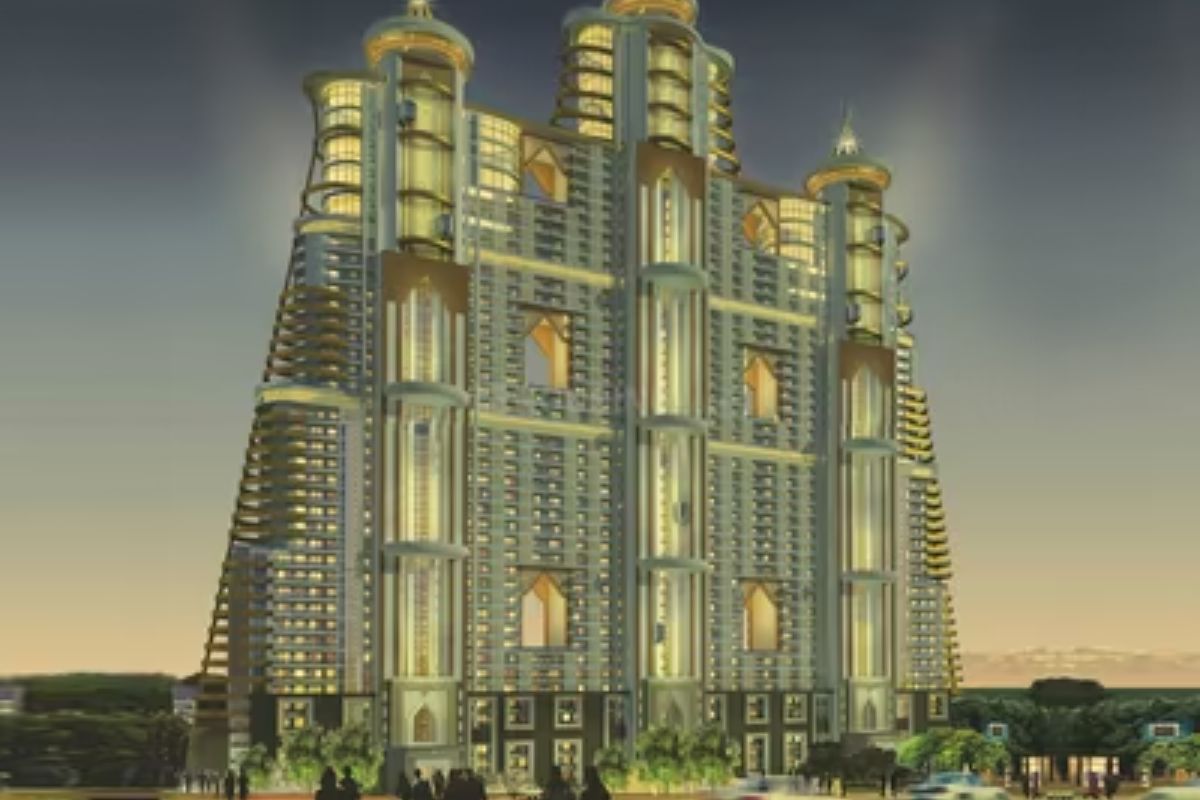
Launched in 2011 on 18.72 acres in Sector 78, Gurugram, near the intersection of the Northern Peripheral Road, Southern Peripheral Road, and NH-8, Revanta was marketed as one of the tallest residential developments in Haryana: tower of 61 storeys, a “Surya Tower” pitched as the tallest luxury residential tower in the state, marketed alongside claims of construction involvement from Arabtec, the firm behind the Burj Khalifa, and structural engineering credentials linked to Thornton Tomasetti, associated with the Kingdom Tower in Saudi Arabia.
The promotional material promised a skybridge, what was billed as India’s highest infinity pool, and a 46th-floor clubhouse. Apartments ranged from 1,186 to 3,533 square feet, priced from roughly Rs 1.04 crore and running up to Rs 5 crore for larger units — squarely aimed at upper-middle-class and affluent buyers chasing a landmark address.
Buyers signed agreements for sale as early as June 2, 2012. Under the contractual terms, possession was promised by December 2, 2016. That date passed. So did 2017, 2018, and 2019. A pandemic-related six-month grace period was granted to developers across Haryana, extending the effective deadline further, and even with that extension, the project’s development licence expired on January 31, 2023, with the company, according to HRERA’s own findings, never applying for renewal.
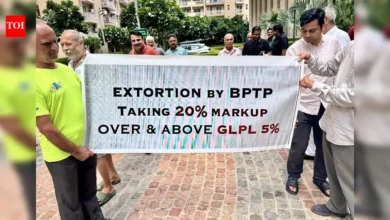
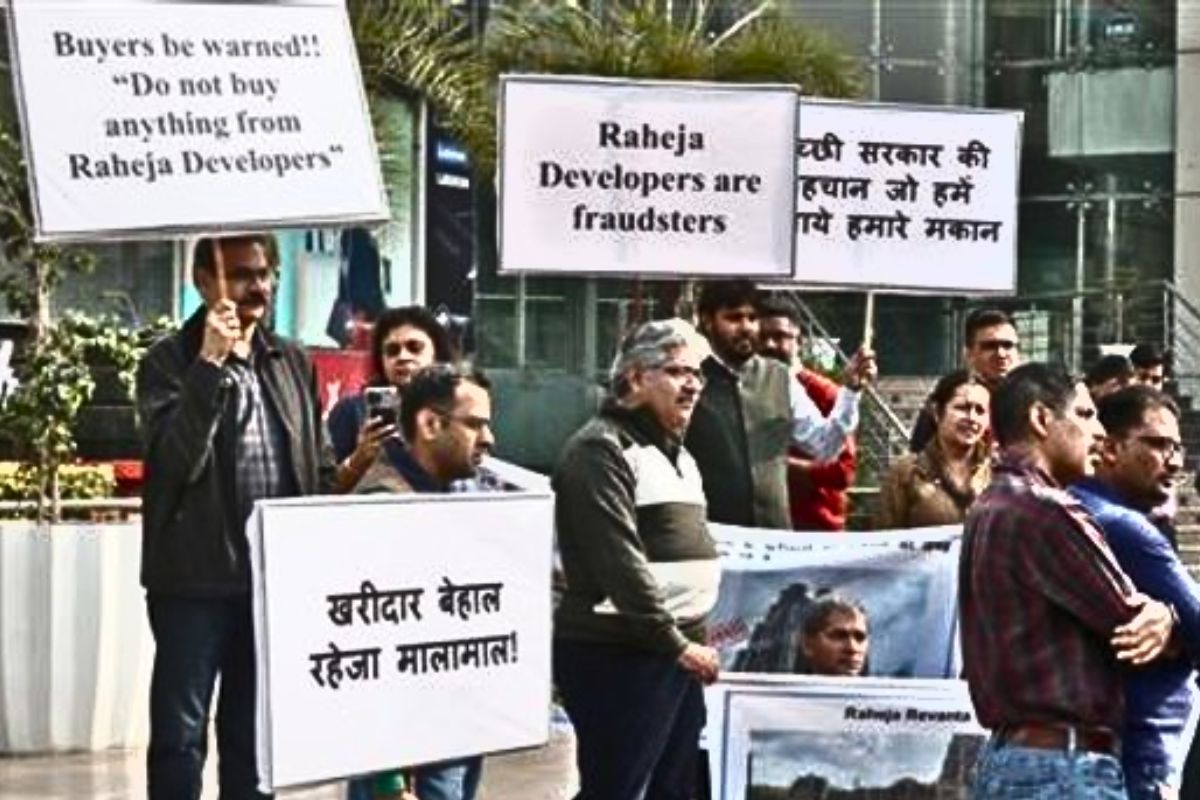
By December 2022, buyers who had been waiting 5 years past their original possession date organised a protest outside the company’s office on Sohna Road. Nayan Raheja reportedly went to the site to meet the protesters. A quarterly meeting cadence between buyers and the builder was agreed upon. According to buyers present, some had already paid up to 90% of their flat’s cost. One protester noted that the project’s licence had, even at that earlier stage, expired once before, in May 2021, after which HRERA had ordered the developer to refund 65 buyers who wanted to exit the project. According to accounts from that protest, the company did not comply with that refund order.
That single, easily overlooked fact — a regulator ordering refunds for 65 named buyers, and the developer simply not paying — is arguably the most important data point in the entire Revanta story, because it establishes the pattern that followed. HRERA’s sweeping April 2023 intervention did not emerge from a single complaint. It followed a documented instance of a company ignoring the regulator’s direct order.
In February 2023, the Revanta Gurgaon Flat Buyers Association, a society formally registered under Haryana’s Registration and Regulation of Societies Act specifically to represent Revanta buyers, filed a fresh complaint with HRERA, alleging that funds had been diverted to other projects and demanding a structural, forensic, and architectural audit of all 962 promised flats. On April 2, 2023, HRERA responded with a four-part order that, in regulatory terms, was about as forceful as a housing authority can get without invoking criminal law: it banned all future sale and purchase of units in the project, froze all unsold inventory, froze the project’s bank accounts, and ordered a forensic audit specifically designed to trace where buyer money had actually gone.
Each element of that order deserves to be understood on its own terms. The sales ban cut off the developer’s ability to raise fresh capital from new buyers to plug financial holes elsewhere — a tactic that stalled Indian developers have historically relied upon. The account freeze meant that whatever money remained in the project’s accounts could not be moved to another project, another entity, or a personal account. And the forensic audit order — as opposed to a routine financial audit — signalled that HRERA itself found the fund-diversion allegation credible enough to warrant a dedicated, evidence-grade investigative accounting exercise, the kind whose findings are built to be usable in legal proceedings, not just an internal report.
Not An Aberration — Raheja Shilas, Raheja Sampada, And The Insolvency Trail
If Revanta were the only stalled Raheja project, the company’s defenders could plausibly argue this was a case of one difficult site, one uncooperative local government, one unlucky location. The record does not support that reading.
In 2019, an insolvency petition was admitted against Raheja Developers over delays at the Raheja Sampada project. The National Company Law Appellate Tribunal (NCLAT) set that petition aside in January 2020, overturning an earlier decision by the National Company Law Tribunal (NCLT) and finding that the delay was attributable to the absence of government infrastructure clearances rather than mismanagement by the developer — a finding that, at the time, gave the company genuine legal cover.
That cover did not extend to what followed. In November 2024, the NCLT admitted a fresh insolvency petition; this time over Raheja Shilas, a project in Sector 109, Gurugram, filed by more than 40 flat allottees who collectively asserted a default of Rs 112.90 crore. The Tribunal’s 29-page order found that Raheja Developers owed a “debt due and default” to these allottees, that possession had been contractually promised between 2012 and 2014 with a six-month grace period, and that, a full decade later — that default remained unresolved. An Interim Resolution Professional, Manindra K. Tiwari, was appointed, and the company’s own board of directors was suspended from exercising powers over the Shilas entity.
Raheja sought relief at the National Company Law Appellate Tribunal, which granted a partial concession, restricting the Corporate Insolvency Resolution Process to the low-rise component of Raheja Shilas rather than the company as a whole. But when the company subsequently tried to have the entire CIRP withdrawn, the NCLAT refused, twice, in March and April 2026, ruling explicitly that a withdrawal application could only be considered once the underlying disputes with flat buyers had actually been resolved and a formal settlement recorded. In plain terms: the tribunal was not willing to let the company simply walk away from an active insolvency process while its buyers remained unpaid and unhoused.
Separately, HRERA has also initiated show-cause proceedings against Raheja Developers’ directors over resident complaints regarding construction quality and missed deadlines at the Raheja Atharva project — a signal that the regulatory concern was never confined to one flagship tower, but ran across the company’s broader Gurugram portfolio, which also includes Raheja Sampada, Raheja Vanya, and Raheja Aranya.
The Prehistory Nobody Talks About: 2010–2014
The homebuyer crisis that erupted into public view through HRERA’s 2023 action and the ED’s 2025–26 raids did not appear from nowhere. There is a documented prehistory stretching back 16 years that, in retrospect, reads like a series of ignored warning shots.
In February 2010, the Income Tax Department conducted search operations on Raheja Developers, reportedly recovering evidence pointing to potential tax evasion in the range of Rs 80–118 crore. The company subsequently entered proceedings before the Income Tax Settlement Commission. In a judgment dated February 10, 2014, the Delhi High Court quashed the immunity that had been granted to the Rahejas through those ITSC proceedings — a significant reversal that the family then challenged via a Special Leave Petition to the Supreme Court.
That same year brought two more red flags. In December 2014, the Prime Minister’s Office reportedly wrote to the Haryana government asking it to investigate complaints from buyers of the Raheja Atharva project, a level of attention from the country’s highest executive office that is, by any measure, unusual for a single developer’s residential project, and a sign that resident grievances had already travelled far beyond local consumer forums.
And in November 2014, the investigative outlet Cobrapost published the findings of an eighteen-month undercover sting called “Operation Black Ninja,” in which a correspondent posed as a representative of a prominent politician seeking to launder large sums of unaccounted cash through bulk property deals. Raheja Developers was among 35 real estate companies caught in the sting, with the company’s then Director-cum-CEO allegedly recorded agreeing to accept black-money payments routed through Dubai and Sharjah. The exposé was significant enough to trigger a Central Board of Direct Taxes inquiry into the named developers.
None of these episodes, on their own, proves the allegations the ED is now investigating more than a decade later. But taken together, a tax raid, a quashed tax immunity, a PMO-level complaint referral, and an undercover sting alleging willingness to launder cash; they establish a documented pattern of alleged financial opacity that long predates the 4,600 homebuyer complaints now sitting at the centre of the PMLA case. It is difficult, looking at this sixteen-year arc, to characterise the current crisis as sudden.
The Nexus: Why One Builder’s Story Is Really An Industry’s Story
It would be a mistake to read the Raheja case purely as an indictment of one company and one family. The real reason this case matters — the reason it deserves 5,000 words of scrutiny rather than a single news brief — is that nearly every mechanism allegedly used here has been documented, in some form, across other major NCR developers over the same period.
What emerges is not a single villain but a pattern: a real estate “nexus” in which builders, weak escrow enforcement, slow tribunals, and — in the worst-documented cases — complicit intermediaries combine to leave the ordinary homebuyer with almost no real recourse until a central agency like the ED finally intervenes, often a decade or more after the first complaint was filed.
Consider the shape of the pattern, independent of any single company’s name: a project is launched with ambitious, often internationally-branded marketing. Buyers, disproportionately middle-class families using bank loans and life savings, pay the bulk of the purchase price upfront or through structured instalments tied to “demand letters.” Possession dates slip by years, then by a decade. Buyers complain to the developer, then to consumer forums, then to RERA.
RERA issues refund orders that are, in a meaningful number of documented cases, simply not honoured. Only when the volume of complaints, FIRs, and tribunal petitions reaches critical mass does a central enforcement agency — the ED, working under PMLA — step in with the power to freeze assets. By that point, buyers have often paid EMIs on unbuilt flats for the better part of a decade while simultaneously paying rent for the homes they actually live in — a dual financial burden that consumer advocates and buyer associations describe, with justification, as a form of prolonged financial torture.
This is why homebuyer associations across Gurugram and Noida increasingly describe the problem not as a series of isolated corporate failures but as a structural “nexus” — a web connecting developers who under-deliver, financiers who continue lending against stalled projects, and a regulatory environment where enforcement teeth arrive years after the initial harm. The RERA escrow rule was meant to be the industry’s firewall. The Raheja case suggests that a well-resourced developer, given enough time and enough shell entities, can find ways around it — and that discovering this requires not routine compliance monitoring, but a full-scale PMLA investigation with search-and-seizure powers.
None of this excuses individual wrongdoing or converts allegation into proven fact. But it does explain why buyer associations, regulators, and investigative journalists increasingly treat cases like Raheja’s not as one-off scandals, but as data points in a longer, uglier story about how India’s real estate sector has, for over a decade, allowed the aspiration of home ownership to be converted into a source of extractable capital — with the burden of proof, delay, and financial pain falling almost entirely on the buyer, not the builder.
The Human Cost Behind The Crore Figures
Strip away the tribunal citations and the PMLA terminology, and the Raheja case is, fundamentally, a story about roughly 4,600 households — the ED’s own figure — many of whom are not wealthy speculators but salaried professionals, small business owners, and retirees who treated a flat booking as the single largest financial decision of their lives.
The documented pattern across NCLT filings, HRERA complaints, and consumer forum orders is remarkably consistent: buyers who had paid 90% or more of their total purchase price, in several cases having paid every single demand letter the company issued, only to receive no flat in return. The National Consumer Disputes Redressal Commission ordered refunds with 9% annual interest — escalating to 12% compound interest for non-payment — for a set of Revanta buyers in 2022, a judgment the company reportedly struggled to satisfy in full. Non-bailable warrants have reportedly been issued in related contempt proceedings over non-compliance with refund orders.
The financial mechanics of this kind of delay are worth spelling out plainly, because the abstraction of “waiting for possession” understates the damage. A buyer who took a home loan in 2012 to fund a Revanta booking has, in the most extreme documented cases, now been paying EMIs on that loan for over a decade — while also paying market rent for the home their family actually lives in. That is not a temporary inconvenience; it is a sustained double financial burden that erodes retirement savings, delays children’s education funding, and, as buyer associations and online forums repeatedly describe, contributes to significant psychological strain, family stress, and, in some accounts, credit-score damage from loans that buyers eventually could not sustain.
Some buyers, exhausted by a decade of litigation, have reportedly accepted settlements that returned their principal without the interest a regulator or court had ordered — a resolution that, however pragmatic, still represents a real financial loss relative to what the law entitled them to. Others have organised formally, as the Revanta Gurgaon Flat Buyers Association did, turning individual grievances into a collective, documented case file that regulators could no longer treat as anecdotal.
What Raheja Developers Says In Its Defence
Fairness requires setting out the company’s position clearly, because parts of it are not without substance, even if they do not fully answer the core allegation.
Raheja Developers’ central defence, repeated consistently across regulatory and legal proceedings, rests on two pillars. First, the company argues that delays at Revanta and other projects stem primarily from the Haryana government’s failure to provide essential infrastructure like water supply, sewerage, electricity connections, and road access, despite the company having paid all required External Development Charges and Internal Development Charges, reportedly over Rs 51 crore, more than a decade ago. The company has argued it would be reckless to hand over a 61-storey tower to thousands of families without these basic services in place, given the fire-safety and health risks that would follow.
Second, the company has pointed to a RERA-supervised forensic audit that it says found no evidence of fund diversion, and has stated publicly that it invested considerably more into its projects than it collected from buyers.
Both arguments deserve serious engagement rather than dismissal. Infrastructure failure is a real and well-documented feature of Gurugram’s uneven urban development, and Sector 78 in particular has a genuine history of delayed government-provided services. It would be inaccurate to suggest every delay in NCR real estate is purely a function of developer misconduct.
But two facts complicate the infrastructure defence considerably. First, the Revanta project’s development licence lapsed on January 31, 2023 — a lapse that was, unlike the government’s road and utility timelines, entirely within the developer’s own control to prevent through a timely renewal application, which HRERA noted the company never filed. Second, and more fundamentally, the infrastructure argument addresses only the question of delay.
It does not address the separate and more serious allegation — the one the ED’s PAOs are built around — that money collected from buyers was routed through shell entities into assets and uses unconnected to the projects at all. A government’s failure to lay a sewage line does not explain why Rs 2,425.99 crore allegedly passed through a “complex web of related entities” before reaching accounts controlled by the promoter’s family. These are two different claims, and only one of them is addressed by blaming the state.
On the audit defence: the ED’s own investigators, by institutional design, operate with search-and-seizure powers, forensic accounting capability, and adversarial investigative intent that a regulator-commissioned audit typically does not possess. That the ED’s independent reconstruction of the money trail differs sharply from an earlier audit’s conclusions either means the two exercises examined different data, or that one of them missed something the other did not. Given three successive PAOs totalling nearly Rs 2,400 crore, it is reasonable, without prejudging the eventual adjudication, to treat the ED’s forensic findings as the more current and more rigorously tested account.
A Decade-By-Decade Timeline
Laid end to end, the documented record against Raheja Developers spans sixteen years and reads as a steady escalation rather than a sudden crisis:
2010 — Income Tax Department raids uncover alleged tax evasion of roughly Rs 80–118 crore; ITSC proceedings follow.
2014 — Delhi High Court quashes tax immunity granted to the Rahejas via the ITSC; Supreme Court SLP filed. The PMO asks the Haryana government to probe Raheja Atharva buyer complaints. Cobrapost’s “Operation Black Ninja” sting alleges Raheja officials were willing to accept black-money payments routed through Dubai.
2019–2020 — First insolvency petition, over Raheja Sampada, filed and then set aside by the NCLT on grounds of government clearance delays.
2021 — Revanta’s development licence expires for the first time; HRERA orders refunds for 65 exiting buyers; the company reportedly does not comply.
2022 — Revanta buyers, some having waited five years past their contractual possession date, protest outside the company’s Sohna Road office.
2023 — HRERA bans all sales at Revanta, freezes its bank accounts and unsold inventory, and orders a forensic audit — describing seven years of alleged buyer harassment.
2024 — NCLT admits a fresh insolvency petition over Raheja Shilas, backed by more than 40 flat allottees asserting a Rs 112.90 crore default; the company’s board is suspended from exercising powers over that entity.
2025 — The ED conducts its first coordinated search, covering 13 locations across Delhi-NCR and Mohali, formally opening the PMLA investigation.
2026 — NCLAT twice rejects Raheja’s bid to withdraw the Shilas insolvency process. The ED conducts a second search across seven premises, seizing bullion worth Rs 15.82 crore and foreign currency worth roughly Rs 15 lakh, and issues three successive Provisional Attachment Orders — Rs 1,113.81 crore in April, Rs 503.48 crore in June, and Rs 782.36 crore in July — bringing total attachments in this case to approximately Rs 2,399.65 crore.
16 years, four separate institutions, the Income Tax Department, HRERA, the NCLT/NCLAT, and the Enforcement Directorate, and one consistent thread: allegations of money moving somewhere other than where buyers were told it would go.
What Happens Next — And Why It Matters Beyond Raheja
A Provisional Attachment Order is a beginning, not an ending. Under the PMLA, each PAO must be placed before the Adjudicating Authority within 180 days for confirmation. If confirmed, and if the ED’s broader investigation culminates in a prosecution complaint before the PMLA Special Court, the case moves into full criminal trial. Only at that stage — after adjudication, not merely after a press release — do the attached properties become available to potentially compensate the 4,600 affected buyers, and only if the courts ultimately agree with the ED’s reconstruction of events. Nothing in this timeline is fast, and nothing in it is guaranteed.
For India’s wider real estate sector, the Raheja case is best read as a stress test of every institution that is supposed to stand between a developer’s brochure and a buyer’s life savings. RERA’s escrow rule, on paper, should have prevented large-scale fund diversion; in practice, its enforcement depended on filings and periodic checks that a sufficiently determined and well-advised developer could allegedly route around using layered corporate structures.
Consumer courts issued refund orders that went unpaid for years. It took the Enforcement Directorate — an agency built for organised financial crime, not housing disputes — to bring search-and-seizure powers, forensic tracing, and asset freezes to bear. That escalation should not be necessary for a housing dispute to be resolved. That it was necessary here is itself the most damning finding in this entire case.
The question this leaves for policymakers, regulators, and the roughly one crore Indian households currently holding bookings in under-construction projects across the country is not really about Navin Raheja, Nayan Raheja, or any single company. It is about whether “RERA-registered” and “escrow-compliant” mean anything more than a filing on a government website if the underlying money can still, allegedly, be moved through enough related entities to disappear from view for over a decade — and whether the only reliable mechanism left to protect a buyer’s life savings is waiting for a criminal investigation to arrive, years after the harm is already done.
Conclusion — A Decade Waiting For Keys That May Never Come
The story of Raheja Developers, as it stands today, provisional, unadjudicated, and contested by the company at every stage, is nonetheless a story with numbers precise enough to demand accountability regardless of how the final legal questions are resolved. Rs 2,425.99 crore collected. Approximately 4,600 families. Rs 2,399.65 crore now frozen across three separate attachment orders. Sixteen years between the first tax raid and the third PMLA seizure. A single project — Revanta — where buyers waited more than a decade, paid over 90% of their dues, and watched a development licence lapse without the company even applying to renew it.
Behind every one of those figures is a family that treated the purchase of a flat not as a transaction but as a milestone — the kind Indian households save for across decades, celebrate with relatives, and stake their financial futures on. What the Enforcement Directorate’s investigation alleges, and what a sixteen-year documentary record of tax raids, PMO referrals, undercover stings, unpaid refund orders, and insolvency filings collectively suggests, is that for thousands of those families, that milestone was allegedly converted into something else: a pool of capital, moved through companies most of them had never heard of, for purposes they were never told about.
Raheja Developers disputes this characterisation and has offered its own account, rooted in genuine infrastructure failures that are not unique to this company. Both things can be examined honestly in the same breath: that Gurugram’s civic infrastructure has failed developers and residents alike for years, and that the specific allegation of routing buyer money through shell entities is a separate, more serious charge that an infrastructure defence does not resolve.
What is not in dispute is the calendar. It has been fifteen years since Raheja Revanta was launched. It has been three years since HRERA banned its sales and ordered a forensic audit. It has been more than a year since the Enforcement Directorate’s first raid. And it has been, for the roughly 4,600 families still waiting, considerably longer than that since anyone promised them a home they could actually walk into.
Until the towers are finished, the refunds are paid in full, or a court delivers a final verdict on where Rs 2,425.99 crore actually went, the only honest thing that can be said about the Raheja Developers case is that it remains — for regulators, for the judiciary, and above all for the families still paying EMIs on flats they do not own — unfinished business.