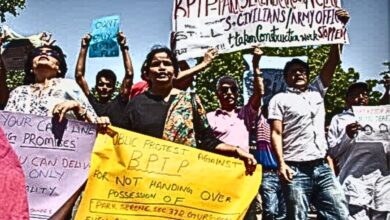
BPTP vs Raheja Developers: A Comparative Anatomy of India’s Two Most Corrupt & Notorious Real Estate Mafia


In the National Capital Region’s real-estate landscape, two names — BPTP Limited (promoted by Kabul Chawla) and Raheja Developers Ltd (led by Navin M. Raheja and Nayan N. Raheja) — stand as textbook illustrations of how large developers can accumulate years of homebuyer grievances, police FIRs, regulatory complaints and enforcement actions while personal and corporate accountability remains elusive or heavily delayed. Both companies have faced allegations of collecting substantial sums from homebuyers, prolonged non-delivery of projects, and diversion of funds. Both have attracted attention from the Economic Offences Wing, the Enforcement Directorate and, in BPTP’s case, the CBI. Yet the trajectories differ in scale, timeline and intensity of recent asset attachments, revealing both common structural advantages enjoyed by large builders and distinct enforcement histories.
1. FIRs and Criminal Complaints: Longevity vs Recent Concentration
BPTP carries a far longer criminal-complaint history. The landmark case began in January 2011 when Faridabad Central Police Station registered an FIR on complaints from over 1,000 homebuyers in projects including Discovery Park, Park Serene and Parklands. Buyers alleged they had paid 95–100 % of the consideration (aggregate claims around ₹400 crore) yet received no possession. Charges invoked IPC sections for cheating (420), criminal breach of trust (406), forgery (467–471) and criminal conspiracy (120-B). A non-bailable warrant was issued against Kabul Chawla; reports indicated he left the country for extended periods. Between 2011 and 2016, additional FIRs proliferated across Faridabad, Gurugram and Delhi. In April 2026 the CBI registered a regular case (RC2192026E0001) against BPTP and its unknown directors/promoters following a Supreme Court direction, alleging criminal conspiracy, cheating and provisions of the Prevention of Corruption Act in the context of a builder-bank nexus in loan disbursals.
Raheja Developers’ criminal exposure is more concentrated in the recent period. Multiple FIRs registered by the Economic Offences Wing of Delhi Police form the predicate offences for the ED’s PMLA investigation. These FIRs rest on complaints by homebuyers who alleged they were defrauded after investing in residential projects that faced significant delays or non-delivery. The ED has stated that the company collected approximately ₹2,425.99 crore from around 4,600 homebuyers. No equivalent early-2010s mass FIR of the BPTP scale appears in the publicly reported record for Raheja, but the volume of affected allottees and the quantum of alleged collections are substantial.
Comparative note: BPTP’s FIR trail spans more than a decade with repeated police and CBI interventions; Raheja’s is more tightly linked to a 2022 ECIR and successive 2026 attachments. In both cases, the translation from FIR to charge-sheet, trial and personal conviction of promoters has remained slow or incomplete.
2. ED Raids, FEMA/PMLA Probes and Property Attachments
This is the area of sharpest contrast in recent intensity.
Raheja Developers has faced aggressive provisional attachment under the Prevention of Money Laundering Act.
- 28 April 2026: Properties valued at ₹1,113.81 crore attached.
- 15 June 2026: Further properties valued at ₹503.48 crore attached.
- ≈31 July 2026: Additional immovable properties worth ₹782.36 crore attached. Cumulative provisional attachment: approximately ₹2,399.65 crore. The ED’s Delhi Zonal Office has described the case as involving large-scale diversion of homebuyer funds collected under the pretext of providing residential units. Investigation continues against the company, Navin M. Raheja and associated persons.
BPTP’s most prominent ED action was the multi-city raids of 26–27 August 2025. Teams searched BPTP offices in Delhi, Noida and Faridabad as well as the residences of Kabul Chawla and whole-time director Sudhanshu Tripathi. The focus was alleged FEMA violations involving over ₹500 crore of foreign direct investment from Mauritius-based entities in 2007–08, structured with prohibited put and swap options. Documents were seized and lockers frozen. The ED explicitly linked the probe to multiple existing FIRs concerning non-completion of projects and diversion of funds. While the raids carried strong money-laundering overtones and potential PMLA angles, the publicly reported record does not show provisional attachments on the multi-thousand-crore scale seen in the Raheja case.
Comparative note: Raheja currently faces one of the largest recent PMLA attachment exercises linked to homebuyer funds in the NCR. BPTP’s ED scrutiny has centred more on historical FDI/FEMA violations intertwined with long-standing domestic fund-diversion allegations. Neither set of public reports details classic “hawala” channels; the allegations centre on diversion of homebuyer collections, layering through related entities, and, in BPTP’s case, irregular foreign investment structures.
3. CBI Involvement
BPTP has a clearer CBI footprint. Beyond the 2015 and 2018 raids that seized ledgers allegedly showing diversion of buyer deposits, the April 2026 FIR (RC2192026E0001) was registered pursuant to a Supreme Court order in a batch of homebuyer matters. It specifically examines alleged collusion between the builder and bank officials in the disbursement of housing loans without proper due diligence.
Raheja Developers’ public record, as reflected in the 2026 coverage, centres on EOW FIRs feeding into the ED’s PMLA probe. No equivalent recent CBI registration or multi-location CBI raid is highlighted in the same contemporaneous reports.
4. Consumer Cases, RERA Matters and Judicial Strictures
Both companies have generated large volumes of consumer litigation and RERA complaints.
BPTP has been the subject of thousands of complaints across district forums, state commissions and the National Consumer Disputes Redressal Commission. The Supreme Court has repeatedly intervened, ordering refunds with elevated interest (including 18 % per annum in a September 2025 judgment) and criticising the builder for unjust enrichment and decade-long delays. Haryana RERA has also passed refund orders in multiple matters. Projects such as Spacio, Park Serene, Amstoria and Parklands feature repeatedly in these proceedings.
Raheja Developers faces parallel pressure from homebuyer associations over delayed possession of roughly 4,600 units. While the volume of reported Supreme Court or NCDRC orders is less prominently catalogued in the 2026 attachment coverage, the underlying EOW complaints and the scale of alleged collections indicate a comparable base of aggrieved allottees. Delhi High Court proceedings on Nayan Raheja’s quashing plea and the Saket Court interim protection order form the current judicial front.
Comparative note: BPTP’s consumer and RERA litigation is more extensively documented over a longer period, with multiple apex-court interventions. Raheja’s recent judicial focus has been on liberty and attachment-related proceedings arising from the PMLA investigation.
5. Money-Laundering Complaints and Fund-Diversion Allegations
Both face core allegations that funds collected from homebuyers were not applied to the projects for which they were raised.
- Raheja: ED states that of the ≈₹2,425.99 crore collected, substantial portions were diverted. The successive 2026 provisional attachments under PMLA are the direct enforcement response.
- BPTP: Allegations of diversion appear in the 2011 FIR and subsequent police/CBI actions (ledgers seized in 2015/2018 allegedly showing transfer of buyer deposits to unrelated ventures). The 2025 ED raids explicitly referenced multiple FIRs for non-completion and fund diversion alongside the FEMA investigation.
No verified public reporting in the examined material establishes classic hawala networks for either company. The money-laundering narrative is framed through PMLA (Raheja) and FEMA-plus-diversion (BPTP).
6. Judicial Protection and the Pattern of Interim Relief
In August 2026 a Saket Court Additional Sessions Judge granted interim protection from arrest to Navin M. Raheja and Nayan N. Raheja, directing them to cooperate with the ED and listing the matter for further hearing. The court emphasised that non-bailable warrants have serious consequences and should not be issued mechanically.
BPTP’s history shows a different manifestation of the same phenomenon: non-bailable warrants issued but not effectively executed for long periods, continued project launches, and the ability to pursue an IPO pathway despite an active ED investigation and a fresh CBI FIR.
Analytical Conclusion: Shared Architecture of Delayed Accountability
The comparison reveals a shared architecture rather than identical timelines.
- Resource asymmetry allows both companies to deploy elite legal teams capable of securing interim protection, challenging process, and prolonging multi-forum litigation.
- Institutional fragmentation (police → RERA → consumer forums → ED/CBI) creates sequential delays that favour the party with deeper pockets and longer staying power.
- Procedural safeguards (bail as the rule, reluctance to issue mechanical NBWs, emphasis on cooperation) are applied after years of buyer suffering, producing a temporal inequity that ordinary allottees experience as systemic bias.
- Scale of recent attachment currently weighs more heavily against Raheja; duration and multiplicity of criminal and consumer proceedings weigh more heavily against BPTP.
In both cases the ultimate burden falls on the same constituency: middle-class homebuyers who continue to service loans on incomplete or non-existent units while the legal and enforcement machinery moves at a pace that large, well-resourced developers can absorb and navigate. Until the gap between the volume of complaints and the speed of personal and restorative accountability is closed, the pattern documented in the BPTP and Raheja sagas will continue to define a significant segment of India’s real-estate enforcement landscape.