Manu Sharma Was Once The Face Of The Jessica Lal Murder. Today He Is Siddhartha Sharma, A Whisky Businessman. How Did One Of India’s Most Notorious Convicts Build A New Life While The Woman He Killed Never Got One?
What does it take to reinvent yourself in India when money, family connections and an existing business ecosystem are behind you? The Jessica Lal murder case gave us Manu Sharma. Years later, Manu Sharma became Siddhartha Sharma, entered the whisky business and built a new public life. Here is what that extraordinary reinvention tells us about power, memory, identity and access to a second life in India.

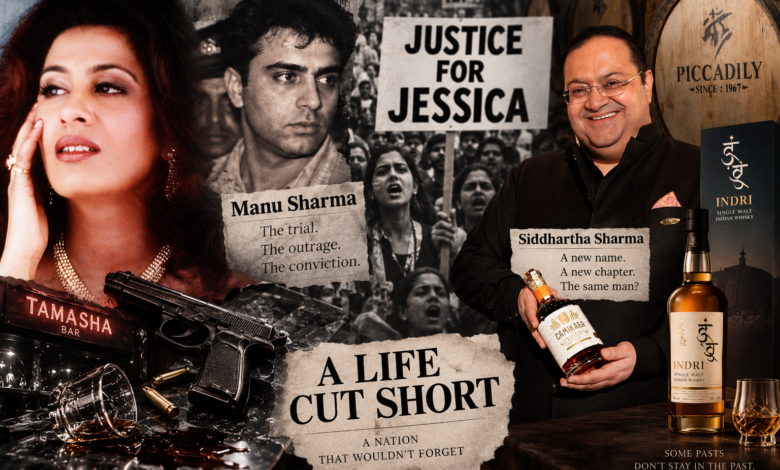
There was a time when the name Manu Sharma needed no introduction. It was attached to one of the most infamous murder cases in modern India, the killing of model and bartender Jessica Lal at a late-night party in Delhi in April 1999.
The case would go through an acquittal, a furious public reaction, a reversal by the Delhi High Court and, eventually, the Supreme Court’s confirmation of Sharma’s conviction and life sentence. The Supreme Court record identifies him as Sidhartha Vashisht alias Manu Sharma and found that he had fired the shot that killed Jessica Lal at the Tamarind Café after she refused to serve him liquor.
For years, the name Manu Sharma was inseparable from Jessica Lal. The case became bigger than the people inside the courtroom because the first verdict appeared to have ended it: in February 2006, a trial court acquitted the accused. The Delhi High Court overturned that decision later that year, holding Sharma guilty of Jessica’s murder and sentencing him to life imprisonment. In April 2010, the Supreme Court upheld the conviction.
That should have been the end of the story, at least in the conventional sense. A murder had been committed, a man had been convicted, a life sentence had been imposed and the Supreme Court had spoken.
But the story did not end in prison. It simply disappeared from the front pages for a while. And somewhere between the man India knew as Manu Sharma and the businessman now known as Siddhartha Sharma, an entirely different chapter began.
Before The Reinvention Came Jessica Lal
The details of that night matter because the distance between the two identities only makes sense when the starting point is remembered.
On the night of April 29–30, 1999, a private party was being held at Tamarind Café at Qutub Colonnade in Delhi. Jessica Lal and Shyan Munshi were serving at the bar. According to the prosecution case accepted by the courts, Sharma arrived with friends, asked for liquor after the bar had closed, and, after being refused, pulled out a .22 pistol. One shot was fired into the ceiling and another struck Jessica near her left eye. She was taken to hospital and was declared dead in the early hours of April 30.
The case that followed was anything but straightforward. More than 100 witnesses were examined during the trial, yet the prosecution failed to secure a conviction at the first stage. The 2006 acquittal became the point at which a murder case that had already attracted enormous attention threatened to disappear into the machinery of the courts. The High Court would later take a different view of the evidence, pointing to eyewitness identification, the .22 pistol, ammunition recovered from Sharma’s abandoned vehicle and other evidence before concluding that he was guilty.
The Supreme Court’s 2010 judgment went through the evidence in detail. It recorded that witnesses had identified Sharma as the man who had asked for whisky and fired the fatal shot, that a similar .22 cartridge was recovered from the Tata Safari he had abandoned, and that his conduct after the shooting formed part of the prosecution case. The Court concluded that the evidence established beyond reasonable doubt that Manu Sharma had murdered Jessica Lal.
And that is the man we are talking about when we talk about Siddhartha Sharma today. Not a different person. Not a distant family connection. The same man.
When The System Almost Lost Jessica
For years, the case moved through the courts while the evidence appeared to unravel in front of everyone. Several prosecution witnesses turned hostile during the trial, including Shyan Munshi, while others who had been present that night changed or withdrew their earlier accounts.
The result was devastatingly simple: after seven years, a case that had once seemed impossible to ignore ended with a Delhi trial court acquitting Manu Sharma and the other accused in February 2006.
The reaction was immediate and enormous. The acquittal produced nationwide outrage, and the case became a rare moment when the machinery outside the courtroom refused to accept the machinery inside it. Media organisations campaigned publicly, candlelight marches were held and ordinary citizens took to the streets demanding that Jessica’s death not disappear behind hostile witnesses and an acquittal.
NDTV’s account of its campaign describes the disparity starkly: Sharma could afford private lawyers while Jessica’s family, which was not formally a party to the case, depended on an overburdened public prosecutor.
The Delhi High Court then took up the case, and the direction changed completely. In December 2006, it overturned the trial court’s acquittal and convicted Manu Sharma of murder, sentencing him to life imprisonment.
The Supreme Court upheld the conviction and life sentence in April 2010. The man who had walked into a Delhi party in 1999 and shot Jessica after she refused to serve him a drink was now a convicted murderer serving a life term.
But the story of what it took to get there is important. Jessica’s family did not simply wait for the courts to eventually correct themselves. Her mother, May Lal, died in 2000 while waiting for justice. Her father, Ajit Lal, died in 2006, around the time the trial court had acquitted Sharma. Sabrina Lal remained the family member who continued the fight, even as the years consumed the people closest to Jessica. She died in 2021 – one year after Sharma was released from Tihar.
The People Who Refused To Let The Case Die
The Jessica Lal case became a national story precisely because too many people refused to let the first verdict be the final word. Sabrina Lal became the face of that fight, while the media campaign turned the phrase “Justice for Jessica” into a national demand.
The case exposed the extraordinary gap between a family seeking justice and an accused backed by considerable resources and influence. It also exposed what happened when witnesses changed their stories and a murder case that had dominated public attention suddenly appeared to have no one responsible for it.
There was a point when the public had every reason to believe the system had failed Jessica. The trial court had acquitted Sharma. Witnesses had turned hostile. The family had spent years waiting. The headlines after the acquittal captured the absurdity of the moment: “No one killed Jessica.” Then the public response forced the case back into the spotlight, the High Court revisited the evidence and the conviction finally came. The Supreme Court later confirmed it.
Sabrina would eventually say that the 2006 conviction gave her justice, even though it took another twelve years for her to find enough closure to forgive Sharma. In 2018, after he had spent 15 years in prison, she told authorities she had no objection to his release and said she wanted to let go of the anger and baggage she had carried since 1999. That position matters because it was hers to take; it does not erase the years she spent fighting to get the conviction in the first place.
Then, eventually, Manu Sharma disappeared from public view.
The Conviction Was Not The End
For Manu Sharma, the legal battle eventually produced the outcome that the Jessica Lal campaign had fought for. The Delhi High Court convicted him of murder in December 2006 and sentenced him to life imprisonment, and the Supreme Court upheld that conviction in 2010. He was no longer the man who had walked out of a trial court with an acquittal; he was a convicted murderer serving a life sentence.
But a life sentence did not mean that Sharma would necessarily spend the rest of his life behind bars. His case went through the prison system’s sentence-review process, and by 2018 the Delhi government had begun considering his premature release. The Sentence Review Board considered his conduct in prison, the period already served and other factors before recommending his release. Sabrina Lal had also told authorities that she had forgiven him and had no objection to his release.
In June 2020, after the recommendation was approved, Sharma walked out of Tihar after roughly 15 years in prison.
There is nothing mysterious about the legal mechanism itself. Premature release exists within India’s prison and remission framework.
The more interesting question begins after the prison gates opened. What happens to a man whose name once dominated national headlines when the sentence is over? Does he return to the same life he left behind?
Does the conviction follow him into every professional room, every business meeting and every public interaction? Or can a person with the right family, money, connections and business infrastructure construct a life in which the old identity gradually becomes background noise?
In Sharma’s case, the answer is unusually visible.
Manu Sharma did not simply disappear into an anonymous private existence after prison. He emerged as Siddhartha Sharma, and the next chapter of his life was not built in obscurity. It was built in business.
And Then Came Siddhartha Sharma
This is where the story takes a turn that would have been difficult to imagine when the name Manu Sharma was dominating television screens and newspaper front pages. The man who had spent years inside Tihar eventually became publicly identified as Siddhartha Sharma, a name that today appears in the corporate records of Piccadily Agro Industries, the company behind the Indri whisky brand.
Piccadily’s corporate filings identify Siddhartha Sharma as one of the company’s promoters and a substantial shareholder. Its FY2024-25 annual report showed him holding more than 21.4 million shares, representing 22.73% of the company. The same company has built Indri into its flagship Indian single-malt whisky brand, turning what might once have been an ordinary family-business connection into a substantial commercial enterprise.
And this is where the contrast becomes difficult to ignore.
The name Manu Sharma once summoned a murder case, a dead woman, a failed prosecution, hostile witnesses, public protests and a prolonged battle for justice. The name Siddhartha Sharma now appears in a completely different context – corporate filings, promoter shareholding, whisky, business expansion and the rise of an Indian spirits brand.
The past did not change. The public identity around the man did. And in Sharma’s case, there was an established family business, capital, corporate infrastructure and a route back into the commercial world.
Jessica Lal never had any of those things waiting for her.
From A Family Business To A Whisky Empire
The reinvention becomes even more striking when the business itself is put into context. Siddhartha Sharma did not emerge from prison into an empty room and build a whisky company from nothing.
He returned to an established business family whose roots in alcohol go back decades. Piccadily’s own history traces the family’s business beginnings to 1953, when Pt. K.N. Sharma started Kedar Nath and Sons in Punjab, later expanding into liquor retail, hospitality and, eventually, alcohol manufacturing. The family established a sugar mill and distillery in 1994.
That history matters because it changes the description of what happened after prison. This was not simply a convicted man getting a second chance at an ordinary job. There was already an ecosystem around him: a family business, assets, an established corporate structure, an industry connection and the capital required to operate at scale. Corporate filings show Siddhartha Sharma holding 21.44 million shares in Piccadily Agro Industries, representing 22.73% of the company, and identifying him as part of the promoter group.
Then came Indri. Piccadily launched the single malt in 2022, and the brand rapidly became the company’s most visible success story, collecting international awards and expanding into markets outside India. The company says Indri recorded more than 40% volume growth in FY2025, while Piccadily’s FY2025-26 results show gross revenue of ₹1,143 crore and net profit of ₹140 crore.
Today, Siddhartha Sharma is not merely a name sitting somewhere inside an old family company. He is presented publicly as a promoter of Piccadily, speaks to the media about India’s premium alcohol industry and its international ambitions, and is associated with a business whose flagship brand has become one of India’s best-known single malts. In a 2024 interview, he spoke as Piccadily’s promoter about the company’s expansion plans, the Indian premium spirits market and its proposed international distillery in Scotland.
And that is the part that makes the reinvention difficult to dismiss as a simple case of rehabilitation. The man who once occupied India’s headlines as Manu Sharma now occupies corporate space as Siddhartha Sharma. The old name remains attached to the murder. The new one is attached to business.
The question is not whether he was entitled to rebuild his life after serving his sentence. The question is how different that rebuilding can look when a person walks back into an existing family enterprise with money, connections, capital and a business infrastructure already in place.
And that brings us to the question that the Jessica Lal case has left sitting underneath the entire story: how many people who leave an Indian prison get to walk into that kind of second life?
So look at the distance between the two lives. Manu Sharma was once a name carried by television vans, newspaper front pages and a national campaign for justice. Siddhartha Sharma is now a name found in corporate records and business coverage, attached to a promoter group and one of India’s fastest-growing premium spirits businesses. The murder did not disappear. The conviction did not disappear. Jessica Lal did not disappear. But the man at the centre of that case acquired the space to become something else.
And that is where the story stops being simply about what happened in 1999 and starts asking what happened afterwards. Because the ability to rebuild a life is not distributed evenly. One person may leave prison with a family business waiting, capital already accumulated, professional relationships intact and an industry in which to resume a career. Another may leave with nothing more than a criminal record, lost years, debt, broken employment prospects and the stigma of having been inside a prison.

But Who Gets To Start Again?
India’s criminal justice system is supposed to punish, reform and eventually return people to society. That principle cannot reasonably depend on whether the prisoner is famous, wealthy or unknown. But the circumstances into which people return are nowhere near equal.
The Supreme Court’s Centre for Research and Planning noted in 2025 that 24,879 people who had already been granted bail were still in prison because they could not furnish the required bail bonds. It also found significant bail rejection rates in both Sessions and Magistrates’ courts.
That is the other side of the story. Manu Sharma walked out of Tihar after the Sentence Review Board considered his conduct, rehabilitation prospects and other factors, with the Lieutenant Governor ultimately approving his premature release in 2020. His case had come before the board several times before that. By the time he left prison, there was also a family business waiting outside.
For thousands of ordinary prisoners, the problem is far more basic. Getting out can itself be difficult even after bail has been granted. Finding employment can be difficult. Rebuilding family relationships can be difficult. Carrying a criminal record into an already precarious financial life can make starting again almost impossible. The law may give two people the same right to rebuild. Their ability to actually rebuild can be radically different.
And this is where the Jessica Lal story becomes uncomfortable again. The public once had to fight to prevent Manu Sharma from disappearing from the case. Today, the question is almost the reverse: how completely can a person disappear from the identity created by the case?
The Last Bit, Jessica Never Got A Second Life
Jessica Lal had no second chapter. She could not change her name, change careers, move to another city or wait for public memory to soften. Her family could not negotiate with time. Sabrina Lal spent years pursuing the case, even after the trial court acquitted Sharma, while the public campaign around Jessica became one of the most recognisable examples of media and public pressure forcing a criminal case back into the national spotlight.
Manu Sharma, by contrast, had time. He had prison, parole, education, charitable work, a sentence-review process and eventually freedom. His release was not an escape from the law; it was the outcome of a formal process that took his conduct and rehabilitation into account. Sabrina herself had said she had forgiven him and would not object to his release.
But once outside, the asymmetry becomes impossible to miss. Jessica’s name remained fixed to the night of April 30, 1999. Manu Sharma’s name did not. The murder remained part of the historical record, the conviction remained intact, and yet the person convicted was able to acquire another public identity and build another professional life.
That is the real contradiction at the centre – it deserves attention because his extraordinary reinvention forces a much harder question: in India, who actually has the money, connections, family infrastructure and social capital required to turn a past life into a footnote?