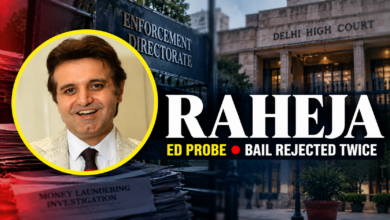
Heera Group’s ₹5,978-Crore Investor Crisis: Seven Properties Auctioned for ₹15.03 Crore, but the Bigger Question Remains—When Will Victims Get Their Money Back?
From promises of returns exceeding 36% annually to years of legal proceedings, attached assets and a Supreme Court-directed recovery process, the Heera Group case raises a fundamental question about financial accountability: can the sale of a handful of properties deliver meaningful justice to thousands of investors who say their money remains trapped?


The Directorate of Enforcement (ED), Hyderabad Zonal Office, announced on 14 October 2026 that registration had been completed for seven immovable properties auctioned for approximately ₹15.03 crore. The properties comprise six flats in H.S. Royal, Shaikpet Village, and a house in MLA Colony, Banjara Hills, Hyderabad. The sale deeds were registered in favour of the successful highest bidders on 6 October 2026. According to the agency, the proceeds are to be transferred to the Serious Fraud Investigation Office (SFIO) for onward disbursement to genuine victims and claimants, in accordance with Supreme Court directions.
The announcement marks a tangible step in recovering money from assets attached in the proceedings involving Nowhera Shaik, the Heera Group of Companies and others. But it also highlights the enormous gap between the scale of the alleged financial wrongdoing and the amount realised in this particular auction. ED says its investigation revealed that more than ₹5,978 crore had been collected from the public through promises of abnormally high returns exceeding 36% per annum. Against that figure, the seven properties generated approximately ₹15.03 crore.
The comparison is stark. ₹15.03 crore is only about 0.25% of ₹5,978 crore. This is a comparison of the proceeds from one auction with the amount ED says was collected from the public; it is not a final calculation of the total recoverable loss, the outstanding liability, or the proportion of assets ultimately available for restitution. Nevertheless, it illustrates why the sale of seven properties, though important, cannot by itself answer the larger question confronting investors: how much money can actually be recovered, how quickly can it be distributed, and what remains to be done to establish accountability?
The bitter reality is that a successful auction is not the same as completed restitution. Registration of the sale deeds is a procedural milestone. Transfer of the proceeds to the SFIO is a further step. Actual payment to verified claimants is another. These stages must not be confused, and the public should not be asked to treat progress at one stage as proof that the entire recovery process is complete.
The legal trail: why the latest auction cannot be viewed in isolation
The present recovery exercise is the latest chapter in a case that has been before investigative agencies and courts for years. Its significance lies not just in the properties now sold, but in the repeated judicial interventions required to move the process forward.
2017–2018: Complaints, unpaid withdrawals and the first serious warning signs
The legal record predates the latest ED announcement by almost a decade. In a Telangana High Court order dated 13 November 2018, arising from Crime No. 170 of 2018 registered by Hyderabad’s Central Crime Station, the State sought cancellation of regular bail previously granted to Nowhera Shaik.
The material discussed in that order recorded that the Heera Gold Exim business was established for buying and selling gold and did not have authority to collect public deposits, according to the court’s consideration of the investigation record. The proceedings also referred to statements from 106 witnesses or depositors who said they had deposited approximately ₹8 crore with Heera Gold Exim in that particular case.
More troublingly, the order recorded that 6,558 withdrawal applications amounting to approximately ₹167.37 crore were pending between April and October 2018, apart from online withdrawal applications. These were figures recorded in the proceedings at that time; they should not be mistaken for the total number of investors or the total liabilities across the wider group.
The High Court cancelled the bail granted in that particular case. The State had also submitted that similar investigations were underway in Andhra Pradesh, Karnataka, Kerala, Maharashtra and other states. These developments established that the questions surrounding investor money were not merely a consequence of the 2026 auction. They had already triggered substantial legal action in 2018.
The uncomfortable question is why the wider recovery process has required such prolonged intervention. Early complaints and unpaid withdrawal requests may not establish criminal guilt by themselves, but they make a compelling case for investigators to trace the money decisively, consolidate verified claims and avoid allowing the passage of time to become an additional burden on investors.
2018: A separate political controversy
Another episode was reported in May 2018, when seven candidates who contested the Karnataka Assembly elections under the All India Mahila Empowerment Party filed a cheating complaint against party president Nowhera Shaik. The candidates alleged that cheques had been collected towards party funds and that promised campaign assistance, reportedly up to ₹28 lakh per candidate, had not been provided.
This was a separate allegation involving election-related expenditure, not proof of the allegations concerning Heera Group investors. Its relevance is limited but worth recording in a comprehensive account of the publicly reported controversies surrounding Shaik.
Shaik also reportedly argued during the 2018 proceedings that political rivalry had contributed to the action against her. In another report, she attributed the cessation of dividend payments to losses she said followed demonetisation and the introduction of GST. Those were her reported explanations, not judicial findings that resolved the investors’ complaints.
A fair investigative report must record such responses. It must also recognise that an explanation for a business failure does not, by itself, answer the central questions: where did the money go, what liabilities remain, and what assets can lawfully be recovered?
2021: Interim bail was accompanied by a demand to settle investor claims
The Supreme Court granted Shaik interim bail in January 2021, directing efforts towards clearing the liabilities of complainants in cases where chargesheets had been filed or complaints had been made. Contemporary reporting described the case as involving approximately ₹5,600 crore collected from around 1.72 lakh investors.
The Court’s approach at that stage was not simply to release an accused person and leave investors to fend for themselves. It sought a mechanism to assess claims and return money. The reported arrangements included a proposed ₹6 crore contribution to the SFIO and the use of certain funds attached by investigative authorities, including approximately ₹21 crore attached in Maharashtra and ₹22 crore by ED, towards payments to complainants.
The Court recognised that there were many claimants and that merely accumulating money in another account would not resolve the problem. It wanted the process to reach investors.
That distinction remains crucial in 2026. A recovery system should not be judged by the number of properties attached, accounts frozen, hearings attended or press releases issued. Its ultimate test is how much verified money reaches the people entitled to receive it.
October 2024 to March 2025: The Supreme Court’s patience was being tested
The Supreme Court’s orders in October 2024 marked a significant escalation. The Court recorded that the effort to raise ₹580 crore for settling investor claims had made no progress. On 18 October 2024, it cancelled the bail granted to Shaik and directed that the separate FIRs registered in various states be investigated in accordance with law. It also directed the SFIO to proceed with company-law offences, leaving other offences to the respective police authorities, while permitting ED to continue its work.
The proceedings subsequently moved towards monetising attached assets.
In November 2024, ED announced that the restitution process had begun following the Supreme Court’s directions. The agency said the investigation had traced funds collected from investors into movable and immovable properties held in the names of Shaik, Heera Group companies, relatives and associates. It reported that properties worth approximately ₹400 crore had previously been provisionally attached and confirmed by the PMLA Adjudicating Authority.
The Supreme Court permitted the auction of two properties to help settle investors’ claims and directed that details of other unencumbered properties be provided. It also directed Shaik to deposit ₹25 crore with ED within three months.
On 5 March 2025, the Supreme Court recorded that the ₹25 crore had not yet been deposited. It granted a final three-month opportunity, reiterating that failure to comply would result in automatic cancellation of bail. The Court also permitted ED to auction properties attached under a subsequent provisional attachment order and directed that vehicles attached in the case could be auctioned as well.
The same order recorded that ED had attached 28 properties in addition to 96 properties previously attached. The figure is a snapshot of the position reported to the Court at that hearing, not a definitive statement of the number of assets ultimately sold or available for immediate distribution.
These orders show why the current auction is important. They also show that the recovery process did not emerge suddenly in October 2026. It followed repeated directions, additional opportunities and a clear judicial emphasis on converting assets into money for claimants.
The attachment figures demand a transparent accounting of assets and proceeds
ED’s latest release states that five Provisional Attachment Orders were issued, covering properties valued at approximately ₹428.83 crore. It also confirms that a Prosecution Complaint and a Supplementary Prosecution Complaint have been filed before the Special Court under PMLA in Hyderabad.
That figure must be treated carefully. The value of attached property is not the same as cash in a recovery account. A provisional attachment is not a sale. A sale is not necessarily completed restitution. And neither attachment nor arrest should be presented as a criminal conviction.
Nevertheless, the difference between the attachment figure and the amount ED says was collected from the public makes a comprehensive asset accounting essential.
The public deserves answers to several basic questions. What is the latest verified inventory of properties and other assets attached in the case? Which assets have been auctioned, which remain under litigation, and which are subject to competing ownership claims or encumbrances? What is the expected realisable value of the remaining assets, rather than merely their assessed market value? How much money has been received, how much has been spent on administration and recovery, and how much has actually reached verified investors?
These are not unreasonable demands. They are the minimum information required to evaluate the effectiveness of an asset-recovery process on this scale.
The property valuations are not the same as recoverable money
Supreme Court proceedings in November 2024 recorded details of three properties that had been proposed for consideration in the recovery process. The values included approximately ₹90.09 crore as the fair market value of Naina Towers, with an estimated realisable value of ₹81.08 crore; approximately ₹120.64 crore for Heera Foodex, with an estimated realisable value of ₹109.58 crore; and approximately ₹753.77 crore for land associated with Heera Retail at Tolichowki, with an estimated realisable value of ₹678.39 crore.
These were figures placed before the Court in the course of proceedings. They do not establish that these sums were realised or that every property was immediately available for unencumbered sale.
Indeed, ED’s status report raised issues concerning survey-number discrepancies and multiple recorded owners in relation to the Tolichowki property. The report also referred to physical verification of the properties. Such issues matter because an asset’s headline valuation means little if questions of title, ownership, possession or encumbrances prevent its timely sale.
This is precisely why the remaining recovery exercise needs a property-by-property status report. The public should not be left to compare valuations appearing in old court papers with auction receipts years later without an authoritative explanation of what was sold, what remains, and why.
April–July 2026: Bail cancellation, arrest and court-directed execution of sale deeds
The Supreme Court’s order dated 8 April 2026 again brought the case into sharp focus. The Court recorded concerns about the lack of progress in settling investor claims and stated that Shaik had not cooperated with ED in executing sale deeds for properties sold to auction purchasers. It noted that 16 sale deeds were to be executed.
In the same order, the Court cancelled her bail and directed her to surrender before the jail authorities within one week. The order also reiterated that FIRs registered in different states should be investigated in accordance with law, with the SFIO’s role confined to company-law offences and other offences left to the appropriate police authorities.
According to ED’s October 2026 release, Shaik did not comply with the surrender direction. A non-bailable warrant was issued by the Special Court under PMLA, Hyderabad, on 7 May 2026. ED, acting on intelligence inputs in a joint operation with Haryana Police, traced and apprehended her in Gurugram on 21 May 2026. She was then taken to Hyderabad, produced before the Special Judge under PMLA and remanded to judicial custody.
The Supreme Court’s subsequent order of 27 July 2026 directed that the Registrar (Protocol) of the Telangana High Court be deputed to execute sale deeds on behalf of the petitioner-accused. The order records that ED had sought the Court Registrar’s intervention to execute 16 sale deeds and facilitate further auctions.
That sequence is significant. The recovery effort had reached a point where court-directed execution was required to move conveyances forward. It underlines why a clear, published accounting of sale deeds, properties and receipts is now necessary.
The latest ED announcement confirms registration of seven properties. It would be useful for the agency to clarify publicly how this milestone relates to the 16 sale deeds referred to in the Supreme Court proceedings, and what progress has been made on the other conveyances and assets.
The 2025 cheque-dishonour proceedings: another separate commercial dispute
The public record also contains a separate set of proceedings before the Karnataka High Court concerning 17 cheques allegedly issued by Shaik in her capacity as CEO and Managing Director of Heera Group in favour of M/s 1-Help Technology and Software Solutions Pvt. Ltd.
In an order dated 3 September 2025, the Karnataka High Court dealt with petitions seeking to quash complaints under Section 138 of the Negotiable Instruments Act. The complainant alleged that it had completed software-related work under an agreement, that a liability of approximately ₹9.84 crore remained unpaid, and that cheques issued towards that liability were dishonoured.
The defence disputed the complainant’s account and alleged, among other things, that the software company had directly collected funds in Heera Group’s name and misused cheques. Those assertions were the parties’ respective positions, not findings that should be presented as established facts.
The High Court dismissed the petitions seeking to quash the complaints, holding that the proceedings should not be terminated on the technical grounds raised. That order allowed the complaints to proceed; it should not be misrepresented as a final conviction for cheque dishonour or as proof of the underlying allegations in the larger investor matter.
The proper journalistic point is narrower: separate commercial disputes and legal proceedings continued to surface even after the original investor complaints. Each must be tracked on its own record and reported with its actual procedural status.
Why investors need more than another announcement
The sale of seven properties is a concrete development. It should not be dismissed or trivialised. But neither should it be treated as proof that the wider problem is close to resolution.
For investors, the important figures are not merely the value of attached assets or the total consideration received from an auction. They are the amount of claims verified, the amount approved for payment, the amount actually disbursed, the number of claimants paid in full or in part, and the value of assets still available for recovery.
The Supreme Court’s April 2026 record itself referred to the administrative work involved in processing investor claims. It noted that copies of 7,298 claims had been provided to Shaik at her request, that another 3,100 copies were ready for delivery, and that further copying work was continuing. The record also referred to a balance of approximately ₹4.57 crore in a particular deposit account after specified expenses and reimbursements.
Those figures describe the position of particular claim-processing and deposit arrangements at that point in time. They should not be interpreted as the total amount of verified claims, all money recovered in the case, or the sum ultimately available to investors. But they do show why the claim-verification and distribution process must be documented, adequately resourced and completed without avoidable delay.
Years after withdrawal requests were being documented in court proceedings, claims administration was still a live issue. This is exactly where a stronger public accountability mechanism is required.
A press release can announce that seven properties have been registered. It cannot substitute for a transparent report showing how many people have received their money and how many are still waiting.
What ED, SFIO and the state police must do next
The next stage should be faster, more coordinated and much more transparent.
First, publish a consolidated restitution dashboard. ED and SFIO should provide a periodically updated, privacy-protective account of claims received, claims verified, amounts approved, payments completed, rejected claims and reasons for rejection. Investors should be able to check the status of their own claims through a secure process instead of having to depend on rumours or repeated representations.
Second, publish a complete asset-recovery statement. For every material property or asset, the authorities should disclose its attachment status, valuation basis, encumbrance position, auction status, sale consideration received, registration status and net proceeds available for restitution, subject to legal restrictions and court directions. Older valuations must be reconciled with current figures so that the public can understand what was realised and what remains recoverable.
Third, expedite the tracing of proceeds of crime. ED’s stated investigation concerns assets allegedly acquired from money collected from investors and held in the names of Shaik, Heera Group entities, relatives and associates. The agency should continue following the financial trail, examining beneficial ownership and related-party transactions, and taking lawful steps against assets established to be linked to proceeds of crime. Any action against a third party must be evidence-based, proportionate and consistent with due process.
Fourth, enforce a time-bound, inter-agency investigation. The Supreme Court has directed state police authorities to investigate the FIRs registered in their jurisdictions and clarified that the SFIO should deal with company-law offences. ED should continue its work under PMLA. These parallel responsibilities should not become a reason for fragmented records, duplicated efforts or unexplained delay. A coordinated progress mechanism should identify which agency is responsible for each outstanding issue and when the next action is due.
Fifth, accelerate trials and procedural decisions. The courts and investigative authorities should prioritise the effective progression of the relevant proceedings, subject to the rights of all parties and the requirements of a fair trial. Speed must mean diligent investigation, timely filing and adjudication, and proper examination of evidence—not shortcuts that prejudice the accused or compromise the reliability of the outcome.
Sixth, make restitution measurable. Investors should receive a clear explanation of how claims will be ranked and verified, how any distributable proceeds will be allocated under the applicable court directions, and how disputed or incomplete claims can be challenged. If recovered funds are insufficient to satisfy all verified claims, the authorities should explain the applicable process openly instead of allowing uncertainty to persist.
The uncomfortable conclusion: property registration is progress, not closure
The Heera Group case has already seen years of complaints, investigations, attachment proceedings, bail orders, Supreme Court interventions and efforts to monetise property. The latest seven-property registration is a meaningful step in that long process.
But a registered sale deed is not the final measure of justice. The decisive question is whether the proceeds will move efficiently through the restitution process to the people who are legally entitled to receive them—and whether the remaining assets and alleged financial flows will be investigated with the urgency the scale of the case warrants.
The authorities should not be satisfied with counting properties. They must account for money. They should not be satisfied with announcing attachments. They must disclose the progress of recovery. And they should not allow the complexity of a multi-state investigation to become a permanent explanation for why investors are still waiting.
The Supreme Court has repeatedly directed the process towards accountability and recovery. It is now for the agencies and courts, each within its authority, to demonstrate that those directions translate into measurable results.
The most important announcement still to come is not that another property has been auctioned. It is how much money has reached verified victims, how many claims remain unresolved, what assets are still available, and when the remaining work will be completed.
Legal disclaimer
This report is based on publicly available court records, official enforcement-agency statements and contemporaneous news reporting reviewed for this article. Allegations remain allegations unless and until they are established in accordance with law. An arrest, a non-bailable warrant, cancellation of bail, provisional attachment of property, permission to auction assets or the filing of a prosecution complaint does not, by itself, amount to a criminal conviction.
As of 18 October 2026, the public records reviewed for this report do not establish a final criminal conviction against Nowhera Shaik in the principal Heera Group investment-fraud and PMLA matter. ED’s latest release states that further investigation is in progress. The status of separate complaints or proceedings must be assessed independently and should not be inferred from the status of this principal case.
References to relatives, associates, companies, political candidates or other parties reflect only the specific roles or allegations recorded in the cited materials. No person or entity should be treated as guilty by association. Any response, clarification, subsequent court order or material development that changes the factual position should be considered and reported fairly.