The Autumn Fall Very Hard For TDI, As ED Continues Search On Day 3!
As Enforcement Directorate teams dig deeper into TDI Infratech’s Mohali offices for a third consecutive day over alleged PR-6 land compensation irregularities, the raids lay bare a far darker saga. For over two decades, TDI Infrastructure and its promoters allegedly collected thousands of crores from ordinary Indians, diverted the money, left projects incomplete for 16–18 years, and treated courts, regulators and homebuyers as obstacles to be outmanoeuvred. This is not isolated mismanagement. It is a textbook case of how powerful real-estate interests systematically harass buyers, exploit legal delays, and treat the rule of law as a negotiable inconvenience while public infrastructure and private dreams both remain unfinished.


Bigshot Builders vs Broken Dreams: TDI’s PR-6 Scam and the Systematic Fleecing of 14,105 Families
On Wednesday, 30 September 2026, Enforcement Directorate officials remained inside the Sector 119 office of TDI Infratech Limited in Mohali for a third straight day. What began on 28 September as a 15-member team’s search, accompanied by CRPF personnel, has stretched into an exhaustive examination of land-deal records, computers, electronic devices, CCTV footage and mobile phones of company officials. Mattresses had already been brought in for overnight stays. The probe centres on alleged irregularities in compensation for land acquired for the 200-foot-wide PR-6 Master Plan road, a corridor meant to connect Sector 117 on Airport Road with the Banur-Landran road.
Sources indicate the focus is on the transfer of roughly 6.557 acres to persons connected with the developer after the Section 11 notification of 14 October 2020 under the land-acquisition law. GMADA’s own affidavit before the Punjab and Haryana High Court alleged that these post-notification transfers were structured to claim higher compensation at rates applicable to farmers, potentially imposing an additional burden of around ₹6 crore on the public exchequer.
After the land received Change of Land Use clearance, titles were allegedly shifted to relatives. When the arrangement came to light, TDI approached GMADA seeking cancellation of the registrations. The ED action followed multi-day searches at the GMADA office itself, part of a broader probe into alleged irregularities in the authority’s land-bank operations that some reports have framed on a scale of ₹10,000 crore.
The same day, ED teams also raided the office of another Mohali realtor-jeweller, STJ Group, on the sixth floor of Mohali Citi Center-2 in Aerocity. The simultaneous actions signal that the agency is widening its net around real-estate dealings in the region. Officials have remained tight-lipped, but the sequence is unmistakable: first GMADA records, then TDI’s own headquarters, then related entities. This is not a routine verification. It is the latest chapter in a long, documented pattern of alleged fund diversion, project delays measured in decades, regulatory non-compliance, and the systematic harassment of homebuyers by one of North India’s more visible builder groups.
The PR-6 episode itself is revealing. The road was first notified in 2013. A social-impact assessment spoke of roughly 73 acres. Acquisition awards were cleared years ago and GMADA has reportedly spent around ₹200 crore on land procurement. Yet the corridor remains unfinished and closed to the public more than a decade later. Residents of surrounding sectors have protested outside TDI’s office, citing chronic congestion, waterlogging, restricted emergency access and the fact that the road was used as a selling point when properties were marketed.
A High Court stay arising from the compensation litigation has halted construction. TDI’s position has been that the matter is sub judice. The practical result is that ordinary citizens continue to pay the daily price of an incomplete arterial road while the developer and the authority litigate over valuation formulas.
This is the visible tip. The deeper record is far more damning. Between 2005 and 2014, TDI Infrastructure Limited (formerly Intime Promoters Private Limited) and related entities launched multiple commercial and residential projects, primarily in Kundli and Sonipat, Haryana. According to the Enforcement Directorate’s own findings, the company collected approximately ₹4,619.43 crore as advance booking amounts from 14,105 customers across 26 projects. Occupation certificates for four projects remain pending. One project, Park Street, is still incomplete. In the worst cases, possession delays have stretched to 16–18 years. A child born when a buyer paid for a flat would now be old enough to vote, yet the flat may still not exist in usable form.
The ED’s investigation, triggered by 26 FIRs and chargesheets filed by Delhi Police and its Economic Offences Wing, alleges a clear mechanism. Substantial portions of the money collected from homebuyers were diverted to subsidiaries, erstwhile subsidiaries and land-owning companies as advances for land purchases and other purposes. Customer funds were also used to repay existing loans and make investments rather than to complete the very projects for which the money had been paid. The result was predictable: stalled construction, endless delays, and thousands of middle-class families trapped between bank EMIs and rent on homes that never materialised.
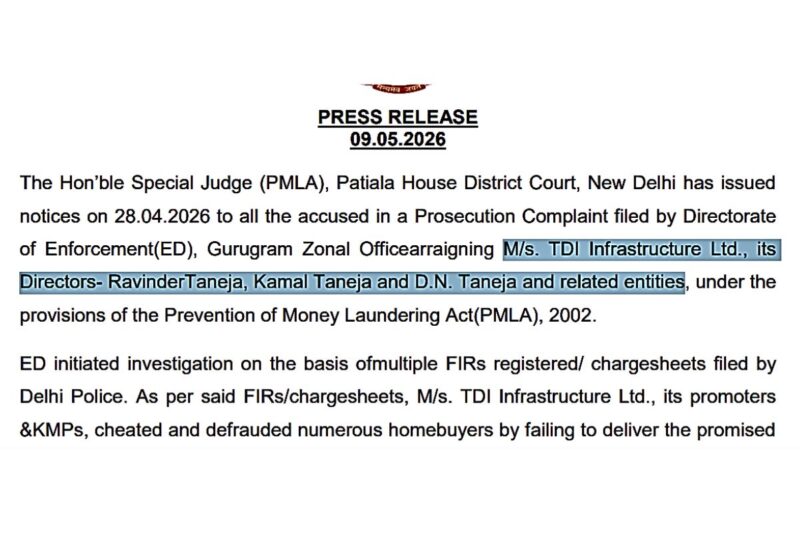
Enforcement has moved in stages. In 2024 the ED provisionally attached properties worth roughly ₹45.49 crore. In March 2026 it attached further assets valued at approximately ₹206.40 crore (including land and commercial units in Kamaspur, Sonipat), later updated to bring the cumulative proceeds of crime identified to ₹349.55 crore. A prosecution complaint under the Prevention of Money Laundering Act was filed against the company and directors Ravinder Taneja, Kamal Taneja and D.N. Taneja.
The Special PMLA Judge at Patiala House issued notices in April 2026. Separate environmental proceedings before the National Green Tribunal resulted in an order for ₹95.08 crore in compensation related to sewage-treatment and other failures at projects including Kingsburry Apartments, My Floor 2 and Tuscan City. The ED later attached commercial spaces at TDI Mall linked to those environmental violations.
In May 2026, the Haryana Real Estate Regulatory Authority, Panchkula, ordered civil imprisonment of five directors, Kamal Taneja, Devki Nandan Taneja, Ravinder Kumar Taneja, Renu Taneja and Ved Prakash, for three months in an execution proceeding arising from a 2019 homebuyer complaint. The authority characterised the company’s conduct as deliberate delay tactics and non-compliance with repeated show-cause notices and payment directions. Civil imprisonment under the Code of Civil Procedure is a coercive tool, not a criminal sentence, yet the decision to pierce the corporate veil and target individual directors was significant in an industry long accustomed to treating regulatory orders as optional.
These are not isolated administrative lapses. They form a consistent pattern. Courts have refused to quash FIRs. Consumer commissions and RERA forums have passed refund and possession orders that then require further execution proceedings because compliance is partial or absent. High Court stays obtained in compensation disputes freeze public infrastructure for years. Environmental orders are challenged and prolonged. Meanwhile, the same group continues to operate, market projects, and, according to the latest ED action, allegedly structure land transactions in ways that shift public compensation burdens.
The human cost is measured in ruined financial plans, prolonged stress, and a quiet erosion of faith in institutions. Government employees who cashed provident-fund savings, retired teachers who treated a plot as a nest egg, young couples who took home loans and now service both EMI and rent ; these are the people who paid ₹4,619 crore. The attached assets of ₹349 crore represent only a fraction of that sum. Even if eventually confiscated and distributed, the arithmetic of restitution will leave most buyers far short of recovery. Justice delayed by a decade or more is justice diminished.
What makes the TDI episode particularly instructive is how effectively the system can be gamed. RERA arrived too late for projects launched between 2005 and 2014. Escrow requirements and stage-wise disbursement norms were not yet in force when the bulk of the money was collected. Banks, through subvention schemes, often released large loan amounts directly to developers against incomplete construction. Auditors, company-law safeguards and town-planning authorities failed to halt the diversion in real time. When buyers finally reached police stations, consumer forums and RERA, the process became a relay race across agencies — each with limited powers, each taking years — while the promoters remained free to litigate, restructure entities, and continue business under related names.
The current ED searches at TDI Infratech and the parallel action at STJ Group are therefore more than technical inquiries into one road’s compensation formula. They are the federal system finally applying pressure to a model that has treated homebuyers as a permanent source of cheap capital and the judiciary as a forum for endless delay. The PR-6 transfers, if established as alleged, would show the same willingness to re-engineer transactions after the acquisition process had begun in order to maximise private gain at public cost. The earlier diversion of buyer funds shows the same willingness to prioritise land acquisition and debt servicing over the delivery of the homes that justified the collection of money in the first place.
India’s real-estate sector has long operated with an implicit understanding that big developers can absorb penalties, stretch timelines, and outlast individual complainants. TDI’s record of 14,105 customers, ₹4,619 crore collected, multi-year delays, successive ED attachments, a PMLA prosecution complaint, NGT compensation orders, and now a third day of raids over land-compensation irregularities demonstrates how that understanding works in practice. It also demonstrates the human and institutional price. Public roads remain unfinished. Drainage fails. Families remain in limbo. Courts and regulators are forced into prolonged contests over basic compliance.

The autumn of 2026 has brought the Enforcement Directorate into TDI’s own offices for the third consecutive day. That physical presence is significant. Whether it produces lasting accountability, confiscation that actually reaches victims, personal consequences that change promoter behaviour, and systemic reforms that prevent the next generation of the same fraud, will determine if this is merely another episode in a long saga or the beginning of a genuine correction.
For the thousands of homebuyers who have already waited 16 or 18 years, the only meaningful measure is whether the homes they paid for, or the money they lost, ever materialise. Until then, the critique remains stark: powerful real-estate interests have repeatedly shown they can harass ordinary buyers, outmanoeuvre regulators, and treat the law as a set of procedures to be managed rather than obligations to be met. The ED’s continued search is a necessary interruption of that pattern. It is long overdue.