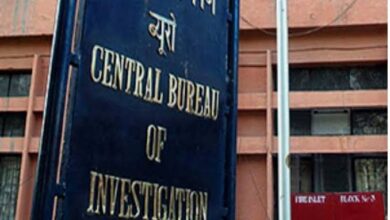
CBI’s 21st Chargesheet: Acme Realties Joins The Growing List As India’s Real-Estate Mafia Continues To Crush Homebuyers
On 28 September 2026 the Central Bureau of Investigation filed its 21st chargesheet in the Supreme Court-directed probe into large-scale homebuyer fraud, this time against five erstwhile promoters and directors of Acme Realties Private Limited and its holding company Acme Housing India Private Limited over the Acme Boulevard project in Mumbai’s Jogeshwari East. The agency recorded that the accused induced buyers through false assurances and fraudulent representations, securing financial gains by illegal means. This latest filing sits inside a far larger pattern: dozens of similar chargesheets already submitted against builders across NCR and beyond, parallel Enforcement Directorate action against TDI Infrastructure for collection of ₹4,619.43 crore from 14,105 customers, multi-year delays of 16–18 years, and a documented culture in which ordinary citizens lose life savings while projects remain incomplete.

On 28 September 2026 the Central Bureau of Investigation, the CBI submitted its 21st chargesheet in the ongoing national investigation into homebuyer fraud. The document names five erstwhile promoters and directors of M/s Acme Realties Private Limited and its holding company M/s Acme Housing India Private Limited. The project under scrutiny is Acme Boulevard, located at Village Majas, Sarvodaya Nagar, Jogeshwari (East), Mumbai.
The chargesheet, filed before the Additional Chief Judicial Magistrate (CBI Cases), 3rd Court, Esplanade Court, Mumbai, records that the accused induced homebuyers through false assurances and fraudulent representations and obtained financial benefits by illegal and deceptive means. Offences cited include criminal conspiracy, cheating, criminal breach of trust and dishonest receipt of stolen property under the Indian Penal Code.
The CBI stated that it is simultaneously investigating another 32 cases registered pursuant to directions of the Supreme Court against various builder companies and unknown officials of financial institutions across the country. These cases concern cheating and diversion of funds involving homebuyers. The 21st chargesheet is therefore not an isolated filing. It is the latest formal step in a coordinated central investigation that has already produced chargesheets against a succession of real-estate firms and, in several instances, bank officials.
Earlier chargesheets in homebuyer fraud case is 20 in number.
They are M/s Rudra Buildwell Constructions Pvt. Ltd., M/s Dream Procon Pvt. Ltd., M/s Jaypee Infratech Ltd., M/s AVJ Developers (India) Pvt. Ltd., M/s CHD Developers Pvt. Ltd., M/s Sequel Buildcon Pvt. Ltd., M/s Logix City Developers Pvt. Ltd., M/s Manju J Homes India Ltd., M/s Shubhkamna Buildtech Pvt. Ltd., M/s Ninex Developers Ltd., M/s Decent Buildwell Pvt. Ltd. and others.
In multiple filings the CBI has recorded the same core method: builders and their directors induced buyers with assurances of timely possession and attractive subvention or payment schemes, collected large sums, and then failed to deliver while funds were diverted or misutilised. In several cases bank officials have been arrayed for their role in sanctioning and disbursing loans under arrangements that left buyers exposed.
The Supreme Court had directed the CBI to examine what it described as an “unholy nexus” between builders and banks, particularly around subvention schemes in which loan amounts were disbursed directly to developers who were supposed to service EMIs until possession. Investigation has shown that in numerous projects the promised possession never materialised, buyers continued to carry the debt burden, and the underlying funds moved away from construction. The CBI’s successive chargesheets document this pattern project by project and city by city.

Parallel to the CBI’s work, the Enforcement Directorate has pursued money-laundering investigations arising from the same underlying FIRs and chargesheets filed by Delhi Police and its Economic Offences Wing. One of the most extensively documented of these cases involves TDI Infrastructure Ltd. and its directors Ravinder Taneja, Kamal Taneja and D.N. Taneja.
According to the ED’s own May 2026 prosecution-complaint press release, the agency collected evidence that TDI Infrastructure launched commercial and residential projects in Kundli and Sonipat and took approximately ₹4,619.43 crore as advance booking amounts from 14,105 customers across projects launched between 2005 and 2014. Occupation certificates for four projects remained pending. One project, Park Street, remained incomplete. In one project buyers faced delays of 16 to 18 years.
The ED recorded that substantial amounts collected from these customers were diverted to subsidiaries, erstwhile subsidiaries and land-owning companies as advances for land purchases and other purposes. Customer funds were also used for repayment of loans and investments rather than for completion of the projects for which the money had been paid. This diversion produced the construction delays and the non-delivery of possession.
Provisional attachments followed in stages: approximately ₹45.49 crore in 2024, a further ₹206.40 crore in March 2026 (including land and commercial units in Kamaspur, Sonipat), and a later attachment of ₹304.06 crore, bringing the cumulative figure of attached proceeds of crime to ₹349.55 crore. The Special Judge, PMLA, Patiala House District Court, issued notices to the company, the named directors and related entities on 28 April 2026.
A separate criminal proceeding against TDI Infratech Ltd. reached the Delhi High Court in March 2025. FIR No. 57/2020 at Barakhamba Road Police Station under Sections 406 and 420 IPC concerned a commercial plot booked in 2006. The complainant paid approximately ₹22.47 lakh.
Investigation established that money had been collected between 2006 and 2009 before the project possessed the required approval from the Department of Town and Country Planning. A chargesheet under Sections 406, 420 and 120B IPC was filed against the company and directors Kamal Taneja, Ravinder Kumar Taneja, Devki Nandan Taneja and Ved Prakash. The High Court refused to quash the FIR, holding that prima facie material existed for the offences.
Environmental enforcement has added another layer. The National Green Tribunal in July 2022 imposed environmental compensation of ₹95.08 crore against three TDI projects in Sonipat—₹72 crore for Kingsburry Apartments, ₹10.8 crore for My Floor 2 and ₹12.28 crore for Tuscan City—after accepting findings on sewage treatment, solid-waste management and related deficiencies. The order was challenged in the Supreme Court. In March 2025 the ED separately attached eight commercial spaces at TDI Mall, Kundli, valued at approximately ₹5.61 crore, treating them as proceeds of crime arising from the same environmental non-compliance: untreated sewage collected and discharged onto open land by tanker instead of being processed through required sewage-treatment plants.
In Panipat, town-planning authorities issued show-cause notices in 2024 over alleged sales of undetermined land, green areas, parks and roads, and unauthorised alteration of approved layouts. TDI Infracorp (India) Ltd., a distinct corporate entity formerly known as Taneja Developers & Infrastructure Panipat Ltd., appears in consumer proceedings involving plotted developments and disputes over external and infrastructure development charges.
Haryana RERA’s docket continues to carry multiple TDI Infrastructure and TDI Infracorp matters into 2026. In May 2026 HRERA Panchkula ordered civil imprisonment proceedings against five directors—Kamal Taneja, Devki Nandan Taneja, Ravinder Kumar Taneja, Renu Taneja and Ved Prakash—in an execution case arising from a homebuyer complaint, for repeated non-compliance with its directions.
The September 2026 ED search at TDI Infratech’s Sector 119 office in Mohali, conducted by a 15-member team that remained until late night, examined records linked to land compensation for the PR-6 road project. Sources indicated excess payments of around ₹6 crore effected through transfers to relatives after acquisition, together with Change of Land Use issues. The search followed earlier examination of GMADA records.
These specific records—CBI’s successive chargesheets against Acme, Rudra Buildwell, Dream Procon, Jaypee, Logix, CHD and others; the ED’s quantified collection of ₹4,619.43 crore from 14,105 TDI customers and the subsequent diversions; the 16–18 year delays; the NGT compensation order; the RERA civil-imprisonment direction; the Mohali land-compensation search—form a continuous documentary chain. The method is consistent: project launches accompanied by marketing of timely possession and attractive payment plans; collection of large advances and bank disbursements; diversion or non-application of funds to construction; prolonged non-delivery; and the transfer of the resulting losses onto individual families who continue to service loans or lose their savings.
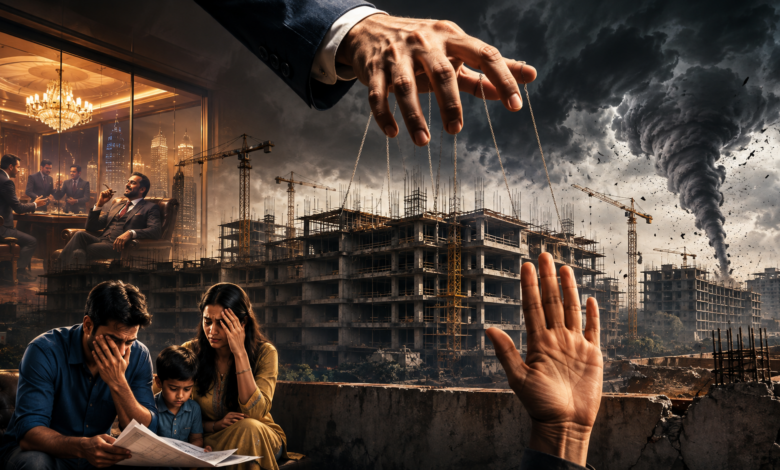
The human cost is measured in years of rent paid while EMIs continue, in cancelled marriages and delayed children’s education, in medical emergencies met without the security of a finished home, and in the quiet exhaustion of middle-class households that had treated the purchase of a flat as the central act of financial planning. In project after project the same sequence appears: brochure promises, booking amounts, construction that slows or stops, refunds that are refused or delayed, and legal processes that stretch across a decade or more. The CBI’s 21st chargesheet against the Acme promoters is simply the most recent formal recognition of that sequence in one more city.
The scale is national. Supreme Court directions produced the registration of dozens of cases. The CBI has moved from preliminary enquiries to regular cases to chargesheets in successive batches. The Enforcement Directorate has converted police FIRs into PMLA prosecutions and asset attachments measured in hundreds of crores. State RERA authorities continue to receive complaints and issue execution orders. Yet the underlying projects remain incomplete, the original customer funds remain unaccounted for in full, and new launches continue under the same corporate structures or their successors.
The real-estate networks that produce these outcomes operate through layers of special-purpose companies, land-owning entities, related-party advances and bank relationships. Customer money is treated as working capital for the group rather than as a trust for a specific project. When construction stalls, the buyer is left with a paper allotment and a continuing debt. When regulators intervene, the response is litigation, settlement in individual cases, or corporate restructuring that leaves the original liability diluted. The CBI chargesheets, the ED attachments and the RERA orders document the results; they do not yet reverse them for the majority of affected families.

The September 2026 filing against Acme Realties therefore functions as both a specific prosecution and a marker of systemic continuity. Twenty earlier chargesheets have already placed other builders and, in several instances, bank officials before the courts. The TDI record supplies one of the largest quantified examples of collection, diversion and delay. The environmental and planning proceedings supply independent evidence of non-compliance that itself generated further financial benefit. Together they describe an industry segment in which the extraction of citizen savings has become routine, the delivery of homes has become optional, and the legal process has become the primary remaining avenue for accountability. The citizens who paid remain, years later, without the homes they were sold.