A Palace of Peace Or A Circus of Power? Inside The United Nations’ Billion-Dollar Illusion
Founded on the ashes of a world war to guarantee that mass death would never again go unanswered, the United Nations now presides over a planet still burning — Gaza, Ukraine, Sudan, Syria — while its marble halls host galas funded by the same nations whose vetoes paralyze it. Who wrote its rules? Who punishes its failures? Who decides which genocide gets a resolution and which gets silence? This is an interrogation of an institution that asks the world to trust it with peace, while offering no mechanism to hold itself accountable when peace never comes.

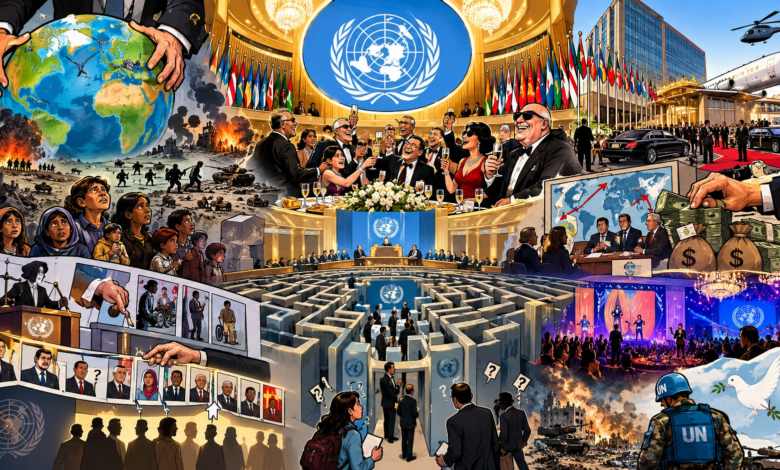
Who Punishes the UN When It Fails? The Question 193 Nations Refuse to Answer
A Promise Written in the Blood of 70 Million People
The United Nations was not born out of idealism alone. It was born out of horror. Seventy to eighty-five million people were dead. Cities had been reduced to ash. And in 1945, the victors of the Second World War sat down and promised the survivors that this — the concentration camps, the firebombing, the annihilation of entire generations — would never be allowed to happen again. That was the purpose. Not a debating society. Not a stage for diplomats to pose for photographs. A guarantee.
Eighty years later, that guarantee lies in ruins across Rwanda, Srebrenica, Darfur, Sri Lanka, Syria, Sudan, Gaza, and Ukraine — and the uncomfortable, unavoidable question this raises is not whether the United Nations has failed on occasion. It is whether failure was quietly built into its architecture from the very beginning, whether the UN was designed less to achieve peace than to perform the appearance of pursuing it, while the five nations who wrote its founding rules retained every tool necessary to block it whenever peace became inconvenient to their own interests.
Who Decides the Rules — and Why Do Five Nations Get to Veto the Will of 188 Others?
Here is the first uncomfortable truth: the United Nations does not run on democracy. It runs on the veto. The Security Council — the only body with the power to authorize real enforcement action — grants five permanent members (the United States, Russia, China, France, and the United Kingdom) the unilateral ability to block any resolution, regardless of how many other nations support it. This is not a footnote. It is the operating system.
As of mid-2019, the Soviet Union and Russia had cast 141 vetoes, the United States 83, the United Kingdom 32, France 18, and China 14. Every single one of those vetoes represents a moment when the collective will of the international community was overruled by a single government defending its own interest.
Ask yourself: what kind of “peace-preserving” institution hands five nuclear-armed governments a permanent trump card over the fate of the other 188? A former UN official’s description of how the practice actually unfolds should chill anyone who still imagines the Security Council as a deliberative democratic body: the permanent members meet privately and then present their resolutions to the full council as a fait accompli, behaving “like a private club of hereditary elite-members who secretly come to decisions and then emerge to tell the grubby elected members that they may now rubber-stamp those decisions.” That is not global governance. That is oligarchy wearing the robes of multilateralism.
And when Russia used its lone veto to override thirteen other votes condemning its own 2014 annexation of Crimea, the world witnessed the veto not as a safeguard, but as a weapon — a permanent member using its Security Council seat to shield itself from the consequences of its own aggression. If the body meant to prosecute the powerful for violating peace instead hands the powerful the pen to erase the charges against themselves, has the United Nations ever truly been an instrument of justice, or merely its aesthetic?
Who Punishes the UN When It Fails? Who Takes Accountability?
This is the question that should keep every taxpayer, every diplomat, and every grieving family from Srebrenica to Kigali awake at night: when the United Nations fails — catastrophically, with body counts in the hundreds of thousands — who is punished? Who resigns? Who goes to prison? Who pays reparations that actually reach the dead’s families?
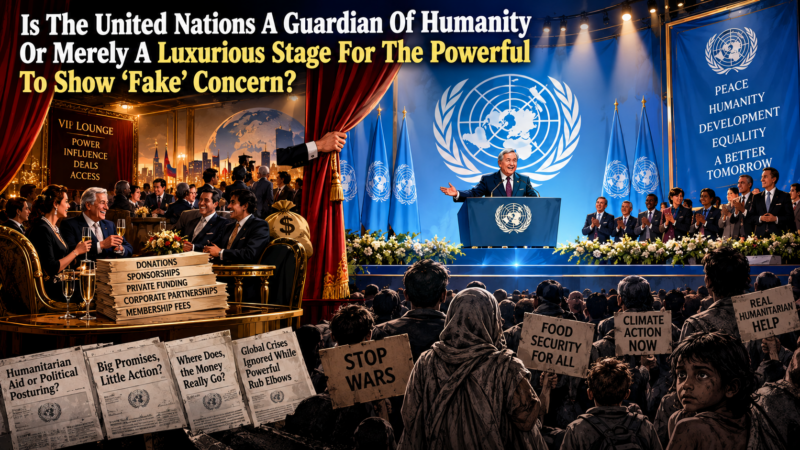
The record answers with silence. During the 1994 Rwandan genocide, roughly 800,000 people were slaughtered in a hundred days while UN peacekeepers, under a mandate too restrictive to intervene, watched. No Security Council member was sanctioned. In July 1995, Bosnian Serb forces massacred more than 8,000 Muslim men and boys in Srebrenica — a town that had been formally declared a UN “safe area” and was protected by 400 armed Dutch peacekeepers, yet the UN forces did nothing to prevent the massacre.
This was, by scale, the worst mass killing on European soil since the Holocaust — inside a zone the UN itself had promised to protect. No one was court-martialed by the United Nations. No structural consequence followed for the institution that made — and broke — that promise.
Move to Sri Lanka, 2009. A formal UN-commissioned review, led by former UN official Charles Petrie, found that as tens of thousands of civilians were killed in the final months of the civil war, UN staff were afraid to publicize widespread killings, top UN leaders did not intervene, and the fifteen-member Security Council did not give “clear” orders to protect civilians. The internal review itself used the words “dereliction of duty” — the United Nations , in effect, indicting its own conscience, and then continuing to operate exactly as before. Rights groups estimated up to 40,000 dead, most killed in army shelling, while the institution charged with protecting them wrote a report and moved on.
Then there is Haiti. United Nations peacekeepers from Nepal were identified as the source of a cholera outbreak that killed over 10,000 Haitians and sickened hundreds of thousands more — and the United Nations’ first response was not grief, not urgency, not accountability. It was to invoke diplomatic immunity and refuse to provide compensation. It took six years, and the deaths of more than 9,000 human beings, before Secretary-General Ban Ki-moon finally admitted the UN’s culpability, saying he was “profoundly sorry.”
He promised $400 million to help the victims. By January 2020 — nearly a decade after the outbreak began — the United Nations had delivered only 5 percent of that amount. Ninety-five percent of a promise to the dead and the dying, unpaid. Is there a more damning statistic for an institution that claims to represent the conscience of humanity?
This is the deepest wound in the UN’s design: there is no external body empowered to punish the United Nations. It writes its own rules, investigates its own failures, apologizes on its own timeline, and pays what it chooses, when it chooses — if at all. An institution that judges nations has never been made to answer to any court above itself.
A Gala for the Rich, Dressed as a Summit for the Poor
Every September, world leaders descend on New York for what the United Nations calls “High-Level Week” — a spectacle of motorcades, five-star hotel blocks, red-carpet arrivals, and gilded General Assembly Hall proceedings, ostensibly convened to discuss famine, war, and climate catastrophe. Who funds this theater? The same 193 member states whose populations are told, simultaneously, that the organization cannot afford to feed refugees or fully staff its peacekeeping missions.
The UN’s own finances make the contradiction almost grotesque: while the organization repeatedly warns of bankruptcy and closed 2025 with a record $1.6 billion in unpaid assessed contributions, its ceremonial machinery — the flags, the interpreters, the security details, the catered receptions for heads of state — continues uninterrupted. Ask the families in famine-stricken regions whether they see the gala or only its aftermath: another resolution, another statement of “deep concern,” another photograph of applause.
Is this the “art of getting peace, at the cost of cutting the globe into pieces”? The metaphor is not far from the mechanics. Every resolution on Syria, Sudan, or Gaza that dies in a veto is a piece of the globe the Security Council has quietly agreed to let fracture, while the institution’s public face continues to project the choreography of concern.
Who Decides Where the Money Goes — and What Is the Criteria?
The United Nations’ regular budget for 2026 stood at roughly $3.5 billion, funded overwhelmingly by a small handful of powerful economies. The United States is assessed at 22 percent — the maximum ceiling the organization allows any single nation to bear — followed by China at 20 percent, Japan at 6.9 percent, and Germany at 5.6 percent. Peacekeeping funding follows a similar pattern, with the United States assessed 26.15 percent and China close behind.
This is not a neutral arithmetic exercise — it is a direct channel of leverage. A landmark academic study by Ilyana Kuziemko and Eric Werker found a documented, measurable relationship between rotating Security Council membership and foreign aid flows: countries that win a temporary Security Council seat during periods the international press treats as consequential see U.S. aid rise by an average of 170 percent, or roughly $16 million more, and UNICEF funding to those same countries rise by 63 percent during their tenure — increases that evaporate the moment the country’s term on the Council ends.
Even the researchers, unable to prove intent, could not escape the implication: “it is impossible though to say if the increase of foreign aid payments by the US or by the United Nations have changed receiving countries’ voting behavior, as they would never admit being open for bribery.” When the price of a nation’s United Nations vote correlates this cleanly with a spike in aid that vanishes the instant the vote is no longer needed, is that diplomacy, or is that the world’s most sophisticated influence-purchasing operation, laundered through the language of humanitarian assistance?
If the United Nations Exists to Spread Peace, Why Are Wars Unstoppable?
This is the question that cuts to the bone. If the United Nations’ foundational mandate is, in its own charter’s words, “to maintain international peace and security… [and] to enforce the peace by taking preventive or enforcement action,” why does the twenty-first century read like an unbroken chronicle of the United Nations watching catastrophe unfold from the sidelines?
Consider the pattern the historical record actually shows: the Security Council intervened decisively to protect oil-rich Kuwaitis in 1991, but poorly protected resource-poor Rwandans in 1994 — a juxtaposition that answers, with brutal clarity, whether strategic interest or human life drives the UN’s selective urgency. In Darfur, an estimated 300,000 civilians were killed in what became the largest mass killing in the region’s history, while the institution charged with stopping genocide continuously failed to act. During the Syrian Civil War, New Zealand’s own Prime Minister stood at the General Assembly podium and heavily criticized the UN’s inaction more than two years into a conflict that would eventually kill hundreds of thousands and displace millions.
Was the United Nations ever built to achieve peace — or was it built, from 1945 onward, to manage the optics of pursuing peace while its most powerful architects retained the veto to ensure their own conduct, and that of their allies, would never be genuinely constrained? Every war that continues unresolved while the Security Council debates procedure is a data point in favor of the second, darker interpretation.
A Golden Hall for Bureaucrats — and a Maze Nobody Can Navigate
Ask any humanitarian worker who has tried to move emergency aid through the United Nations system how fast it moves, and you will hear the same word: glacial. Former UN Special Representative Mohamed Sahnoun’s own post-mortem on the catastrophic 1992 Somalia intervention found that the United Nations was “totally outperformed by NGOs, whose competence and dedication sharply contrasted with the United Nations’ bureaucratic inefficiencies and excessive caution,” with most UN envoys operating from the safety of their desks in Nairobi rather than visiting clan leaders in the field — bureaucrats managing a genocide-adjacent catastrophe from air-conditioned offices in a neighboring capital, while the people they were meant to serve died within reach.
And the corruption embedded in that bureaucratic maze is not speculative. The Oil-for-Food Programme suffered from widespread corruption and abuse, dogged throughout its existence by accusations that profits were unlawfully diverted to the government of Iraq and to United Nations officials themselves.
A psychological study of workplace corruption bluntly observed that “there are few organizations in the Western world that could survive with the allegations of mismanagement, scandal, and corruption that permeate the United Nations,” describing the institution for many of its own employees as “little more than an enormous watering hole.” This is an organization that, faced with its own reputational crisis, developed an “ethics quiz” for staff with answers so self-evidently obvious that the entire exercise reads as parody rather than reform.
Who Decides Which Human Rights Are Preserved — and Which Are Ignored?
If any single fact should disturb anyone who still believes the UN’s Human Rights Council functions as a genuine guardian of human dignity, it is this: as of 2023, only 30 percent of the countries sitting on the Human Rights Council were classified as “free” by the think tank Freedom House.
That same year, Iran was chosen to chair the Council’s Social Forum, drawing condemnation from 26 human rights groups over the killing of protesters during the Mahsa Amini demonstrations. In 2024, the UN’s own Commission on the Status of Women appointed Saudi Arabia to chair its 69th session on women’s rights, a decision Amnesty International condemned by citing the country’s “abysmal record when it comes to protecting and promoting the rights of women.”
Who decided that the nations most frequently accused of the gravest human rights violations should be handed the gavel meant to judge human rights violations? What message does that send to a woman silenced in Tehran, or a woman denied basic freedoms in Riyadh, watching her own oppressors preside over the very forum that claims to speak for her?
Who Decides Which Crisis Gets Priority — and Which Gets Silence?
The UN’s attention is not distributed according to body count. It is distributed according to politics. Former U.S. Secretary of State John Kerry accused the United Nations Human Rights Council of focusing disproportionately on allegations of abuses by Israel, and even the UN’s own Secretary-General Ban Ki-moon argued that the UN had focused disproportionately on Israel, with a volume of resolutions he believed actively hampered the organization’s effectiveness.
Historian Robert Wistrich calculated that “a third of all critical resolutions passed by the United Nations Human Rights Commission during the past forty years have been directed exclusively at Israel,” while, by his account, there has “not been a single resolution even mentioning the massive violations of human rights in China, Russia, North Korea, Cuba, Saudi Arabia, Syria, or Zimbabwe.”
And in a chilling coda from 2024, the UN’s own former Special Adviser on the Prevention of Genocide, Alice Wairimu Nderitu, alleged her contract was not renewed after she declined to label Israel’s conduct in the Gaza war a genocide, and separately accused the United Nations of being overly focused on Israel while ignoring other humanitarian crises in Ukraine and Sudan. Whether or not one accepts her framing, the fact that a UN insider — the very official whose job was to watch for genocide — publicly alleged that institutional priorities were being shaped by politics rather than by the scale of human suffering should alarm anyone still trusting the UN’s crisis calendar to reflect where humanity is actually dying fastest.
The Verdict — and the Case Against It
None of this proves the United Nations is a conscious, coordinated fraud. A 2005 RAND Corporation study did find the United Nations successful in two out of three peacekeeping efforts, outperforming comparable U.S.-led nation-building missions, and the 2005 Human Security Report documented a genuine decline in wars, genocides, and human rights abuses since the Cold War, crediting international activism largely spearheaded by the UN. U Thant’s quiet diplomacy helped steer the world back from the brink during the Cuban Missile Crisis. These are not small footnotes; they are real, human lives saved by an imperfect institution doing, at times, exactly what it was built to do.
But an institution’s successes do not erase the pattern of its failures, and a pattern this consistent — vetoes that shield the powerful, bureaucracy that outpaces urgency, budgets that fund galas while missions go unpaid, human rights councils chaired by human rights violators, and eight decades without a single mechanism to hold the organization itself accountable — deserves more than polite diplomatic language. It deserves the interrogation this article has tried to give it. The United Nations may not be a scam in the criminal sense. But for the families of Srebrenica, Kigali, Colombo, and Port-au-Prince, the distinction between “scam” and “institutional failure with no consequences” is not a distinction that brings anyone back to life.