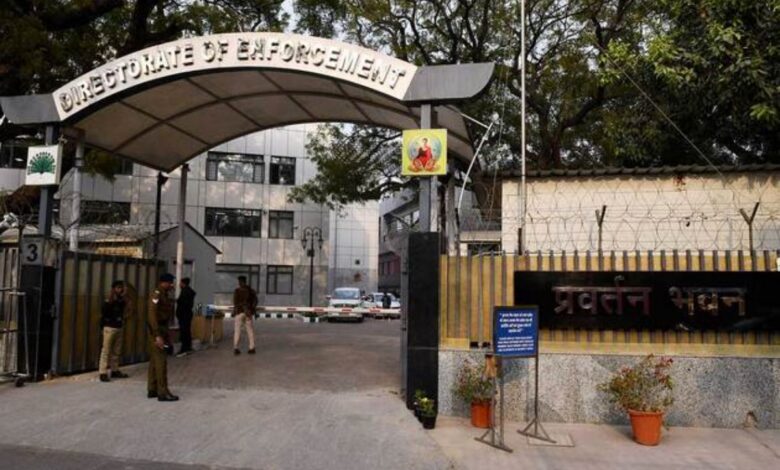
The Enforcement Directorate has restituted Rs 37,57,697 to investors in a money-laundering case involving Bluemax Capital Solutions Private Limited. The Madurai Sub-Zonal Office of the ED carried out the restitution on the orders of the Special Court under the Prevention of Money Laundering Act in Madurai. The announcement was made on 30 October 2026.
The case relates to allegations that the company collected more than Rs 100 crore from members of the public. According to the ED, the company represented that the money would be invested in forex, commodities, gold and other trading activities and promised attractive returns. The ED has stated that the company was not authorised to undertake forex trading and that the funds were not used in the manner represented to the investors.
Portions of the money were allegedly routed through bank accounts of other entities and individuals. Some funds were used to acquire cryptocurrency and to invest in movable and immovable properties. The ED has seized, frozen and attached assets that include cryptocurrency valued at approximately Rs 8.89 crore. The agency has said that restitution to other victims whose applications have been allowed by the Special Court is continuing.
This is not a new investigation. The ED first made public details of the case in December 2022. On 2 December 2022, the Madurai Sub-Zonal Office announced the arrest of four persons on 18 November 2022. The arrested individuals were R. Aravinth, S. Gopalakrishnan and S. Bharathraj, described as directors of Bluemax Capital Solutions Private Limited, and J. Amarnath, described as their associate from Tuticorin.
The ED said multiple FIRs had been registered by Tamil Nadu Police in 2020 and 2021 against the company, its directors and others after complaints from members of the public who alleged they had been cheated under the guise of investments in forex, commodities and gold trading. At that time the agency put the amount allegedly collected from the public at approximately Rs 108 crore.
According to the ED, the directors had created a company website that contained false features. The website gave investors the impression that they were participating in real-time forex trading. Investors were shown information that appeared to show actual trading activity in their accounts. The agency stated that the siphoned-off money was layered and used for cryptocurrency investments and the purchase of movable and immovable properties by the directors. It also said funds had been diverted to overseas entities in Hong Kong, the UAE and Switzerland.
At the stage of the December 2022 announcement, the ED disclosed that it had seized cash, jewellery and cryptocurrency worth approximately Rs 2.13 crore and frozen bank balances of approximately Rs 3.24 crore.
On 15 February 2023 the ED announced that it had filed a prosecution complaint before the Special Court in Madurai against Bluemax Capital Solutions Private Limited, its directors and others. The Special Court took cognizance of the money-laundering offence. The four persons named earlier remained the focus of the complaint. The February 2023 release revised the reported collection figure to approximately Rs 116 crore.
The ED again described the alleged operation of the website. It stated that Bluemax created a fake website that misled investors into believing they were trading in forex, gold and commodities through their individual accounts. The website was later shut down and shown as having been hacked. Investors were told that the invested money had been lost.
The agency repeated that portions of the funds had been diverted to overseas entities in Hong Kong, the UAE and Switzerland and that the money was layered and used for cryptocurrency investments and the acquisition of movable and immovable assets by the directors. The same asset figures of Rs 2.13 crore seized and Rs 3.24 crore frozen were restated. The four accused were in judicial custody at the time of that announcement.
The FIRs registered by Tamil Nadu Police invoked several provisions. These included Section 120B of the Indian Penal Code dealing with criminal conspiracy, Section 406 dealing with criminal breach of trust, Section 409 dealing with criminal breach of trust by specified persons, and Section 420 dealing with cheating and dishonestly inducing delivery of property. The FIRs also invoked Section 5 of the Tamil Nadu Protection of Interests of Depositors (in Financial Establishments) Act, 1997, and Sections 3, 4, 5 and 21 of the Banning of Unregulated Deposit Schemes Act, 2019.
A significant development occurred in the High Court in July 2026. Six investors approached the Madurai Bench of the Madras High Court seeking modification of conditions attached to refund orders. The petitioners were M. Kurinji, C. Sakthivel, S. Rajeswari, Sweta Jain, S. Soniya Dhevi and S. Benjamin. They were described as investors who had deposited money with Bluemax Capital Solutions Private Limited and whose matured deposits had not been returned.
The High Court recorded that a case had been registered in Crime No. 1 of 2023 by the Tamil Nadu Police under the provisions mentioned earlier. It also noted that the ED had initiated proceedings under the Prevention of Money Laundering Act and that certain amounts had been recovered.
The Special Court in Madurai had already passed separate orders in January 2026 allowing the applications of these six investors. The orders directed refund of 75 per cent of the amounts claimed by each of them. The dates of the Special Court orders ranged from 2 January to 21 January 2026.
The Special Court had imposed a condition that the investors must execute bonds for the relevant amounts with one surety for an equivalent amount. The surety was required to produce a solvency certificate issued by revenue authorities not below the rank of Tahsildar. The investors told the High Court that this condition had become impossible to fulfil because the Tamil Nadu Government had discontinued the issue of solvency certificates under a government order dated 26 May 2025.
The High Court examined the relevant rules on restoration of confiscated property. It observed that the rules required claimants to execute bonds undertaking to produce the restored property before the Special Court when required, but did not require sureties to produce solvency certificates. Taking note of the discontinuation of solvency certificates, the High Court set aside that specific condition.
It directed that the investors and sureties must execute bonds for amounts determined by the trial court and that the investors themselves must file affidavits undertaking to refund the money if required by the trial court. The remaining conditions imposed by the Special Court were left undisturbed. The petitions were allowed on 15 July 2026 by a bench of Justice A.D. Jagadish Chandira and Justice R. Poornima.
Section 8(8) of the Prevention of Money Laundering Act provides the legal basis for restoration of confiscated property to eligible claimants. The Special Court can direct the Central Government to restore confiscated property or part of it to a claimant who has a legitimate interest in the property, has suffered a quantifiable loss as a result of the money-laundering offence, has acted in good faith, has taken reasonable precautions and is not involved in the offence. An amendment allows the Special Court to consider such claims during the trial itself if it considers it appropriate.
In this case the sequence has been that Tamil Nadu Police registered FIRs on investor complaints, the ED investigated the alleged laundering of the funds and identified assets, assets including cryptocurrency were seized, frozen and attached, the ED filed its prosecution complaint, investors approached the Special Court seeking restoration, the Special Court allowed applications and directed refunds, and the ED has begun implementing the orders, starting with the restitution of Rs 37,57,697 announced on 30 October 2026.
The ED has disclosed that cryptocurrency valued at approximately Rs 8.89 crore forms part of the assets seized, frozen and attached. Earlier disclosures in 2022 and 2023 had referred to cryptocurrency investments made with diverted funds and to transfers to overseas entities. The December 2022 release also referred to companies and bank accounts in offshore locations including the UAE, Hong Kong, Belize and the United Kingdom. The February 2023 release referred to diversion of funds to entities in Hong Kong, the UAE and Switzerland.
The timeline of the case as disclosed in the public documents runs from October 2019, when the ED has alleged that the directors staged a false hacking of the company server and informed investors that their money had been lost, through the registration of multiple FIRs in 2020 and 2021, the arrests in November 2022, the filing of the prosecution complaint in February 2023, the filing of restoration applications by investors in 2025, the Special Court orders in January 2026 directing 75 per cent refunds, the High Court order in July 2026 modifying the surety conditions, and the ED’s restitution announcement in October 2026.
The three collection figures disclosed by the ED over time are approximately Rs 108 crore in December 2022, approximately Rs 116 crore in February 2023, and more than Rs 100 crore in the October 2026 release. The October 2026 figure of approximately Rs 8.89 crore for assets including cryptocurrency stands alongside the earlier disclosures of Rs 2.13 crore seized and Rs 3.24 crore frozen. The restitution of Rs 37,57,697 is one payment made under court orders. Further restitution is stated to be under way.
The individuals named by the ED as directors are R. Aravinth, S. Gopalakrishnan and S. Bharathraj. J. Amarnath has been described as their associate. The ED has alleged that the directors were involved in creating the website, diverting investors’ funds and acquiring assets, and that they had established companies and bank accounts through Bluemax Global Limited in offshore locations. These remain allegations under investigation and trial. The PMLA prosecution is continuing before the Special Court in Madurai.
The case is being handled under both the predicate offences registered by the Tamil Nadu Police and the money-laundering proceedings under the Prevention of Money Laundering Act. The restitution process under Section 8(8) is proceeding independently of the final outcome of the criminal trial, as permitted by the statute and the court orders already passed.