Arabtec-Raheja Gamble: From Dubai Towers To Decades Of Tears
In 2011, Arabtec Construction and Raheja Developers announced a grand joint venture to build Revanta, Phoenix and Shristi. Homebuyers paid. Families in Kathputli Colony were displaced. Years later the towers remain incomplete, insolvency petitions pile up, and the Enforcement Directorate names Arabtec among the accused after a reported ₹380 crore transfer linked to non-existent vendors. This is not a corporate dispute. It is the story of life savings trapped in unfinished concrete, of children growing up in transit camps, and of ordinary Indians still waiting for the homes they were promised while money moved through routes that investigators now call proceeds of crime. The agony continues.

They (The Rahejs) promised us homes. They took our money. The towers never came. The joint-venture banners came down. The years piled up. And somewhere in the middle of it all, approximately ₹380 crore is alleged to have moved to Arabtec Construction (India) Pvt. Ltd. while homebuyers and displaced families waited, and waited, and are still waiting.
This is not an abstract corporate story. It is the story of people who paid 90–95 percent of the cost of a flat and still do not have keys. It is the story of families whose homes in Kathputli Colony were demolished in 2014 with the promise of permanent rehabilitation within two years, only to remain in temporary shelters more than a decade later.
It is the story of a construction partnership that was announced with international fanfare in 2011 and that later appears in an Enforcement Directorate prosecution complaint filed in November 2026. From the homebuyer’s point of view, every year of delay is not a commercial inconvenience. It is stolen time, stolen interest, stolen peace, and in too many cases, stolen health and family stability.
The public record does not yet allow us to declare that Arabtec alone caused every delay or that every rupee of the reported transfer was stolen. But the record is already enough to fill any homebuyer with dread. Three projects were publicly linked to the Arabtec-Raheja construction arrangement. At least two of them became symbols of prolonged suffering. And a substantial sum of money, drawn from the same pool that homebuyers paid into, is now under investigation as part of a much larger alleged diversion of funds.
Raheja Projects That Never Delivered What Was Promised
Raheja Revanta, Sector 78, Gurugram
Revanta was sold as a landmark high-rise development. Contemporary reports spoke of a 56-storey tower rising nearly 195 metres and roughly 1,200 residential units. Buyers signed agreements in 2012. The contractual possession period was 42 months including a six-month grace period. Many paid the overwhelming bulk of the sale consideration, often 90 to 95 percent, trusting that an international construction partner would deliver on schedule.
Years passed. Construction lagged. Layout plans were allegedly changed to increase floors without buyer consent. Force majeure and infrastructure excuses were offered. Buyers went to consumer forums, to the High Court, and finally, in large numbers, to the National Company Law Tribunal. In June 2026 the NCLT admitted an insolvency petition against Raheja Revanta, filed by 176 homebuyers holding 99 units who said they had collectively paid more than ₹137 crore. The project’s RERA registration is recorded as lapsed. HRERA proceedings continue.
From the homebuyer’s vantage point the questions are brutal and simple. Where did the money go? What portion of the construction was actually completed by the joint-venture partner publicly announced for the project? Why were people who paid almost the entire price still fighting for possession more than a decade later? Every additional year of delay meant EMIs on a non-existent flat, rent on temporary accommodation, children’s education disrupted by uncertainty, and the quiet erosion of middle-class security. The insolvency petition is not a technical legal event. It is the formal admission that hundreds of families have been left holding paper instead of homes.
Raheja Phoenix and the Kathputli Colony Tragedy
Phoenix was never just another private apartment project. It was tied to the redevelopment of Kathputli Colony in West Delhi. The 2011 announcement described a 50- or 54-storey residential tower, a shopping mall and approximately 2,800 affordable housing units. For the residents of Kathputli Colony the promise was different and more urgent, which says, leave your homes so the land can be redeveloped, live temporarily in transit camps, and receive permanent improved housing within roughly two years.
Homes were demolished in 2014. Families were shifted to transit camps, including at Anand Parbat. More than a decade later, a detailed investigation published in 2025 documented that many were still living in temporary structures. Seepage, inadequate water, shared sanitation, disrupted livelihoods, and community fracture were the daily reality. Some were moved farther away. Others had to find their own arrangements. The commercial and residential development that was supposed to rise on the land remained incomplete.
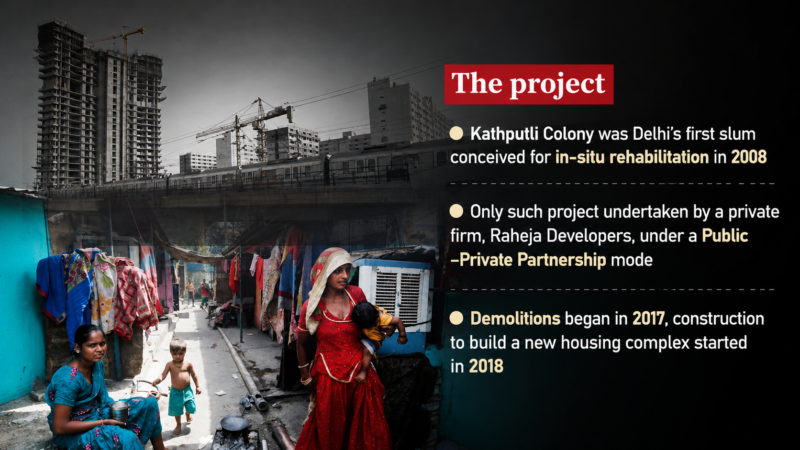
This is a different kind of agony from the private buyer who paid for a flat. These were people whose existing homes were taken away under the promise of better ones. The temporary camps were never meant to become permanent. Yet years turned into more than a decade. Children grew up in transit. Elderly residents died waiting. Traditional occupations linked to the old colony became harder to sustain. The human cost is not measured only in rupees. It is measured in dignity, in community, in the basic human need for a stable place to live.
The Arabtec-Raheja announcement had named Phoenix as one of the three projects. What is already established is the outcome for the people who were displaced- Prolonged uncertainty and continued hardship. From their point of view the distinction between developer, contractor and authority is secondary. The homes they were promised did not materialise on the timeline that was held out to them.
Raheja Shristi, Gurugram
Shristi was described as a development of approximately 300 high-end residential apartments, also included in the same US$204 million construction arrangement announced in 2011. When a project is publicly tied to a major joint-venture construction partnership and then fades from clear documentation, homebuyers who may have invested in it are left without transparency. For any buyer who paid money into a project associated with that partnership, the lack of clear, timely possession remains a live source of anxiety.
The Money Trail That Homebuyers Cannot Ignore
The Enforcement Directorate’s prosecution complaint of 6 November 2026 named Arabtec Construction (India) Pvt. Ltd. among 21 accused in the PMLA case against the Raheja group. Separately, reporting attributed to ED sources stated that approximately ₹380 crore was transferred to Arabtec Construction (India) Pvt. Ltd. and that investigators allegedly found that certain vendors to whom the company claimed to have paid for construction materials did not exist.
The broader ED case states that Raheja Developers collected approximately ₹2,699.13 crore from around 4,600 homebuyers and investors. Of this, ₹1,353.26 crore was identified as proceeds of crime, ₹1,175.86 crore allegedly taken out of project, escrow and RERA accounts for purposes other than construction, and ₹177.40 crore allegedly collected in cash outside registered agreements. Money is said to have moved to group companies, entities operated through employees and relatives, land-purchasing vehicles, and between RERA accounts of different projects. Most of the group’s projects, according to the agency, remain incomplete.
The reported ₹380 crore transfer sits inside this larger picture. It is not an additional sum to be simply added to the ₹1,353 crore figure; it is one of the transactions under scrutiny. The allegation that some vendors did not exist is particularly corrosive from a homebuyer’s perspective. Construction expenditure should leave a verifiable trail: GST-registered suppliers, purchase orders, invoices, e-way bills, transport records, gate entries, stock registers, and measurable incorporation of materials into the building. If the trail leads to entities that never existed, the money that left project accounts did not become steel, concrete, labour or finished flats. It went somewhere else.
The original 2011 joint-venture announcement presented Arabtec as holding a 63 percent stake and Raheja 37 percent, with a construction contract value of roughly US$204 million (then about ₹1,020 crore) for the three projects and a 48-month schedule. The Indian entity, Arabtec Construction (India) Pvt. Ltd., was incorporated in February 2012. Nayan Navin Raheja appears in the reported director history. The relationship later showed signs of strain; a 2021 High Court matter between the parties recorded mediation efforts and a submission that the UAE-based Arabtec Construction LLC was in liquidation.
The Dubai parent group itself moved toward dissolution and insolvent liquidation in 2020. The Indian company is a separate legal entity, but the collapse of the parent raises obvious questions about continuity of construction capacity, funding and accountability.
The Decades-Long Agony of Ordinary Buyers and Displaced Families
For the private homebuyer the arithmetic of delay is merciless. EMI payments continue while the flat does not exist. Rental costs accumulate. Opportunity cost of the capital locked in an incomplete project compounds. Children’s schooling, marriage plans, medical needs and retirement timelines are all disrupted. Many buyers are middle-class families who stretched themselves to the limit of their borrowing capacity precisely because they believed the project would be delivered on the contractual timeline.
When that timeline stretches to a decade or more, the psychological and financial pressure becomes crushing. Some face coercive recovery actions even as the developer remains unable to hand over possession. Others watch the project enter insolvency proceedings and realise that recovery of their money is now a distant, uncertain prospect.
For the residents of Kathputli Colony the injury is deeper still. They did not choose to buy into a private development. Their existing homes were demolished under a redevelopment scheme that held out the promise of permanent housing. Temporary transit accommodation was never intended to become a permanent sentence. The documented conditions of seepage, water shortages, shared sanitation, loss of traditional livelihoods, and the scattering of community networks represent a sustained failure of the social contract that was offered to them. Every year of continued residence in those camps is another year of deferred dignity.
Both groups share a common experience: the sense that money collected for construction did not produce the construction that was promised. The ED’s larger allegation that substantial sums left project and RERA accounts for other purposes only intensifies that sense of betrayal. When investigators further allege that some of the construction-material vendors did not exist, the homebuyer’s natural reaction is not technical caution. It is anger and fear. Anger that the system allowed this to continue for so long. Fear that the money is gone and the homes will never come.
The original Arabtec-Raheja partnership was sold as a marriage of international construction expertise and local development ambition. The public announcement created expectations of professional delivery. Those expectations were not met for large numbers of people who paid money or who surrendered their existing homes.

The projects stand as physical monuments to unfinished promises. The reported financial movements stand as questions that investigators must resolve. And the human cost continues to accumulate in the form of unfinished lives — families still renting, still waiting for keys, still living in transit, still calculating how much more of their remaining working years will be consumed by a home that was supposed to have been delivered long ago.
This is the reality that any discussion of Arabtec’s role in the Raheja fund-diversion case must confront. The corporate details matter. The legal distinctions between allegation and proof matter. But from the homebuyer’s point of view the central fact is simpler and more devastating: the money left their accounts, the homes did not arrive, and the years of waiting have already exacted a price that no court order can fully restore.