‘Plant Ganja In His Bag’: When Moral Policing Is Not Enough, The Real Police Enter The Scene To Harass The Citizens Of The Country!
In a chilling echo of cinematic injustice, a senior Madhya Pradesh police officer is heard on CCTV instructing colleagues to plant marijuana on a young man simply because an adult unmarried couple refused to summon their parents. What begins as classic moral policing at a Seoni hotel rapidly escalates into an alleged threat to manufacture a narcotics case. The incident, coupled with the hotel owner’s claims of systematic extortion, exposes a darker reality: when officers decide private adult choices are unacceptable, the very institution meant to uphold the law becomes the instrument of its violation. The question is no longer whether the system is broken—it is how long citizens must endure its active hostility.

Recall the scene from the 2011 film Singham. A police inspector Rakesh Kadam, played by Sudhanshu Pandey, is driven to suicide after a powerful gangster-politician frames him on false corruption and smuggling charges. The audience is meant to feel righteous anger, where the system has been twisted by a criminal to destroy an honest officer. Now cut to November 2026 in Seoni, Madhya Pradesh. The script has been rewritten with grotesque precision. This time the person issuing the order to plant evidence is not a don. It is an Additional Superintendent of Police. The target is not a corrupt official but an ordinary adult citizen whose only “crime” was spending time with a consenting adult partner in a hotel room.
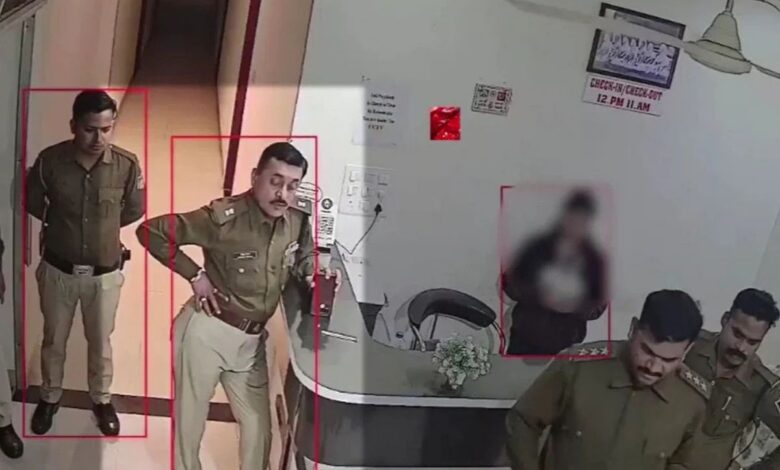
On 13 November 2026, at Hotel Siddharth (also referred to as Sidarth Hotel) on Babariya Road, CCTV cameras recorded what should never have occurred in a constitutional republic. Additional SP Deepak Mishra, along with other officers including SDOP Chanchalesh Markam and Kotwali TI Satish Tiwari, confronted an unmarried adult couple. The woman told the officers what any reasonable person would consider sufficient, as they both were adults, they belonged to the same caste, and they intended to marry. The officers were unmoved. They insisted the couple contact their parents. When the woman refused to unlock her phone and make the call, the conversation took a turn that should terrify every citizen.
“Plant some ganja on the boy,” the Additional SP is heard saying.
Let that sentence settle.
A senior police officer, in uniform, allegedly instructing subordinates to manufacture evidence of a serious criminal offence under the Narcotic Drugs and Psychotropic Substances Act.
Not to investigate a crime. Not to respond to a complaint. Simply to punish two adults for the temerity of refusing to submit their private lives to parental and police supervision.
This is not moral policing that has overreached. This is moral policing that has graduated into the fabrication of criminal cases. When sermons about family honour and social values fail, the khaki uniform is used to threaten the destruction of a young man’s life through planted drugs. The consequences of such a frame-up are not abstract. Arrest, years of court proceedings, social stigma, loss of employment, financial ruin, and the very real possibility of imprisonment even if the charges are eventually disproved. The process itself becomes the punishment.
The hotel owner, Sanju Sanodiya (also reported as Sanjay Sanodia), has added another layer of rot. He alleges that local police demanded a monthly payment of ₹25,000. When he refused or failed to pay the full amount, the raids began. The couple’s presence, he claims, became convenient leverage. In other words, the same machinery that lectures citizens about morality is itself accused of running an extortion racket. Moral policing, it appears, is not only about controlling sexuality; it is also a useful pretext for extracting money and demonstrating power.
What makes the episode particularly corrosive is the casualness of the alleged threat. There is no evidence of panic or improvisation in the reported footage. The suggestion to plant ganja is delivered as if it were a routine administrative option; something officers can simply choose when citizens do not comply. That normalisation is the real scandal. It suggests a culture in which the fabrication of cases is not an unthinkable violation but a tool available in the toolkit of enforcement.
India’s Constitution guarantees personal liberty and the right to privacy. The Supreme Court has repeatedly affirmed that adult citizens are free to make intimate choices without interference from the state or society, provided no law is broken. Yet on the ground, in far too many districts, police continue to treat unmarried adult couples in hotels as legitimate targets of harassment. The Seoni incident is only the latest and most brazen illustration. It reveals that for some officers the law is not a boundary but a weapon to be deployed selectively against those who refuse to perform obedience.
The response so far has been partial and predictable. The Kotwali station in-charge has been attached to the police lines and an inquiry ordered. Reports indicate that proposals for suspension of the senior officers involved have been sent to the state government. These are necessary first steps, but they are also the minimum. A departmental inquiry that ends with a transfer or a mild reprimand will only confirm that the system protects its own. What is required is a transparent criminal investigation into the alleged threat to plant narcotics and into the hotel owner’s extortion claims. Anything less tells every young couple in Madhya Pradesh and beyond that their privacy remains conditional on the mood of the local police.
Citizens do not exist to perform respectability for the benefit of police officers or their notions of tradition. Adults do not require permission slips from parents or the local thana to occupy a hotel room. And no officer, regardless of rank, has the right to treat the NDPS Act as a personal instrument of coercion. The viral video from Seoni has forced a temporary reckoning. Whether that reckoning produces genuine accountability or merely another cycle of outrage followed by institutional amnesia will determine how safe ordinary Indians remain from the very people sworn to protect them.
The khaki uniform is not a licence for moral tyranny. When it is used as one, the public has every right, and every duty, to demand that the law be applied with equal force against those who wear it.