Why Advocates Across India Are Demanding Manan Kumar Mishra To Show His Degree. Calling Manan Kumar Mishra A Cockroach Advocate As Per Definition Of CJI Surya Kant
Manan Kumar Mishra: Regulator, Politician, and the Erosion of Institutional Trust

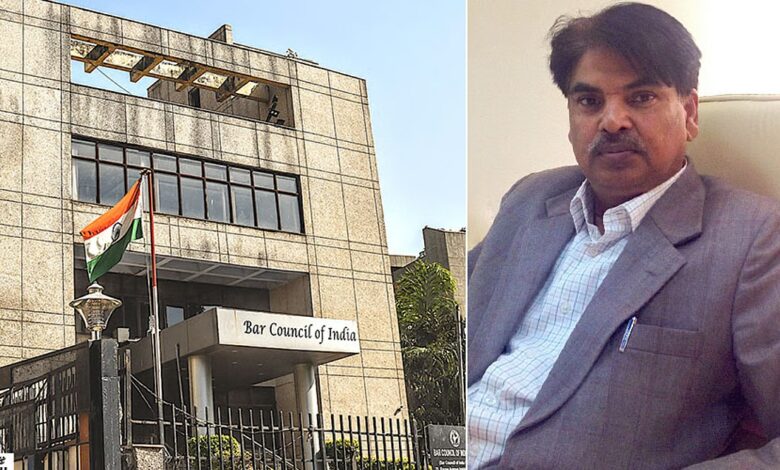
Manan Kumar Mishra has controlled the Bar Council of India for most of the period since 2014 and was re-elected for a seventh consecutive term in 2025. At the same time he sits as a BJP Member of the Rajya Sabha. That combination of statutory power over every advocate in India and active membership of the ruling party is the defining feature of his public career. What follows is a critical examination of the controversies, allegations, criminal proceedings and institutional failures that have marked his long tenure.
Dual Office and the Problem of Neutrality
In 2024 Mishra was elected to the Rajya Sabha while remaining BCI Chairman. A challenge arguing that the dual role created an impermissible office-of-profit or statutory conflict was dismissed by the Delhi High Court; the Supreme Court declined to interfere. The legal result is clear. The institutional result is not. The BCI regularly interacts with the Union government on legislation, legal education, professional regulation and matters touching constitutional institutions. When its Chairman is simultaneously a parliamentarian of the party in power, the appearance of political neutrality collapses. Critics across the Bar have argued that the arrangement turns a professional regulator into an extension of political authority. Mishra’s defenders cite the failed court challenge and his repeated election by BCI members. The criticism persists because independence is measured by conduct and perception, not solely by the absence of a judicial declaration of illegality.
Collective Punishment: The NALSAR Episode and Earlier Patterns
On 13 August 2026 Mishra, acting as BCI Chairman, ordered every State Bar Council not to enrol any graduate of NALSAR’s 2026 batch while the Council investigated an alleged campaign against Chief Justice of India Surya Kant’s invitation to the university’s convocation. An entire graduating class was placed under a professional cloud without individual findings, notice or hearing. The order was widely condemned as arbitrary. Within hours the full Council modified it, recognising that the vast majority of students had no connection to the disputed conduct. By the early hours of 14 August the proceedings against the batch itself were closed. Mishra later described the original decision as having been taken “in haste.” The rapid reversal limited the damage. It did not erase the readiness to use the gateway into the profession as a collective disciplinary weapon.
This was consistent with earlier conduct. During protests connected with the Madras High Court the BCI suspended approximately 126 advocates. Mishra acknowledged that conventional individual inquiries had not preceded the action and that names had been obtained through various sources. The suspensions were later stayed or reconsidered once the agitation ended. The method is recurrent: broad regulatory action first, individualised process later, if at all.
Criminal Proceedings That Did Not Survive Scrutiny
Two personal criminal matters appear in the public record.
A private complaint accused Mishra and other BCI functionaries of cheating, criminal breach of trust, forgery and conspiracy in connection with the Certificate of Practice and fee framework. The Magistrate took cognisance under Sections 420 and 468 of the Indian Penal Code. The Patna High Court examined the complaint, found the allegations essentially bald, noted the absence of material showing that Mishra had fabricated documents, deceived the complainant or personally appropriated funds, and characterised continuation of the prosecution as an abuse of process. The proceeding was quashed.
A separate case arose from an election poster allegedly displayed when Mishra contested as a Bahujan Samaj Party candidate. Cognisance was taken under Section 171F IPC and the Bihar Prevention of Defacement of Property Act. The Patna High Court accepted the challenge that there was no evidence linking Mishra, his agent or anyone acting on his instructions to the poster, and set aside the cognisance order.
Mishra’s 2024 Rajya Sabha affidavit declared that he had no pending criminal cases. No ED prosecution, CBI chargesheet, PMLA case or disproportionate-assets proceeding against him personally has been located in the public record. The two complaints that existed were terminated in his favour. They form part of the historical record; they do not constitute convictions or judicial findings of guilt.
Allegations of Financial Impropriety and Procurement Questions
Allegations of personal financial misconduct have circulated but have not crystallised into proven cases.
The Supreme Court in 2024 held that State Bar Councils and the BCI could not impose enrolment charges beyond the statutory amounts fixed by the Advocates Act. Additional compulsory fees were declared legally impermissible and coercive. The judgment was a significant institutional rebuke to a fee regime that operated during Mishra’s tenure. It did not find that the excess sums had been diverted to him personally.
Questions have also been raised about the BCI’s engagement of contractors for administration of the All India Bar Examination. Legal reporting has scrutinised the credentials of the contractor, the due-diligence process and the transparency of procurement. The BCI has maintained that the process was fair and that an inquiry involving a retired Supreme Court judge found no impropriety. No independent court judgment, CAG report or investigative-agency finding has established that Mishra personally received kickbacks or diverted examination funds. The controversy remains unresolved; it cannot honestly be stated as proven personal fraud.
Claims that BCI fees or AIBE moneys were transferred to Mishra personally lack supporting judicial or forensic findings in the public domain.
Restriction of Criticism and Confrontational Responses
In 2021 the BCI approved rules under which criticism of Bar Councils, their office-bearers or their decisions could be treated as professional misconduct carrying the risk of suspension or removal from the rolls. The rules were held in abeyance after strong opposition from the Bar Association of India and others, but the episode remains one of the clearest documented attempts to equate institutional criticism with professional wrongdoing.
When LiveLaw published a critical article alleging that Mishra used the Chairman’s office in personal or political battles, the BCI passed a resolution condemning the piece and contemplated governmental and legal action. Mishra recused himself from that agenda item; the Council still acted institutionally. Critics viewed the response as an attempt to chill scrutiny of the regulator itself.
Mishra has also publicly attacked senior advocates who criticised judicial administration, condemned the 2018 press conference by four Supreme Court judges, and written to the Chief Justice of India seeking the transfer of a Kerala High Court judge who had made critical oral observations about the BCI’s election nomination fee. Defending institutional dignity is legitimate. Treating adverse judicial observations or professional criticism as grounds for institutional retaliation is not.
Political Use of the Regulatory Platform
Mishra has repeatedly deployed the BCI’s stature for positions many advocates regard as partisan. He has offered to campaign for Narendra Modi while invoking his representative role in the legal profession, described the Prime Minister in highly laudatory terms at BCI-related events, sought a court holiday for the Ram Mandir consecration, characterised CAA protesters in sweeping derogatory language, and issued statements on Chairman’s letterhead alleging that student protests were being exploited by anti-national or foreign forces without publicly presenting evidence. After the abrogation of Article 370 he used the office to commend the decision, prompting objections that the Chairman should not convert a contested constitutional question into an institutional endorsement.
The defence is that a parliamentarian is entitled to political views. The objection is that the statutory regulator of the entire profession should not speak as though those views are the collective position of India’s advocates.
Governance Failures
The Supreme Court has repeatedly expressed dissatisfaction with the large volume of unresolved advocate-misconduct complaints pending before State Bar Councils and the BCI. In 2026 it directed a performance audit or equivalent review of the disciplinary system, emphasising the need for transparency and institutional effectiveness. The Central Information Commission has criticised the BCI’s failure to make mandatory proactive disclosures under the RTI Act. These are documented shortcomings during a period of prolonged single leadership.
The Accurate Measure of the Record
The public record does not establish that Manan Kumar Mishra is a convicted fraudster, a money-launderer, or a person against whom ED or CBI corruption cases have been successfully pursued. The two personal criminal complaints that reached cognisance were terminated in his favour. Allegations of personal diversion of BCI or AIBE funds have not been judicially or forensically substantiated.
What the record does establish is a sustained pattern of institutional conduct: the simultaneous occupation of regulatory and political office; repeated resort to collective disciplinary measures later withdrawn or modified; attempts to restrict criticism of the regulator itself; the use of the BCI’s platform for partisan political positioning; confrontational responses to journalists, advocates and judges; and governance failures in disciplinary disposal and transparency that have drawn repeated judicial and statutory criticism.
These are not minor procedural lapses. They go to the core of whether the body that decides who may practise law in India operates with the independence, fairness and credibility the profession requires. On that measure the long tenure of Manan Kumar Mishra has left large sections of the Bar convinced that the Bar Council of India has become overly personalised, politically aligned and institutionally aggressive. That is the real case that must be answered.