Two Exits. A Probe Begins. Investors Panic. HDFC Bank Says Nothing Is Wrong. But Is That Really The End Of The Story?
A chairman doesn’t usually walk away from a banking giant invoking “values and ethics” and leave everyone guessing. But Atanu Chakraborty did. HDFC Bank offered reassurance. Investors wanted answers. Then came a ₹45-crore probe, Dubai investment complaints and more uncomfortable questions. Suddenly, the silence looks louder than the explanation. So what exactly is happening behind HDFC Bank’s closed doors?

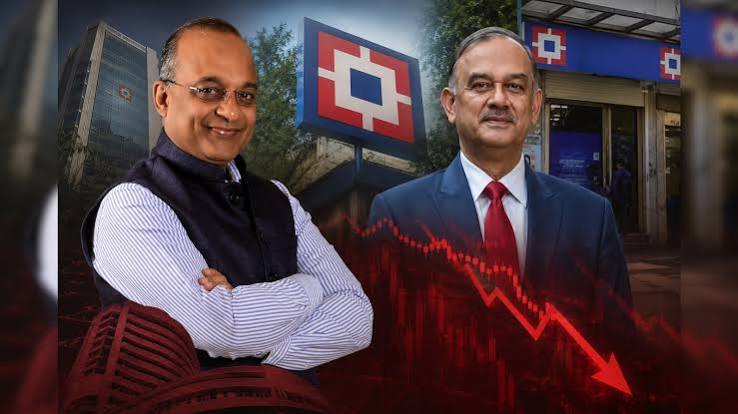
HDFC Bank was supposed to be the picture of institutional stability. Instead, within months, two of the most important people at the top of India’s largest private-sector bank have decided to walk away — first its part-time chairman Atanu Chakraborty, who resigned unexpectedly citing practices that were not in line with his “values and ethics”, and now its Managing Director and CEO Sashidhar Jagdishan, who has decided not to seek another term and will leave the bank on October 26, 2026.
The two departures are not being explained in the same way.
Chakraborty left with language that immediately raised questions about principles, saying his decision was driven by concerns over practices rather than operational or material considerations and insisting that there were “no other material reasons” behind his resignation. Jagdishan, by contrast, has offered a very different explanation, saying that “with issues addressed, this is the best time to resign.”
That difference in language is difficult to overlook and so is the timing.
When Chakraborty resigned earlier this year, HDFC Bank shares fell nearly 9% intraday to around ₹772, reflecting how quickly investors reacted to uncertainty around the circumstances of his departure.
Now, with Jagdishan preparing to leave as well, the market is once again being forced to ask whether these are simply two separate leadership decisions or whether they point to a deeper period of transition inside an institution that has built much of its reputation on predictability and continuity.
The bank has moved quickly to contain that uncertainty, saying its board has decided to fast-track the process of identifying Jagdishan’s successor. But succession is not merely an administrative exercise when the outgoing CEO has spent years at the centre of the institution and the chairman who was supposed to provide board-level oversight has already left under circumstances that remain the subject of intense scrutiny.
Even the market’s reaction has begun to acquire a perception of its own.
Macquarie had earlier warned that the nature of Jagdishan’s eventual tenure decision could determine whether uncertainty around HDFC Bank’s leadership eased or continued to weigh on the stock, with a new CEO potentially taking time to settle into the role. Now that the succession question is real rather than hypothetical, investors have a very different problem to price – leadership stability, succession, governance. And, sitting quietly behind all three, the unanswered question left by Chakraborty.
Atanu Chakraborty was not a chairman who had spent his tenure surrounded by controversy. A former senior bureaucrat and Economic Affairs Secretary, he had arrived at HDFC Bank with the kind of institutional credibility that generally brings authority without drama. His tenure coincided with one of the biggest transformations in the bank’s history – the merger with HDFC Ltd. – yet he remained a relatively low-profile figure until the day he chose to leave.
Then he used two words that changed the character of the story.
“Values and ethics.”
Months later, the bank is preparing for another change at the very top. Jagdishan says the issues have been addressed and that this is the right time to resign.
Chakraborty said something was fundamentally out of alignment with his principles.
Neither statement, by itself, establishes wrongdoing. But put the two departures in the same frame, and a question becomes increasingly difficult to avoid: What exactly is happening inside HDFC Bank?
The Word That Changed Everything
Chakraborty’s resignation would have been easier to file away as an ordinary boardroom transition if he had used ordinary boardroom language. He did not. His reference to “values and ethics” transformed what might otherwise have been a routine leadership change into a question about judgement, governance and the practices taking place inside the institution he had been appointed to oversee.
That distinction is important because “ethics” is not the language of a chairman merely changing jobs. It suggests a line had been drawn somewhere. The problem was that Chakraborty did not say where.
He did not identify a particular transaction. He did not name a particular executive. He did not accuse the bank of regulatory wrongdoing. He did not leave behind a detailed indictment of HDFC Bank’s management.
Instead, he left behind a sentence broad enough to protect him from making a specific allegation, but pointed enough to make investors wonder what had happened behind the boardroom doors.
The bank, meanwhile, maintained that there were no other material reasons for his resignation and that there was nothing fundamentally wrong with the institution. That created an awkward contradiction in perception.
- If the departure had nothing material behind it, why invoke values and ethics at all?
- If it was simply a difference of opinion, what was the disagreement about?
- And if Chakraborty believed that certain practices were incompatible with his principles, had those practices been examined internally before he decided to leave?
- These are not questions that necessarily imply misconduct. They are questions about governance.
And governance becomes particularly sensitive when the person raising the question is not an outsider, a disgruntled shareholder or a former employee, but the chairman himself.
Chakraborty had spent years inside the institution. He had occupied the position from which management was supposed to be overseen, challenged and questioned. He was therefore not merely commenting on HDFC Bank from the outside when he walked away.
He was walking away from the boardroom and fundamentally that is what gave his choice of words its weight. And perhaps more importantly, it explains why investors were not satisfied with being told that the bank remained fundamentally sound.
Financial strength was not really what they were asking about; instead they wanted to understand the decision that had prompted the chairman to leave – what exactly did Atanu Chakraborty mean by “values and ethics”?
When Chakraborty resigned, HDFC Bank’s shares fell nearly 9% intraday, touching around ₹772. Billions in market value disappeared in a matter of hours.
The Questions Were Already There
The Chakraborty resignation did not occur in a vacuum, even if the circumstances surrounding it initially appeared to be a singular boardroom disagreement.
HDFC Bank was already operating under the weight of questions that extended beyond its share price or quarterly performance, touching instead on the more uncomfortable territory of how financial products were sold, how customer interests were protected, how internal controls functioned and, ultimately, how much distance existed between the governance framework described on paper and the decisions being made inside the institution.
These make the surrounding questions more irrelevant and become more significant because they provide the context in which Chakraborty’s otherwise unusual language has to be examined.
The first issue concerns the bank’s dealings with large institutional deposits and an alleged arrangement involving theMaharashtra State Road Development Corporation, or MSRDC, in which the economic benefit allegedly provided to the depositor became the subject of an internal investigation.
The matter is significant not simply because of the amount involved, reportedly running into tens of crores, but because of the question at its heart: was a financial benefit effectively being provided through a route that allowed it to sit outside the conventional structure of deposit interest?
According to the material surrounding the matter, MSRDC had placed substantial funds with HDFC Bank, while the bank’s Asset Liability Committee had approved an interest rate of around 4.5% for deposits of that nature. The subsequent arrangement allegedly provided an effective return of approximately 6.01%, with the difference reportedly being routed through the bank’s marketing budget rather than being reflected as additional interest.
That distinction may sound technical but it is not.
In banking, the way money is classified can matter almost as much as the money itself. A payment described as a sponsorship, contribution or marketing expense does not necessarily cease to have an economic effect simply because it carries a different label. The question for regulators and investigators is therefore not merely what the payment was called, but what it actually achieved.
And that is precisely why the reported internal investigation matters.
The allegations reportedly included questions over the use of local vendors, documentation and due diligence, while some invoices were said to contain photographs that had been reused. The total value of the payments has been reported in the range of roughly ₹39.7 crore to ₹45 crore across the relevant financial years.
Again, these are matters arising from the reported investigation and should not be presented as established wrongdoing unless and until the appropriate authorities determine otherwise.
But there is a larger governance question sitting underneath them.
Who approved it? Who knew about it? And how did something of this scale move through the institution’s systems?
And in this case, the timing makes the question even more difficult to ignore. The reported internal probe was initiated by HDFC Bank’s Audit Committee on March 12.
Six days later, Atanu Chakraborty resigned.
That six-day gap is striking.
It is also dangerous territory for anyone trying to construct a neat causal story.
There is no evidence establishing that Chakraborty resigned because of the MSRDC matter. His resignation letter did not name it. The bank has not publicly accepted such a connection. To turn chronology into causation would be to claim more than the evidence currently permits.
But chronology can still raise questions. And this one does.
For investors, that distinction matters enormously. Because the issue is no longer whether one can prove a direct link between two events. The more fundamental question is whether the bank can provide enough transparency around both events for investors to make that judgement for themselves.
And that is where the HDFC Bank story begins to move beyond one chairman’s resignation.
The ₹45-crore question is not proof that the bank was improperly governed. But it is another reason to ask how its governance actually worked when commercial interests, institutional relationships and internal controls collided.
And there were other questions waiting in the background.
- Some involved the products being sold to customers.
- Some involved the bank’s overseas operations.
- Some involved information and customer data.
Together, they form a much larger backdrop to the two words Chakraborty left behind – Values. Ethics.
The question is whether those words describe one man’s disagreement with the institution or whether they point towards a governance conversation HDFC Bank can no longer afford to keep narrowly framed.
The Dubai Investment Questions
If the MSRDC matter raises questions about internal controls, the controversy surrounding HDFC Bank’s Dubai operations raises a different but equally uncomfortable issue: what exactly were customers being sold, what risks were they being asked to take, and how clearly were those risks being communicated to them?
The issue centres on investments linked to the Carlisle Luxembourg Life Fund, a life-settlement product that was reportedly offered to investors through HDFC Bank’s Dubai operations. More than 75 investors have reportedly raised complaints involving investments of more than $13.5 million, alleging that the product was presented to them as a relatively secure, insurance-linked investment while the risks attached to the structure were not adequately understood.
That distinction is crucial. The question is whether the risk presented to the customer matched the risk embedded in the product. The investors’ allegations suggest that it did not.
According to the complaints, investors were shown historical returns in the range of roughly 12% to 19%, creating an impression of attractive and relatively stable performance, while the structure also involved leverage that could multiply the exposure substantially. Some investors reportedly received financing of between three and five times the deposits they had blocked with the bank.
That is where the numbers become important.
Leverage can turn a seemingly manageable investment into something considerably more volatile. A customer who believes they are investing one amount may, in economic terms, be exposed to several times that amount, with the consequences becoming particularly severe when markets move against them.
And markets did move.
When the Covid-era disruption hit, investors say the structure came under enormous pressure, leaving them facing losses and difficulties around liquidity and redemption. What may initially have looked like a high-return investment opportunity consequently became a much more complicated financial exposure.
The investors have since sought regulatory attention, with complaints reportedly being considered by authorities in the jurisdictions involved.
HDFC Bank’s Dubai operations had already faced regulatory scrutiny before this dispute.

In 2025, the Dubai Financial Services Authority took action against the bank’s DIFC branch over the alleged mis-selling of Credit Suisse Additional Tier-1 bonds to retail customers, imposing restrictions on the branch’s ability to onboard new clients and conduct specified financial-services activities with them.
The AT1 episode involved a completely different product and set of circumstances. But it would also be too convenient to pretend that the earlier episode has no relevance whatsoever.
Because both cases raise a similar underlying question: how does a major financial institution ensure that customers understand the risks attached to complex products being sold through its distribution network?
That question becomes particularly important when the customers involved are not professional institutions capable of absorbing complex risks, but individuals who may rely heavily on the bank selling them the product to explain what they are actually buying.
And this is where the HDFC Bank story starts becoming more difficult to compartmentalise.
- The MSRDC matter concerns the way a financial benefit was allegedly structured and accounted for.
- The Dubai complaints concern the way investment risk was allegedly presented to customers.
- The earlier AT1 action concerns alleged mis-selling of another complex financial product.
- Different episodes.
Different facts in different jurisdictions but all of them ultimately lead back to the same broad territory: controls, conduct and accountability. And that is precisely why Chakraborty’s resignation remains so intriguing.
The Post-Merger HDFC Bank Was A Different Institution
There is another piece of the puzzle that cannot be ignored when trying to understand the tensions that may have developed inside HDFC Bank: the merger with HDFC Ltd. was not simply a transaction that enlarged the balance sheet. It created a fundamentally different institution, bringing together two organisations with their own histories, operating cultures, systems, risk frameworks and ways of making decisions.
The merger was completed in July 2023, but the real work began afterwards.
Combining two financial institutions of that scale requires far more than integrating accounts and technology. It requires people to agree on priorities, management structures, risk appetite, capital allocation and, perhaps most importantly, who has the final say when commercial ambition collides with caution.
Those questions rarely produce headlines when everything is working. They become much more visible when people at the top begin to disagree.
HDFC Bank entered the post-merger period carrying enormous expectations. It had to absorb the legacy of HDFC Ltd., manage a substantially larger organisation and continue delivering the growth and profitability expected from one of India’s most closely watched banks.
At the same time, the institution was operating in a rapidly changing financial environment in which deposits, credit growth, margins and technology were all becoming increasingly competitive.
That creates pressure. And that is where the role of a chairman becomes particularly important.
A non-executive chairman is not supposed to run the bank. That responsibility belongs to management. But the chairman is expected to challenge management, scrutinise important decisions and ensure that the institution does not lose sight of the principles that underpin its governance.
The difficulty begins when the chairman and management develop different ideas about where that oversight should end. And this is where the Chakraborty episode becomes more interesting than a conventional leadership dispute.
If his concerns really did build over a period of time, as his later explanations suggest, then his resignation may have represented the end of a process rather than the beginning of one.
The public simply saw the final act. A resignation letter. Two words. “Values and ethics.”
What it did not see were the conversations, disagreements and decisions that may have preceded them. That is the part of the story that remains largely hidden. And perhaps it is also why the subsequent controversies matter.
The MSRDC matter, the Dubai investment complaints, the earlier AT1 episode and questions around customer information are not necessarily connected. Treating them as one chain of wrongdoing would be unjustified.
But they do provide different windows into the same broad question: how does HDFC Bank balance commercial objectives with the governance standards expected of an institution of its size and importance?
That question becomes even more significant now that another leadership transition is underway. Because Chakraborty has left. Jagdishan is leaving. And HDFC Bank is preparing to decide who comes next.
The institution may emerge from this period stronger, with clearer governance and a more settled leadership structure. Or the departures may ultimately prove to have been symptoms of deeper disagreements that the market has only begun to understand.
For now, there is one thing the bank cannot control. The questions are no longer coming from just one departing chairman. They are coming from investors, regulators, customers and the market itself.