BPTP’s ₹750-Crore SkyNest Sales Blitz: 150 Homes Reportedly Sold, but Discovery Park Allottees Have Taken the Project Dispute to HRERA
BPTP is celebrating a reported ₹750-crore sales milestone at SkyNest Towers in Greater Faridabad. Yet an HRERA document records a serious complaint by Discovery Park allottees alleging changes to the original development plan, a reduction in project land area and the omission of promised amenities. The complaint is not a finding of fraud. But the questions it raises about project boundaries, approvals, allottee consent and regulatory oversight deserve answers that no publicity campaign or industry award can substitute for.

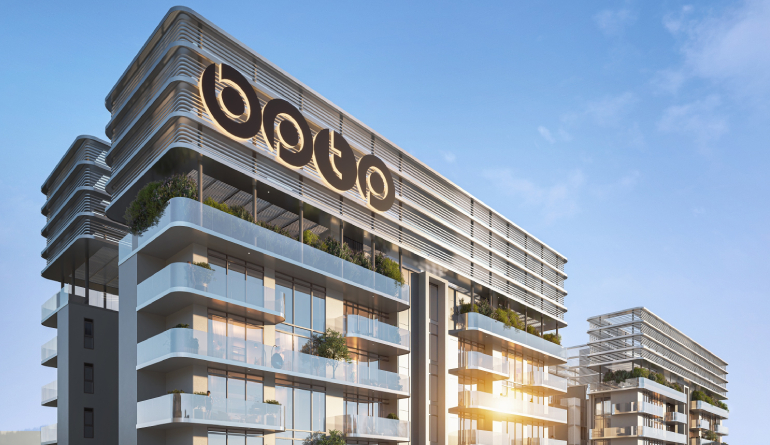
The headline says ₹750 crore. The regulatory questions remain.
The real estate industry loves a sales milestone. A developer announces that buyers have booked expensive apartments, the announcement travels across news and property portals, awards and architectural features are mentioned, and the project is presented as a premium destination attracting confident investors.
BPTP Limited’s SkyNest Towers has received precisely this kind of publicity.
In October 2026, BPTP announced that it had sold approximately 150 apartments worth ₹750 crore at SkyNest, its luxury residential development in Sector 80, Greater Faridabad. The stated average ticket size is approximately ₹5 crore per apartment.
The announcement was reproduced across several publications, including agency-distributed and press-release channels. One Business Standard version explicitly appeared in its press-release section and stated that no Business Standard journalist was involved in creating the content.
That provenance matters. A company’s sales announcement is newsworthy, but its claims should not automatically be mistaken for independently audited transaction data.
The developer has every right to promote a residential project. Homebuyers, however, have an equally legitimate right to ask what lies behind the brochure, the launch photographs and the congratulatory headlines.
How many sales have been registered? How much money has actually been collected? How many bookings remain conditional? What is the precise number of apartments in the project? Have all relevant development approvals and changes been disclosed accurately? And what is the status of the regulatory complaint relating to the larger Discovery Park development with which complainants say the SkyNest land is connected?
These are not questions that can be dismissed simply because a project is selling expensive homes.
Nor does a regulatory complaint establish that a developer has committed fraud. The obligation of responsible journalism is to investigate the available evidence, identify the outstanding questions and demand verifiable answers.
In SkyNest’s case, the available records raise a particularly important issue: a new luxury-project sales narrative is unfolding while a group of Discovery Park allottees has asked Haryana’s real estate regulator to investigate alleged changes to the original development and the creation of a separate project registration.
That regulatory history deserves to be examined alongside the sales publicity, not buried beneath it.
1. What exactly is BPTP claiming?
BPTP’s October announcement puts the reported sales at approximately ₹750 crore, covering 150 apartments in SkyNest Towers.
The arithmetic is straightforward:
| Particular | Reported figure |
|---|---|
| Apartments reportedly sold | 150 |
| Aggregate reported sales value | ₹750 crore |
| Average ticket size | Approximately ₹5 crore |
| Total project apartments in launch and sales coverage | 325 |
| Estimated gross development value announced at launch | ₹1,800 crore |
| Approximate project investment reported at launch | ₹1,100 crore |
The figures require careful interpretation.
The ₹750-crore figure is the developer’s reported sales value. It is not proof that ₹750 crore has been collected in cash. It is not a profit figure, and it does not reveal the amount of outstanding instalments, cancellations, refunds, registration duties or other liabilities.
Similarly, the estimated gross development value of ₹1,800 crore is a projection of the project’s overall value, not guaranteed revenue or net profit. The ₹1,100-crore investment estimate reported at launch should not be treated as an audited final cost.
The distinction between booked value and money received is especially important in a market where residential transactions may involve construction-linked instalments extending over several years.
A serious sales announcement should make it possible to understand what the headline number represents. Is the figure based on expressions of interest, accepted applications, executed builder-buyer agreements, formal allotments or another accounting measure? How many apartments have been registered through conveyance deeds? How much has been received from the reported sales?
The publicly circulated announcement does not answer all these questions.
Consequently, the ₹750-crore figure should be reported accurately as BPTP’s sales claim, rather than presented as an independently audited finding.
The problem is not that a developer has publicised strong sales. The problem arises when a promotional headline is treated as a complete account of a project’s commercial and regulatory position.
2. The 325-versus-504 question: Why do the published unit counts differ?
One of the most significant discrepancies in the available publicity concerns the number of residential units.
BPTP’s April 2026 launch materials and subsequent sales coverage describe SkyNest as a project comprising 325 residential apartments across two towers.
However, the developer’s announcement concerning the Times Realty & Infrastructure Conclave award in August 2026 describes SkyNest as comprising 504 residential units.
These figures are not interchangeable.
If the total inventory is 325 apartments, the reported sale of 150 represents approximately 46.2% of the inventory.
If the applicable total is 504 apartments, the same 150 sales represent approximately 29.8%.
The difference is material. It affects the interpretation of sales velocity, the proportion of the inventory reportedly sold and the remaining units available for sale.
This discrepancy does not establish wrongdoing. It does, however, demand a straightforward clarification from BPTP.
Is 504 a revised project configuration? Does it refer to a different phase, a broader development or another inventory category? Was the award announcement based on outdated or incorrect information? Or is the 325-unit figure the one that reflects the registered project?
The correct answer should be available from the applicable registered disclosures, approved building plans and any subsequent amendments.
Until the figures are reconciled, even a seemingly simple calculation of the percentage of apartments sold is uncertain.
For a project marketed at an average price of approximately ₹5 crore per apartment, the exact inventory is not a minor editorial detail. It is material commercial information.
A luxury project’s inventory should be a matter of documentary precision, not a moving figure across promotional announcements.
3. The HRERA complaint: Why Discovery Park has become central to the SkyNest story
The most consequential document reviewed for this report is a five-page extract of a resolution passed by the Haryana Real Estate Regulatory Authority, Panchkula, at its meeting on 29 July 2026.
The matter is identified as Item No. 327.37, a representation-cum-complaint concerning BPTP Limited.
The representation was submitted by allottees of Discovery Park, Sector 80, Faridabad. The complainants sought regulatory intervention against the promoter and raised issues concerning the original development plan, the division of the project land, revised building approvals and the registration of SkyNest Towers as a separate project.
Their allegations are serious. They must also be described accurately: they are allegations contained in the complaint and have not been established as facts by the five-page extract itself.
What was Discovery Park originally supposed to contain?
According to the complaint, the original group-housing development was licensed over approximately 16.331 acres under Licence No. 44 of 2008.
The complainants refer to original building-plan approval dated 27 June 2012. They state that the original plan contemplated 12 principal residential towers, two EWS towers, one nursery school, one primary school, a shopping complex and a clubhouse.
Their grievance is that the development subsequently departed materially from that original plan.
The complainants allege that only nine principal towers and two EWS towers had been developed, while the promised schools remained unconstructed. They argue that the original mix of housing and common facilities was part of what buyers believed they were purchasing into.
For a homebuyer, this is not an abstract argument over architecture. Schools, community facilities, shopping areas and shared amenities can influence a decision to invest in a residential project, particularly when those facilities are represented as part of the planned development.
The complaint therefore raises a legitimate question for the regulator: what did the original licence and building plans require, what has actually been developed, and what amendments were subsequently approved?
The answers must come from the official plans, completion records, occupancy certificates and the promoter’s response.
What do the complainants allege about SkyNest?
The complaint alleges that Discovery Park was subsequently registered under HRERA Registration No. 297 of 2017 for approximately 10.74 acres and that SkyNest Towers received a separate registration under No. HRERA-PKL-FBD-881-2026, dated 9 April 2026.
The complainants contend that the land used for SkyNest forms part of the larger area originally licensed for Discovery Park.
They also allege that revised building plans dated 5 March 2026 were obtained without the consent of two-thirds of the relevant existing allottees, which they say was required under applicable law.
On that basis, they asked HRERA to examine the separate registration, the revisions to the development plan and the alleged diminution of the original project’s amenities.
The complaint invokes Section 14 of the Real Estate (Regulation and Development) Act, 2016, and refers to a DTCP Haryana public notice concerning changes to approved building plans.
These claims require detailed regulatory scrutiny. They cannot responsibly be converted into a conclusion that the new project registration was unlawful without examining the complete approval record and the promoter’s defence.
An important qualification: The acreage figures themselves need reconciliation
There is an additional issue that a rigorous investigation should not overlook.
The complaint refers to a total original licensed area of 16.331 acres and a Discovery Park area of 10.74 acres. It identifies 5.931 acres in one passage in connection with SkyNest, while another passage refers to a revised plan over approximately 5.391 acres.
These figures do not reconcile neatly.
Subtracting 10.74 acres from 16.331 acres produces 5.591 acres—not 5.931 acres or 5.391 acres. Adding 10.74 acres and 5.931 acres produces 16.671 acres, exceeding the stated original total.
This may reflect a drafting error, different measurements or an unresolved distinction between licensed, registered, revised-plan and project-boundary areas. The extract does not explain the difference.
That discrepancy should not be concealed merely because it complicates the complainants’ case. Equally, it should not distract from the substantive questions they have raised.
The logical course is to obtain the original licence, sanctioned plans, revised plans, site plans, land schedules, registration certificates and any amendments. The regulator should identify the precise parcels, their areas and the legal basis for the separate project registration.
Land records are capable of being checked. The relevant plans should be compared. This issue does not require speculation; it requires documents.
4. What HRERA has—and has not—decided
The procedural status of the complaint is crucial.
The July 2026 extract directs the Authority’s office to send the complaint to the promoter by email and registered post, with the promoter required to file its reply at least one week before the next hearing. The extract records an adjournment to 9 September 2026.
The public HRERA project listing subsequently showed further adjournments, including on 9 September, 16 September and 14 October 2026. As of the latest listing reviewed for this report, no substantive order deciding the central allegations had been uploaded for the 14 October hearing.
The distinction is fundamental.
The regulator has not, in the material reviewed, cancelled SkyNest’s registration on account of this complaint. The July document does not find that BPTP committed fraud. It does not declare the revised building plans null and void, and it does not grant the complainants’ requested reliefs.
At the same time, the existence of an approved registration does not make the questions raised by the complainants disappear. SkyNest’s registration was approved on 9 April 2026, and the separate representation-cum-complaint remains a regulatory matter requiring an appropriate response.
The public deserves clarity on what the Authority has examined, what material it has received from the promoter, which plans and land records it has compared, and whether the disputed issues are being decided through a reasoned order.
The regulator should avoid both extremes: treating untested allegations as established wrongdoing, or allowing a substantive complaint to disappear into a sequence of adjournments without a clear explanation of its progress.
5. Awards and adjectives cannot substitute for project verification
SkyNest has received promotional attention beyond its sales announcement.
BPTP announced that the project won the “Landmark High-Rise Development of the Year” award at the ET NOW Realty Conclave & Awards 2026 in June. It later announced the “Premium High-Rise Development of the Year” award at the Times Realty & Infrastructure Conclave 2026 in August.
These announcements form part of the project’s marketing narrative. The relevant releases describe design, landscaping, amenities and premium residential positioning.
Awards can recognise design, planning or other specified attributes. But an award announcement does not establish that every promised facility will be completed, that every building-plan amendment has received all necessary consents, or that a separate land parcel has been correctly identified.
The point is not to dispute the existence of the awards. It is to distinguish recognition from regulatory compliance.
A development may have attractive architecture and still require scrutiny of its approvals. A project can record strong sales and still face questions from existing buyers. Those propositions are not contradictory.
Indeed, the greater the sums involved, the stronger the case for transparent disclosure.
For a project with a reported average apartment price of around ₹5 crore, buyers should not have to rely on publicity material alone to understand the approved inventory, the scope of amenities and the development timeline.
6. The longer BPTP record: Previous projects, buyer protests and delayed-possession disputes
The SkyNest complaint does not arise in a vacuum. Public records from earlier years document multiple buyer disputes involving BPTP projects.
This history needs to be examined carefully. A past complaint does not prove that SkyNest is defective or that every BPTP project has been abandoned. Nor does every case result in an identical finding against the company.
Nevertheless, the recurrence of possession-delay disputes, refund demands and disagreements over charges across different projects makes it reasonable to examine the company’s record of meeting commitments to buyers.
Projects named in historical delay-related protests
A May 2016 report by ETRealty covered a protest at Jantar Mantar by approximately 200 buyers associated with seven BPTP projects in Gurugram and Faridabad.
The projects named included:
- Park Elite Floors — sectors 75–85, Faridabad.
- Park Elite Floor II — Sector 77, Faridabad.
- Park Elite Premium — Faridabad.
- Discovery Park — Faridabad.
- Park Serene — Gurugram.
- Park Generation — Gurugram.
- Park Spacio — Gurugram.
The report quoted buyers describing prolonged waits for possession and uncertainty over project progress and communications. One buyer said there had been no construction at the relevant sites for two years. Buyers also raised concerns about refund requests and the consequences of seeking cancellation.
Those statements were attributed to the protesting buyers; they were not judicial findings that all seven projects had been abandoned.
BPTP’s spokesperson, in the same report, said delivery dates had been communicated to customers individually and that the company was focused on delivering the homes as early as possible.
This contemporaneous response should remain part of the record. The substantive question, however, is whether contractual delivery dates were met and how the disputes were ultimately resolved.
An investigation should distinguish historical delays from current project status. It would be inaccurate to label all seven developments abandoned in 2026 merely because they featured in a 2016 protest.
Additional projects appearing in regulatory and consumer proceedings
The records reviewed also identify the following projects in complaints, regulatory discussions or consumer disputes:
- Park Generations: Consumer proceedings resulted in refund and interest directions in three complaints decided together in January 2024.
- Parklands / Parklands Pride: Consumer proceedings concerned delayed possession and associated compensation or refund claims.
- Park Spacio / Park Serene Spacio: Homebuyer disputes concerning delayed possession and the implementation of settlement terms reached the Supreme Court.
- Park Terra: The Terra Flat Buyers Association pursued refund relief through the consumer-disputes system and the Supreme Court.
- Pedestal @70A / Pedestal Floors: Buyer disputes concerning possession and a subvention arrangement are reflected in consumer proceedings and a separate CBI investigation.
- Park Generation, Park Spacio, Park Terra, Amstoria, Aster Garden and Mansions Park Prime: These projects were identified in HRERA proceedings involving common issues relating to charges and buyer grievances.
The last group appeared in connection with a high-powered committee constituted by HRERA to examine matters raised by buyers. The issues included super-area calculations, cost escalation, sewage-treatment charges, electrification, taxes, maintenance, parking, club membership, preferential-location charges and other levies.
The inclusion of a project in this list does not establish that it was abandoned or that every allegation was upheld. It demonstrates why each project must be examined on its own records.
A complete, verified list of projects abandoned, stalled or delayed as of October 2026 would require a current project-by-project examination of registration status, construction progress, occupancy certificates, possession records and final regulatory orders. The available material does not justify presenting every historically disputed project as presently abandoned.
7. Consumer-forum findings: What adjudicated disputes actually show
There is a difference between an angry complaint and a reasoned decision. Several BPTP matters have progressed beyond allegations and resulted in specific orders.
A. Sanjay Rastogi: Supreme Court’s 2021 refund order
In BPTP Limited v. Sanjay Rastogi, decided on 12 April 2021, the Supreme Court considered an order directing BPTP to refund ₹1,19,05,546 with interest to a flat buyer.
The Court recorded that BPTP had received approximately ₹1.19 crore but had argued that there was no flat-buyer agreement. That position had been disbelieved by the consumer commission. The Supreme Court held that BPTP had failed to deliver possession within the contractual period and found no error in the findings supporting the refund.
The Court reduced the interest rate from 10% to 9% annually and directed payment in compliance with the modified order by 15 July 2021.
This was a consumer dispute resulting in a refund and interest obligation. It was not a criminal conviction.
B. Park Generations: Three refund decisions in January 2024
In January 2024, the National Consumer Disputes Redressal Commission decided three related complaints concerning Park Generations.
In the principal complaint, the commission found that possession had been offered on 15 October 2019 despite the earlier contractual date of 5 June 2016. It held BPTP deficient in service and ordered a refund of ₹62,16,653 with simple interest at 9% per annum, together with ₹50,000 in litigation costs.
The two other complaints involved different apartments and contractual dates:
- One complainant was directed to receive ₹64,92,098 with 9% simple interest and ₹50,000 in costs.
- Another was directed to receive ₹65,65,887 with 9% simple interest and ₹50,000 in costs.
The commission stipulated an interest rate of 12% until realisation if the specified repayment deadlines were missed.
Across those three complaints, the principal refund amounts total approximately ₹1.93 crore, excluding interest and costs.
These were individual adjudicated disputes. They should not be represented as a blanket order covering every buyer in Park Generations, still less as a finding against SkyNest.
C. Parklands Pride: Delayed possession and compensation
In Rajesh Gupta v. BPTP Ltd., decided on 29 May 2023, the Delhi State Consumer Disputes Redressal Commission addressed a dispute involving Parklands Pride in Sector 77, Faridabad.
The commission held that BPTP had been deficient in service by not delivering the flat within the stipulated period.
It directed BPTP to provide physical and vacant possession and to pay contractual delayed-possession compensation of ₹10 per square foot per month for the specified period, from 11 December 2014 until the offer of possession on 17 July 2018, after deducting ₹3,18,130 already paid.
The order also awarded ₹3 lakh for mental agony and harassment and ₹50,000 towards litigation costs. It directed that no further demands be raised for the flat.
Again, this was a consumer decision with specified reliefs, not a criminal finding of fraud.
D. Parkland: Refund ordered in Anoop Agarwal’s case
In Anoop Agarwal v. BPTP Ltd., decided on 4 May 2021, the consumer commission considered a delayed-possession dispute concerning a plot in the Parkland development at Faridabad.
BPTP was directed to refund ₹64,67,608 with interest at 6% per annum, calculated from the dates on which instalments were received through the date of the judgment. If the refund was not made by 3 July 2021, the applicable interest was to increase to 9% per annum until realisation.
The order also awarded ₹3 lakh for mental agony and harassment and ₹50,000 in litigation costs.
These decisions illustrate a recurring category of disputes: whether contractual possession commitments and the terms governing money paid by consumers have been honoured.
E. Park Serene Spacio: Supreme Court rejects BPTP’s appeals
On 12 February 2024, the Supreme Court dismissed BPTP’s appeals in the dispute involving the BPTP Spacio Park Serene Flat Allottees Welfare Association.
The underlying consumer complaint had been disposed of by consent. The terms included offering possession where it had not been delivered within five months, after securing the required occupancy certificate and completing construction, and providing simple-interest compensation at 6% per annum for the specified periods of delay.
The consent terms also addressed title deeds, holding charges, timely-payment discounts and loyalty bonuses.
Subsequent disputes over the implementation of the settlement led to execution proceedings. The Supreme Court found no ground to interfere with the impugned orders and directed BPTP to extend the benefits, including loyalty bonuses and timely-payment discounts, and to hand over possession where this had not already been done.
A settlement order should not be recast as a criminal judgment. Its significance is that agreed buyer-protection obligations were enforceable and were the subject of further litigation.
F. Terra Flat Buyers Association: Supreme Court proceedings in 2024
In BPTP Limited and Others v. Terra Flat Buyers Association, decided on 28 November 2024, the Supreme Court considered appeals arising from consumer-commission refund directions.
The underlying orders directed refunds with 9% annual interest for the concerned complainants. The Supreme Court recorded that 11 of the 14 complainants had settled with BPTP, leaving three for consideration.
The Court held that the remaining complainants should receive the same 9% interest rate and permitted withdrawal of the principal and interest already deposited in the Court registry. It directed any shortfall to be made good within four weeks.
This is important for a balanced investigation: the record includes settlements and payments as well as litigation. It does not support the assertion that no buyer disputes have ever been resolved.
But it does establish that the consequences of delayed housing delivery have, in multiple cases, required formal adjudication rather than being resolved solely through the developer’s public assurances.
8. What the regulatory and court record says about enforcement
The enforcement record requires a careful distinction between the SkyNest–Discovery Park complaint and separate proceedings concerning other matters involving BPTP.
Haryana RERA
SkyNest Towers: HRERA approved the project registration on 9 April 2026 under registration number HRERA-PKL-FBD-881-2026. Its public listing subsequently recorded the representation-cum-complaint brought by Discovery Park allottees and successive adjournments. In the records reviewed, no final decision granting the complainants’ requested cancellation or declaring the project fraudulent has been established.
Discovery Park: The complaint identifies the original licence, the 2017 registration and subsequent changes that the allottees say require examination. The regulator should compare these assertions with the original and amended plans and make a reasoned determination.
Park Spacio: HRERA’s official record shows that 45 cases involving Park Spacio were taken up together on 26 April 2022 because of common issues, although the individual cases were considered in respect of the relief each complainant sought.
Other BPTP projects: HRERA’s proceedings also refer to common issues involving Park Generation, Park Terra, Amstoria, Aster Garden and Mansions Park Prime, among others. These proceedings concerned matters including charges, escalation, maintenance and other disputed levies.
These regulatory records demonstrate that BPTP has been involved in a substantial number of buyer-related proceedings. They do not establish that every complaint was upheld or that SkyNest is itself in breach of the law.
Punjab and Haryana High Court
In a batch of BPTP appeals decided on 19 April 2022, the Punjab and Haryana High Court addressed appeals against orders concerning pre-deposits required under the Real Estate (Regulation and Development) Act, 2016.
BPTP’s counsel acknowledged that the point in issue was covered against the company by the Supreme Court’s judgment in Newtech Promoters and Developers. The High Court dismissed the appeals while giving six weeks to deposit the amounts directed by the Haryana Real Estate Appellate Tribunal. The orders also provided for appeals to be revived if the required deposits were made.
The decision is significant because it concerned statutory pre-deposit requirements linked to amounts already awarded in RERA proceedings. It should not be described as a criminal sentence or a finding of fraud.
In another matter, Sandeep Jagota v. M/s BPTP Ltd. and Others, decided on 21 July 2026, a petition was dismissed as withdrawn, with liberty to move the appropriate application before the Haryana Real Estate Appellate Tribunal. That was a procedural disposal, not a ruling on the merits of the underlying dispute.
Delhi High Court
A review of the identified Delhi High Court records did not establish a court-imposed penalty against BPTP specifically for the SkyNest–Discovery Park allegations.
The High Court has dealt with other disputes involving BPTP, including commercial and arbitration matters. For example, in Chandrasen Singh, Proprietor of Sunshine Finishes v. BPTP Ltd., decided on 25 September 2026, the Court referred a contractual payment dispute concerning construction work at Park Serene Spacio to arbitration. The contractor’s claims totalled approximately ₹14.8 lakh across specified heads; the Court left the parties’ substantive rights open for adjudication.
That is not a penalty against BPTP, and it should not be represented as one.
Supreme Court
The Supreme Court’s orders in the Sanjay Rastogi, Park Serene Spacio and Terra Flat Buyers Association matters resulted in specified refunds, interest, compensation-related obligations or directions concerning possession and settlement terms.
Those orders are relevant to the wider history of consumer disputes involving BPTP. They are not findings that the separate SkyNest project is fraudulent.
The proper conclusion is neither that the developer has never faced adverse orders nor that every adverse consumer order proves criminal conduct. The records establish the former is incorrect; they do not establish the latter.
9. Enforcement agencies: The FEMA investigation and compounding order
A particularly important development in BPTP’s wider corporate record concerns the Enforcement Directorate’s investigation under the Foreign Exchange Management Act, 1999.
This matter is separate from the SkyNest–Discovery Park complaint. It must not be presented as an investigation into SkyNest unless an official record establishes that connection.
The ED searches in August 2025
According to the ED’s press release dated 29 August 2025, the agency conducted searches on 26 and 27 August 2025 at multiple locations in Delhi-NCR and Noida in connection with a FEMA investigation involving BPTP.
The searches covered company premises and the residences of Chairman and Managing Director Kabul Chawla and Whole-Time Director Sudhanshu Tripathi.
The ED stated that its investigation concerned foreign investment totalling approximately ₹537.5 crore from two Mauritius-based entities:
- ₹322.5 crore from CPI India I Ltd., Port Louis, Mauritius.
- ₹215 crore from Harbour Victoria Investment Holding Ltd., Mauritius.
The ED alleged that the investments, made in 2007–2008, contained put/swap-option clauses providing foreign investors with assured returns on exit in contravention of the FEMA provisions then applicable.
The agency also stated that the searches resulted in the freezing of bank lockers and the seizure of documents and digital evidence. It said that certain overseas entities and a New York property were being examined in the investigation.
The release further stated that multiple FIRs were registered against BPTP and its directors across Delhi-NCR concerning alleged prolonged non-completion of projects and diversion of funds. It did not, in that release, identify every FIR by number, police station, charge or current procedural status.
These were statements made by the investigative agency in describing its investigation. They should not be misrepresented as criminal convictions.
The ₹4.84-crore compounding order in September 2026
On 1 October 2026, the ED announced that the Reserve Bank of India had issued compounding orders dated 17 September 2026 concerning FEMA contraventions involving BPTP and its directors.
The one-time compounding amounts were:
| Party | Amount |
|---|---|
| BPTP Limited | ₹4,03,62,500 |
| Kabul Chawla | ₹40,36,250 |
| Sudhanshu Tripathi | ₹40,36,250 |
| Total | ₹4,84,35,000 |
The specific contravention identified in the ED release involved the issuance of shares to foreign investors with an optionality clause assuring an exit price or return, contrary to the FEMA regulations cited in the announcement.
The ED stated that the compounding resulted in termination of the investigation and further proceedings only in respect of the contravention that had been compounded.
This qualification must not be omitted.
Compounding under FEMA is not equivalent to a criminal conviction, but neither should the payment be presented as if the regulator had made no finding of a contravention. Equally, the termination of proceedings concerning the compounded matter must not be portrayed as proof that every other allegation or proceeding has been resolved.
The public-interest questions are precise: what was the outcome of the matters compounded, what other investigations remain open, and what is the current status of the FIRs the ED referred to in its 2025 release?
Those questions should be answered through official disclosures and case-status records.
10. The CBI investigation concerning Pedestal @70A
A separate development concerns BPTP’s Pedestal @70A project in Sector 70-A, Gurugram, and a residential-loan subvention arrangement.
This matter is distinct from SkyNest.
In its order dated 20 April 2026 in M/s BPTP Limited v. Central Bureau of Investigation, the Supreme Court recorded that the CBI had registered FIR No. RC2192026E0001 at Economic Offences Wing-I, New Delhi, against BPTP and a director.
The case arose in the context of the Supreme Court’s wider investigation into alleged collusion or connivance between real estate developers and financial institutions in the handling of subvention schemes.
The petitioners were included in the FIR following representations by two homebuyers associated with Pedestal @70A. The Supreme Court recorded BPTP’s submission that 180 units had been developed and completed and that, apart from the two respondents, no other homebuyer had complained against the company in that matter.
The Court allowed the writ petition to be disposed of while permitting BPTP to produce its material before the CBI, so that the agency could investigate both the allegations of the homebuyers and the company’s position.
This order is consequential because it confirms a specific CBI FIR involving BPTP in the context of a wider investigation into subvention schemes. It does not establish that the allegations in that FIR have been proved.
Nor does the material reviewed establish that this CBI case concerns SkyNest or the Discovery Park land dispute.
The FIR must be followed through its own evidentiary and procedural record: the allegations, the applicable statutory provisions, the evidence collected, any status reports and any eventual decision to file a charge sheet or close the case.
The public should not be asked to treat an FIR as a conviction. Equally, the existence of a live investigation is a reason for accurate scrutiny, not a reason to pretend the matter does not exist.
11. What has been established about FIRs, ED, CBI and EOW action?
A consolidated picture of the enforcement record is essential because different agencies and legal proceedings are often carelessly conflated.
Enforcement Directorate: The ED publicly confirmed its 2025 FEMA searches involving BPTP, Kabul Chawla and Sudhanshu Tripathi. It subsequently announced the RBI’s ₹4.8435-crore compounding orders for the specified FEMA contraventions.
CBI: The Supreme Court’s 20 April 2026 order confirms FIR RC2192026E0001 involving BPTP and a director in connection with Pedestal @70A and the wider investigation of subvention schemes.
Economic Offences Wing-I, New Delhi: The specific FIR is identified in the Supreme Court record as registered by the CBI at EOW-I, New Delhi. This should not be double-counted as a separate Delhi Police EOW case without evidence of a distinct FIR.
Other Delhi-NCR police FIRs: The ED’s August 2025 release referred to multiple FIRs against BPTP and its directors concerning project non-completion and alleged fund diversion. The press release does not provide a complete case-number-wise list or the current status of those cases.
What remains unverified: The records reviewed do not establish a complete list of every police FIR, every EOW investigation, every charge sheet or every final report involving BPTP or its directors. It would be misleading to invent missing case numbers or attribute the same FIR to several agencies.
These are not technical distinctions. They determine whether a report accurately states who investigated what, which conduct was under scrutiny and what the legal outcome actually was.
12. The central question: What does the ₹750-crore announcement answer about SkyNest?
The October sales announcement does not answer the central issues raised by the Discovery Park complainants.
It does not reconcile the 325-versus-504 apartment-count discrepancy across project announcements.
It does not resolve the differing acreage figures in the complaint and establish the exact relationship between the original Discovery Park licence area and the SkyNest parcel.
It does not determine whether the alleged changes to the original building plans required two-thirds allottee consent in the circumstances of this development.
It does not establish whether the schools, shopping complex and other facilities originally promised to Discovery Park buyers were delivered, or whether any amended plan lawfully altered those commitments.
And it does not establish the outcome of the HRERA representation.
These questions require the developer’s documents and the regulator’s determination. They cannot be resolved by counting press mentions, citing average ticket sizes or repeating award titles.
It would be equally irresponsible to claim that the complaint has already proved fraud. The available extract does not support that conclusion. The allegations are serious enough to warrant examination, but the burden remains on the relevant evidence and the legal process.
The correct response to unresolved regulatory questions is greater disclosure, not louder publicity.
13. What action should follow?
A number of practical steps would advance transparency without prejudging guilt.
First, HRERA should issue a reasoned determination on the Discovery Park representation. The Authority should identify the relevant licensed area, the approved and revised plans, the applicable consent requirements and the legal basis for the separate SkyNest registration. If further evidence is needed, it should specify what is missing and establish a clear timetable for the next steps.
Second, the DTCP and HRERA records should be reconciled. The original licence, the 2012 plans, subsequent amendments, the SkyNest registration documents and the project-area schedules should be compared and made available as permitted by law. The land-area discrepancy should be resolved through official records, not speculation.
Third, BPTP should clarify the apartment inventory. The company should explain why certain promotional announcements refer to 325 units and others to 504. Its explanation should identify the applicable registered inventory and any formal amendment.
Fourth, the developer should publish sufficiently clear sales information. Where commercially and legally appropriate, it should distinguish reported bookings, confirmed allotments, cancellations, amounts received and registered transactions. The ₹750-crore figure should be explained in terms that make its scope understandable to prospective buyers.
Fifth, the ED should provide clarity on the status of its proceedings. Its own release limits the effect of compounding to the contravention compounded. The current status of any separate proceedings should be established from official records and communicated accurately.
Sixth, the CBI should proceed expeditiously in the Pedestal @70A matter and the wider subvention investigation. Its investigation should evaluate the homebuyers’ allegations and the company’s submissions, with appropriate status reporting before the competent court. Where separate police FIRs are involved, the relevant agencies should clarify their numbers and status to the extent lawfully disclosable.
Finally, consumer forums and enforcement agencies should avoid unnecessary delay. A dispute involving a homebuyer’s life savings deserves timely adjudication. A regulatory complaint involving changes to a development plan deserves a reasoned response. Where evidence warrants enforcement action, it should be taken promptly and according to law. Where the evidence does not support an allegation, that too should be made clear.
The demand is not for predetermined arrests or predetermined findings. It is for speed, transparency, documentary verification and accountability.
Conclusion: A sales milestone is not a substitute for accountability
BPTP says that SkyNest has sold 150 luxury apartments worth approximately ₹750 crore. That claim may be commercially significant, but it does not settle the regulatory questions concerning the project’s relationship with Discovery Park.
The complaint before HRERA is not a judgment of fraud. It is, however, a documented representation by allottees asking the regulator to examine the original development plan, subsequent amendments, land division and allegedly missing facilities.
The project’s promotional record also contains a material inconsistency in the stated apartment count. That discrepancy calls for clarification before the sales figure is used to calculate the proportion of inventory sold.
The company’s wider public record includes consumer-forum decisions ordering refunds, interest, possession or compensation in specific disputes. It also includes the ED’s publicly announced FEMA investigation and subsequent compounding orders, as well as a separate CBI FIR concerning Pedestal @70A. Those proceedings relate to distinct facts and legal issues; they must not be conflated with the SkyNest complaint.
What the record establishes is that BPTP’s broader operations have faced significant regulatory, consumer and enforcement scrutiny. What it does not establish is that SkyNest has been found fraudulent or that every allegation against the company or its directors has been proved.
That is precisely why transparent, timely scrutiny is necessary.
If the SkyNest land and approvals are fully compliant, the documentary record should be able to demonstrate that. If the complaint rests on incorrect measurements or a misunderstanding of the approved plans, those points can be explained. If the regulator finds violations, it must take the action authorised by law.
A high-value launch announcement can attract buyers. An award can enhance a project’s profile. A widely circulated press release can dominate a news cycle.
None can take the place of a regulator’s reasoned decision, a court’s order or a verified account of what has actually been delivered.
For a company selling apartments at an average reported price of approximately ₹5 crore, the demand for clear documents and credible answers is neither unreasonable nor hostile. It is the minimum standard of accountability that prospective and existing homebuyers should expect.
The real measure of a residential developer is not simply how much it says it has sold, but whether its commitments to buyers are honoured and its regulatory questions are answered transparently.
Editorial disclaimer
This report distinguishes between the developer’s published claims, allegations recorded in regulatory complaints, findings made in adjudicated proceedings and investigations that remain subject to the legal process.
The allegations made by Discovery Park allottees concerning the SkyNest–Discovery Park relationship remain allegations unless and until established by the competent authority or court. The HRERA extract reviewed does not establish that BPTP committed fraud, and it does not record the cancellation of SkyNest Towers’ registration.
The ED’s FEMA investigation, the subsequent compounding orders and the CBI investigation concerning Pedestal @70A concern specified matters and must not be represented as findings that SkyNest itself is unlawful. Compounding under FEMA is not a criminal conviction, and the outcome of a particular civil or consumer dispute must not be misrepresented as a criminal judgment.
Based on the public records reviewed for this report, no criminal conviction of BPTP Limited, Kabul Chawla or Sudhanshu Tripathi in relation to the specific matters discussed above has been identified. This is a qualified statement about the records reviewed, not a claim that every possible proceeding involving every individual has been exhaustively checked.
The call for stronger enforcement is a call for time-bound investigation, transparent regulatory decisions and prompt trials wherever warranted by the evidence—not for punishment in advance of proof.