The Rolls-Royce and the Bankruptcy Papers: Paras Gupta’s Luxury-Car Image Meets a ₹37.15-Crore Insolvency Record

There are moments when a luxury car stops being merely a luxury car.
Not because owning an expensive automobile is illegal. It is not.
Not because a photograph beside a Rolls-Royce proves financial wrongdoing. It does not.
But because time has a brutal way of putting old symbols of prosperity next to new documents of financial distress.
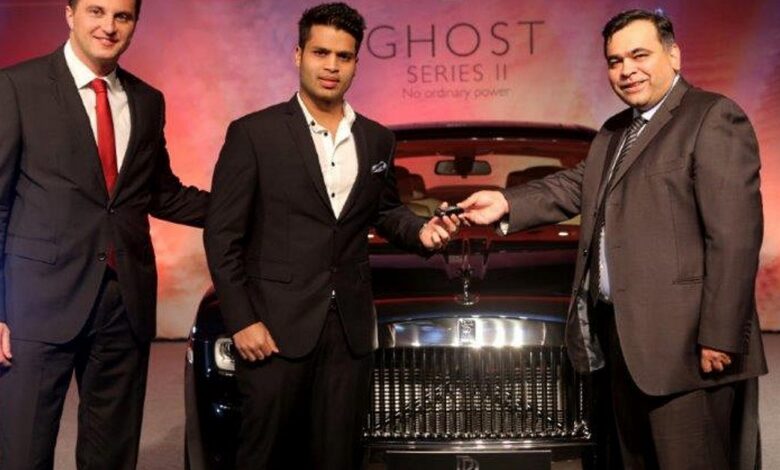
In January 2015, the Economic Times profiled 22-year-old Paras Gupta as the youngest owner in India of a Rolls-Royce Ghost Series II. The article identified him as a director of Mother’s Pride and described a family surrounded by high-end automobiles: a BMW X5 previously driven by Paras, a Maserati and Mercedes E63 associated with his elder brother Prateek, and family vehicles including a Toyota Land Cruiser V8, Mercedes S350, Range Rover Evoque and Toyota Land Cruiser Prado. Paras himself said he hoped the Ghost would be the first of many Rolls-Royces the family would own.
The reported 2015 price of the Ghost Series II was about ₹4.48 crore ex-showroom. Cartoq, in a later 2023 article revisiting the story, similarly described Paras as having bought the car at age 22 and cited the approximate ₹4.48-crore ex-showroom price.
Ten years later, the public record looks very different.
On 29 August 2025, the National Company Law Tribunal declared Paras Gupta bankrupt in personal-guarantor insolvency proceedings. The order recorded a default of ₹37,14,59,029.04, approximately ₹37.15 crore, as of 31 March 2025, and appointed Saurabh Chawla as bankruptcy trustee.
That juxtaposition is striking enough without inventing a single fact.
The young man once showcased as a Rolls-Royce owner was later a bankrupt personal guarantor with a recorded default of more than ₹37 crore.
That is not a social-media accusation.
It is the chronology.
From “youngest Rolls-Royce owner” to “declared bankrupt”
The contrast is almost too neat to write as fiction.
In 2015, Paras Gupta was presented in the lifestyle press as a 22-year-old embodiment of youthful success. Economic Times described him as a director of Mother’s Pride and focused on his enthusiasm for luxury cars and the social status attached to his Rolls-Royce. The article even quoted him hoping that the Ghost would be the first of many Rolls-Royces the family would own.
The image was one of abundance.
Then came the insolvency record.
Paras Gupta was not merely related to people facing financial distress. He was himself brought into personal insolvency proceedings as a personal guarantor for facilities obtained by Mothers Pride Education Personna Pvt. Ltd. The NCLT order records the default at ₹37.15 crore and ultimately declares him bankrupt.
That fact changes the nature of the public conversation.
The lazy version of the story is:
“The parents were bankrupt while the son lived luxuriously.”
The documented version is more consequential:
The son himself ultimately became the subject of bankruptcy proceedings.
This was not simply a family photograph beside a car
One can dismiss a luxury-car story as vanity.
One cannot dismiss an NCLT bankruptcy order as vanity.
The Paras Gupta bankruptcy proceeding followed a personal-insolvency resolution process that had been admitted on 22 March 2024. According to the order, the process moved forward without an approved repayment plan, and bankruptcy followed. The NCLT then formally declared Paras Gupta bankrupt and appointed a trustee.
The significance lies in the sequence.
A personal guarantee is not the same thing as criminal wrongdoing.
A default is not the same thing as fraud.
Bankruptcy is not a criminal conviction.
These distinctions must be protected.
But bankruptcy is also not an imaginary inconvenience. It is a formal statutory process arising from financial obligations that have gone seriously wrong.
So when the earlier public image is one of exceptional luxury and the later legal record is one of personal insolvency, journalists are entitled to ask the obvious question:
What happened?
₹4.48 crore at 22; ₹37.15 crore default by 2025
There is a particularly sharp numerical contrast.
The Rolls-Royce Ghost Series II that Paras Gupta acquired at 22 was reported to cost around ₹4.48 crore ex-showroom in 2015.
His bankruptcy order records a calculated default of ₹37.1459 crore as of 31 March 2025.
That default figure is more than eight times the reported ex-showroom price of the Rolls-Royce.
That comparison is mathematically true.
But it should not be twisted into a claim that the car caused the debt, financed the debt, or was purchased from the same money.
The records do not establish that.
The legitimate point is different:
The scale of the financial exposure documented in 2025 was vastly larger than the price of the luxury symbol with which Paras Gupta had been publicly associated a decade earlier.
That is exactly the sort of contrast that should trigger financial questions, not criminal conclusions.
And the family insolvency story does not end with Paras
The timing becomes even more extraordinary when the wider family record is placed beside his.
The source material documents Devendra Gupta’s bankruptcy order of 29 August 2025 and Sudha Gupta’s bankruptcy order of 4 September 2025. It also records unsuccessful appellate challenges involving the family. The NCLAT’s 11 December 2025 common order dismissed connected bankruptcy appeals involving Sudha Gupta, Devendra Gupta, Paras Gupta, Prateek Gupta and Raj Rani Gupta, among others.
So this is not a newspaper constructing a dramatic family metaphor.
There really were multiple personal-guarantor insolvency proceedings in the same family network.
That makes the 2015 lifestyle profile much harder to view as a complete picture of the family’s finances.
The family image was not merely affluent—it was conspicuously affluent
The 2015 Economic Times article does not describe an ordinary middle-class upgrade.
It describes a 22-year-old with a Rolls-Royce.
It says his previous vehicle was a BMW X5.
It says his brother drove a Maserati and a Mercedes E63.
It lists a family fleet including Land Cruiser V8, Mercedes S350, Range Rover Evoque and Prado.
And Paras reportedly talked not simply about owning the Ghost, but about hoping it would be the first of many Rolls-Royce models the family would have.
There is nothing unlawful about any of this.
But there is a difference between private consumption and public projection.
Once that projection becomes part of a public record, later financial events inevitably invite comparison.
That is not jealousy.
It is scrutiny.
The really uncomfortable question is not “Why did he buy the car?”
That is too simplistic.
The more important question is:
How was the financial architecture of this family and its businesses structured at the time such wealth was being publicly displayed, and what does the later insolvency record reveal about that architecture?
The court material shows that Paras was not a disconnected beneficiary standing outside the business structure.
He was a personal guarantor.
That matters.
A personal guarantor assumes legal financial exposure in relation to another person’s or company’s debt.
And in Paras Gupta’s case, that exposure ultimately culminated in a bankruptcy order.
This is where the old luxury profile and the new insolvency record collide.
There is another uncomfortable number in the family record
The broader source dossier records a January 2025 repayment-plan table in Sudha Gupta’s personal insolvency matter showing liabilities of approximately ₹774.73 crore against a proposed payment of ₹15 lakh. That number must be interpreted carefully: it is a liability total reproduced in an insolvency repayment-plan record, involving multiple creditors and guarantee relationships, and it is not a judicial finding of a ₹774.73-crore fraud.
Yet the figure is impossible to ignore.
Put beside that, the record of Devendra Gupta’s bankruptcy and Paras Gupta’s ₹37.15-crore default paints a picture of substantial financial exposure across multiple members of the family.
Again, those figures cannot be added together as if they were one pot of stolen money.
They are different legal liabilities.
But their existence together explains why a luxury-car story from 2015 has acquired a very different flavour in hindsight.
And then there is the wider corporate background
The school ecosystem did not encounter only one isolated insolvency.
The research identifies three separate corporate insolvency proceedings:
Mothers Pride Education Institution Pvt. Ltd. — admitted to CIRP on 11 October 2022.
Presidium Educational Institution Pvt. Ltd. — admitted on 29 November 2022.
Mothers Pride Education Personna Pvt. Ltd. — admitted on 4 January 2023.
These are legally distinct companies.
That distinction matters.
But so does the fact that the same wider school-business ecosystem appears repeatedly in lender recovery and insolvency proceedings.
The later NCLT and NCLAT history became complicated: the NCLT terminated the three CIRPs in June 2026, while indexed NCLAT material in July 2026 supported an interim stay of the termination. The complete subsequent appellate position was not fully retrieved.
So the correct journalistic conclusion is not that all the companies were permanently out of insolvency.
Nor is it that they were definitively still in CIRP.
The correct conclusion is that their insolvency history became the subject of continuing judicial dispute.
That is already remarkable.
What about the Indian Express investment case?
This is where the public narrative becomes even more uncomfortable—but also where discipline is essential.
In January 2019, the Indian Express reported that the Economic Offences Wing of Delhi Police registered a case against owners, developers and branch heads of Mother’s Pride over allegations by Satbir Singh and 12 others.
The reported allegation involved approximately ₹4.15 crore, said to have been collected through investment arrangements promising returns or school-fee concessions/waivers. The report said the complainants submitted documents concerning payments to the accused persons and institutions.
Sudha Gupta’s response, as reported at the time, was that Mother’s Pride had many franchisees and that the matter would be examined at that level.
That is an allegation, not a conviction.
The point is not to convert it into a proven ₹4.15-crore fraud.
The point is that the public record had already entered the world of EOW-investor complaints years before the family bankruptcy orders.
And no, the Rolls-Royce does not prove misuse of investor money
This is where responsible investigative journalism must draw a hard line.
There is no evidence in the material reviewed establishing that the Rolls-Royce was purchased with investor money.
There is no verified evidence presented here that it was bought with school funds.
There is no verified evidence that it was bought with fraudulent proceeds.
There is no established bank trail linking the car purchase to the ₹4.15-crore EOW allegations.
And there is no court finding connecting the Rolls-Royce to the subsequent ₹37.15-crore default.
Anyone who asserts those propositions as facts goes beyond the record.
That is precisely why the question remains a question.
But the question deserves to be asked loudly
Because the alternative—simply admiring the old luxury image while ignoring the later court record—is equally unsatisfactory.
A 22-year-old was publicly profiled as the owner of a ₹4.48-crore-plus Rolls-Royce.
The family was publicly associated with a stable of luxury vehicles.
The family’s educational business later appeared in investor complaints and multiple insolvency proceedings.
Paras Gupta himself became a personal guarantor.
He entered personal insolvency proceedings.
No repayment plan emerged.
And the NCLT ultimately declared him bankrupt.
That is an extraordinary financial arc.
The car is a symbol. The bankruptcy order is the evidence.
This distinction is crucial.
The Rolls-Royce is a symbol of what the family’s public image looked like in 2015.
The bankruptcy order is evidence of what the financial system looked like for Paras Gupta in 2025.
One is lifestyle journalism.
The other is judicial documentation.
One tells us how wealth was presented.
The other tells us that a major financial obligation ultimately reached the formal bankruptcy machinery.
That is why the juxtaposition is so powerful.
What happened to the dream of “many Rolls-Royces”?
This is where the irony becomes almost cruel.
In 2015, Paras Gupta was quoted as saying he hoped the Ghost would be the first of many Rolls-Royce models the family would have.
A decade later, the public record is no longer talking about the next Rolls-Royce.
It is talking about:
personal insolvency;
default;
creditors;
bankruptcy;
trustees;
estate administration;
corporate debt;
guarantees;
and NCLT and NCLAT proceedings.
That is a brutal change in vocabulary.
But it is the vocabulary of the official record.
A luxury car cannot be used as a defence against a balance sheet
There is another lesson here.
When wealthy promoters proudly showcase luxury assets during prosperous years, those assets become part of the public narrative.
When the same ecosystem later encounters insolvency, creditors have a legitimate interest in understanding assets, guarantees, liabilities and the financial structure.
The question is not whether wealth is sinful.
It is not.
The question is whether the public story of prosperity matched the underlying financial reality.
That cannot be answered from a car photograph.
It requires documents.
Bank statements.
Tax records.
Purchase invoices.
Financing agreements.
Guarantees.
Company accounts.
MCA filings.
Asset schedules.
Insolvency disclosures.
That is the investigation that should follow.
There is one especially uncomfortable paradox
Paras Gupta’s story highlights a basic weakness in how India often treats visible wealth.
A luxury automobile can create an instant impression of commercial success.
But an NCLT order can reveal something very different.
The public sees the car.
The creditor sees the guarantee.
The lifestyle page sees the 22-year-old entrepreneur.
The insolvency court sees the personal guarantor.
The showroom sees a buyer.
The bankruptcy trustee sees an estate.
Those are four very different pictures of the same decade.
And the Gupta family’s wider legal record makes the contrast harder to ignore
The source dossier records:
a CBI disproportionate-assets prosecution involving Devendra Gupta and an alleged ₹9.48-crore disproportionate-assets figure;
personal bankruptcy proceedings involving Devendra, Sudha, Raj Rani and Paras Gupta;
a reported ₹4.15-crore EOW investor case;
a reported ₹2.85-crore Ghaziabad investment/fee allegation;
civil recovery litigation;
multiple school-company insolvency proceedings;
bank enforcement;
tax searches;
and other litigation across different forums.
That does not make every allegation true.
It does not make every rupee part of a common fraud.
It does not convert bankruptcy into criminality.
But it does make the old luxury narrative impossible to examine in isolation.
The harshest criticism is therefore not that Paras Gupta owned a Rolls-Royce
That would be cheap.
The harshest criticism is that the public record now presents a spectacular disconnect between the family’s earlier image of abundant private wealth and the later scale of financial distress documented in court proceedings.
And that disconnect demands an explanation.
Not a slogan.
Not a PR statement.
Not a photograph.
Not a claim that “businesses go through cycles”.
An actual documentary explanation.
Because when a 22-year-old is publicly celebrated for a ₹4.48-crore Rolls-Royce, and a decade later is formally declared bankrupt over a recorded ₹37.15-crore default, the public is entitled to ask what happened in the intervening years.
The question that now hangs over the Rolls-Royce
Was the car ever evidence of the family’s real financial strength?
Perhaps it was.
Was the later bankruptcy proof that the earlier wealth was illegitimate?
No such conclusion is established.
Was the Rolls-Royce purchased from investor money?
Not established.
Was it connected to any of the later defaults?
Not established.
But did the man who owned that Rolls-Royce at 22 later become a bankrupt personal guarantor with a recorded default of more than ₹37 crore?
Yes.
Did his parents also face personal bankruptcy proceedings around the same period?
Yes.
Did the wider school-business ecosystem face multiple corporate insolvency proceedings and lender disputes?
Yes.
That is why the Rolls-Royce story should no longer be read merely as a tale about a young man’s taste for luxury.
It is now a chapter in a much larger story about wealth, guarantees, corporate structures, debt, insolvency and accountability.
And perhaps the most piercing irony is this:
In 2015, the question was how many Rolls-Royces the family might own. By 2025, the courts were asking what part of the family’s assets and obligations belonged in bankruptcy.
The distance between those two questions is where the real investigation begins.