What DLF’s Zero-Encumbrance Declaration Really Means For The Stock, The Sector, And The Portfolio
As India's largest listed real estate developer enters a pivotal phase of expansion, the promoter group of DLF Limited has filed a clean bill of health with stock exchanges, confirming zero encumbrance on their shareholding for the financial year ended March 31, 2026. Renuka Talwar, representing five promoter group entities collectively holding 6.10% of DLF's paid-up equity, made the declaration under SEBI's Takeover Regulations. At a time when real estate stocks face volatility and investor scrutiny is at its peak, this disclosure carries far more weight than a routine compliance filing; it may be signalling DLF's next big strategic move.


DLF Promoter Group Confirms No Encumbrance on Shares in FY26. What It Means for Investors, the Market, and India’s Real Estate Giant
In the world of Indian capital markets, regulatory filings are often dismissed as routine paperwork. But every once in a while, a disclosure lands that tells a far deeper story; one about corporate confidence, strategic intent, and the financial health of a company that shapes skylines across the country. The latest such filing comes from the promoter group of DLF Limited, India’s most iconic real estate developer, and it carries a message that every investor should read carefully.
Renuka Talwar, a member of the promoter group of DLF Limited, has officially declared to BSE Limited and the National Stock Exchange of India Limited that no encumbrance was created on the shares held by the promoter group during the financial year ended March 31, 2026. The declaration was made under Regulation 31(4) of the SEBI (Substantial Acquisition of Shares and Takeovers) Regulations, 2011, a mandatory compliance mechanism that requires promoters holding significant stakes to annually confirm whether their shares are free from any pledge, lien, or other form of encumbrance.
The five entities covered under this declaration are Ms. Renuka Talwar, Mallika Housing Company LLP, Raisina Agencies LLP, Parvati Estates LLP, and Universal Management and Sales LLP, collectively represent 6.10% of DLF’s paid-up equity share capital. When viewed against the broader promoter holding of 74.08% in DLF as of Q4 FY26, this declaration takes on significant weight. The promoter group’s stake is not just large; but it is clean, unencumbered, and strategically intact.
Understanding the Filing: What Is Share Encumbrance and Why Does It Matter?
For the uninitiated, share encumbrance refers to any restriction placed on shares owned by promoters, most commonly in the form of a pledge. When promoters pledge their shares, they use them as collateral to raise loans, typically for personal or business purposes. While this is a legal and common practice, it introduces risk. If the share price falls and the promoter cannot repay the loan, the lender can sell those pledged shares in the open market, triggering a sharp decline in the stock price.
India has seen several high-profile corporate disasters, from Zee Entertainment to Reliance Capital, where promoter pledging spiralled into a confidence crisis, triggering stock crashes and investor panic. SEBI, recognising this systemic risk, mandated that promoters disclose encumbrance details annually under the Takeover Regulations. A clean declaration, like the one filed by DLF’s promoter group, is therefore not just a compliance checkbox. It is a statement of financial discipline and corporate governance.
For DLF, a company with a market capitalisation of approximately ₹1,58,222 crore and a stock currently trading at ₹639.20, this declaration reinforces a narrative of promoter confidence at a time when the broader real estate sector is navigating headwinds.
DLF’s Financial Foundation: Strong Enough to Stand Without Pledges
To understand why this declaration is significant, one must first appreciate where DLF stands financially. The company’s fundamentals as of the latest available data paint a picture of a business that is not under financial stress, and therefore has no need to pledge shares for capital.
DLF carries a Debt-to-Equity ratio of just 0.05, which is remarkably low for a capital-intensive real estate developer. Its net cash position stands at ₹15,200 crore as of Q1 FY27, with an additional ₹11,000 crore sitting in RERA-mandated escrow accounts that will progressively unlock over FY27 and FY28 . The company’s EBITDA margin stands at 31.28% and its net profit margin is 30%; these are the metrics that are the envy of most real estate peers.
The development business alone is expected to generate free cash flows of ₹7,000–8,000 crore annually, while the annuity (rental) business, anchored by DLF Cyber City Developers Limited (DCCDL), in which DLF holds a 66.67% stake, is targeting 20–25% CAGR in Net Operating Income over the next 4–5 years. With occupancy at 95% by area and 97% by value across its 50 million square feet of operational rental assets, the cash engine is running smoothly .
In short, DLF’s promoters have no financial compulsion to pledge shares. The business generates enough cash to fund its own ambitions.
Does the Clean Encumbrance Status Signal a Shift Toward Stake Sales Rather Than Pledging?
In Indian corporate history, promoters have traditionally used two levers to raise capital: pledging shares (borrowing against them) or selling stakes (diluting their holding). The fact that DLF’s promoter group has maintained a clean encumbrance record suggests they are not under pressure to use either lever right now, but it does open the door to a more strategic interpretation.
DLF’s promoter holding stands at 74.08%, which is comfortably above the regulatory minimum and gives the promoter group significant headroom to sell a portion of their stake without losing control of the company. In a market where institutional appetite for quality real estate stocks remains strong, FIIs held 13.54% in Q4 FY26, though this dipped to 12.31% by Q2 FY27, which is a well-timed promoter stake sale could be a far more efficient and less risky way to raise capital than pledging.
Pledging shares is essentially a debt instrument, as it creates liability, introduces margin call risk, and signals to the market that the promoter may be under financial stress. A stake sale, on the other hand, is a clean transaction that brings in equity capital, improves liquidity in the stock, and can attract large institutional investors. For a company like DLF, which is eyeing aggressive expansion in Mumbai, Gurugram, Goa, and beyond, having unencumbered shares is a prerequisite for any such strategic transaction.
That said, there is no current indication that a stake sale is imminent. DLF’s management has consistently emphasised disciplined capital allocation and a net cash positive balance sheet. The clean encumbrance record is more likely a reflection of financial strength than a precursor to dilution. But the optionality it creates, the ability to raise capital cleanly if needed, is a strategic asset in itself.
How Might This Declaration Influence Investor Confidence and DLF’s Stock Performance?
DLF’s stock has had a mixed year. Currently trading at ₹639.20, the stock is 19.58% below its 52-week high of ₹794.80, though it has recovered 30.61% from its 52-week low of ₹489.40. Over the past year, the stock has delivered a -15.26% return, reflecting broader real estate sector volatility and some quarter-on-quarter softness in revenue recognition.
In this context, the promoter group’s clean encumbrance declaration serves as a confidence signal, a reminder to the market that the people who know this company best are not scrambling for liquidity or hedging their bets. Promoter pledging is one of the most closely watched red flags by institutional investors and retail analysts alike. Its absence, especially when declared formally and publicly, tends to have a calming effect on market sentiment.
For institutional investors, particularly FIIs and domestic mutual funds, governance quality is a key criterion. A promoter group that maintains zero encumbrance even as the real estate sector faces cyclical pressures demonstrates financial resilience and long-term conviction. This can attract fresh institutional interest, particularly as DLF approaches what management has described as an “inflection point” in FY28, when large projects like Arbour begin contributing to P&L and unlock an estimated ₹39,000 crore in gross margin potential.
The real estate market in India, while facing near-term headwinds from elevated interest rates and slower-than-expected volume growth in certain micro-markets, remains structurally strong. DLF’s sales guidance of ₹20,000 crore for FY27 and its deep launch pipeline across Gurugram, Mumbai, and Goa provide a credible growth narrative. The clean encumbrance filing adds a governance layer to this financial story, and governance, in today’s ESG-conscious investment world, is increasingly being priced into valuations.
Could Zero Encumbrance Signal an Upcoming Acquisition or Expansion Plan?
This is perhaps the most intriguing interpretation of the filing, and the one that deserves the most careful analysis.
In corporate strategy, unencumbered promoter assets are a prerequisite for certain types of transactions, particularly mergers, acquisitions, and large-scale joint ventures where counterparties or lenders require clean collateral structures. If DLF’s promoter group were in the middle of a leveraged acquisition or a complex financing arrangement, their shares would likely carry some form of encumbrance. The fact that they don’t is consistent with a company that is either in a pre-transaction positioning phase or is simply maintaining financial discipline as a matter of policy.
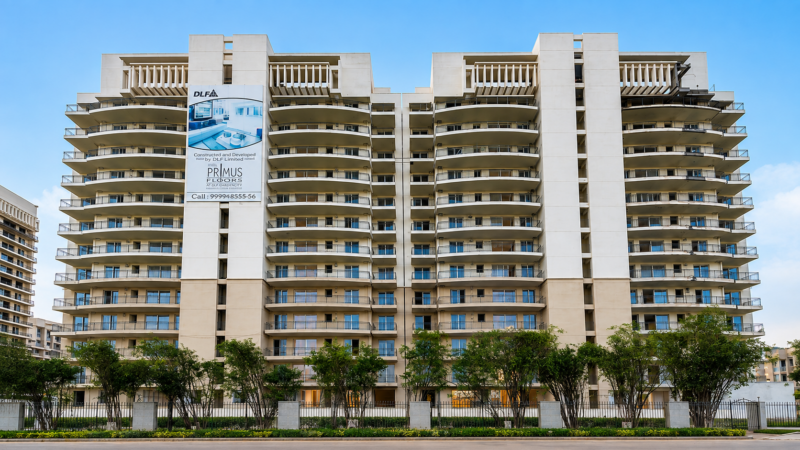
DLF’s management has been explicit about its expansion strategy. The company has spent ₹545 crore on land acquisition over recent quarters, including strategic parcels in Gurgaon and an ₹80 crore deposit for an NCR auction . Management has stated they are “always open for opportunistic deals that will be margin accretive” . The Mumbai market, entered through the Westpark project, has a potential of over 5 million square feet of development, with the next phase of 800,000 sq ft planned within FY27 .
Beyond land, DLF’s rental business pipeline is described by management as “possibly the deepest pipeline in the rental business that exists in the country”, with 11–12 million sq ft under construction across Downtown Gurgaon, Downtown Chennai, Atrium Place, Cyber City Hyderabad, and Cyber City 2 . Funding this pipeline requires capital, and having unencumbered promoter assets ensures that DLF can access debt markets, equity markets, or strategic partnerships on the most favourable terms.
The ₹11,200 crore in RERA balances that will start unlocking from FY27/28 onwards further strengthens the company’s ability to self-fund expansion without needing to leverage promoter shareholding. But in a world where large-scale acquisitions, land banks, commercial assets, or even distressed real estate portfolios, can emerge suddenly, having a clean balance sheet at both the company and promoter level is a strategic advantage.
The Bigger Picture: Governance as a Competitive Moat
In the Indian real estate sector, governance has historically been a weak link. Promoter pledging, related-party transactions, and opaque capital structures have plagued many developers. DLF, as the sector’s largest listed player, has increasingly differentiated itself not just through the quality of its projects but through the quality of its governance.
The annual encumbrance declaration by Renuka Talwar and the associated promoter group entities is a small but meaningful data point in this larger narrative. It tells investors that the promoters of DLF are not using their shareholding as a piggy bank. It tells lenders that the company’s ownership structure is clean. And it tells regulators that DLF takes its compliance obligations seriously.
With a dividend CAGR of 28% over the last five years, a net cash positive balance sheet, and a launch pipeline targeting ₹20,000 crore in FY27 , DLF is a company that is building for the long term. The promoter group’s clean encumbrance record is not just a regulatory filing, but it is a declaration of intent.
In a market that often rewards short-term narratives, DLF’s promoter group has quietly filed one of the most reassuring disclosures of the year. Zero encumbrance on shares held by five promoter group entities, covering 6.10% of the company’s equity, may seem like a technical compliance matter. But read in the context of DLF’s financial strength, expansion ambitions, and governance track record, it is a signal worth paying attention to.
For investors, this is a reminder that in real estate, as in life, the strongest foundations are the ones you cannot see. And right now, DLF’s foundation looks cleaner than ever.
Disclaimer: This article is for informational purposes only and does not constitute investment advice. Please consult a SEBI-registered financial advisor before making investment decisions.