Chandrachud’s Old Boys Club Warning To Jaising’s Dirty Secret Of Sexual Harassment: How The Justice Of Indian Chamber Remains Compromised
From Patriarchal Structures To Unexplained Notes At An Official Residence To Sexual Harassment: What More Remains Hidden Behind The Indian Chambers Of Justice

The Indian higher judiciary occupies a unique constitutional position. It is the final interpreter of the Constitution the guardian of fundamental rights and the institution that resolves disputes that other organs of the state cannot. That elevated role demands corresponding standards of transparency diversity and accountability. Over the past several years a series of public statements by senior figures within and around the system together with hard statistical data have laid bare structural features that continue to undermine public confidence.
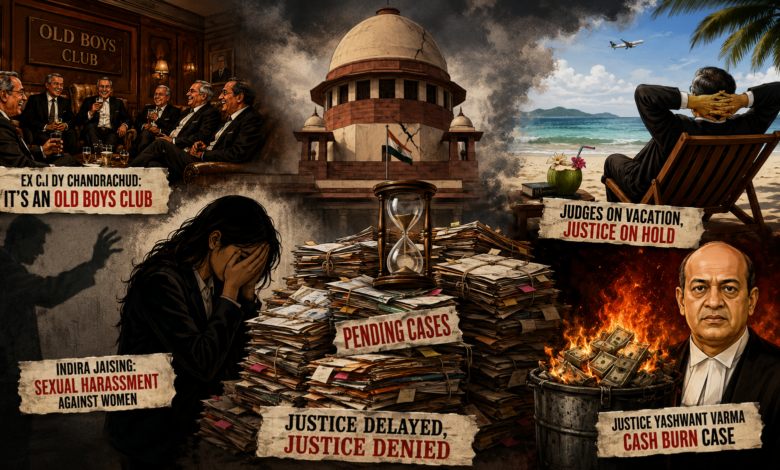
Former Chief Justice of India D Y Chandrachud described the entry points into the legal profession as an old boys club.
Senior Advocate Indira Jaising has characterised sexual harassment within the judiciary as its dirty secret. Case pendency has crossed five crore. Judicial vacancies remain stubbornly high. And the discovery of substantial unexplained currency notes at the official residence of a High Court judge after a fire in March 2025 produced rare parliamentary findings of proved charges before ending in resignation. These are not isolated anecdotes. They form a pattern of hierarchy opacity and delayed justice that the data and the documented statements make impossible to dismiss.
Begin with the feeding pool. In November 2022 shortly after assuming office as Chief Justice D Y Chandrachud told an audience at the Hindustan Times Leadership Summit that the structure of the legal profession across India remained feudal patriarchal and not accommodative of women. Entering the chambers of senior counsel he said is an old boys club. Access is gained by tapping connections and networks rather than through democratised merit based processes.
Until that changes he argued the judiciary will not see adequate representation of women or of persons from marginalised communities. He returned to the theme in later addresses noting that bar associations and bar councils themselves function as old boys clubs because contesting elections requires extensive networking that disadvantages women. A 2021 study he cited showed that only about two percent of elected representatives in state bar councils were women. These were not casual remarks. They came from the head of the judiciary acknowledging that the pool from which judges are drawn is itself skewed by informal networks of privilege.
The consequences appear in the composition of the higher judiciary. Women remain a small minority on the benches of High Courts and the Supreme Court. The same hierarchical culture that restricts entry also shapes internal dynamics. Senior Advocate Indira Jaising has stated publicly that sexual harassment is the dirty secret of the Indian judiciary. In a lecture delivered in 2026 she said that in the course of her practice she has represented multiple women judges who approached her with complaints of sexual harassment by male colleagues.
She recounted an account given by one woman judge of a practice in which women district court judges were required to line up wear matching sarees and throw flowers at retiring High Court judges as they entered a dining room. The same judge according to Jaising was later asked by a male judge to attend his twenty fifth wedding anniversary celebration and dance to an item number. She refused and lost her job. Jaising has written that no one wants to talk about these matters.
The hierarchy between the higher judiciary and the district judiciary she has argued creates conditions in which such complaints are difficult to raise and even more difficult to pursue to a transparent conclusion. These statements come from one of the most experienced advocates in the country who has litigated gender and equality issues for decades. They describe a culture of power imbalance that the formal equality of the Constitution has not fully displaced.
Layered on top of these cultural and representational problems is the sheer volume of unresolved cases. As of mid 2026 the National Judicial Data Grid and related official figures placed total pendency across the system at well over five crore cases. District and subordinate courts alone accounted for nearly five crore. High Courts carried more than sixty lakh. The Supreme Court itself had approximately ninety five thousand pending matters.
Roughly one in ten district court cases and nearly a quarter of High Court cases had been pending for more than a decade. The Law Commission recommended fifty judges per million population as long ago as 1987. Current working strength remains closer to fifteen to twenty two per million depending on the measure used. High Court vacancies have hovered around thirty percent. District court vacancies exceed twenty percent in many states and reach far higher in some. The result is an average caseload that makes timely disposal structurally difficult.
Judicial recesses compound the problem in the public perception. High Courts and the Supreme Court observe long summer and winter vacations. While judges do hear urgent matters during these periods and while the volume of work performed during term time is substantial the optics of extended recesses against a backdrop of five crore pending cases remain difficult to defend.

Litigants whose liberty property or livelihood depend on a hearing experience delay as denial. The data on under trial prisoners on civil suits that outlast the lives of the parties and on commercial disputes that deter investment all point to the same conclusion. The system is under staffed under resourced and organised in ways that prioritise institutional calendar over the urgency of individual cases.
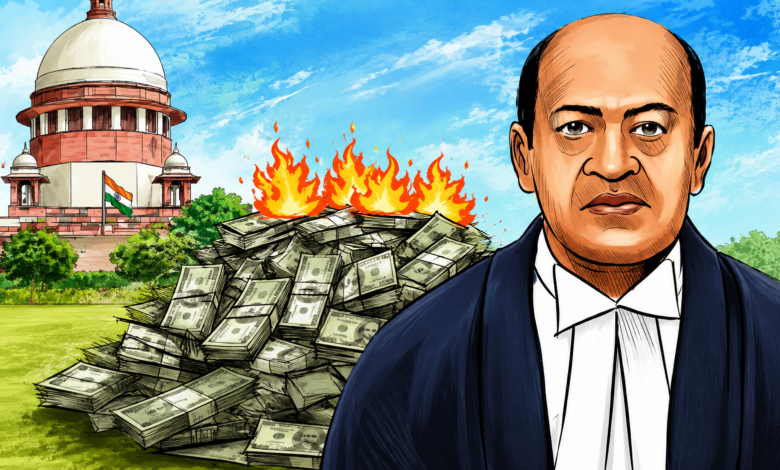
Into this environment of backlog hierarchy and limited transparency came the events of March 2025. A fire broke out at the official residence of Justice Yashwant Varma then a Delhi High Court judge at thirty Tughlak Crescent. Fire and police personnel reported seeing substantial quantities of five hundred rupee notes described as bundles heaps and stacks some burnt half burnt or wet inside a storeroom that formed part of the official premises. The notes were never seized counted or inventoried. They later became unavailable.
An in house committee constituted by the then Chief Justice found that the storeroom was under the control of the judge and his family and that the allegations warranted removal proceedings. The judge was transferred to the Allahabad High Court and judicial work was withheld. Nearly two hundred members of Parliament from both sides of the aisle signed a motion for removal.
A three member parliamentary inquiry committee under the Judges Inquiry Act found all three charges proved. Substantial unexplained currency had been present the judge had failed to explain its presence source or ownership material evidence had not been preserved and the explanations offered were evasive and unsatisfactory when tested against independent witnesses and corroborative material. Justice Varma resigned. The removal proceedings became infructuous.
The sequence is instructive. A serious allegation involving physical evidence inside official residential premises produced rare bipartisan political will and a formal inquiry that reached proved findings. Yet the ultimate outcome was resignation rather than a completed constitutional removal. This is consistent with the historical record. No High Court or Supreme Court judge has been successfully removed through the full process of inquiry followed by addresses of both Houses of Parliament. Earlier cases involving alleged financial impropriety or other misconduct ended in failed votes resignations or prolonged criminal trials that produced acquittals. The constitutional threshold is deliberately high to protect judicial independence. The practical effect is that accountability often stops short of a conclusive public resolution.
These elements old boys club entry points documented allegations of sexual harassment by women judges extreme pendency high vacancies extended recesses and the incomplete arc of the Varma inquiry are not random. They reflect a system that still relies heavily on informal networks internal processes whose outcomes are rarely published and a removal mechanism so demanding that it has never produced a completed removal.
The 8630 complaints against sitting judges received by the office of the Chief Justice of India between 2016 and 2025 illustrate the volume of grievance. The near absence of published outcomes illustrates the opacity. The limited public disclosure of asset declarations by High Court judges further reduces visibility. Chandrachud’s own words about the feudal and patriarchal character of the profession and Jaising’s description of sexual harassment as a dirty secret provide internal corroboration that hierarchy and gender imbalance remain live issues.
None of this requires the conclusion that the higher judiciary as an institution is corrupt or that every judge is compromised. The data and the statements support a narrower and more precise critique. The pathways into the profession remain skewed by networks of connection. The internal culture continues to generate complaints of harassment that are difficult to surface.
The volume of pending cases has reached levels that make timely justice the exception rather than the rule. Vacancies persist. Recesses continue. And when serious allegations involving unexplained currency inside official premises arise the process that follows can produce findings of proved charges yet still end without a completed removal. These are structural deficits. They are measurable. They have been acknowledged by the former Chief Justice of India and by one of the country’s most senior advocates. They are visible in the National Judicial Data Grid and in the parliamentary record of the Varma inquiry.
Reform that respects judicial independence is possible. Democratising access to chambers and to bar association leadership would enlarge the pool from which judges are drawn. Transparent and time bound handling of complaints of harassment would address the culture Jaising has described.
Filling vacancies with urgency and reviewing the length of judicial recesses in light of the backlog would reduce delay. Clearer protocols for the immediate preservation of any material found at official residences and greater public reporting of the outcomes of in house inquiries would strengthen accountability without lowering the constitutional threshold for removal. None of these steps requires abandoning the principle of judicial independence. They require recognising that independence without transparency and without timely justice carries its own costs.

The public record is no longer silent. Chandrachud named the old boys club. Jaising named the dirty secret. The National Judicial Data Grid records the five crore pending cases. The parliamentary committee recorded the proved charges arising from the currency found after the fire at thirty Tughlak Crescent. The question is no longer whether these problems exist. The question is how long the system can continue to operate with entry points that remain networked rather than open with internal hierarchies that generate silenced complaints with a backlog that grows faster than disposal and with accountability mechanisms that reach findings yet rarely reach final constitutional consequence. The data and the documented statements leave little room for complacency.