Expired Food And Fake Drugs Across Three States: Why India’s Food Safety Keeps Failing?

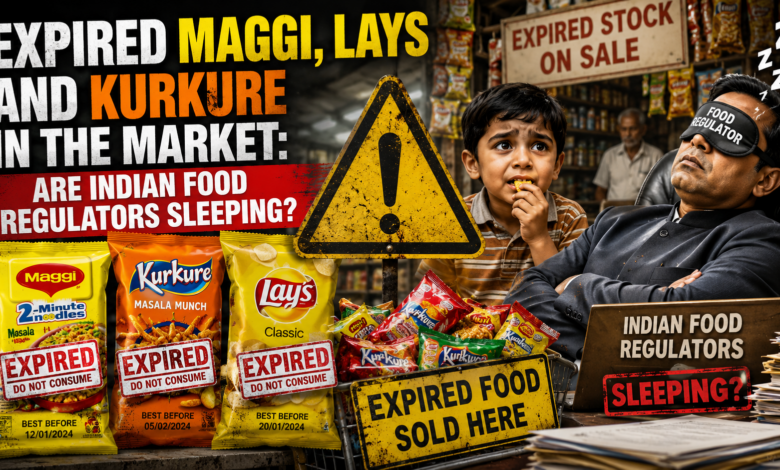
In the space of a few months in 2026, three separate enforcement actions in three different states have laid bare the same grim pattern, in the hunt towards a safe food environment for India.
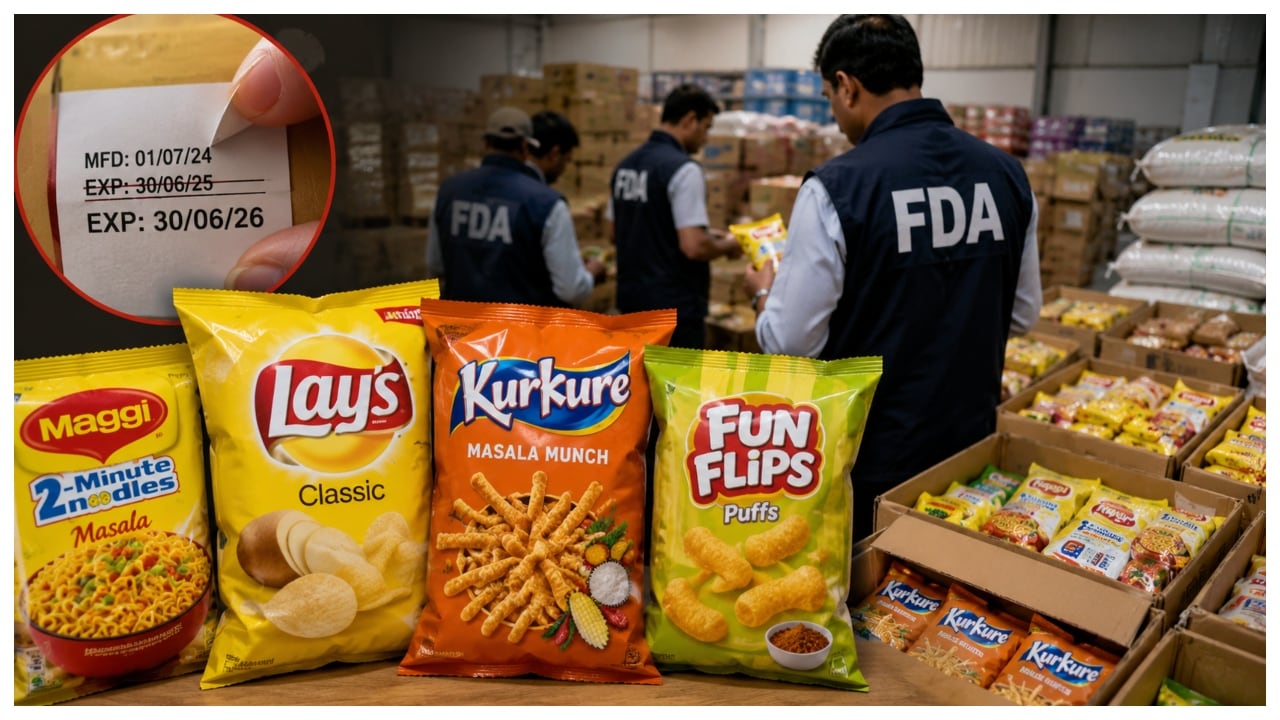
In Delhi’s Okhla industrial area, police arrested seven people and seized more than twenty lakh rupees worth of expired or near-expired international branded food products whose manufacturing and expiry dates had been chemically erased and reprinted.
In Jaipur, Rajasthan’s Food Safety Department destroyed roughly one and a half lakh kilograms of expired Amul non-dairy products after finding that dates had been wiped from thousands of packets with thinner and acetone.
Near Bengaluru’s Bidadi toll gate, officials raided an unlicensed farmhouse unit and recovered spurious and expired injectable medicines valued at nearly five crore rupees, many carrying forged labels of multinational pharmaceutical companies, including vials marked with the name of Pfizer.
These are not isolated scandals. They are successive chapters in a single story of systemic failure: a supply chain so porous, an enforcement architecture so reactive, and a profit motive so powerful that expired and counterfeit goods continue to re-enter the market with disturbing regularity.
Begin with the Delhi case. In early July 2026, a team from Okhla Industrial Area police station, acting on intelligence, raided a unit in southeast Delhi. What they found was not a crude back-room operation but a functioning repackaging facility. Near-expiry and already expired stocks of Thums Up, Fanta, Bournvita, Horlicks, Maggi noodles, ghee, Paper Boat juices and other packaged foods and beverages had been procured at throwaway prices. Original dates were removed using chemical thinners.
Fresh manufacturing and expiry dates were printed. Nutritional stickers and barcodes were replaced. The refurbished stock was then channelled into retail outlets and e-commerce platforms across the country. Seven people were arrested, including the seventy-year-old company owner Darshan Singh Sachdeva, the manager, the accountant, an operator, a warehouse keeper and two supervisors. An FIR was registered under relevant sections of the Bharatiya Nyaya Sanhita covering adulteration, cheating and related offences. The seizure value stood at just over twenty lakh rupees. The absolute figure is modest compared with larger busts, yet the method is industrial and the intent unmistakable: convert waste into inventory by overwriting the only information that stands between the consumer and potential harm.
Travel west to Jaipur a few months earlier. In March 2026 the Rajasthan Food Safety Department, responding to a complaint on the state helpline 181, inspected a warehouse belonging to a firm dealing in Amul non-dairy products. Officials discovered approximately twelve thousand cartons of expired items, containing noodles, ketchup, mayonnaise, sauces, energy drinks and similar goods. In roughly three thousand of those cartons the printed expiry dates had been erased. Thinner, acetone and other chemicals capable of removing ink were recovered on site. The warehouse licence itself had lapsed.
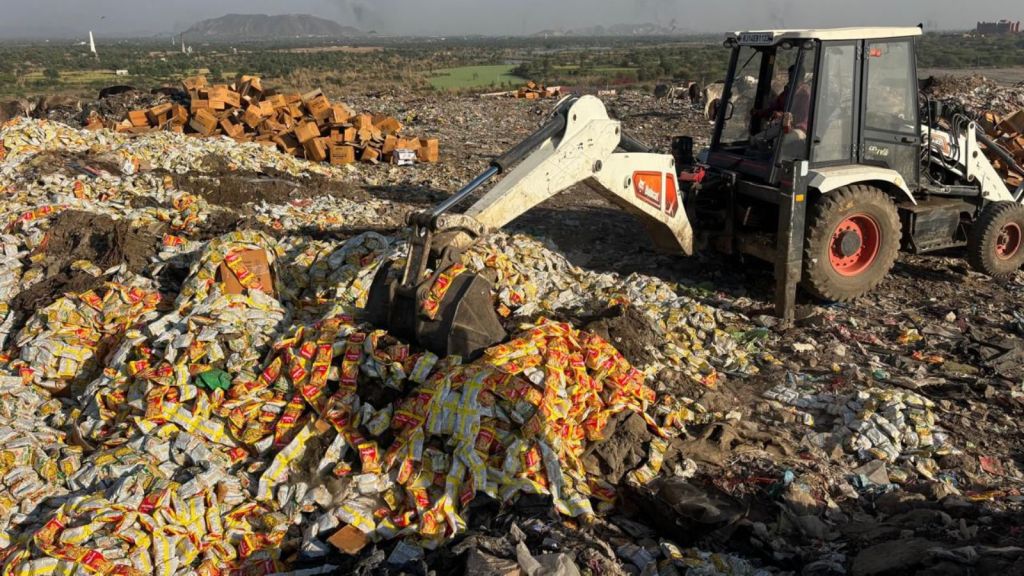
The businessman later told investigators he had learned the technique from YouTube videos. The quantity was so large that destruction required four days and twenty-seven trucks. The stock, amounting to about one and a half lakh kilograms, was taken to a dumping ground and destroyed at the firm’s expense. Notices were issued. Samples were collected. The machinery used for any attempted repackaging was seized. Once again the pattern is identical: expired branded goods, chemical erasure of dates, intention to reintroduce the material into the commercial chain, and an enforcement response that arrives after the fact.
Now move south to the outskirts of Bengaluru. On 18 August 2026 the Drug Enforcement Wing of the Karnataka Food Safety and Drug Administration, acting on a tip-off, raided a farmhouse at Kurubarakeranahalli near the Bidadi toll gate. The premises had no valid licence for pharmaceutical activity. Inside, officials found an industrial injection-filling machine, stoppers, caps, packaging material, forged labels, stamps and printing equipment. The inventory of medicines recovered was valued at approximately four crore ninety-one lakh rupees.
The single largest component was five thousand six hundred forty vials of CEFIAVIGENT 2.5 Injection valued at three crore thirty-eight lakh rupees. Other recoveries included one thousand five hundred thirty-one vials of HIZLAM injectables, four hundred seventy vials of Xavitaz, two hundred sixty-four vials of EMBLAVEO carrying the name of Pfizer Limited on the label, and smaller quantities of Zavicefta, TIGYNT, Aztreo and Trezam injections. Thirty boxes of expired medicines worth about thirty-five lakh rupees were also seized.
Health Minister U.T. Khader stated that lower-cost medicines were being procured from units in Himachal Pradesh and Telangana, refilled into new vials and relabelled to resemble expensive multinational and imported products. Some of the drugs in question are used in critical care and intensive-care settings. The accused running the operation was reportedly based in Dubai. Non-functional QR codes on certain labels further indicated the counterfeit nature of the packaging. The case is being examined under the Drugs and Cosmetics Act, whose provisions on spurious drugs carry penalties that can extend to life imprisonment.
Place these three episodes side by side and the clear picture becomes exhausting in its consistency. The raw material is always the same: expired or near-expired stock purchased cheaply because legitimate channels no longer want it. The technology is elementary and widely available—chemical solvents to erase printed dates, ordinary printers and stickers to create new ones, basic filling and sealing equipment to reconstitute packaging.
The distribution channels are the ordinary arteries of commerce: local retailers, high-end stores in some earlier cases, e-commerce platforms, pharmacies and even hospitals. The human cost is diffuse and therefore easy to ignore until a patient receives a sub-potent or contaminated injection or a family consumes food that has long since passed its safe shelf life. The regulatory response is almost always reactive: a tip-off, a raid, a seizure, arrests, a press conference, destruction of stock, notices issued. Then the cycle resumes somewhere else.
Why does the cycle of adulterated food, or expired food, or mis-labelling persist in India?
First, the economics remain favourable. Expired stock that would otherwise be destroyed retains residual commercial value if the only barrier—visible date information—can be removed at low cost. Second, detection probability is low. India’s food and drug control apparatus is chronically under-staffed relative to the volume of manufacturing units, warehouses, transporters and retailers it must supervise. Laboratory capacity is uneven. Follow-up investigations that would map entire interstate networks are slow and resource-intensive. Third, penalties, while severe on paper for spurious drugs, are often diluted in practice by procedural delays, bail, and the difficulty of proving knowledge and intent across multiple layers of middlemen.
Licence suspension or cancellation of one premises does not prevent the same promoters from shifting operations a few kilometres away or into another state. Fourth, consumer awareness and vigilance remain limited. Most buyers trust the brand name and the printed date. Few possess the means or the habit of verifying batch authenticity through official channels.
The Bengaluru case is especially alarming because it moves the problem from packaged snacks into the domain of injectable antibiotics and critical-care medicines. When vials bearing the name of a multinational company are filled with lower-cost or expired material and then sold into hospital supply chains, the risk is no longer merely gastrointestinal discomfort. It becomes therapeutic failure, antimicrobial resistance, or direct toxicity.
The presence of non-functional QR codes and the allegation of a Dubai-based handler point to a level of organisation that transcends a single farmhouse. The Rajasthan case, by contrast, shows how even a trusted domestic brand such as Amul can become a vehicle for fraud once its products leave controlled distribution and enter secondary warehouses. The Delhi operation demonstrates that the same techniques applied to soft drinks and packaged foods can scale through e-commerce and reach consumers who believe they are purchasing genuine imported goods.
What would a response worthy of the problem look like? It would begin with real-time, digitised tracking of high-risk batches from manufacturer to final retailer, with mandatory scanning of unique identifiers at every hand-off. It would treat the erasure of expiry information and the application of forged labels as predicate offences attracting swift, non-bailable action against organisers rather than only the low-level operators found on site. It would require pharmaceutical and food companies to maintain active surveillance of secondary markets and to report anomalous pricing or packaging anomalies.
It would invest in far greater numbers of trained food-safety and drug-control officers and in rapid, accredited testing laboratories capable of turning around results in days rather than weeks. It would close the YouTube-to-warehouse pipeline by treating the public dissemination of date-tampering methods as a form of facilitation. And it would publish, in searchable form, the outcomes of every major seizure so that patterns of recurrence become visible to journalists, researchers and the public.
Until such structural changes take root, the raids in Okhla, Jaipur and Bidadi will remain what they currently are: necessary but insufficient theatre. Stock is seized. Some accused are arrested. Press statements are issued. The material is destroyed or inventoried. Then, somewhere else, another warehouse fills with near-expiry cartons, another set of chemical bottles appears beside a printer, and another batch of vials is filled and labelled with a name that does not belong to it.

The consumer continues to trust the packet or the vial because the alternative—constant suspicion—is exhausting. The system continues to treat each bust as a discrete success rather than as evidence of an unbroken business model. The three cases of 2026 do not represent three separate failures. They represent one continuous failure measured in different cities, different commodities and different rupee values. The only variable that changes is the date on the next press release.