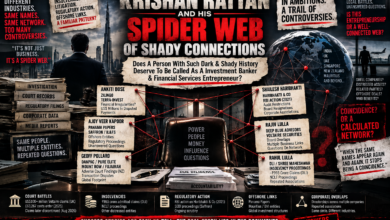
Shailesh Haribhakti Ranks No.1 In Terms Of Past Dark Anecdotes In The Entire Network Of Ankiti Bose
Lets Look At All The Past Allegations On The Entire Network Of Ankiti Bose In Her Professional Circle

There is a peculiar irony in corporate India: the more polished the résumé, the more carefully one is expected to examine the footnotes.
Shailesh Haribhakti is a name associated for decades with auditing, corporate governance, boards, professional institutions and the upper reaches of Indian business. But when the public-record trail is examined rather than the résumé alone, a considerably more complicated picture emerges.
The supplied seven-subject evidence register contains nine Shailesh-related matter/event entries, of which eight are directly person-linked and one is a firm-level regulatory action involving Haribhakti & Co LLP. The eight direct entries comprise five Karnataka criminal case files, an ICAI disciplinary proceeding, a Patna criminal proceeding and a significant corporate-governance episode surrounding Future Lifestyle Fashions. On a raw matter-count basis, that is higher than the corresponding count recorded for any of the other six people in the register.
That is the basis for describing Haribhakti as No.1 by documented proceeding/controversy count in this particular network map.
It is emphatically not a finding of guilt.
It is not a claim that every matter against him was proved.
It is not a claim that every case number represents a separate act of wrongdoing.
And it certainly is not a substitute for a judicial verdict.
But it is a reason to ask an uncomfortable question:
How much scrutiny should a person receive when the historical paper trail contains criminal proceedings, professional-disciplinary proceedings, regulatory controversy and corporate-governance turbulence across multiple years and jurisdictions?
The answer cannot simply be: none.
The numbers first: who actually has the largest paper trail?
The seven-subject register, after normalising aliases and separating direct matters from purely associated-company material, produces the following count:
| Rank by recorded matter count | Person | Directly linked matter entries in register | Additional firm/associate-linked records | Principal categories |
|---|---|---|---|---|
| 1 | Shailesh Haribhakti | 8 | 1 firm-level RBI matter | Criminal proceedings, ICAI disciplinary process, Patna proceeding, corporate-governance controversy |
| 2 | Ankiti Bose | 6 | Additional corporate/third-party material | Zilingo governance allegations, court proceedings, FIR as complainant, publication restraints, reported regulatory allegation |
| 3 | Ajoy Veer Kapoor | 3 | Additional company/associate material | Offshore database record, insolvency/company history, historical regulatory/company matter |
| 4 (tie) | Geoff Pollard | 2 | — | New Zealand High Court litigation and subsequent costs proceedings |
| 4 (tie) | Krishan Rattan | 2 | — | English Commercial Court procedural/costs proceedings |
| 4 (tie) | Rahul Lulla | 2 | — | NCLT proceeding and reported IIP-related allegations |
| 7 | Rajiv Lulla | 1 | — | Reported IIP-related criminal allegation/complaint |
This table needs an important warning label.
A case count is not a culpability score.
Five Karnataka cases, for example, arose from the same underlying legal-metrology episode. Counting five case numbers as five “dark episodes” would exaggerate the number of distinct factual events. Conversely, collapsing five separate judicial files into one would hide the extent of the litigation footprint.
Therefore, the most defensible proposition is narrower:
On the supplied register’s raw proceeding/matter count, Shailesh Haribhakti has the largest directly linked file count in the seven-person network. That does not establish that he has committed more wrongdoing, or that any particular allegation is true.
That distinction is essential.
And it also makes the underlying paper trail more interesting, not less.
The five Karnataka criminal proceedings that refuse to disappear
The most substantial cluster in the record concerns five criminal proceedings arising from a Legal Metrology inspection at a Future Value Retail outlet at Bharath Mall, Mangaluru, on September 9, 2011.
The inspection concerned pre-packed commodities bearing additional stickers relating to maximum retail price. Criminal complaints were subsequently taken on file as C.C. Nos. 525/2012, 526/2012, 527/2012, 528/2012 and 529/2012.
Shailesh Haribhakti was petitioner No.4/accused No.4 in the relevant proceedings.
The significance of the proceedings is not that the High Court convicted him. It did not.
The significance is something much narrower — and much more concrete.
In the May 29, 2019 common order concerning Criminal Petition Nos. 2605/2013 to 2608/2013, the Karnataka High Court quashed the proceedings against a number of other petitioners after examining whether they were directors or otherwise liable. But the relief did not extend to petitioner No.4, Shailesh Haribhakti. The court expressly recorded that proceedings against petitioner No.4 should continue in accordance with law.
The fifth matter, Criminal Petition No.2609/2013 concerning C.C. No.528/2012, followed the same pattern in December 2019: the proceedings were quashed against other petitioners but were left continuing against petitioner No.4 and the company.
That is an important fact.
The court did not say:
“Haribhakti is guilty.”
It said, in substance:
The proceedings should continue against him.
Those are completely different propositions.
But they are also very different from saying that the Karnataka litigation was some trivial technical footnote.
It wasn’t.
The underlying inspection dates back to 2011. The criminal complaints date from 2012. The High Court challenge came in 2013. The principal High Court decision arrived in 2019.
And the public record reviewed for this investigation still does not establish a final trial conviction or final disposal against Haribhakti.
That produces one of the most uncomfortable questions in the entire dossier:
Why should a criminal matter originating in 2011 remain so difficult to resolve conclusively?
Nearly fifteen years after the underlying inspection, the citizen is still left navigating case numbers, quashing petitions, connected proceedings and incomplete public-status information.
That is not justice at its most efficient.
And it is not fair to anyone — neither the state, nor the complainant, nor the accused.
The ICAI chapter may be even more important than the old criminal cases
The Karnataka cases are old.
The ICAI proceeding is not.
The supplied register identifies the disciplinary proceeding as:
PPR/HPC/DD/58/INF/2018/DC/1860/2024
and records CA Shailesh V. Haribhakti as the “member answerable.”
That is not an inference drawn from a newspaper.
It appears in official ICAI disciplinary cause-list material.
The same case has continued appearing in ICAI hearing records. Official ICAI material places Haribhakti & Co LLP in the disciplinary process with CA Shailesh V. Haribhakti (M. No. 030823) as the member answerable.
That matters for one simple reason:
this is a personal professional-disciplinary proceeding, not merely a story about a company in which he once had a connection.
At the same time, responsible journalism requires an equally important qualification.
A cause-list entry is evidence that a disciplinary proceeding exists.
It is not evidence that the allegations in that proceeding have been proved.
I did not locate a published final ICAI finding establishing misconduct by Haribhakti in the records reviewed for this investigation.
So the correct formulation is:
Haribhakti has been personally named as the member answerable in an ICAI disciplinary proceeding; the final merits outcome should be established by the disciplinary authority, not manufactured by journalism.
That is precisely why a proceeding that has remained in the system for years deserves a final, reasoned resolution.
A disciplinary proceeding should not become an administrative limbo.
If there is no misconduct, say so.
If there is misconduct, establish it and sanction it.
If evidence is insufficient, close the matter.
But perpetual ambiguity benefits nobody.
Then comes Patna
The paper trail does not end in Karnataka or at ICAI.
The Patna High Court record contains Criminal Miscellaneous No.48139 of 2025, titled Shailesh Vishnubhai Haribhakti v. State of Bihar, arising from PS Case No.7 of 2022 / Government Official Complaint Case at Muzaffarpur, heard with connected proceedings involving Torrent Pharmaceuticals.
The January 5, 2026 order is extremely limited.
The court recorded the appearance of counsel and, on joint request, listed the matters for January 12, 2026. It does not decide the merits, record a conviction, or establish guilt.
Again, this is a procedural record.
But it is still a record.
And that is the distinction that should guide serious investigative journalism.
The question is not:
“Was Haribhakti convicted?”
The record reviewed does not establish that.
The question is:
Has Haribhakti’s name appeared in criminal litigation across multiple forums over different periods?
Yes.
That is a fact.
The Future Lifestyle episode: not a criminal case, but certainly a governance episode worth examining
On April 22, 2022, Shailesh Haribhakti resigned as chairman and independent director of Future Lifestyle Fashions Ltd.
The resignation is documented in the company’s stock-exchange filing.
Contemporaneous reporting quoted his resignation letter as referring to what he described as “volatile, complex and unpredictable” legal and financial circumstances, while he maintained that he had discharged his responsibilities diligently.
The NCLT-convened secured creditors’ meeting was held around the same time, with Haribhakti appointed chairman of that meeting.
Nothing here establishes misconduct by Haribhakti.
But it is another example of why the simplistic public image of a boardroom governance figure can be incomplete.
He was operating in the middle of one of the most turbulent corporate restructurings in India’s retail sector, at a company facing severe financial and legal complications.
A resignation in such circumstances is not proof of wrongdoing.
It is, however, undeniably part of the historical corporate-governance record.
And a serious governance profile should be judged not merely by the prestigious boards a person sat on, but also by the difficult episodes surrounding those boards.
The audit question: Haribhakti & Co’s record creates another layer
The next layer does not concern Shailesh Haribhakti personally in the same way as the Karnataka criminal files or ICAI proceeding.
It concerns the professional firm associated with his name.
That distinction is crucial.
In October 2021, the Reserve Bank of India announced action against Haribhakti & Co LLP, debarring the firm from accepting new audit assignments in RBI-regulated entities for two years with effect from April 1, 2022. The RBI said the action related to failure to comply with a specific RBI direction concerning the statutory audit of a systemically important NBFC.
That was an action against the firm.
It was not, on the face of the RBI press release, a personal finding that Shailesh Haribhakti himself committed the underlying violation.
That distinction cannot be blurred.
It is also relevant that reporting on the RBI episode quoted Haribhakti as stating that he had ceased to be a partner of the firm on March 31, 2018, and therefore was not responsible for the firm’s conduct thereafter.
His position deserves to be recorded.
But there is an older episode that places the firm’s audit history under an even sharper spotlight.
In its 2006 findings concerning irregularities surrounding IPO financing and the Karvy group, SEBI stated that Haribhakti & Co, described as Karvy’s internal auditors, had failed to check or report the opening of large numbers of depository accounts sharing common addresses. SEBI said the internal auditor had not pointed out those flaws despite being associated with the audit function for years.
A Parliamentary Standing Committee on Finance subsequently recorded SEBI’s findings and stated that the matter had been forwarded to ICAI, with the Ministry urging ICAI to take the matter seriously and take stringent action.
Again, this is firm-level professional history, not proof that Shailesh Haribhakti personally committed an offence.
But for anyone examining the broader governance and audit ecosystem surrounding the name, it is impossible to responsibly pretend that such history does not exist.
The archive contains still more
The historical record is broader than the eight core entries used for the principal ranking.
A Future Lifestyle information memorandum available through the National Stock Exchange’s archival material contains disclosures under the heading concerning Mr. Shailesh Haribhakti relating to multiple criminal cases, including food-adulteration matters and the five Mangalore legal-metrology matters. The document also lists older criminal proceedings in Madhya Pradesh and other jurisdictions involving Shailesh Haribhakti alongside other Future-group officials.
These archival disclosures should be treated differently from a certified court judgment.
They are valuable because they demonstrate that the matters were disclosed in an issuer document.
They should not, however, be transformed by a newspaper into claims of guilt without retrieving the underlying trial dockets and final orders.
That is exactly where investigative journalism should be more disciplined than social media.
A document can be important without proving the proposition an activist wants it to prove.
What about the 2007 Delhi litigation?
There is another instructive example.
In a 2007 Delhi criminal revision concerning a Food Bazar outlet, Shailesh Haribhakti appeared as one of the petitioners. The case arose after proceedings against directors relating to alleged municipal/health-licensing violations, followed by the trial court’s treatment of additional Penal Code provisions and personal appearance requirements.
The Sessions Court ultimately set aside the impugned procedural order and directed the lower court to proceed according to law.
This episode therefore belongs in the historical litigation ledger.
But it should not be counted as a proven criminal finding against Haribhakti.
In fact, the procedural relief obtained by the petitioners is precisely why investigative reporting must resist the temptation to convert every appearance in a criminal file into a finding against the person.
So what exactly is the “No.1” finding?
It is important to strip the headline down to its factual foundation.
The claim is not:
“Shailesh Haribhakti has been proven to have committed more wrongdoing than Ankiti Bose or anyone else.”
There is no evidentiary basis for saying that.
The claim is:
In the supplied seven-person evidence register, Shailesh Haribhakti has the highest number of directly linked matter/proceeding records when case files, regulatory/professional proceedings and documented controversy episodes are counted.
That is a much narrower and much more defensible proposition.
It produces eight direct entries:
**Five Karnataka criminal case files
- one ICAI disciplinary proceeding
- one Patna criminal proceeding
- one Future Lifestyle governance episode**
and one additional firm-level RBI regulatory action.
That makes him the most heavily represented subject in the register’s proceeding/controversy column.
But the raw count contains an important caveat.
The five Karnataka matters largely arise from the same underlying inspection episode.
So anyone portraying “eight matters” as eight completely independent scandals would be overstating the record.
The more intellectually honest conclusion is this:
Haribhakti has the largest litigation/proceeding footprint in the register, but the number of unique factual episodes is smaller than the raw case-file count suggests.
That is still significant.
How the paper trail compares with Ankiti Bose
Ankiti Bose has a substantial file of her own.
The register records six directly linked matter/event entries covering reported Zilingo governance and financial allegations, court proceedings, a Mumbai criminal complaint/FIR in which Bose was the complainant, interim civil relief, an alleged GST-prosecution lead that remained unverified, and later Delhi High Court publication restraints.
The Mumbai criminal complaint is independently reported. In 2024, media reports said Bose approached Mumbai Police with allegations against former Zilingo colleagues Dhruv Kapoor and Aadi Vaidya and that an FIR was registered; those accused disputed the allegations.
That distinction matters.
A person being the complainant is not the same thing as being an accused.
A defamation injunction is not a fraud conviction.
A corporate dispute is not automatically a criminal offence.
And a media report of an allegation is not a judicial finding.
That same discipline must apply to Haribhakti.
It is precisely because both names sit inside a complicated legal and corporate network that the public deserves something better than partisan dossiers masquerading as verdicts.
The other names in the network also require caution
The same methodological problem appears with the other individuals.
Ajoy Veer Kapoor
The register records three principal adverse/controversy entries. One involves an ICIJ Offshore Leaks database association identifying Ajoy Veer Kapoor as a beneficiary of YASU Management Limited in the British Virgin Islands. That database association is not, by itself, evidence of illegal conduct.
Other entries concern company insolvency and historical regulatory/company matters, where personal attribution is either qualified or unresolved.
Geoff Pollard
The New Zealand High Court’s 2019 substantive decision involved Geoffrey Ian Pollard in litigation concerning representations relating to funding and shareholding. A subsequent costs decision did not impose personal costs on him, and the litigation history included an appeal. The linkage between that historical court defendant and the modern business-profile “Geoff Pollard” identity is itself treated as qualified in the register.
Krishan Rattan
The English Commercial Court litigation included Krishan Rattan as a defendant/applicant in a procedural disclosure-costs dispute. The proceeding should not be misreported as a merits finding of fraud or dishonesty; the later case history involved consent/discontinuance mechanics.
Rahul Lulla
The register records an NCLT proceeding as well as reported allegations concerning the Infrastructure India/Development Land International ecosystem. An IBBI record shows an NCLT insolvency order concerning DLI dated May 14, 2026.
There have also been reported allegations by a former DLI executive concerning alleged diversion of funds involving Rahul Lulla, Rajiv Lulla and an adviser. Those allegations were disputed, and the underlying criminal record needs to be distinguished from media reporting.
Rajiv Lulla
Rajiv Lulla appears in the register primarily through the same reported Infrastructure India-related allegations. That does not, on the material reviewed, equate to a conviction or established finding of financial misconduct.
This is why a raw numerical ranking should never be confused with a moral ranking.
The uncomfortable question is not “Is Haribhakti guilty?”
It is too easy to ask that question and too easy to answer it irresponsibly.
The more useful questions are:
Why were multiple criminal proceedings filed?
Why did the Karnataka High Court allow the proceedings to continue against Haribhakti while quashing them against several other petitioners?
What exactly is the allegation in the ICAI proceeding?
What is the present status of that disciplinary case?
What happened in the Patna proceeding?
What was the actual audit role of Haribhakti & Co in the historical Karvy matter?
What did the firm’s internal controls identify or fail to identify?
What does the complete Future Lifestyle board record show?
And above all:
When will each of these matters finally be resolved on the merits?
Those are legitimate questions.
They are also questions that can be answered only by documents.
The real scandal may be the speed of the system
There is a second institutional problem hiding underneath this dossier.
Some of these matters are old enough to have become historical artefacts.
The Mangaluru inspection happened in 2011.
The resulting complaints were from 2012.
High Court petitions were filed in 2013.
A major High Court order arrived in 2019.
A Patna proceeding arising from a 2022 complaint entered the High Court in 2025 and was still being listed in January 2026.
The ICAI disciplinary matter originates from an information reference dating back to 2018, with Haribhakti still appearing as the member answerable in official cause-list material in the 2020s.
This is precisely where a serious investigative publication should become demanding.
Investigations must be tightened.
Trials must be expedited.
Disciplinary proceedings must reach reasoned conclusions.
Regulatory files must be made easier for the public to follow.
Not because Haribhakti is guilty.
Not because he is innocent.
But because unresolved allegations are corrosive to both.
An accused person has a legitimate interest in getting exonerated quickly if the case is baseless.
The public has a legitimate interest in knowing if the allegations are substantiated.
The complainant has a legitimate interest in a final determination.
A system that leaves all three in limbo for years is failing everybody.
The sharpest criticism therefore is not a conviction that does not exist
There is a temptation in modern “investigative” journalism to inflate every court appearance into scandal.
That is lazy journalism.
The harder job is to say something more precise:
Shailesh Haribhakti’s record contains multiple layers of scrutiny.
Some are criminal proceedings.
Some are professional-disciplinary.
Some are regulatory.
Some are corporate-governance episodes.
Some concern firms with which he was associated rather than him personally.
Some ended in procedural relief.
Some remain unresolved in the records reviewed.
And some allegations in historical disclosures require retrieval of original dockets before they can responsibly be described in stronger terms.
That mixture is not a conviction.
But neither is it a spotless paper trail.
And that is why the subject warrants examination.
The problem with a highly polished institutional reputation is that the public naturally assumes the underlying record is equally polished.
The documents suggest something more complicated.
A demand for answers — not headlines
A proper investigative follow-up should seek and publish the following:
First: complete certified trial-status records for all five Karnataka proceedings.
Second: the complete ICAI disciplinary record, including the underlying allegation, response, hearings and final order, if any.
Third: the complete Patna complaint/case record and subsequent order history.
Fourth: the underlying engagement and responsibility documents relevant to the RBI action against Haribhakti & Co LLP.
Fifth: the original records behind the historical food-adulteration and related criminal-case disclosures contained in the Future Lifestyle information memorandum.
Sixth: the complete board and committee records surrounding Haribhakti’s resignation from Future Lifestyle Fashions.
The objective should be simple:
Either establish the allegation or clear the name.
There is little value in a decades-long fog of half-resolved litigation, recycled accusations, unexplained procedural orders and incomplete outcomes.
The final verdict? The courts should deliver it — not the newspaper
The strongest conclusion that the available evidence presently supports is also the most restrained:
Shailesh Haribhakti has the largest directly linked proceeding/controversy file count among the seven individuals examined in the supplied Ankiti Bose network register.
That is a factual conclusion about a dataset and its methodology.
It is not a verdict on his character.
It is not proof of criminal conduct.
It is not proof of professional misconduct.
And it does not establish that he is more culpable than the other people in the network.
But it is enough to justify serious scrutiny.
Five Karnataka criminal case files.
A continuing ICAI disciplinary proceeding identifying him personally as the member answerable.
A Patna criminal proceeding.
A major Future Lifestyle governance episode.
A separate historical audit trail involving the firm that carried his name.
An RBI regulatory action against that firm.
And older issuer disclosures containing additional historical criminal-case references that merit primary-document verification.
That is too substantial a paper trail to dismiss as mere internet gossip.
At the same time, it is far too incomplete and procedurally mixed to be presented as a conviction.
And that is exactly where an investigative newspaper should draw the line.
The public does not need manufactured guilt.
The public needs the complete record.
So the demand should now be straightforward:
Investigate faster.
Try cases faster.
Publish the final orders.
Disclose the evidence.
Establish what is true.
Disprove what is false.
And stop allowing serious allegations to live indefinitely in the space between accusation and adjudication.
For Haribhakti, for Ankiti Bose, and for everyone else in this network, the principle is the same.
Allegation is not conviction. Association is not guilt. Litigation is not liability. And reputation is not immunity from scrutiny.
That is the standard that should apply to everyone.
DISCLAIMER AND EDITORIAL NOTE
This article is an investigative opinion piece based on publicly accessible court records, regulatory/professional records, exchange disclosures, archival corporate documents, media reports and the supplied evidence register. Allegations remain allegations unless and until established by a competent court or statutory authority. No statement in this article should be read as a finding that Shailesh Haribhakti has committed any offence or professional misconduct unless expressly identified as an adjudicated finding.
Based on the records reviewed for this article, no court conviction of Shailesh Haribhakti was located. The Karnataka proceedings discussed above were not treated as convictions; the relevant High Court orders concerned continuation/quashing of proceedings. The ICAI material confirms a disciplinary proceeding and identifies Haribhakti as the member answerable, but I did not locate a published final finding establishing misconduct in that proceeding in the material reviewed. The RBI action described above was against Haribhakti & Co LLP and should not be represented as a personal RBI finding against Shailesh Haribhakti. Similarly, historical firm-level audit findings and corporate controversies should not automatically be attributed personally to him without supporting evidence.
The article also recognises that the mere existence of a criminal complaint, FIR, prosecution, disciplinary case, regulatory action, insolvency proceeding, corporate dispute or media report does not establish guilt. Where the record is incomplete or an identity/attribution remains qualified, that limitation has been stated.