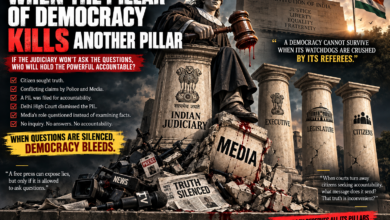
Delhi HC Dismisses Nitin Naresh PIL: When Police Denials Clash With Media Reports, Who Will Answer For The Truth?

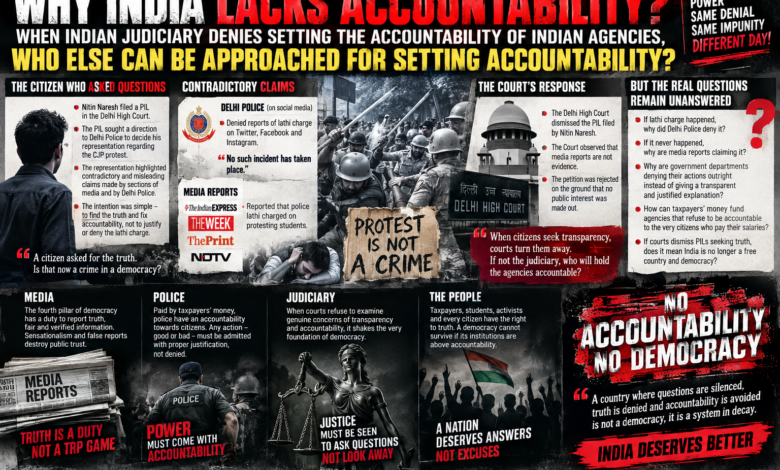
Why India Lacks Accountability: The Nitin Naresh PIL, The CJP Protest And The Unanswered Questions
The right to protest, the duty of the police to explain its actions, and the responsibility of the media to report verified facts are all connected by one fundamental question that Nitin Naresh PIL ask: Who is accountable when the public receives conflicting accounts of what happened?
The Delhi High Court’s dismissal of a Public Interest Litigation (PIL), filed by Mr Nitin Naresh, concerning alleged police lathi-charge during a CJP protest raises precisely that question. A petition seeking clarity about an alleged incident is not the same as proof that the incident occurred. Equally, a court’s dismissal of a PIL is not, by itself, a judicial finding that the underlying allegations were false.
This article examines the matter through the petitioner, Nitin Naresh, and the purpose of his representation and PIL. It distinguishes the reported facts from the questions of public accountability that arise from them.
When a Citizen Asks for the Truth, Who Is Responsible for Finding It?
A democracy does not become accountable merely because its institutions exist. Accountability begins when institutions are willing to explain what they do, citizens are able to question those explanations, and the truth is not allowed to disappear between an official statement and a news report.
The recent Delhi High Court proceedings involving a PIL filed by Mr Nitin Naresh bring this issue into sharp focus. The petition concerned conflicting accounts of an alleged police lathi-charge during a protest organised by the Cockroach Janata Party (CJP). Media reports said police had used force against protesting students. Delhi Police’s social media communications denied the alleged lathi-charge. Mr Nitin Naresh approached the police seeking clarity and subsequently moved the High Court after, according to the reports, receiving no response.
On September 16, 2026, a bench comprising Chief Justice Devendra Kumar Upadhyaya and Justice Tejas Karia dismissed the Nitin Naresh PIL. The court questioned whether a conflict between media reports and a police statement, without more, was sufficient to invoke the jurisdiction of a PIL. The bench also questioned the petitioner’s reliance on the words “accountability” and “transparency” without a specific legal foundation.
The decision has an important legal dimension. It also raises a broader public question: when a citizen seeks an explanation from a public authority about an alleged use of force, what mechanisms exist to establish the facts?
The answer cannot be that every allegation is true. Nor can it be that every official denial ends the matter. The central issue is whether there is a credible, accessible and legally appropriate process for determining what actually happened.
The Petitioner at the Centre of the Dispute
Nitin Naresh is the petitioner around whom this matter revolves. As reported by many news media outlets, he identified himself as being associated with the media community and filed a representation before Delhi Police regarding the conflicting accounts of the CJP protest. His stated objective, as described in the petition-related reporting, was to seek clarity. He was not seeking a judicial declaration that the police had necessarily used excessive force. The reported request was for Delhi Police to decide the representation he had already submitted.
That distinction matters. A petition demanding that a public authority explain its conduct is different from a petition asking the court to punish officers for misconduct. It is also different from a petition seeking compensation for a person who suffered injuries. The legal questions, the evidence required and the available remedies may differ in each case.
Nitin Naresh’s reported approach was based on a straightforward concern: there were two conflicting versions of the same incident. One version came from media reports. The other came from Delhi Police’s official social media communications. If the media reports were accurate, the public would reasonably expect an explanation of the police action. If the police denial was accurate, the public would reasonably expect clarity about why reports of a lathi-charge had circulated.
The petition therefore placed the conflict itself before the court. However, the court did not accept that the conflict, on the material presented, created a public interest issue suitable for PIL jurisdiction. The bench questioned whether the police had a legal duty to decide the particular representation and whether the dispute amounted to a violation of rights or a legal controversy appropriate for the petition.
This is the point at which the public debate must become more precise. The dismissal concerns the court’s decision to entertain the PIL. It does not establish that the police used force unlawfully. It does not establish that the media reports were false. It does not establish that the petitioner acted improperly in seeking clarity. It establishes that the court dismissed the PIL.
What Happened During the CJP Protest?
The reported incident took place against the backdrop of a student protest. According to Hindustan Times, the CJP organised a “Sansad Chalo” march on July 20, 2026, following a hunger strike at Jantar Mantar that had continued for more than three weeks. The protest was connected to demands concerning alleged examination paper leaks, accountability for student suicides linked to the issue, and reforms in the examination system.
The march took place on the opening day of Parliament’s Monsoon Session. The report states that protesters attempted to move through central Delhi and encountered multiple layers of barricades. It further reports that a large group breached the barricades and advanced towards the Parliament complex. According to the same report, security personnel used tear gas and a lathi-charge to disperse the crowd.
The police account, as reported, was that the crowd had become violent and that protesters pelted stones at security personnel, necessitating the use of force. Media reports and videos, meanwhile, presented an account in which police personnel in riot gear were seen beating protesters. Hindustan Times reported that some protesters appeared to have sustained head injuries.
These are significant allegations, but they must remain allegations unless established by evidence. The existence of videos does not, without examination, establish the complete sequence of events, the conduct of every officer, or the legality of each use of force. At the same time, an official denial does not, by itself, prove that no force was used. The difference between these two propositions is the foundation of a responsible public discussion.
The Conflicting Accounts That Led to the PIL
The central factual conflict can be stated simply.
Media reports: Police used lathis against protesting students during the CJP march.
Delhi Police’s reported position: The alleged lathi-charge did not happen, as reflected in police social media communications.
Nitin Naresh PIL concern: Why were these accounts different, and why had his representation seeking clarity not been decided?
The petitioner reportedly asked the court to direct Delhi Police to respond to his representation. This is a narrower request than ordering a criminal investigation or declaring the police guilty of misconduct. Yet the High Court considered that the petition did not involve the type of public interest contemplated by PIL jurisdiction.
The court’s remarks were direct. The bench questioned whether every matter that catches a person’s attention after reading a newspaper should be brought as a PIL. It also said that the words “accountability” and “transparency” could not be used in a vacuum. This observation is central to understanding the judicial reasoning. The court was not merely considering whether the allegation sounded serious. It was examining whether the petitioner had shown a legal basis for the relief sought.
That is an important distinction in constitutional litigation. A public controversy may be significant without automatically becoming a PIL. A citizen may have a legitimate concern without every concern being enforceable through a writ petition. A news report may raise questions without conclusively proving the facts. But the existence of these legal limits does not eliminate the underlying public interest in accurate information.
Why the Petitioner’s Demand for Clarity Matters
The significance of Nitin Naresh PIL lies partly in its modesty. The petitioner was not asking the court to simply accept the media account or the police account. He was asking for the conflicting accounts to be addressed.
That is an important democratic function. Public institutions exercise authority over citizens. Police departments, in particular, have powers that ordinary citizens do not possess. They can restrict movement, impose security measures, disperse crowds and use force in circumstances permitted by law.
When such powers are exercised during a public protest, the public has an interest in knowing what happened. The issue is not that police action is always unlawful. It is not. Police may have legitimate reasons to prevent a crowd from entering a restricted area, protect public safety or respond to violence. But the justification for an action should be capable of examination.
Similarly, the media has a responsibility to distinguish verified facts from allegations, to report official responses accurately and to correct errors when necessary. When two accounts conflict, the public is left with a problem that cannot be solved by repetition. Repeating the police denial does not independently verify it. Repeating a media allegation does not independently establish it. The question is how the truth is to be established.
Nitin Naresh reported representation sought to bring that question before the police. The PIL then sought judicial directions concerning the representation. The High Court’s dismissal means that this particular route did not succeed. It does not necessarily mean that no other legal or administrative route exists.
The Court’s Reasoning: Accountability Must Have a Legal Foundation
The remarks of the Delhi High Court deserve attention because they address the limits of PIL jurisdiction. The bench questioned whether the police had a duty to decide the petitioner’s representation. It also questioned whether the mere contradiction between a police statement and media reports amounted to a public interest issue.
It is reported that the court is saying that a PIL could not be founded simply on the fact that media reports contradicted the police’s stand. This reasoning reflects a concern about the use of constitutional litigation. Courts must determine whether a petition falls within their jurisdiction and whether the relief sought is legally available.
A PIL is not a general-purpose mechanism for resolving every public controversy. The court may require a petitioner to demonstrate a legal injury, a public wrong, a violation of rights or another recognised basis for judicial intervention. The question is whether Nitin Naresh PIL satisfied that threshold? The court answered in the negative and dismissed it.
That conclusion must be respected as the decision in this case. However, the public accountability question remains distinct from the procedural question. Even if a PIL is not the appropriate vehicle, a conflict between official communications and media reports may still warrant clarification through other mechanisms, depending on the facts, the evidence and the applicable law.
The legal system is not required to treat every allegation as established. But a system that is concerned with accountability should also be concerned with whether credible allegations can be examined through appropriate channels.
Why Official Denials Require Evidence, Not Just Authority
The police’s denial is an important part of the story. It is the official account of the institution accused of using force. But official status alone does not make a statement independently verified. The same principle applies to media reporting. A report published by a news organisation is not automatically conclusive evidence merely because it appears in a newspaper. Both institutions have responsibilities.
For police, the responsibility includes explaining the circumstances in which force was used, where relevant, and ensuring that public communications are accurate. For media, the responsibility includes verifying the facts, identifying sources appropriately and distinguishing what is known from what is alleged. The public’s interest lies in the accuracy of the final account.
If force was used, the question is whether it was lawful, necessary and proportionate in the circumstances. If force was not used, the question is why multiple reports suggested otherwise. If force was used but the official statement denied it, the discrepancy itself becomes important. If reports exaggerated the nature of the action, that too requires clarification.
The truth may be more complicated than either side’s initial account. That is why the petitioner’s reported request for clarity cannot simply be reduced to support for one side of the dispute. His stated objective, as described in the reports, was to understand the discrepancy.
The Public Interest in Police Accountability
Police departments are public institutions. Their personnel are paid from public funds, and their powers are exercised in the name of public order and safety. That creates a legitimate expectation that police conduct should be subject to legal and institutional accountability.
Accountability does not mean that officers must accept every allegation against them. It means that allegations can be assessed through lawful processes and that official decisions are capable of explanation. This principle becomes particularly important when the alleged conduct concerns a protest.
The right to peaceful assembly is constitutionally protected, subject to reasonable restrictions. Public authorities may impose restrictions for legitimate reasons, but the exercise of those powers remains subject to law.
A protester who alleges unlawful force may have legal remedies depending on the circumstances. A police officer who alleges violence by protesters may also have legal protections and remedies. A court must examine evidence rather than assume either version is correct.
The CJP matter illustrates the difficulty that arises when the public is presented with competing accounts but the route chosen to resolve the conflict is rejected. The result can be a perception that the truth has not been established. That perception should not be confused with a finding that the truth is unknowable. Nor should it be treated as proof that the institutions involved acted unlawfully. But it is a legitimate concern for democratic governance.
The Role of the Media: The Fourth Pillar and the Duty to Verify
The media is often described as the fourth pillar of democracy. The phrase reflects the importance of journalism in informing citizens, scrutinising public authorities and bringing public issues into the open. That role carries responsibilities.
When reporting on alleged police violence, a news organisation should seek evidence, report the police response, distinguish eyewitness accounts from verified facts and avoid presenting disputed claims as settled conclusions. The police, for its part, should communicate accurately and avoid creating confusion through statements that do not reflect what occurred.
In the CJP matter, the reported conflict between media accounts and Delhi Police’s social media communications is precisely the kind of disagreement that can damage public confidence if it remains unresolved. The issue is not whether the media should always be believed. It is whether the media and police should both be held to standards of accuracy.
If the media reports an event that did not occur, it should be corrected. If the police denies an event that did occur, the denial should be examined. If both accounts contain partial truths, the public deserves the fuller picture. A democracy cannot function effectively when citizens are expected to choose between competing institutional narratives without access to credible evidence.
The High Court’s Dismissal Does Not End Every Question
The dismissal of the PIL is a judicial outcome, but it does not automatically answer all factual questions about the protest. It does not establish whether a lathi-charge occurred in the manner described by the media. It does not establish whether the police denial was accurate. It does not establish whether the petitioner was entitled to a response to his representation under a specific legal provision.
Those questions require separate analysis. The reported proceedings also show that the court’s concern was with the legal basis of the petition. The bench questioned whether the police had a duty to decide the representation and whether the petition involved a public interest issue. This means that the public debate should not treat the dismissal as a verdict on the underlying allegation.
The court’s order should be read in full to understand the precise reasons for dismissal, the relief sought and whether any observations were made on the merits of the allegations. The available news reports provide an account of the hearing, but the complete judicial order would be the appropriate source for a definitive legal analysis of the reasoning.
What This Means for Citizens Seeking Accountability
The case raises an uncomfortable but important question: what should a citizen do when a public authority’s account conflicts with news reports? The answer depends on the nature of the issue.
A person directly affected by alleged police misconduct may have specific legal remedies. A person seeking information may be able to use transparency mechanisms where applicable. A complaint may be addressed to the relevant authority or oversight body. A court may be approached where there is a recognised legal basis for judicial intervention.
The appropriate route is not always a PIL. That is the legal lesson suggested by the High Court’s decision. But the broader democratic lesson is equally important: the rejection of one route should not be interpreted as a reason to stop asking legitimate questions.
The public has an interest in knowing whether allegations of police misconduct are supported by evidence. The police has an interest in ensuring that its conduct is not misrepresented. The media has an interest in maintaining credibility through accurate reporting.
All three interests are compatible with the rule of law.
A Concerning Question for Democracy
The most concerning aspect of the matter is not simply that a PIL was dismissed. Courts dismiss petitions for many reasons, including jurisdictional limits, lack of legal foundation and failure to establish a public interest.
The concern arises when a dispute over alleged state action leaves the public uncertain about what happened.
That uncertainty can undermine confidence in institutions.
It is important, however, not to overstate the conclusion. The dismissal of Naresh’s PIL does not establish that India is no longer a free country or that democracy has ended. Such a conclusion would go beyond the facts reported in the case.
What can reasonably be said is that the matter highlights a continuing challenge for democratic accountability: the need for public institutions to provide accurate explanations, for the media to verify contested claims, and for citizens to have access to appropriate legal remedies.
The petitioner’s concern was reportedly not to justify or deny the alleged lathi-charge, but to seek clarity about the conflicting accounts.
That objective deserves to be understood on its own terms.
The question is not whether a court must order an inquiry whenever a media report contradicts a police statement. The question is whether there are effective ways to establish the truth when credible conflicting accounts arise.
That is a question for the legal system, the police, the media and the public.
Conclusion: The Demand for Truth Should Not Become the Casualty
The Nitin Naresh PIL places a simple democratic concern before the public: if two accounts of an alleged police action conflict, who is responsible for establishing what happened?
The Delhi High Court dismissed the petition, holding that the matter did not fall within the public interest jurisdiction invoked by the petitioner. That decision is the legal outcome of the case.
But the public accountability issue is broader.
A citizen’s request for clarity is not proof of wrongdoing. A police denial is not, by itself, proof that no wrongdoing occurred. A media report is not, by itself, proof of every allegation it contains.
The truth must be established through evidence and lawful procedures.
The CJP protest controversy demonstrates why that process matters. Allegations of police violence affect public trust. Conflicting media and official accounts create uncertainty. And when a petition seeking clarity is dismissed, the public may reasonably ask what other mechanisms are available to resolve the dispute.
That question should not be dismissed merely because the word “accountability” is politically or rhetorically powerful.
Accountability is not a slogan. It is a process.
Transparency is not a demand that every allegation be accepted. It is a demand that public institutions explain themselves within the law.
The central lesson from the Nitin Naresh PIL is therefore not that the court’s dismissal proves a failure of democracy. It is that democratic institutions must continue to provide lawful, credible and accessible means of resolving disputes over public authority.
The public deserves accurate information. The police deserves a fair assessment of its conduct. The media deserves scrutiny of its reporting. And citizens deserve to know where they can turn when these accounts do not match.
Until those questions are answered through appropriate evidence and procedures, the controversy surrounding the CJP protest will continue to raise concerns about the practical meaning of accountability in India.