Sachin Mittal: The Instant-Loan Emperor and the 365-Percent Machine
An investigative opinion on Sachin Mittal, Loanwalle, Naman Finlease, the “fintech cloud,” and a business model a High Court once wrote down in black and white: one per cent a day.

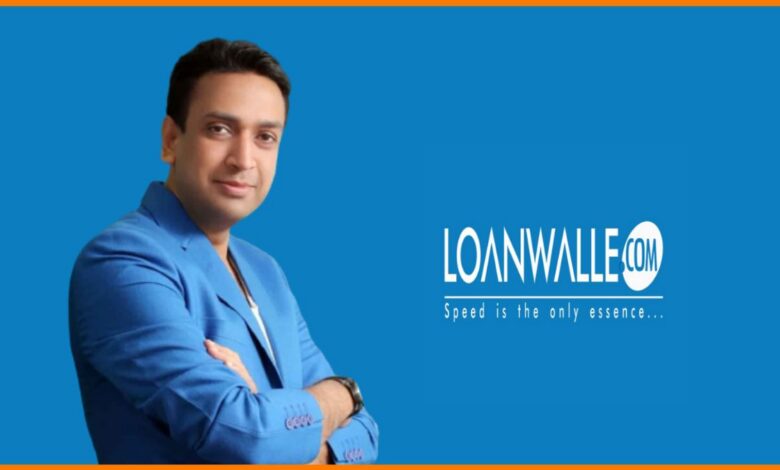
There is a particular Indian genius for dressing a village moneylender in a hoodie, slapping a Certificate of Registration on the wall, and calling the result “financial inclusion.” Sachin Mittal has practised that genius with unusual stamina. The brand on the phone has been Loanwalle. The lender in a Karnataka High Court file is Naman Finlease Private Limited. The latest press kit sells Fintech Cloud Private Limited as a ₹1,500-crore “technology and operations platform.” The legal person in today’s Loanwalle footer is a May-2026 company called 8byte.ai. The DIN that keeps turning up is 02683561. The interest rate that refuses to die is the one the founder himself advertised in 2020 and that a High Court recited in 2023: one per cent per day.
That is not a slogan. That is arithmetic with teeth.
The product, in the founder’s own words
On 25 January 2020, The New Indian Express published a straightforward product pitch. Loanwalle.com, founded by Sachin Mittal, offered emergency loans of ₹5,000 to ₹1 lakh for 7–30 days, approved in fifteen minutes. Mittal’s quote is not ambiguous:
“The interest rate is 1 per cent per day and the loan cannot be exceeded beyond 30 days.”
One per cent per day. Not per month. Not “reducing balance, subject to credit score.” Per day. On a thirty-day clock timed to the salaried victim’s next paycheck.
Three years later, that number walked into a courtroom wearing an NBFC certificate.
On 19 July 2023, in Naman Finlease Private Limited v. State of Karnataka (W.P. No. 13963 of 2023), the Karnataka High Court recorded Naman’s own case: it was an RBI-registered non-deposit-taking NBFC; it had sanctioned ₹25,000 to one Sri Chaithanya on 30 November 2022 through the app Loanwalle, which the company described as its creation; the contracted interest was 1 per cent per day; repayment was due 3 January 2023. The borrower later alleged recovery harassment. Bengaluru police registered Crime No. 289 of 2023 under IPC Sections 419, 420, 504 and 506 and IT Act Sections 66C and 66D, and froze Naman’s bank account. The High Court later set aside the freeze because police had not complied with Section 102(3) CrPC. It did not try the interest rate. It did not acquit anyone on the merits. It left the door open for lawful fresh action. The recital of 1% a day stayed on the page.
That is the heartbeat of this story. Multiple loan products. Different brand names. Various partner NBFCs and LSPs behind them. One documented commercial logic: extract from people who need money before the next salary credit, at a rate no bank would print on a home-loan brochure.
Do the arithmetic they hoped you would never do
Take the structure that has defined this corner of digital payday lending.
A salaried employee “borrows” ₹50,000. A 10% fee is sliced off the top. He receives ₹45,000. Interest is charged at 1% of the ₹50,000 face every day — ₹500 a day. In thirty days that is ₹15,000 in interest. Add the ₹5,000 fee. He owes ₹65,000. He has used ₹45,000 for a month.
- Simple period cost on cash in hand: ₹20,000 / ₹45,000 = 44.4% in 30 days.
- Simple annualisation of that month: roughly 541%.
- Simple annualisation of 1% a day on face principal: 365%.
- Daily compounding of 1%: (1.01)365−1≈(1.01)^{365}-1 \approx 3,678% effective annual.
Now shrink the ticket the way the user’s own cycle describes it. A ₹40,000 face, same machinery, same month-end trap: renew, deduct again, disburse again, demand again. Three turns and the interest extracted exceeds the original principal. That is not “APR sensitivity.” That is a meat grinder with a Play Store icon.
No household on a salary cycle can sustain 365%–540%+ money. They do not have to. The product is designed so they renew. One day’s delay and the recovery machinery starts — calls not only to the borrower but to family and office colleagues; physical appearances at home and workplace; the social humiliation that RBI’s Fair Practices Code and digital-lending guidelines were written to stop. The trapped borrower takes a second app to pay the first. Then a third. That is not a customer journey. That is a funnel.
Call it a “fintech cloud” if the phrase helps the valuation deck. On the ground it is a digitised, scaled-up version of the village sahukar who used to sit under the peepal tree in every bad Hindi film about farmers. The only upgrade is the call-centre and the bureau tag.
The web, not the single app
The public record does not show one lonely app. It shows a costume change.
Naman Finlease Private Limited, CIN U70101DL1997PTC088735, incorporated 1997, registered office S-370, Basement, Panchsheel Park, New Delhi 110017, RBI registration publicly displayed as N-14.01466, still appears on the Reserve Bank’s list of NBFCs as an Investment and Credit Company that cannot take public deposits. Commercial profiles and the Karnataka High Court both tie Loanwalle to that company. MCA mirrors have long attached Sachin Mittal’s DIN 02683561 to Naman’s board history.
Loanwalle Finserve Private Limited sits in the same director graveyard. So do Maple Technosoft, DS Loan Solutions, Top Mortgage Brokers, assorted chit-fund vehicles and a string of struck-off or noisy appointments that would make any serious diligence officer sit up. None of that is a certified ownership tree. All of it is a director-history that refuses to look like a single, tidy startup.
Fintech Cloud Private Limited, CIN U72900DL2021PTC375556, incorporated January 2021, names Mittal founder and director. A September 2026 sponsored note in The Hindu BrandHub said Indiabulls Limited had signed to acquire 70% in an all-share deal valuing the company at about ₹1,500 crore (consideration ₹1,050 crore). The same note claimed Fintech Cloud did ₹133.77 crore revenue and ₹30.31 crore profit before tax in FY26 — the number the user flagged as the scale question. If an aggregator layer is booking that kind of top line, the NBFCs whose books it services are not running a lemonade stand. They are running hundreds of crores of short-tenor paper at payday economics. That is the point of the “cloud”: centralise origination, KYC, disbursement and recovery across brands while the regulated entity keeps the CoR.
Today’s Loanwalle website no longer shouts “1% a day” on the homepage. It sells a multi-lender marketplace, “50+ partners,” personal-loan copy at 2.9166% a month / 35% APR, 1–3 year tenures. The footer says powered by 8byte.ai, CIN U62020MH2026PTC471057, incorporated May 2026, Mumbai address. Other write-ups name Ampire Fintech as the present operator of the same brand. A 2015 brand wearing a 2026 company is not innovation. It is fog. Fog is how a borrower who signed with Naman in 2022 cannot find who owns the harassment in 2026.
U.Y. Fincorp’s April 2025 exchange filing put a ₹20-crore NBFC sleeve under a Fintech Cloud arrangement branded FUNDOBABA. Different sticker. Same neighbourhood.
Multiple products. Different names. Partner NBFCs. One documented historical rate. One founder orbit. That is the web.
The other docket the press kit does not lead with
On 11 June 2023, Sachin Mittal was arrested in FIR 84/2023, PS Special Cell, Delhi. Sections invoked, as recorded by the Delhi High Court: IPC 420, 467, 468, 471, 384, 506, 120B. The prosecution case, as recited in Sachin Mittal v. State (NCT of Delhi), Bail Appln. 2576/2023, decided 28 March 2024, alleged that two home loans totalling about ₹6.80 crore — ₹3 crore from IDBI Bank, ₹3.80 crore from ICICI Bank — were obtained against Gurugram properties using forged documents. The Court recorded the State’s account that Mittal ran Naman Finlease; that interrogation produced a narrative of fraudulent loans to feed the NBFC and private moneylenders; that associates prepared forged papers. Reporting of the status report has put the State’s wider count at seven FIRs and sixteen identified victims. He was given fourteen days’ police custody. He later obtained regular bail. The High Court expressly did not decide guilt. Public e-Courts material cited in later reporting still showed the matter pending years after the FIR, with supplementary investigation dragging.
Those are prosecution allegations. They are not a conviction. They are also not a rumour invented on Twitter. They sit in a High Court bail order next to the same name that founded Loanwalle, sat on Naman, and now fronts a ₹1,500-crore LSP story.
A listed acquirer doing a four-figure-crore share swap around a founder with that docket is not a lifestyle feature. It is a governance question. Markets are allowed to ask it. Regulators are supposed to.
What RBI’s own rules already said — and what the silence looks like
RBI’s digital-lending framework was not written for fun. It was written because unregulated and lightly supervised apps had turned India into a laboratory for 1%-a-day paper, contact-list scraping, workplace humiliation and rollover traps. The Bank created a public Digital Lending App directory precisely because unscrupulous players kept claiming association with regulated entities. It told regulated lenders they remain responsible for their LSPs. It told them recovery must not become a street performance.
Against that backdrop, the documented facts are ugly in their simplicity:
- A founder on tape (print) selling 1% a day.
- An RBI-registered NBFC telling a High Court the same rate on a Loanwalle ticket.
- A criminal complaint of recovery harassment that produced an FIR and an (later quashed-on-procedure) account freeze.
- A separate Special Cell case of alleged forged-property bank loans in the crores, arrest, bail, no verdict.
- The same NBFC still printing its RBI number.
- The brand still collecting KYC under a new CIN.
- A young “cloud” company booking ₹134 crore of revenue and shopping a ₹1,500-crore valuation.
No published RBI cancellation of Naman’s CoR, and no public monetary-penalty order against Mittal on these specific matters, has been located in the open record reviewed for this piece. That is not an acquittal by Mint Street. It is an absence. Absences are how predatory machines keep breathing.
The taunt that writes itself
They will say it is “risk-based pricing for thin-file borrowers.” Risk-based pricing does not need to eat the principal in ninety days.
They will say it is “only a marketplace now.” Marketplaces do not erase a High Court recital of the old product.
They will say Fintech Cloud is “built for regulation, not around it.” A company built for regulation does not need a founder whose other shop is still explaining 1% a day to a Karnataka judge while a Delhi trial calendar keeps getting new dates.
They will say borrowers signed the KFS. Desperate people sign anything at 11 p.m. when the rent is due. That is why usury laws and fair-practice codes exist. A signature is not a moral blank cheque for 3,678% compounding.
The internet is full of people who took one “emergency” loan and discovered there is no emergency exit — only another app, another deduction, another agent who knows their employer’s phone number. That chorus is not proof of any one man’s guilt in a criminal court. It is proof the product works exactly as designed.
Who funds the book? If the platform layer is printing ₹130-plus crore a year, the NBFCs behind the apps are not hobbyists. They are running a factory. Factories this loud do not stay invisible unless someone prefers not to look.
What must happen now
Allegations are cheap. Dockets are not. The country does not need another viral thread. It needs:
- RBI to treat a High Court recital of 1% a day on a registered NBFC’s own app as a supervisory event, not a curiosity — inspect the historical book, the LSP contracts, the partner-NBFC chain, the recovery vendors, and whether the DLA directory actually captured every skin this operation has worn.
- Delhi Police / the trial court to stop treating FIR 84/2023 as a calendar ornament. Three years from FIR to “still pending” is not due process. It is due decay. If the case is weak, say so in a judgment. If it is strong, lead evidence. Either outcome is cleaner than this fog.
- Karnataka investigators to finish, lawfully, whatever remains of Crime 289/2023 instead of letting a procedural quashing of a freeze become a burial.
- SEBI and the acquirer’s board to force disclosure that a retail shareholder can actually read: founder litigation, related-party NBFCs, historical pricing, LSP revenue quality — not a BrandHub poem about “multi-dimensional impact.”
- Parliament and the Bank to stop pretending India has no usury problem because there is no hard statutory cap. When the documented daily rate is 1%, the “board-approved policy” joke has run out.
Speedy investigation. Speedy trial. Speedy regulatory action. That is not vengeance. That is the minimum a Republic owes people who borrowed ₹45,000 and were told the future would only cost ₹500 a day.
Disclaimer
This is an investigative opinion piece based on publicly available court orders, contemporaneous news reports, company and MCA-mirror records, RBI lists, and corporate announcements cited above. All criminal allegations against Sachin Mittal and associated persons or companies remain allegations. No court of law has convicted Sachin Mittal till date. The Delhi High Court granted him regular bail in March 2024 without determining guilt. The Karnataka High Court quashed an account freeze on procedural grounds and did not adjudicate the underlying recovery complaint on merits. Corporate valuations and revenue figures cited from company/sponsored releases have not been independently audited by this writer. Readers should not treat this article as a finding of criminal or civil liability. The persons and entities named are entitled to their defence. The public is entitled to faster, tighter investigation and trial — and to a regulator that treats 1% a day as a siren, not a footnote.