Nayan Raheja’s Journey From Raheja Riches To Two Bail Rejections. Is It Time For The ED To Dig Deeper And Is There Hope For 4,600 Homebuyers
Two courts have denied Nayan Raheja anticipatory bail, but the bigger questions remain. With ₹2,425 crore allegedly collected from 4,600 homebuyers and the ED probing the money trail, where did the funds go, who was responsible, and will this investigation finally bring buyers closer to justice?

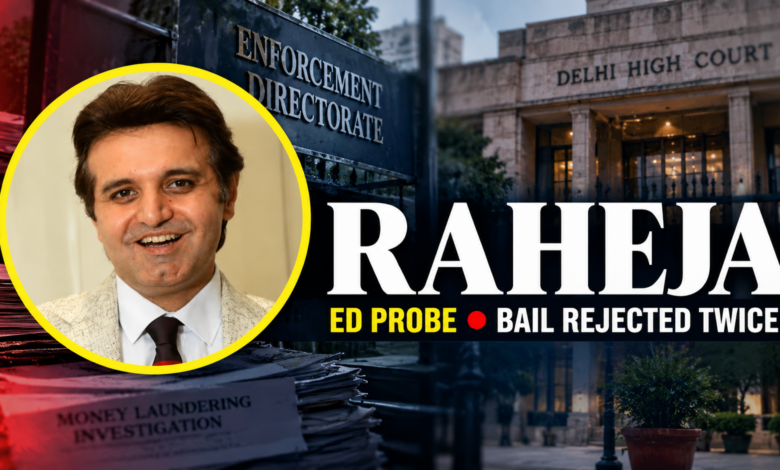
Nayan Raheja has now suffered two setbacks in his bid to secure anticipatory bail, first at the Saket court and then at the Delhi High Court. The latest rejection, on October 15, 2026, puts the spotlight back on the Enforcement Directorate’s money-laundering investigation into allegations involving thousands of homebuyers.
But the bigger question is what happens next. Will investigators be able to establish where the money went, who was responsible, and whether the people who paid for homes will finally get answers?
For the estimated 4,600 homebuyers associated with the case, the legal battle is only one part of a much longer wait. A court refusing pre-arrest protection does not automatically recover their money, deliver their homes or resolve their disputes. Those outcomes depend on what the investigation establishes and what remedies become available to the affected buyers.
The immediate issue, therefore, is not simply that Raheja has been denied bail twice. It is whether the investigation can now bring greater clarity to a case involving substantial sums, disputed transactions and buyers who still need answers.
₹2,425 Crore From 4,600 Homebuyers. Where Did the Money Go?
The scale of the investigation is difficult to ignore. According to the Enforcement Directorate, Raheja Developers collected approximately ₹2,425.99 crore from around 4,600 homebuyers across various residential projects.
The agency alleges that a substantial portion of these funds was diverted through a network of related entities and shell companies and used for purposes unrelated to the construction and completion of the homes for which the money was collected.
The ED has also alleged that funds were ultimately transferred to entities controlled by the company’s director, family members and close associates. Its investigation has involved searches, the seizure of documents and digital evidence, and the provisional attachment of properties.
The financial figures raise another question. By July 2026, the ED had reported cumulative provisional attachments with an estimated market value of ₹2,399.65 crore. That figure is close to the ₹2,425.99 crore the agency says it collected from homebuyers, but the two cannot be treated as equivalent. One represents the reported value of attached assets; the other represents money collected from buyers. An attachment is also not the same as money recovered and returned to those buyers.
For the 4,600 homebuyers, therefore, the central issue is not simply how much money was collected or how much property has been attached. It is whether investigators can trace the alleged diversion, establish who was responsible for the transactions and determine what assets, if any, can ultimately be used to provide relief.
And that brings the investigation back to Nayan Raheja. What, specifically, does the ED allege was his role in the financial transactions, and what evidence connects him personally to the money trail? Those questions become particularly important now that two courts have refused him anticipatory bail.
Seven Summonses, Five Non-Appearances and Two Bail Rejections
The road to the two bail rejections began well before the Delhi High Court delivered its latest decision. On July 30, 2026, the High Court recorded Nayan Raheja’s undertaking that he would fully cooperate with the Enforcement Directorate’s investigation. That undertaking later became an important part of the ED’s opposition to his anticipatory-bail application.
The immediate issue was whether Raheja had honoured that commitment. According to the record discussed by Special Judge (PMLA) Sachin Jain in the Saket District Court’s September 19 order, the ED had served him with summonses on seven occasions. He appeared before the agency’s Gurugram Zonal Office twice but failed to appear in person and cooperate on five other occasions, citing different reasons.
The court did not treat this as a minor procedural detail. It held that Raheja had not satisfied the twin conditions under Section 45(1)(ii) of the Prevention of Money Laundering Act, which require the court to be satisfied that there are reasonable grounds for believing that the accused is not guilty and is unlikely to commit an offence while on bail. The court also held that his conduct during the investigation weighed against granting the exceptional protection he was seeking. His anticipatory-bail application was dismissed.
Raheja then approached the Delhi High Court. The matter came before Justice Amit Bansal, who heard the competing submissions before dismissing the plea on October 15, 2026. The High Court noted that the investigation remained ongoing, that Raheja’s role was still being examined and that the material before it did not satisfy the statutory conditions for granting anticipatory bail. His failure to appear despite repeated summonses and the earlier undertaking to cooperate weighed against him.
The ED’s Allegations and Nayan Raheja’s Defence. What Connects Him to the Money Trail?
The central question in this case is not merely whether Raheja Developers collected money from homebuyers and failed to deliver homes within the promised timelines. It is what the investigation can establish about Nayan Raheja’s individual role in the alleged transactions.
The ED’s position is that there is sufficient material to examine his involvement in the affairs of Raheja Developers Ltd., the parent company named in the complaints forming the basis of the investigation, and in subsidiary companies through which the agency alleges homebuyers’ funds were diverted for purposes unrelated to construction. The agency has argued that Raheja’s connection to these entities needs to be examined in the context of the alleged financial transactions.
Raheja’s defence, however, challenges the extent of his involvement. His senior counsel argued that he was not involved in the company’s day-to-day management or decision-making. According to the submissions reported in court coverage, he served as a director of Raheja Developers Ltd. from January 2003 to January 2008 and again from August to November 2010.
His lawyers also pointed to his reported 0.81% shareholding and said he received a salary for providing advice on architectural drawings. They argued that he had not been charge-sheeted in the underlying offences and that there were no proceeds of crime attributable to him.
Why the PMLA’s Bail Conditions Matter, and What the Courts Actually Decided
The legal hurdle facing Nayan Raheja is not simply whether he has been accused of wrongdoing. His application for anticipatory bail was considered under Section 45 of the Prevention of Money Laundering Act (PMLA), which imposes additional conditions on the grant of bail in money-laundering cases.
Broadly, the court must find reasonable grounds to believe that the accused is not guilty of the alleged offence and that he is unlikely to commit an offence while on bail. These conditions apply alongside the other relevant principles governing bail.
In rejecting Raheja’s plea, the Delhi High Court held that the material before it did not satisfy these statutory requirements. It also took a serious view of his failure to appear in person before the ED despite repeated summonses and earlier undertakings to cooperate. The court noted that the investigation was continuing and that his role remained under examination.
One important issue was Raheja’s argument that the ED could not quantify the alleged proceeds of crime beyond the amounts mentioned in the chargesheets relating to the underlying offences.
The High Court rejected the contention that the money-laundering investigation was necessarily confined in that way, observing that an offence under the PMLA is distinct from the underlying scheduled offence. It also made clear that an anticipatory-bail hearing was not the stage for conducting a mini-trial into the precise amount allegedly diverted or determining whether individual transactions were legitimate business transfers.
The immediate consequence is that Raheja has not secured the protection from arrest he sought. The wider question remains whether the ED can substantiate its allegations and establish the individual roles behind the transactions under investigation.
From Raheja Riches to the Money Trail. What Must the ED Establish?
The ED’s investigation is ultimately about more than the amount collected from homebuyers. It is about the movement of that money, the purpose for which it was collected, the transactions through which it allegedly moved elsewhere and the people responsible for those decisions.
In its April 2026 press release, the agency said it had identified approximately ₹2,425.99 crore collected from around 4,600 homebuyers. It alleged that a substantial portion was routed through related entities and shell companies before being transferred to entities controlled by the company’s director, family members and associates. The agency also alleged that some of the funds were used for purposes unrelated to the housing projects, including asset acquisitions and personal uses.
The High Court’s recent reporting provides another important figure. The ED told the court that ₹1,601.63 crore had been diverted from funds received from homebuyers. That amount should not be casually conflated with the total collected. The distinction between the money mobilised, the amount allegedly diverted and the value of attached assets is fundamental to understanding the case.
So what should the ED establish next? First, the agency needs to trace the transactions and identify where the alleged proceeds went. Second, it needs to establish how each relevant individual was connected to those transactions. Third, it must substantiate the allegation that the funds were used for purposes unrelated to the projects, rather than treating every transfer between companies as evidence of wrongdoing.
Raheja’s reported defence is that he was not involved in day-to-day management and held only a 0.81% shareholding. The ED, by contrast, has argued that material collected during its investigation warrants examining his role in the parent company and associated entities. Those competing positions make the underlying records, financial transactions and evidence of individual involvement especially important.
Is There Finally a Glimmer of Hope for 4,600 Homebuyers?
For the thousands of buyers caught up in this case, the question is painfully simple. They paid for homes. The investigation now concerns what happened to the money they handed over, whether the alleged diversion can be established and whether the assets identified by the ED can translate into meaningful relief.
The reported attachment of properties worth approximately ₹2,399.65 crore may appear significant alongside the ₹2,425.99 crore the ED says was collected from homebuyers. But an attachment is a legal measure to prevent assets from being dealt with freely while proceedings continue. It is not the same as recovering that money, distributing it among buyers or ensuring that unfinished homes are delivered.
There are therefore several separate questions that need answers. Can the agency trace the alleged proceeds of crime? Can the legal process establish who was responsible for any diversion? What happens to the attached properties? And what remedies are available to buyers who are still waiting for possession, compensation or the return of their money?
The bail proceedings alone cannot resolve these issues. Even if the investigation establishes the alleged financial wrongdoing, recovery and relief will depend on the relevant legal proceedings, the assets available and the rights of individual buyers.
For the homebuyers, hope must ultimately be measured in outcomes, not court orders alone. An investigation that establishes the money trail and identifies responsibility could be an important step. But the real test will be whether the process moves beyond allegations and produces a practical route to justice.
The Last Bit, What Happens Next? Will The ED Move In, And What Does This Mean For Nayan Raheja?
The Delhi High Court’s rejection of Nayan Raheja’s anticipatory-bail application leaves him without the pre-arrest protection he sought. But the next step is not automatic.
The ED must decide how to proceed with its investigation in accordance with the law, including whether it considers custodial interrogation necessary and whether the legal grounds for arrest are made out. The rejection of anticipatory bail does not, by itself, establish that Raheja has been arrested or that the allegations against him have been proved.
For the agency, the larger task remains the financial investigation. It must establish the alleged movement of homebuyer funds, examine the transactions involving the developer group and associated entities, and determine the individual roles supported by the evidence.
The reported attachment of properties worth approximately ₹2,399.65 crore is a substantial development, but the investigation must still distinguish between assets provisionally secured and money that can ultimately be recovered for affected buyers.
For Raheja, the immediate legal position has changed because two courts have declined to grant him anticipatory bail.
For the homebuyers, the outcome they need is more concrete. They need clarity on the status of their projects, the fate of their payments and the remedies available to them.
If the ED establishes the alleged diversion and the proceedings result in recoverable assets, that could become relevant to efforts to secure relief. But no such recovery should be assumed before it happens.
The question raised by this case is therefore larger than whether a prominent real-estate figure can obtain protection from arrest. It is whether an investigation involving thousands of buyers and thousands of crores can establish what happened to the money and produce meaningful accountability.
Two bail rejections have brought Nayan Raheja’s case to another critical point. The real test now is what the investigation establishes – and whether the people who paid for homes finally see tangible progress towards justice.