BPTP Launches SkyNest While Old Homebuyer Questions Remain: Luxury Sales, Delayed Projects and a Trail of Regulatory Disputes
₹750 crore in reported SkyNest sales. A complaint over the relationship between SkyNest and Discovery Park. Consumer-forum orders involving delayed possession, disputed charges and incomplete contractual obligations in other BPTP projects. A separate CBI investigation concerning the Pedestal @70A project. The question is no longer merely what BPTP is launching next, but how comprehensively the company is resolving the issues raised by buyers who invested in its earlier developments.

There is something particularly revealing about the way India’s real-estate market operates. A new project gets a premium name, impressive architectural renderings, a carefully curated lifestyle narrative and a headline about hundreds of crores in sales. The marketing machinery moves at extraordinary speed. The brochures look immaculate. The towers appear magnificent. The future is always promising.
But what about the past?
What about the homebuyers who claim that possession did not arrive when promised? What about consumers who approached commissions over disputed charges and incomplete obligations? What about residents who have fought over maintenance handovers, sewage infrastructure or common facilities? And what about existing allottees who have now raised a regulatory complaint concerning the relationship between a new luxury development and an older residential project?
These questions are not peripheral to the business of real estate. They are central to it.
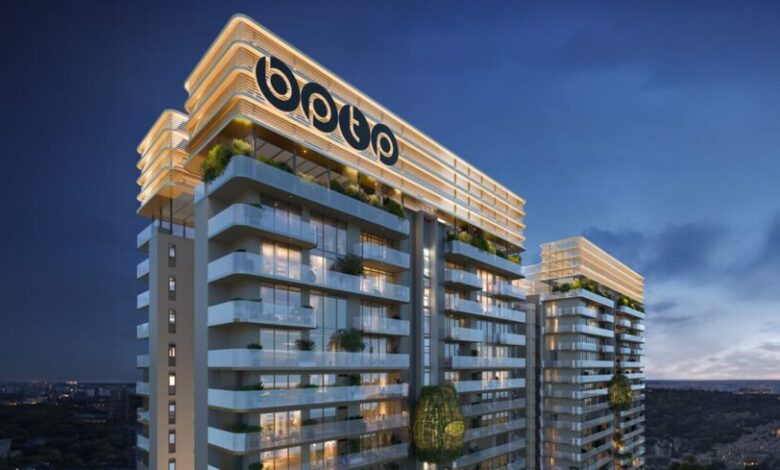
BPTP Limited is promoting SkyNest Towers in Sector 80, Greater Faridabad, as a premium residential development. Company-originated publicity carried by news outlets reports approximately ₹750 crore in sales from 150 luxury homes, translating into an average reported ticket size of ₹5 crore.
Yet an official Haryana Real Estate Regulatory Authority (HRERA), Panchkula, record reveals a representation-cum-complaint concerning SkyNest and the earlier Discovery Park development. The complaint raises questions about land-area changes, revised building plans, previously contemplated schools and other amenities, and the consent of existing allottees.
The Authority’s procedural record does not establish that these allegations have been proved. But it does establish that the concerns have entered the regulatory process.
That creates an unavoidable accountability question.
Why should the excitement surrounding a new luxury launch be allowed to overshadow unresolved questions about the legal and development history of an earlier project?
A developer is entitled to launch new projects. It is equally obliged to honour its contractual commitments, comply with statutory requirements and answer legitimate grievances. New launches do not erase old obligations.
And that is precisely where BPTP’s SkyNest story becomes more complicated than its sales announcement.
1. The ₹750-crore celebration: what exactly is being celebrated?
The reported sales figure is impressive on its face: approximately ₹750 crore from 150 homes, with an implied average price of ₹5 crore per home.
SkyNest’s marketing highlights twin towers approximately 150 metres high, 3 BHK and 4 BHK apartments measuring approximately 3,185–3,856 square feet, more than 82,000 square feet of amenities and around 20 landscaped sky-level spaces.
This is a premium product aimed at buyers willing to pay a substantial price for architecture, space and lifestyle.
But a property headline must not be confused with a complete financial statement.
A company-reported sales value is not necessarily the amount collected in cash. It is not automatically audited revenue. It does not establish how many agreements have been registered, how many transactions have been completed or how many customers have received possession.
Bookings, agreements, collections, registered conveyances and possession are different stages of the real-estate business. An investigative report should not treat them as interchangeable simply because the word sales appears in a press release.
Nor do multiple publications repeating the same company statement necessarily constitute multiple independent verifications of the underlying transactions.
There is a more important issue. Prospective buyers committing ₹3 crore, ₹5 crore or more to an apartment should be entitled to assess the legal and planning position of the project, not simply its advertised appeal.
The company’s sales performance does not settle the questions raised by the Discovery Park complaint. It does not establish whether existing amenities have been delivered, whether revised plans were lawfully approved or whether the precise land boundaries are correctly reflected in the relevant records.
A ₹750-crore sales announcement may be a marketing milestone. It is not a regulatory certificate declaring every surrounding question resolved.
A sophisticated buyer would not invest millions in a company merely because its promotional material looked attractive. The same standard of due diligence should apply to a residential project.
2. SkyNest and Discovery Park: the dispute that deserves centre stage
The HRERA representation places the relationship between SkyNest Towers and Discovery Park under scrutiny.
The supplied regulatory document identifies Licence No. 44 of 2008 as the licence associated with an original group-housing development covering approximately 16.331 acres in Sector 80, Faridabad.
It refers to an original building-plan approval dated 27 June 2012. Under the framework described in the complaint, the development contemplated:
- 12 main residential towers.
- Two economically weaker section (EWS) towers.
- One nursery school.
- One primary school.
- A shopping complex.
- A community building or clubhouse.
The complainants allege that the development delivered to existing allottees does not match that original framework. Their representation states that nine main residential towers and two EWS towers had been developed, while the promised schools remained outstanding.
They also allege that the original development area was divided or reduced, that Discovery Park was registered over a smaller area and that SkyNest was subsequently registered over land forming part of the earlier development.
These are allegations, not established findings of fraud. The original approvals, revised plans, completion certificates, site demarcation and BPTP’s response must determine whether they are substantiated.
Nevertheless, the implications are significant enough to justify a thorough inquiry.
If a buyer selected a residential community partly because it was planned to contain schools and shared amenities, the status of those facilities matters. Their importance does not vanish merely because another part of the development is subsequently marketed as a luxury project.
The central question is whether the original commitments remain legally applicable, whether they have been lawfully altered and, if so, what approvals and consents support those alterations.
BPTP should be asked to answer these questions with documents, not broad statements about its reputation or its sales success.
A new name does not automatically settle an old project’s planning history. A new price list does not extinguish the rights of existing allottees.
The land-area discrepancy: a technical issue that should be settled, not ignored
The complaint refers to an original area of approximately 16.331 acres, a smaller Discovery Park registered area of 10.74 acres and two different figures—5.931 acres and 5.391 acres—in passages describing the later project or revised-plan area.
Other public descriptions refer to SkyNest as occupying approximately 5.4 acres.
The publicly displayed registration information also contains area entries that appear difficult to reconcile when read together. Those entries may refer to different categories of land, such as the larger licensed parcel, the area of an individual phase or another measurement category. A data-entry error or other documentation issue is also possible.
It would be wrong to declare these discrepancies proof of fraud without examining the certified records. But leaving them unexplained is equally unsatisfactory.
BPTP and the relevant planning authorities should publish a certified reconciliation identifying the precise legal and physical boundaries of both projects.
That reconciliation should specify the original licensed area, the area allocated to Discovery Park, the exact SkyNest parcel, the relevant revised plans and the location and legal status of the common facilities.
The authorities should also identify the instrument or approval under which any division of land or alteration in the development layout was permitted.
A homebuyer should not have to reconstruct the legal history of a multi-acre development by comparing inconsistent numbers on separate public documents.
If the land division is lawful, a certified plan should demonstrate it. If the figures reflect genuine non-compliance, the regulator should identify the problem and act under the applicable law.
Until that exercise is completed, the discrepancy is a legitimate issue for investigation—not a verdict.
3. Revised building plans and the consent question
The complaint challenges a revised building plan dated 5 March 2026 and alleges that the required consent of two-thirds of the existing allottees was not obtained.
Section 14 of the Real Estate (Regulation and Development) Act, 2016, governs adherence to sanctioned plans and provides for allottee consent in relation to certain alterations. Whether its requirements apply in the manner alleged depends on the nature of the proposed changes, the statutory framework and the approvals actually granted.
This makes the underlying documents decisive.
The authorities should examine the original building plan, subsequent revisions, the approval file for the revised plan, the allottee-consent records and the legal basis on which each alteration was made.
If consent was required and obtained, the records should establish that. If the law did not require the consent alleged by the complainants, the relevant legal basis should be explained. If the law required consent but it was not obtained, the competent authority should determine the consequences.
No developer should be presumed guilty merely because a complaint alleges that consent was absent. But no credible complaint concerning mandatory consent should be dismissed merely because the promoter has launched a successful new project.
Consent is not a decorative formality when the law requires it. Equally, the allegation that consent was missing must be demonstrated through the relevant records.
The public deserves a direct answer.
4. What happened to the schools and common amenities?
The complainants contend that Discovery Park was originally presented as a comprehensive residential development but that the development delivered has not matched the promised or approved framework.
According to their representation, the project included two schools and other common facilities, but those facilities remained outstanding at the stage described in the complaint.
This claim requires physical inspection and documentary verification.
The authorities should establish whether the schools were mandatory under the original approvals, whether the relevant plans were lawfully revised, whether the facilities were relocated or completed and which entity remains responsible for delivering them.
A detailed public status statement should identify each facility, its approved location, its present status and its relevant completion or approval record.
If the facilities have been delivered in accordance with the operative plans, the evidence should establish that. If they remain incomplete, the company should explain why and identify the applicable delivery obligations.
The issue is not whether a nursery school or a primary school can be mentioned in a marketing brochure. It is whether the approved and applicable development commitments have been fulfilled.
Luxury marketing cannot become an excuse for leaving the status of earlier amenities unclear.
5. A record of delayed possession: Park Sentosa
SkyNest is not the first BPTP-associated project to have faced substantial litigation over possession and construction progress.
One of the clearest examples is Park Sentosa, the group-housing project in Village Nimka, Sector 77, Faridabad.
In Neeraj Chowdhary and Others v. BPTP Ltd. and Others, Consumer Case No. 737 of 2018, the National Consumer Disputes Redressal Commission considered a representative complaint involving BPTP, Countrywide Promoters and Anjali Promoters & Developers.
The complaint arose from apartments booked in 2013–2014. Under the contractual timeline described in the judgment, the commitment and grace periods expired around July 2017.
The complainants alleged that construction progress had been extremely limited, that demands were raised without corresponding progress and that they were left without a clear possession timeline. They also raised grievances about the subvention scheme, financial burdens and the possibility of forfeiture if they sought refunds.
Those claims were disputed by the developers. They argued, among other things, that some purchasers had defaulted on payments, that contractual possession timelines were subject to specified conditions and that the representative complaint was not maintainable in the form presented.
The NCDRC’s decision of 25 May 2022 partly allowed the complaint and directed the opposite parties to refund the amounts deposited by the relevant complainants, with interest at 9% per annum from the respective dates of deposit.
That is a documented consumer-law outcome, not merely an allegation.
The distinction matters because the order demonstrates that at least some Park Sentosa buyers obtained a refund remedy through consumer adjudication. It does not establish that every apartment in the project was abandoned or that every buyer had the same grievance.
But for the affected complainants, the dispute was plainly more consequential than an ordinary disagreement over a marketing claim. Their remedy required proceedings before the national consumer forum.
When a developer starts promoting another premium product, the history of such disputes deserves to be remembered—not to presume guilt in the newer project, but to insist that existing buyers receive the protection and remedies available under law.
6. Princess Park: delayed possession, compensation and a later complaint that was dismissed
Princess Park in Sector 86, Faridabad, provides another example of why BPTP’s property record must be examined case by case.
In the Satpal Singh Bhatia dispute, the consumer commission found an abnormal delay in handing over Flat K-1001. It directed the opposite party to deliver possession within two months, pay compensation at ₹10 per square foot for every month of delay until the relevant possession and completion/occupancy milestones, and refund ₹54,731 collected as yearly maintenance charges.
This was a consumer adjudication concerning a particular allotment. It was not a declaration that the entire Princess Park project had been abandoned.
A later complaint concerning another Princess Park flat, Abhishek Singal v. BPTP Ltd., was dismissed by the Delhi State Consumer Disputes Redressal Commission on 21 September 2026. That complainant had challenged charges, changes in the flat’s area and layout, maintenance, fittings and other matters. The Commission found that the allegations had not been proved by sufficient evidence in the circumstances of that case, including the complainant’s acceptance of the completed property and execution of the conveyance deed.
That dismissal is important and must not be concealed. A responsible report cannot count every complaint as an adverse finding.
The proper conclusion is that Princess Park has produced different consumer disputes with different outcomes: one in which possession and monetary relief were ordered and another in which the claims were dismissed.
This is exactly why the operative judgment—not the headline of a complaint—must determine what can legitimately be stated about a project.
7. Next Door: a 2026 consumer judgment with a clear finding against BPTP
The commercial development known as Next Door in Sector 76, Faridabad, is particularly relevant to the question of delayed or undelivered property.
In Harish Kumar Awasthi and Another v. BPTP Ltd. and Another, Complaint Case No. 43 of 2015, decided on 25 May 2026, the Delhi State Consumer Disputes Redressal Commission considered a dispute concerning an office space booked in February 2008.
The complainants paid the basic sale consideration of approximately ₹36.18 lakh by June 2009. Their complaint stated that possession was expected around August 2010. Although a possession letter was issued in February 2014, the Commission found that the offer did not amount to lawful and complete possession in the circumstances before it.
The order recorded prolonged delay, disputed demands, uncertainty regarding the unit and problems with the execution of required documents. The Commission found deficiency in service and unfair trade practice in the circumstances of the case.
The decision directed a refund of ₹43,29,359.10, with interest at 6% per annum from the respective dates of deposit, provided payment was made by 24 July 2026. It prescribed 9% annual interest for the period of default if the refund was not made by that date. The Commission also ordered ₹1 lakh for mental agony and harassment and ₹50,000 in litigation costs.
The payment-compliance position was not independently established in the records reviewed for this report.
The judgment’s findings relate to the particular Next Door transaction; they cannot automatically be applied to SkyNest. But the ruling is a concrete example of a consumer commission finding that lawful possession had not been delivered within the promised period and granting a refund with interest and compensation.
That is the kind of record that should inform a serious assessment of a developer’s obligations to its buyers.
8. Amstoria: a separate dispute over allotment and charges
BPTP Amstoria in Sector 102, Gurugram, has also figured in consumer litigation.
In Sanjeev Mahajan v. BPTP Ltd., Complaint Case No. 188 of 2022, the Delhi State Consumer Disputes Redressal Commission issued its decision on 8 June 2026.
The case concerned a plot in the Amstoria development. The record describes a delay of approximately seven years in allotment, following intervention in the consumer proceedings, and subsequent disputes over documentation, terms and charges.
The Commission found the delayed-payment-interest charge of ₹8.06 lakh unjustified in the circumstances of that case and directed BPTP to refund the amount with 6% interest, along with ₹1 lakh for mental agony and harassment and ₹50,000 in litigation costs.
This is not proof that the whole Amstoria development was stalled or abandoned. It is a documented finding concerning a specific transaction and a disputed financial demand.
The appropriate lesson is that contractual delivery, charges and documentation can have real financial consequences for buyers, and the relevant evidence must support the demands made by a developer.
9. Park Spacio: pre-possession maintenance charges and a regulatory order
Another 2026 order concerned BPTP’s Park Spacio project in Sector 37D, Gurugram.
According to reporting on the Haryana RERA Gurugram bench’s order dated 26 June 2026, BPTP was directed to refund ₹1,16,545 collected as maintenance charges before possession, with interest at 11% per annum from the date of collection until realisation. The adjudicating officer also awarded ₹1 lakh in compensation and ₹50,000 in litigation costs.
BPTP’s President of Business Development, Rohit Mohan, was quoted as saying the company had not yet been formally served with the order and would review it and consider its legal options.
The company’s response is part of the record and should be acknowledged. Any subsequent appeal or compliance must be checked before describing the order as fully executed or conclusively settled.
Nonetheless, the order is a concrete instance of a regulatory authority directing a BPTP refund and compensation in connection with a disputed charge.
For a buyer, a charge collected before the relevant legal conditions are met is not a trivial accounting detail. The legality and timing of such charges can affect the total cost of ownership.
10. Park Grandeura: residents, sewage infrastructure and maintenance responsibility
Park Grandeura in Sector 82, Faridabad, illustrates a different set of concerns—not a proven abandoned project, but a documented dispute involving common infrastructure and maintenance.
In proceedings before the National Green Tribunal, residents raised a grievance that the sewage treatment plant was not being properly managed and that sewage water was allegedly backing up into flats through drainage systems.
A joint committee inspected the site on 11 April 2023. Its report described a division of maintenance responsibilities involving the residents’ welfare association and the builder, Countrywide Promoters Private Limited, associated with BPTP. The report also recorded a dispute over the maintenance handover and the absence of a clear agreement fixing responsibility for specific services.
The NGT’s order of 19 February 2024 noted that most compliance had been undertaken and directed the committee to ensure implementation of its remaining recommendations within three months. These included clarifying responsibility for the relevant services, regular cleaning of sewer lines and the provision of an additional raw-sewage collection tank as committed by the developer.
A related HRERA complaint by the Park Grandeura Residents Welfare Association, RERA-PKL-2701-2022, concerns the maintenance handover. The publicly available case tracker continued to show that dispute as pending in its latest entries reviewed.
These records do not establish that the whole Park Grandeura project was abandoned. They do, however, show that common infrastructure and the division of maintenance responsibilities became the subject of regulatory and environmental proceedings.
For residents, a completed apartment building is not the end of the developer’s obligations if common services and responsibilities still require resolution.
11. Park Serene: from homebuyer disputes to maintenance-handover tensions
BPTP’s Park Serene/Spacio Park Serene project in Sector 37D, Gurugram, has figured in both possession-related proceedings and a more recent resident-management dispute.
In a Supreme Court record concerning the Park Serene Flat Allottees Welfare Association, the Court noted that the National Company Law Tribunal had initiated the corporate insolvency resolution process against BPTP on 14 November 2022 following a petition by an operational creditor, RBCL Projects Private Limited.
The proceedings became more complex when the operational creditor and a suspended director reached a settlement, and the NCLAT disposed of the relevant appeal in December 2022. The residents’ association challenged the position, arguing that any insolvency process should proceed on a project-specific basis rather than across the company’s assets.
On 17 February 2023, the Supreme Court did not revive the insolvency proceedings. It left the association free to pursue remedies available under the law and directed that the execution proceedings concerning its earlier NCDRC consent order be expedited.
This distinction is essential: the company-wide insolvency process was not left operating as a continuing order by that Supreme Court decision. The episode must not be represented as proof that BPTP is currently undergoing the same insolvency process.
More recently, residents at Park Serene reported dissatisfaction with the transfer of maintenance responsibilities to their elected residents’ welfare association. In August 2026, the association reportedly decided to withhold future maintenance-related payments until the handover process and related concerns were addressed.
This is a resident-management dispute, not evidence that the entire project is physically abandoned. But it demonstrates that the relationship between a developer and its buyers does not necessarily end at the point when a project is described as complete.
A society can have occupied apartments and still face disputes over the control, cost and responsibility for common services.
12. A documented list of delayed, disputed and legally contested BPTP projects
The following list is deliberately restricted to projects for which documentary proceedings, consumer decisions or publicly reported resident disputes were located. It is not a claim that each project has been legally declared abandoned.
| Project | Documented issue | What the record supports |
|---|---|---|
| Discovery Park, Sector 80, Faridabad | Complaint concerning land division, sanctioned-plan changes and outstanding schools/amenities | HRERA representation recorded; allegations not finally adjudicated in the reviewed record |
| Park Sentosa, Sector 77, Faridabad | Delayed possession and construction-progress allegations | NCDRC partly allowed a representative complaint in 2022 and ordered refunds with 9% interest |
| Princess Park, Sector 86, Faridabad | Delayed possession in an individual allotment | Consumer commission ordered possession, delay compensation and refund of specified maintenance charges in the Satpal Singh Bhatia case; a separate 2026 complaint was dismissed |
| Next Door, Sector 76, Faridabad | Prolonged delay and failure to provide lawful and complete possession in a specific office-space transaction | Consumer commission ordered refund of ₹43.29 lakh plus interest, compensation and costs in May 2026 |
| Amstoria, Sector 102, Gurugram | Allotment and disputed interest charges in an individual plot transaction | Consumer commission ordered refund of ₹8.06 lakh plus interest, compensation and costs in June 2026 |
| Park Spacio, Sector 37D, Gurugram | Disputed pre-possession maintenance charges | Haryana RERA ordered a refund with 11% interest, compensation and costs in June 2026 |
| Park Grandeura, Sector 82, Faridabad | Sewage-treatment and maintenance-responsibility dispute | NGT-related inspection and committee recommendations; HRERA maintenance-handover dispute |
| Park Serene/Spacio Park Serene, Sector 37D, Gurugram | Historical possession and insolvency proceedings; later maintenance-handover dispute | Supreme Court left allottees’ remedies open in 2023; residents reported a maintenance-handover dispute in 2026 |
The list above should not be labelled a list of abandoned developments. The records support more specific descriptions—delayed possession in particular cases, consumer refunds, disputed facilities, maintenance controversies and unresolved proceedings.
No comprehensive official list of BPTP projects formally declared abandoned was identified in the material reviewed. Calling every contested or delayed project abandoned would go beyond the evidence.
But this limitation does not diminish the case for scrutiny. It makes clear exactly where documented evidence supports criticism—and where the facts must be established before a stronger allegation can responsibly be published.
13. The CBI investigation concerning Pedestal @70A: a separate but significant development
The CBI investigation concerning BPTP’s Pedestal @70A project in Sector 70A, Gurugram, is particularly important to include because it is an actual criminal investigation—not merely a consumer complaint.
The Supreme Court’s record in M/s BPTP Limited v. Central Bureau of Investigation, dated 20 April 2026, states that the CBI registered FIR No. RC2192026E0001 at Economic Offence Wing-I, New Delhi, against BPTP and a director in connection with the wider inquiry into alleged collusion between real-estate developers and financial institutions concerning home-loan subvention schemes.
The investigation followed directions issued by the Supreme Court in an earlier batch of proceedings on 23 September 2025 and subsequent orders.
The company’s petition challenged its inclusion in the FIR. The Supreme Court recorded BPTP’s submission that 180 units had been developed and completed and that, apart from the two homebuyers involved in that dispute, no other homebuyer had made a complaint against the company concerning that project.
Those are the petitioners’ submissions, not independently established findings in the Supreme Court order.
The Court disposed of the petition because the CBI was already investigating the issues comprehensively, while permitting BPTP and the director to place their material before the investigating agency.
No conviction was recorded in that proceeding. The existence of the FIR establishes that a criminal investigation was registered; it does not establish criminal liability.
Nor is the Pedestal @70A investigation proof that the SkyNest allegations are true. The projects, allegations and evidentiary questions are distinct.
Nevertheless, this case adds to the importance of transparency where home-loan subvention arrangements and the conduct of developers and financial institutions are concerned.
The relevant agency must establish the facts independently, examine the material presented by all parties and proceed in accordance with the law.
A complaint must not be converted into a conviction by publicity. Equally, a criminal investigation ordered within a broader judicial process should not be dismissed as irrelevant merely because a developer is continuing to sell properties elsewhere.
14. The historical income-tax controversy: what the records actually say
BPTP’s earlier income-tax proceedings also warrant careful mention.
The Income Tax Department conducted a search and seizure operation in November 2007. The subsequent assessment proceedings involved seized records relating to property transactions, discounts and alleged cash receipts. The Assessing Officer’s account referred to a statement by the company’s then managing leadership, including an offer of ₹100.01 crore as additional income for the financial year 2007–08.
The interpretation of that statement and its relationship to the subsequent tax additions became disputed.
In its order dated 28 April 2023 in ACIT v. BPTP Ltd., the Income Tax Appellate Tribunal considered the Revenue’s appeals concerning additions associated with alleged unaccounted cash receipts and special discounts.
The Tribunal did not uphold the proposition that every special discount in the relevant records should be treated as unaccounted cash. It recognised that the evidence did not justify that blanket conclusion. At the same time, the proceedings distinguished specific transactions in which seized documents supported the existence of cash receipts not entered in the books.
The Tribunal dismissed the Revenue’s appeals, affirming the appellate treatment of the disputed additions, including the distinction between specific cash receipts supported by the records and the broader allegation regarding all special discounts.
This history must not be sensationalised.
The ₹100.01-crore statement should not be presented as a criminal conviction, nor should the entire amount of alleged special discounts be mischaracterised as proved undisclosed cash. The appellate proceedings expressly addressed those evidentiary distinctions.
But the historical record is relevant to a broader principle: tax and financial disclosures require documentary scrutiny. They cannot be reduced to either a sweeping allegation of wrongdoing or an equally sweeping declaration that every question has disappeared.
The proper approach is to report the assessment history, the company’s objections, the appellate findings and the limits of the decision.
15. Environmental compensation of ₹2.1195 crore: imposed, then set aside
Another major regulatory episode concerned BPTP’s Amstoria residential plotted colony in Sector 102, Gurugram.
In June 2025, the Haryana Water Resources Authority imposed environmental compensation of ₹2,11,95,216 concerning alleged unauthorised groundwater extraction.
The matter arose after a site inspection and committee report concerning tube wells and the verification of no-objection certificates. BPTP disputed the allegations and challenged the procedure followed by the authorities.
On 5 September 2025, the Punjab and Haryana High Court set aside the ₹2-crore compensation order, finding that the action suffered from problems relating to natural justice and due process. The Court directed the matter to be reconsidered through fresh proceedings and physical inspection.
The result must be described accurately.
The compensation order was set aside. It should not be reported as an operative, finally established penalty against BPTP on the basis of that order. Nor does the procedural decision necessarily establish that the underlying environmental concerns were unfounded.
The case demonstrates why enforcement must be both prompt and lawful. If there is evidence of an environmental violation, it must be properly investigated. But a penalty cannot stand merely because an allegation is serious; the process must meet the requirements of law.
A subsequent final outcome in the fresh proceedings was not established in the records reviewed for this report.
16. Other consumer and maintenance disputes: a continuing accountability question
Beyond the major cases already discussed, several proceedings show why the company’s project-level obligations deserve close attention.
At Parklands Pride Plots, the official HRERA listing showed a regulatory agenda concerning submission of bank-account details by BPTP Parklands Pride Ltd. The matter appeared in hearings in 2026 and was again shown as adjourned on 14 October 2026.
That entry is a procedural compliance matter. The published record does not, by itself, establish misappropriation, fraud or a penalty. It is included because current regulatory dockets should be checked rather than assumed to be fully resolved.
At Park Grandeura, the issue concerned sewage infrastructure and maintenance responsibility, with the NGT-linked process recording that most compliance had been completed and directing follow-up on the recommendations.
At Park Serene, a recent resident dispute concerned maintenance handover, while older proceedings involved possession and insolvency-related questions.
These matters differ significantly. Some led to financial relief, some to directions for further action and some remain disputed.
The critical point is not that all of them prove a single pattern of illegality. They do not.
The point is that a developer’s overall public record includes more than its newest launch. It also includes how obligations are met, how residents are treated when disputes arise and how quickly final orders are implemented.
A real-estate group cannot expect its reputation to be assessed only through its best-selling project while its other documented disputes are treated as irrelevant background.
17. Penalties, refunds and compensation: what has actually been ordered?
The following table separates financial remedies granted by consumer or regulatory bodies from criminal penalties and environmental compensation. These categories must not be mixed.
| Project / proceeding | Amount or remedy | Legal status and qualification |
|---|---|---|
| Park Sentosa, 2022 NCDRC order | Refund of deposits with 9% annual interest | Complaint partly allowed; directed at the relevant complainants’ claims |
| Princess Park, Satpal Singh Bhatia dispute | ₹10 per sq. ft. per month in delay compensation; ₹54,731 maintenance refund; possession direction | Consumer commission relief in an individual allotment dispute |
| Next Door, 25 May 2026 | ₹43,29,359.10 refund with 6% interest; 9% interest for the stipulated default period; ₹1 lakh compensation and ₹50,000 costs | Consumer commission order; compliance after the specified deadline was not independently verified |
| Amstoria, 8 June 2026 | ₹8.06 lakh refund with 6% interest; ₹1 lakh compensation; ₹50,000 litigation costs | Consumer commission order concerning disputed interest charges in an individual transaction |
| Park Spacio, June 2026 | ₹1,16,545 refund with 11% interest; ₹1 lakh compensation; ₹50,000 litigation costs | Haryana RERA order concerning maintenance charges collected before possession |
| Amstoria environmental matter, June 2025 | ₹2,11,95,216 environmental compensation | The order was set aside by the Punjab and Haryana High Court in September 2025 on procedural and natural-justice grounds; fresh proceedings were directed |
The figures above should not be totalled and presented as a single amount owed by BPTP. They concern different projects, complainants, legal proceedings and remedies; the status of compliance or subsequent appeals must be verified separately.
It is equally important to distinguish between a refund, contractual delay compensation, litigation costs, regulatory compensation and a criminal fine.
The consumer orders demonstrate that purchasers have obtained relief in particular disputes. They do not establish that the company or its directors have been criminally convicted.
18. What about penalties imposed personally on BPTP’s directors?
This question requires particular care.
The Supreme Court record concerning Pedestal @70A identifies a CBI FIR against BPTP and a director. It does not record a conviction or a personal criminal penalty. The historical income-tax matter refers to a statement made by the company’s then managing leadership, but that is not the same as a court convicting an individual of a criminal offence.
The environmental compensation discussed above was imposed on the company and subsequently set aside by the High Court. The consumer orders primarily concern remedies against the relevant corporate parties in individual transactions.
No verified court record was identified in the materials reviewed establishing a criminal conviction of a BPTP director in connection with the SkyNest–Discovery Park allegations or the Pedestal @70A FIR. Nor did this review identify a final personal criminal fine against a director arising from those specific matters.
This is not a finding that no other proceedings involving any director exist. It is the limit of the records reviewed.
The appropriate demand is for investigation wherever evidence justifies it, lawful accountability if wrongdoing is established and clear public disclosure of the final outcomes. Personal culpability must be determined on evidence, not by association with a company that is facing allegations.
19. What should BPTP be required to disclose about SkyNest?
For SkyNest, a direct and documented response is necessary.
BPTP should be asked to explain the exact land-area figures, the operative sanctioned building plan, the approvals under which the current layout was authorised and the precise relationship between SkyNest and Discovery Park.
It should clarify whether the original schools and other common facilities remain required under the relevant approvals. If so, it should identify their present status, responsible entity and anticipated completion arrangements. If those commitments have been lawfully altered, the company should disclose the relevant approval and the legal basis for the change.
The company should also address the allegation that the consent required from existing allottees was not obtained for the revised plan. The answer should identify whether consent was obtained, whether it was required for the particular change and which records support that position.
The relevant planning authority should independently verify the site boundaries and the planning history. HRERA should establish a firm timetable for the complaint, obtain the promoter’s reply and issue a reasoned order after hearing the parties.
If a site inspection or technical review is needed, it should be arranged promptly. If the complaint is not substantiated, the Authority should state that clearly. If violations are proved, the appropriate legal consequences should follow.
20. Enforcement agencies must act faster—but on verified evidence
The demand is not for a predetermined verdict against BPTP. It is for a regulatory system capable of reaching a timely and defensible verdict.
HRERA Panchkula should resolve the SkyNest representation and clarify the relationship between the complaint and the separate Discovery Park registration proceedings.
The Department of Town and Country Planning should examine the original licence, revised plans, land division and mandatory facilities. The responsible municipal and infrastructure authorities should verify the present condition of the schools and shared amenities where those matters fall within their jurisdiction.
The CBI should conduct the Pedestal @70A investigation independently, examine the material submitted by BPTP as well as that submitted by the complainants and proceed according to the evidence.
Environmental authorities should ensure that concerns about groundwater extraction are addressed through a process that satisfies the requirements of law. Consumer commissions should enforce final orders and provide an effective remedy to purchasers.
Where the material discloses a cognisable criminal offence, the competent agency should take the action authorised by law. Where regulatory violations are established, the responsible authority should issue and enforce appropriate directions. Where criminal charges are justified, proceedings and trials should move without avoidable delay.
Speedy investigation and enforcement are necessary; presuming guilt before investigation is not. The public interest lies in a system that can do both: establish the facts quickly and respect due process.
The longer a material dispute remains unresolved, the longer affected purchasers must live with uncertainty about their money, property rights or common facilities. That is reason enough for the authorities to adopt time-bound procedures and publish clear outcomes.
21. The fundamental problem with the luxury-first narrative
BPTP’s SkyNest announcement is built around aspiration: tall towers, expansive apartments, exclusive amenities and reported sales of ₹750 crore.
But no real-estate developer operates in a vacuum. A company’s public record includes its contracts, its approvals, its delivery commitments and the disputes brought by those who have already paid it.
The SkyNest–Discovery Park complaint raises a specific set of questions about land, planning and facilities. Park Sentosa and Princess Park have produced consumer decisions concerning particular allotments. Next Door has a 2026 order finding deficiency in service and unfair trade practice in a specific transaction. Amstoria and Park Spacio have produced further consumer or regulatory orders concerning individual financial grievances. Park Grandeura’s sewage and maintenance issues reached environmental and regulatory proceedings. Park Serene has a record of possession-related litigation and more recent maintenance-handover tensions. A separate CBI FIR concerns Pedestal @70A.
These matters do not all establish the same thing. Some are allegations, some are adjudicated consumer disputes, some are regulatory directions and some remain under investigation. Their legal outcomes must remain distinct.
But that distinction does not make the questions unimportant. It makes rigorous reporting essential.
The real test of a developer is not merely how well it launches its next project. It is whether earlier commitments are honoured, whether financial demands are justified, whether homes and amenities are delivered as agreed and whether valid grievances are resolved fairly and promptly.
There is no legal prohibition on launching a new project while separate disputes exist. But there is also no legitimate reason to treat new sales as a substitute for answers to old questions.
SkyNest may offer a premium view of the skyline. The public still deserves a clear view of the documents.
The land boundaries should be reconciled. The sanctioned plans should be identified. The status of common facilities should be verified. The complaint should receive a timely and reasoned decision. Any further violations established by competent authorities should lead to appropriate action under the law.
Until then, the ₹750-crore headline remains evidence of reported commercial performance—not a verdict on the outstanding questions concerning SkyNest or the wider record of BPTP projects.
The questions are legitimate. The answers should be documentary. And the process should be faster.
FINAL WORD
A developer can launch a new brand, commission another architectural rendering and announce another commercial milestone. What it cannot do is make a documented dispute disappear by moving the marketing spotlight elsewhere.
BPTP’s next project may be SkyNest. Its next public responsibility should be clarity.
For the existing allottees, the regulatory authorities and the prospective buyers who may invest crores in the company’s newest launch, that is not an unreasonable demand. It is the minimum standard of transparency expected from a business whose product is people’s homes.
STRONG LEGAL DISCLAIMER
This report is based on the identified regulatory records, court and consumer-forum decisions, public project information and company-originated sales publicity available for review as of 14 October 2026.
The allegations concerning SkyNest and Discovery Park—including the alleged division of the original development, changes to sanctioned plans, absence of required allottee consent, non-delivery of promised amenities, inaccurate progress disclosures and alleged violations of applicable laws—remain allegations unless and until established by the competent authority or court. The HRERA proceedings reviewed for this report do not establish that BPTP committed fraud in connection with SkyNest or Discovery Park.
Consumer orders concerning Park Sentosa, Princess Park, Next Door, Amstoria and Park Spacio relate to the particular facts and parties of those proceedings. They must not be represented as findings of criminal guilt in the SkyNest matter. The Princess Park complaint decided on 21 September 2026 was dismissed; that outcome has been acknowledged in this report.
The CBI FIR concerning Pedestal @70A records an investigation into allegations involving a separate project. An FIR is not a conviction. The Supreme Court order reviewed did not convict BPTP or the director concerned.
The ₹2,11,95,216 environmental compensation order concerning Amstoria was set aside by the Punjab and Haryana High Court on procedural and natural-justice grounds, and fresh proceedings were directed. It must not be described as a currently operative penalty on the basis of that order alone.
The historical income-tax proceedings concerned disputed assessments and the evidentiary treatment of specific transactions. They must not be described as a criminal conviction or as proof that every disputed special discount constituted unaccounted cash.
The materials reviewed did not establish a court conviction of BPTP Limited or a named director for the specific SkyNest–Discovery Park allegations or the Pedestal @70A FIR. This is a statement about the records reviewed, not an assertion that no other proceeding exists.