Ankiti Bose Has Not Only Cheated Zilingo & Its Co-Founders But Also Tried To Cheat & Mis-lead Indian Judicial Process & Dwarka District Court

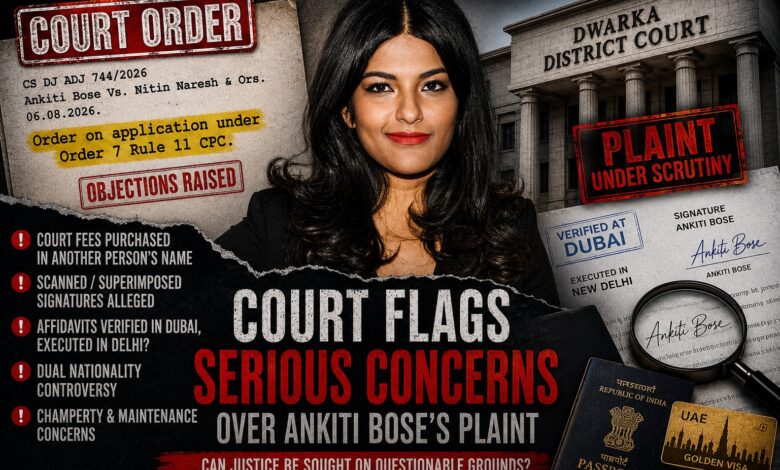
Ankiti Bose, the former co-founder and CEO of the once-celebrated fashion-tech startup Zilingo, has a well-documented history of corporate collapse, board-level ouster, and aggressive litigation. After independent investigations into serious financial irregularities led to her suspension in March 2022 and termination “for cause” in May 2022, Zilingo spiralled into crisis, creditor recalls, mass exits, and eventual liquidation proceedings. Bose has consistently denied wrongdoing and later filed criminal complaints against former colleagues. Parallel to this, critical reporting — including by Inventiva and journalist Nitin Naresh — examined the financial mismanagement, governance failures, and subsequent legal manoeuvres surrounding her tenure and exit.
In 2026 Bose filed a defamation suit (CS DJ ADJ 744/2026, Ankiti Bose v. Nitin Naresh & Ors.) in the Dwarka District Court. She obtained an ex-parte ad-interim injunction from Additional District Judge Harjyot Singh Bhatla restraining the defendants from publishing, circulating or disseminating the impugned article or substantially similar content, and directing its removal. The order observed that Bose was not an accused in the criminal proceedings referenced but rather a complainant in an FIR, and that continued publication risked irreparable reputational harm.
This interim relief was promptly amplified through major media outlets — Economic Times, ANI, Times Now, Devdiscourse, Outlook-linked coverage and others — often framed as a decisive judicial vindication. The narrative projected a picture of a wronged entrepreneur successfully silencing “defamatory” reporting.
Yet the same court, when called upon to examine the plaint itself under Order VII Rule 11 CPC, declined to rubber-stamp the suit. On 6 August 2026 the learned Judge disposed of the defendants’ application for rejection of the plaint without rejecting it, while simultaneously issuing two pointed and conditional directions against the plaintiff. Those directions expose serious procedural and foundational questions that Bose must now address. Far from closing the chapter, the order keeps live the possibility that the plaint itself may become amenable to rejection and that the interim injunction already granted can be vacated if false claims are established.
The Four Objections Raised by the Defendants
The defendants sought rejection of the plaint on four grounds:
- The e-court fees had been purchased in the name of one Ms. Shreya Chanda and not in the name of the plaintiff. Ms. Chanda was not named in the vakalatnama as counsel for the plaintiff.
- Consequently, court fees standing in the name of a person who was neither the party nor an advocate on record for her could not validate the institution of the suit.
- Bose claimed Indian citizenship and relied on Aadhaar and an Indian passport. However, in an earlier suit (C.S. SCJ No. 601/2024 before the South-East District Court, Saket) an order dated 24 March 2026 recorded a submission that the plaintiff was “a national of Dubai” and was unable to come to India due to war in the Middle-East. The defendants argued this revealed dual nationality (impermissible under Indian law), that she was not entitled to Indian passport/Aadhaar, and that a suit predicated on her being an Indian citizen was therefore barred by law.
- The affidavit annexed to the plaint claimed execution in New Delhi while the verification clause recorded verification at Dubai. Paragraph numbers in the verification did not match the actual pleadings. Most seriously, the signatures on the plaint and affidavits appeared to be coloured photocopies or superimposed rather than original signatures of the plaintiff.
The Court’s Detailed Reasoning — And the Two Critical Directions
The Judge examined each ground carefully within the limited scope of Order VII Rule 11 (which requires the Court to look primarily at the plaint and documents filed with it).
On the court-fee issue, the Court noted that plaintiff’s counsel candidly stated Ms. Shreya Chanda was a colleague advocate who had purchased the fees because the matter (injunction) was urgent. Defendant’s counsel could not point to any statutory provision making purchase of court fees exclusively in the party’s name a fatal defect. The Court itself referred to Rule 28 of the Delhi Provinces Stamp Rules, 1934, which places the duty of noting the purchaser’s (and principal’s) name on the vendor. Even if third-party payment raised an inference of champerty or maintenance, Indian law has not adopted the English doctrine in its strict form. Citing Ram Coomar Coondoo (1876), Valluri Ramanamma, the Supreme Court decision in In Re: ‘G’, A Senior Advocate (1955), and subsequent High Court authorities, the Court held that financing arrangements are not per se illegal unless unconscionable or extortionate — a mixed question of fact requiring evidence. At the Order VII Rule 11 stage the defect, even if present, was curable. The plaintiff could be directed to furnish fresh court fees. Whether the named person acted as agent or counsel was a matter for trial, not summary rejection.
On signatures, notarisation and verification, the Court observed that the affidavits appeared notarised, that pleadings may be signed by a party in one jurisdiction and by counsel in another, and that a presumption of regularity attaches to a document that appears duly notarised. Whether the signatures were genuinely those of the plaintiff was a disputed question of fact requiring evidence and therefore outside the scope of Order VII Rule 11. The Court also relied on the e-filing circular of the South-West District (Dwarka) Courts dated 12 September 2024 implementing the Delhi High Court e-filing Rules, 2021, which makes clear that original hard copies are not to be insisted upon as a matter of course. Nevertheless, because a physical copy had been filed and, on careful scrutiny, appeared to be a scanned copy, and because a specific objection had been taken, the Court issued a clear direction: the plaintiff must file the original within 15 days. Failure to do so would render the plaint “amenable to rejection”. The defect was treated as curable, but the Court expressly kept the door open for rejection if the original was not produced.
On the dual-nationality / barred-by-law ground, the Court held that the order-sheet from the other case was a document filed by the defendant. At the Order VII Rule 11 stage the Court cannot look into documents filed by the defendant; it is confined to the plaint and accompanying documents. Bose’s own pleadings and documents (Indian passport + categorical averment of Indian citizenship + UAE Golden Visa) supported the claim of Indian citizenship. A Golden Visa is issued to non-citizens and is consistent with Indian citizenship coupled with UAE residency. The recorded submission in the other case could not be treated as conclusive proof that she was not an Indian citizen. Whether that submission was incorrect or made without instructions was a matter to be ascertained later. The Court therefore directed the plaintiff to file an affidavit explaining her stance on nationality and citizenship. At the present stage the plaint could not be rejected. However, the Court recorded in clear terms that if, after receiving the affidavit, it found that a false claim had been made in the plaint, the interim injunction already granted could be vacated forthwith and the suit could be dismissed by exercising other powers.
The operative order of 6 August 2026 therefore disposed of the Order VII Rule 11 application with two significant directions to the plaintiff:
- Produce the original of the plaint (and related documents) within 15 days, failing which the plaint shall be amenable to rejection; and
- File an affidavit explaining her nationality and citizenship position.
Analytical and Investigative Significance
These directions are not routine housekeeping. They demonstrate that the Court, while declining summary rejection, found the objections serious enough to require curative action under threat of adverse consequences. The court-fee standing in a third party’s name, the apparent scanned nature of the physically filed plaint, and the unresolved tension between the claim of exclusive Indian citizenship and a prior recorded submission of Dubai nationality all remain live issues. The Court has expressly reserved the power to vacate the interim injunction and dismiss the suit if the citizenship claim is ultimately found to be false.
In the broader context, the sequence is revealing. Bose secured an ex-parte injunction that was then widely publicised through mainstream channels. When the defendants pressed the foundational defects in the plaint itself, the same Court refused to treat the suit as unassailable and instead placed the burden back on the plaintiff to cure the identified problems and to clarify her nationality under oath. The judicial process has not been allowed to become a one-way street for silencing critical reporting while leaving basic questions about the very maintainability of the plaint unanswered.
The order of 6 August 2026 therefore stands as a careful, restrained but firm reminder that even a plaintiff who has obtained interim relief remains subject to the ordinary disciplines of the Code of Civil Procedure. Defects in court fees, questions about the originality of signatures, and inconsistencies touching citizenship cannot be brushed aside indefinitely. Bose has been given time and opportunity to cure them. Whether she does so, and whether the subsequent affidavit withstands scrutiny, will determine whether the interim injunction survives and whether the suit itself continues. The Dwarka Court has kept those questions open — precisely as a court of law must.