Bengaluru Raids On Taj And Lalit Find Rotten Food, Shattering The Illusion Of Premium Dining. Money Does Not Buy Quality And Turns The Street Food Debate On Its Head
Are they saving on costs? Expired milk. Rotten vegetables. Questionable meat storage. This is what food safety raids uncovered inside some of Bengaluru’s top hotels, including Taj and The Lalit. The findings challenge a long-held belief that higher prices guarantee better standards and force an uncomfortable rethink of what consumers trust.

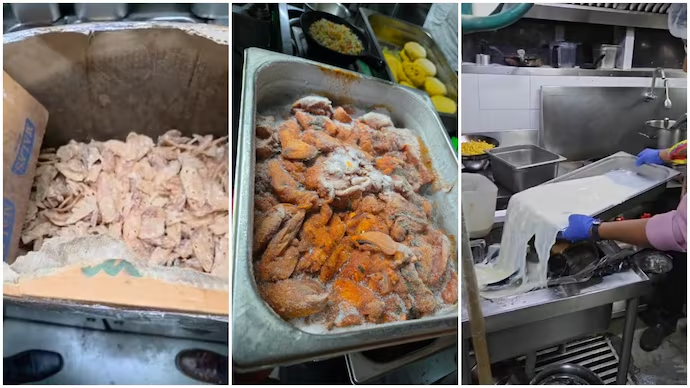
Bengaluru’s food safety raids on top hotels including Taj and The Lalit have uncovered expired milk, rotten food and serious hygiene lapses, challenging the belief that higher prices guarantee better standards. The findings not only disrupt trust in premium dining but also turn the long-standing street food debate on its head.
A large-scale food safety inspection drive across Bengaluru’s premium hotels has uncovered multiple violations, including the presence of expired food, rotten meat and fungal growth on vegetables in some of the city’s most prominent hospitality establishments.
The inspections were carried out by the Karnataka Food Safety and Drug Administration, which deployed around 30 teams to inspect 26 three-star and five-star hotels across all BBMP zones in Bengaluru.
The drive covered well-known properties including The Lalit Ashok, Shangri-La Bengaluru, Four Seasons Hotel, Vivanta Bengaluru Whitefield, Taj Yeshwantpur and Radisson Blu (The Atria).
During the inspections, officials reported finding expired milk, rotten meat and vegetables with visible fungal growth. Several kitchens and storage areas were found to be unhygienic, with improper food handling practices and inadequate segregation of vegetarian and non-vegetarian items. Authorities also noted the presence of misbranded food products and violations of Food Safety and Standards Authority of India (FSSAI) labelling norms.
In one of the most significant recoveries, approximately 105 kilograms of expired food items were seized from Radisson Blu (The Atria), including around 50 kg of chicken, 25 kg of meat, 23 kg of fish and 7 kg of vegetables.
As part of the exercise, officials collected 35 food samples (including chicken, mutton, fish, edible oil, milk, spices, tea powder, cheese, sauces and lemon juice) which have been sent for laboratory testing. Further action will depend on the results of these tests.
Following the inspections, notices were issued to the concerned food business operators, and legal proceedings are expected to be initiated in cases where violations have been confirmed. Authorities also seized and destroyed quantities of food deemed unsafe for consumption.
The inspection drive, according to officials, was aimed at ensuring that even high-end hotels comply with food safety regulations under the Food Safety and Standards Act, 2006. Karnataka Health Minister UT Khader stated that the exercise was intended to ensure that top-tier establishments adhere strictly to hygiene and safety norms.
In response, the Indian Hotels Company Limited, which operates Taj hotels, said that no rotten food was found at its properties and that Taj Yeshwantpur scored 95 out of 100 on the food safety and hygiene scale. The company maintained that reports suggesting otherwise were inaccurate and reiterated that food safety remains a non-negotiable priority across its hotels.
The Price vs Reality Disconnect
For most consumers, dining at a five-star hotel comes with an assumption that extends far beyond taste or presentation. It carries an implicit guarantee of safety, hygiene and quality – one that is often justified by the price on the menu. Premium pricing, in many ways, becomes shorthand for trust.
The findings from Bengaluru’s hotel inspections disrupt that assumption. The presence of expired milk, rotten vegetables and improperly stored meat inside some of the city’s most expensive dining spaces suggests that cost and compliance do not necessarily move together.
This disconnect is not just about hygiene lapses, but about what consumers believe they are paying for. When a meal costs significantly more, it is expected to reflect stricter standards – in sourcing, storage and handling. The raids, however, indicate that higher pricing does not automatically translate into better practices behind the scenes.
What this ultimately challenges is a deeply ingrained consumer belief: that spending more reduces risk. In this case, the evidence suggests otherwise – that the assurance attached to premium dining may be more perceived than guaranteed.
The Illusion of Standards
What makes the findings from Bengaluru’s inspections particularly striking is the contrast between what consumers see and what inspectors found. Luxury hotels invest heavily in creating an experience – polished interiors, carefully plated dishes, uniformed staff and an overall sense of precision. Cleanliness, in such spaces, is not just expected, it is part of the brand.
The inspections, however, point to a different reality behind the scenes. Kitchens and storage areas in several establishments were found to have expired ingredients, improper handling practices and gaps in basic hygiene protocols. The presence of fungal growth on vegetables and expired dairy products suggests that the systems meant to ensure quality control are not always functioning as expected.
This gap is indicative of a larger issue within the hospitality industry – the distinction between presentation and process. While the front-end is designed to communicate consistency and care, the back-end does not always reflect the same level of discipline. For consumers, this creates a mismatch between perception and reality, where visible standards can mask underlying lapses in everyday operations.
Cost Cutting vs Consumer Safety
Behind the lapses uncovered during the inspections lies a question that extends beyond individual negligence – the role of cost management in daily operations. Even in premium establishments, kitchens operate under pressure to control wastage, manage inventory efficiently and maintain margins.
In such an environment, decisions around when to discard perishable items or how long to store them can become critical. Delayed disposal, reuse of ingredients nearing expiry and bulk procurement at lower costs are practices that, while aimed at efficiency, can increase the risk of compromised food quality if not strictly monitored.
The findings from Bengaluru suggest that these pressures may, at times, translate into shortcuts within the system.
When expired dairy, spoiled produce and improperly stored meat are found in high-end kitchens, it raises a fundamental concern – whether operational efficiencies are being prioritised in ways that directly affect consumer safety. For consumers, this introduces an uncomfortable possibility: that the price of a meal may reflect the experience on the plate, but not necessarily the rigour of the processes behind it.
The Systemic Supply Chain Problem, Dark Stores
While the violations were uncovered inside hotel kitchens, the problem may not begin there. Food safety in large hospitality operations depends on an extended supply chain – vendors, transport systems and storage facilities – all of which play a role before ingredients reach the kitchen.
Recent scrutiny of quick-commerce “dark stores” points to similar concerns. Inspections and regulatory notices have flagged instances of expired stock, improper storage and even fungal growth on food items inside these facilities, which act as the backbone of rapid delivery platforms. In some cases, expired products were reportedly mixed with fresh inventory, raising questions about how consistently basic safety protocols are followed across high-volume storage systems.
If such lapses are being detected at the storage and distribution level, the implications extend far beyond a single sector. Whether it is a luxury hotel kitchen or a fast-moving dark store, both rely on the same fundamental processes – sourcing, storage and handling of perishable goods.
The findings from Bengaluru, when seen alongside these developments, suggest that the issue may not be confined to individual establishments but could be rooted in broader procurement and supply practices. This shifts the conversation from isolated violations to a more structural concern – whether the systems that move food across the chain are robust enough to ensure safety at every stage.
Public Health Risk
Beyond the immediate shock of what was found, the implications of such lapses are rooted in public health risk. Expired dairy products, improperly stored meat and vegetables showing fungal growth are not just indicators of poor hygiene – they are potential sources of foodborne illness.
When perishable items are stored beyond safe limits or handled without proper segregation, the likelihood of bacterial contamination increases significantly. This can lead to conditions ranging from mild food poisoning to more serious gastrointestinal infections, particularly when pathogens spread through cross-contamination in shared storage or preparation areas.
The concern is amplified in high-volume kitchens, where large quantities of food are processed and served daily. A single lapse in handling or storage can affect multiple consumers within a short period, increasing the scale of potential exposure.
Trust Collapse in Premium Spaces
For many consumers, dining at a luxury hotel is not routine – it is reserved for occasions that carry meaning. Celebrations, family gatherings, business meetings and milestones are often tied to these spaces, not just for the food but for the assurance that comes with the setting.
That assurance is built on trust. Unlike everyday dining, where choices may be driven by convenience, premium establishments are expected to meet a higher standard across every aspect, including hygiene and safety. The price, the brand and the environment together reinforce the belief that these are among the safest places to eat.
The findings from Bengaluru disrupt that belief. When lapses of this nature are identified in establishments that are positioned at the top end of the market, it introduces uncertainty into spaces that are otherwise considered reliable.
For consumers, this creates a deeper concern than a single violation. It raises a broader question about how much of that trust is based on verified standards, and how much of it rests on perception shaped by brand and pricing.
Class Bias and the Perception Flip
Food safety conversations in India have long carried an implicit bias. Street food, by default, is often viewed as risky – associated with inconsistent hygiene, open environments and minimal regulation. In contrast, premium dining spaces are perceived as controlled, monitored and therefore safer.
The findings from Bengaluru complicate that assumption. When violations such as expired stock, improper storage and hygiene lapses are identified within high-end kitchens, the distinction between what is considered “safe” and “unsafe” begins to blur.
This is not to suggest that risks are identical across all segments, but it does show how perception can shape judgment. Clean presentation, controlled environments and brand reputation often influence consumer confidence, sometimes more than actual compliance with safety practices.
In effect, the hierarchy of trust – where informal food is treated with caution and premium dining with confidence – is called into question. The issue may not be where the food is served, but how consistently safety standards are followed across different segments of the industry.
Regulatory Theatre vs Reality
The scale of violations uncovered during the Bengaluru inspections raises a fundamental question about enforcement – how much of compliance is routine, and how much of it is driven by the possibility of inspection.
The fact that such issues were identified during a coordinated raid suggests that these lapses were not entirely hidden or isolated. Instead, they point to gaps that may persist in the absence of regular scrutiny. If standards improve only when inspections are underway, it indicates a system that is reactive rather than preventive.
This brings into focus the consistency of regulatory oversight. Are inspections frequent and unpredictable enough to ensure continuous compliance, or do they occur in phases that allow establishments to prepare in advance? The difference between the two can significantly influence how strictly safety protocols are followed in day-to-day operations.
The Raid Effect
Incidents like the Bengaluru inspections tend to follow a familiar pattern. A large-scale raid uncovers violations, the findings trigger immediate public attention and concern, and enforcement agencies respond with notices and corrective action.
In the days that follow, establishments often move quickly to address visible lapses – improving storage practices, discarding questionable stock and reinforcing hygiene protocols. For a period, compliance levels tend to rise, driven by heightened scrutiny and reputational risk.
However, over time, the intensity of oversight and public attention can fade. Without sustained monitoring, the incentive to maintain strict adherence may weaken, increasing the risk of a gradual return to earlier practices. This cycle – inspection, correction and eventual complacency – can limit the long-term impact of enforcement efforts.
One City Or A National Pattern
The findings from Bengaluru raise a question that extends beyond the city itself. The hotels inspected are part of a larger, interconnected hospitality industry, where operational practices – from sourcing and storage to kitchen management – tend to follow similar patterns across locations.
If violations of this scale can be identified in a major metro with established regulatory systems, it is difficult to assume that such issues are limited to a single geography. This brings into focus the need for a broader approach to enforcement.
Isolated inspection drives, while effective in identifying immediate violations, may not be sufficient to address systemic gaps. Comparable, unannounced checks across other cities could provide a clearer picture of how widespread these issues are.
The Last Bit, A Bite Into Food Poisoning
The Bengaluru inspections have done more than expose violations within a set of hotel kitchens – they have brought into focus the assumptions that shape how consumers evaluate food safety. Price, brand and presentation often serve as proxies for trust, even though they do not always reflect what happens behind the scenes.
What this episode indicates is the gap between perception and verification. While regulatory systems exist to enforce standards, their effectiveness ultimately depends on consistency, transparency and follow-through. Without these, compliance risks becoming situational rather than sustained.
For consumers, this leaves an unresolved question. If visible indicators such as cost and ambience are not reliable measures of safety, what should be?
Until that question is addressed through stronger oversight and clearer accountability, the assurance associated with premium dining may remain, at least in part, a matter of belief rather than certainty.